
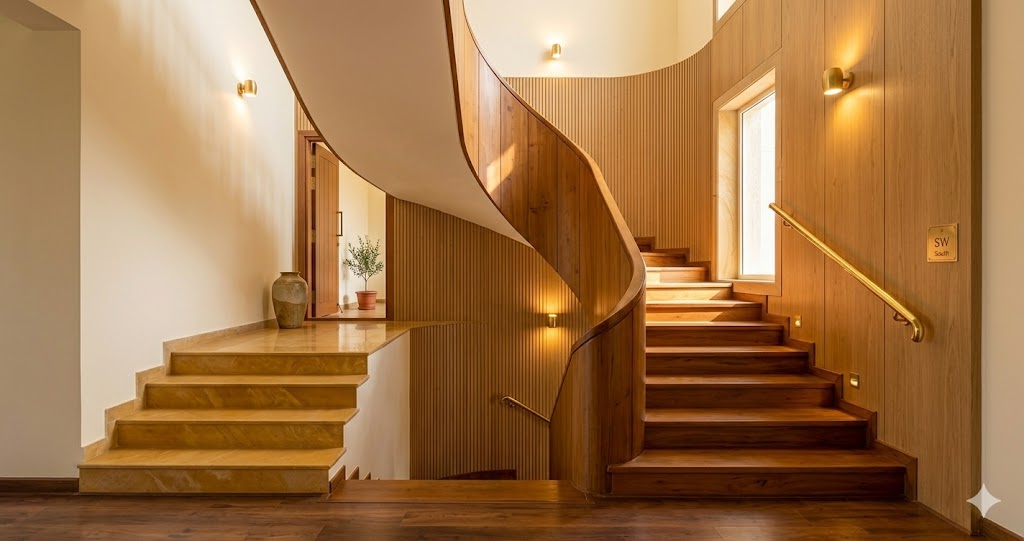
Staircase Vastu — A 2026 Working Reference for Indian Homes (Duplex, Villa, Independent House)
SW/S/W placement · Clockwise ascent · Odd step counts · Under-stair rules
Staircase vastu is the most-overlooked vastu topic in 2026 India — because it only applies to duplex apartments, villas, and independent houses, not to single-floor flats. But for the 25-30% of premium Indian homeowners who do live in multi-level homes, staircase placement is one of the single most load-bearing vastu decisions in the entire dwelling — a heavy structural mass that anchors the home for the next thirty years and that almost no one revisits once the slab is cast.
This is a 22-minute working reference for homeowners (and the interior designers they hire) building, retrofitting, or evaluating staircase vastu in Indian duplex, villa, and independent-house contexts. It covers the direction and rotation rules, the eight common staircase typologies with vastu compatibility ratings, the step-count rule (5/7/9/11/13/15), material and finish specifications, ten common pitfalls and the fix for each, what to do with under-stair space, the apartment adaptation when the builder has already fixed the geometry, three remedy tiers, and how traditional staircase vastu differs from modern stair-safety best practice (NBC 2016 Part 6, IS 4838).
The staircase carries the home's vertical energy — its placement, direction, rotation, and number of steps determine whether the home's prana rises easily or struggles upward. A badly placed staircase is felt as fatigue on every climb. A well-placed one is felt as lift — the upper floor reads brighter, lighter, more alive than the lower floor, even when the apertures are smaller.
For complementary depth see Vastu for Modern Homes, Vastu House Plan India, Entrance Vastu, North-Facing House Vastu, Vastu for Kitchen, and Vastu for Bedroom. To validate your current plan against the canonical sixteen-rule checklist, run our free Vastu Compliance Checker — and to read direction without a magnetic compass at hand, the Vastu Compass gives an aligned overlay.
This guide refreshes every 24 months — staircase vastu canon is evergreen, but Indian building-code overlays (NBC 2016 Part 6, IS 4838) revise periodically. Last verified: May 2026 · Next verify: May 2028.
What Staircase Vastu Is (and When It Applies)
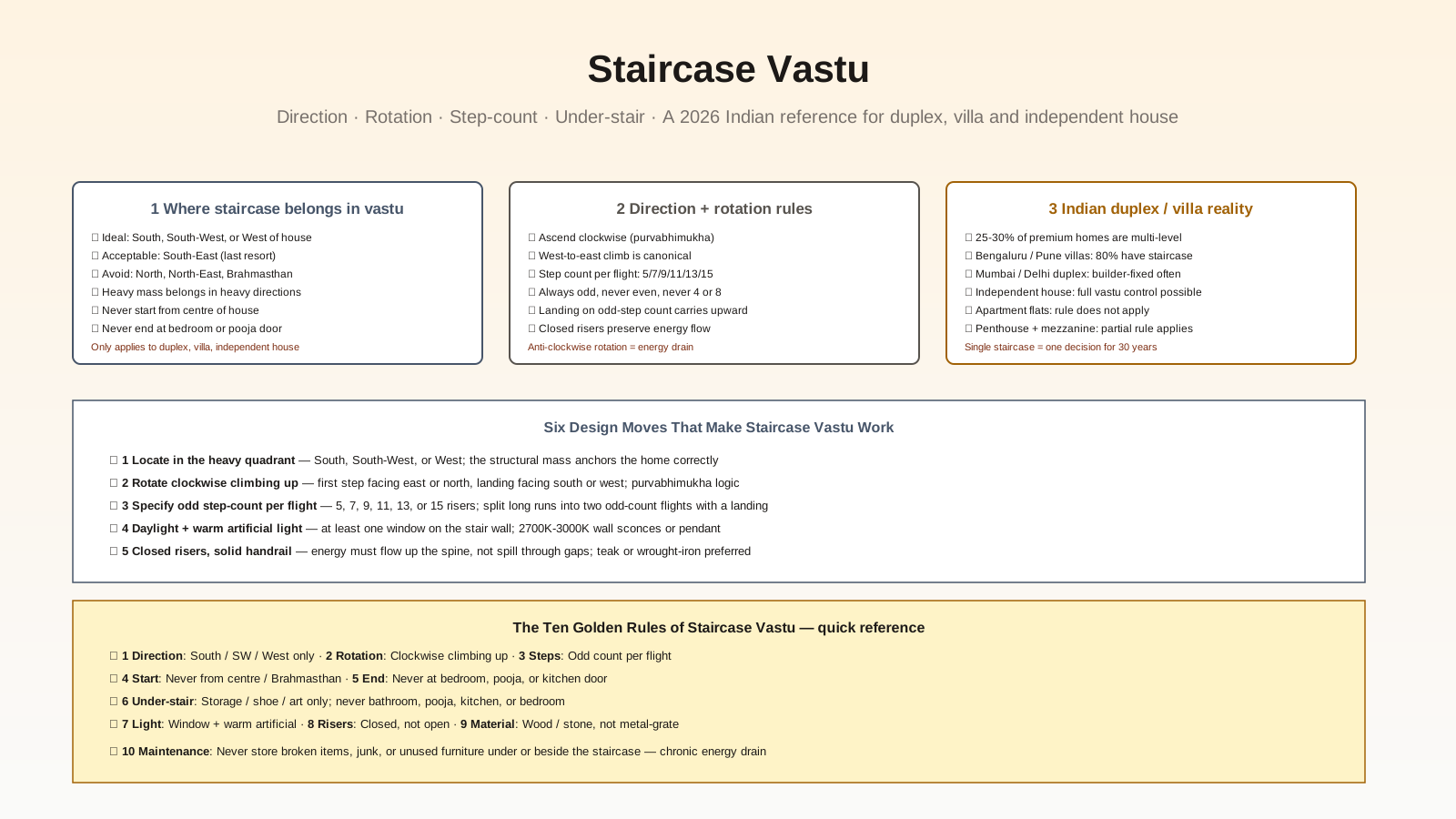
Staircase vastu is the application of vastu shastra principles — the classical Indian architectural science codified in texts like Mayamatam, Brihat Samhita, and Vishwakarma Vastu Shastra — to the placement, orientation, and form of a residential staircase. The discipline treats the staircase as a structural object with mass, weight, and directional energy flow, all of which interact with the home's overall vastu grid.
The core idea: a staircase is a heavy object that channels vertical energy. Heavy objects in vastu belong in the heavy quadrants (south, south-west, west). The direction of ascent matters because it sets the rotational flow of prana through the home. The number of steps matters because numerical rhythm closes (or breaks) the energy loop at the top. The space under the staircase matters because compressed energy zones cannot host sacred or fragile activities.
When staircase vastu applies — and when it does not
| Dwelling type | Staircase vastu applies? | Why |
|---|---|---|
| Single-floor apartment / flat | No | No internal staircase |
| Duplex apartment | Yes (partial) | Internal staircase exists; placement often builder-fixed |
| Villa (gated community) | Yes (full) | Designer typically has full control at planning stage |
| Independent house (plot-built) | Yes (full) | Maximum vastu control possible from foundation up |
| Penthouse with private terrace stair | Yes (partial) | Apply to internal stair only |
| Mezzanine within a single flat | Yes (partial) | Apply rotation + step-count, relax direction |
| Studio loft with ladder access | No | Ladder is treated separately, not a staircase |
The honest qualifier: for 70-75% of urban Indian homeowners living in single-floor flats, this guide is not directly applicable to their own home — but it remains essential context if they are planning to move to a duplex or villa, or evaluating one to buy.
Direction and Rotation Rules
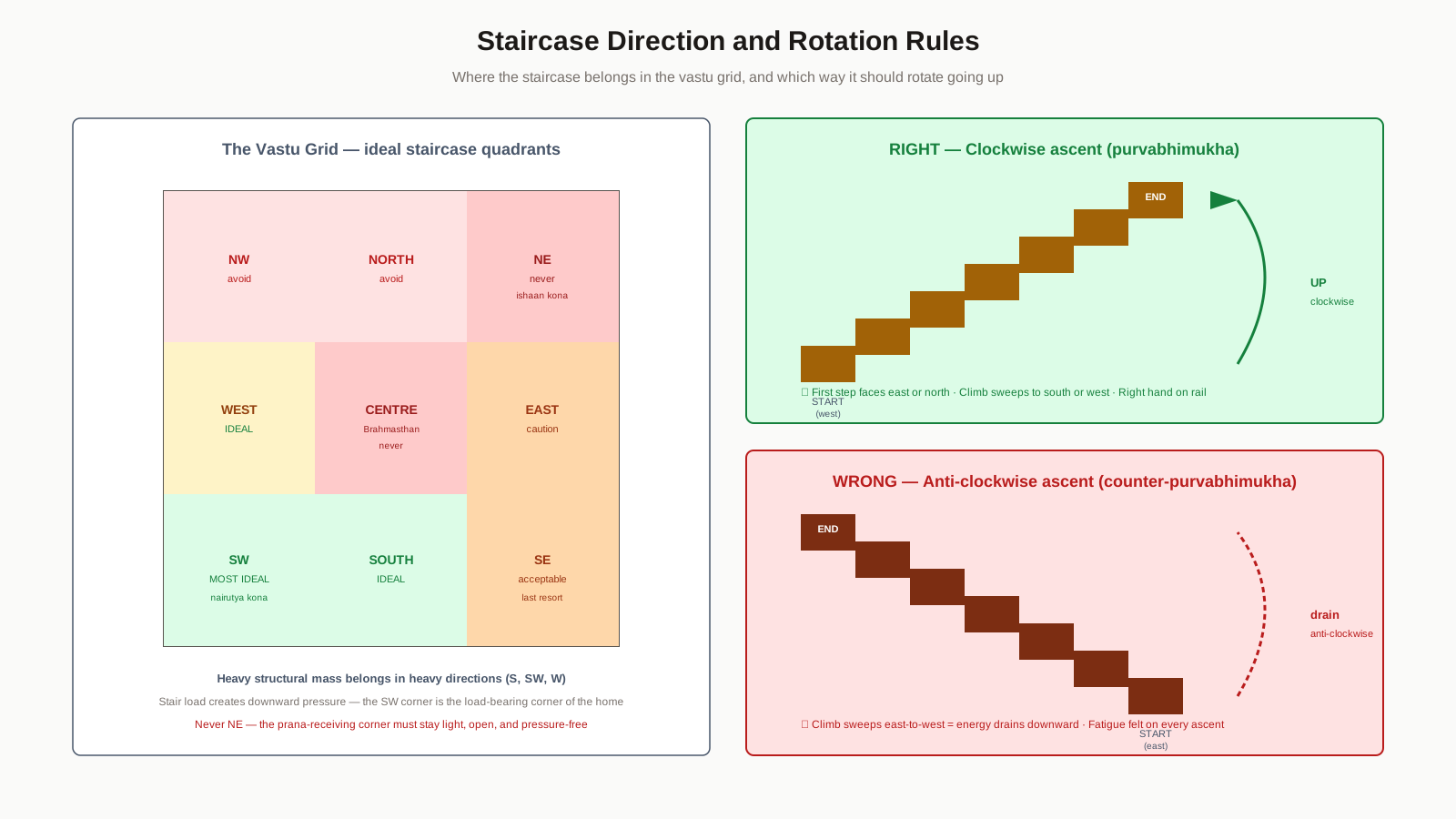
The direction rule — where the staircase belongs in the vastu grid
The vastu grid divides the home footprint into nine cells (3x3). Heavy structural mass belongs in the heavy quadrants — south, south-west, and west — because the south-west corner (nairutya kona) is the load-bearing corner of the cosmological diagram. Light apertures (windows, balconies, the main entrance, the pooja room) belong in the light quadrants — north, north-east, and east — because the north-east corner (ishaan kona) is the prana-receiving corner.
A staircase, being a heavy load-bearing structure, follows the heavy-mass rule:
| Direction | Vastu rating | Notes |
|---|---|---|
| South-West (nairutya) | Most ideal | Anchors the home, supports vertical energy |
| South | Ideal | Heavy mass aligned with sun's southern arc |
| West | Ideal | Heavy mass on the setting-sun side |
| South-East (agni) | Acceptable last resort | Fire element zone; tolerable if no other option |
| East | Caution | Light zone; staircase here blocks morning prana |
| North-West (vayu) | Avoid | Air element zone; instability of placement |
| North | Avoid | Wealth-receiving zone; mass blocks inflow |
| North-East (ishaan) | Never | Most prohibited zone; sacred corner |
| Centre (Brahmasthan) | Never | Cosmic centre must remain empty |
The diagnostic: stand at the entrance of the house, face inward, and identify the south-west corner. If the staircase is there, you have the ideal placement. If it is at the diagonal opposite (north-east), you have the most serious vastu violation in the dwelling.
The rotation rule — clockwise ascent (purvabhimukha)
Beyond placement, the direction in which a person climbs the staircase matters. The canonical rule: ascend clockwise. The first step should face east or north, the climb should sweep toward south or west, and the landing at the top should sit in the south-west or south quadrant. This is called purvabhimukha — the east-facing ascent — and it mirrors the sun's apparent diurnal sweep across the Indian sky.
The opposite — anti-clockwise ascent, where the first step faces west or south and the climb sweeps to north or east — is called counter-purvabhimukha. The energetic interpretation: it pulls prana downward rather than carrying it upward, and the body registers this as low-grade fatigue on every ascent. The reverse rule applies for descent: descending counter-clockwise (sweeping east-to-west) is natural and unproblematic.
Things the staircase must never do
- Never start from the centre of the house (Brahmasthan must remain empty)
- Never end directly at a bedroom door (descent disturbs sleep)
- Never end directly at the pooja room door (sacred space must not face descent)
- Never end directly at the kitchen door (fire element disturbance)
- Never share a wall directly with the main entrance facing outward (energy leaks)
- Never be visible directly from the main entrance (insert a console, screen, or jaali)
Types of Staircase and Vastu Compatibility
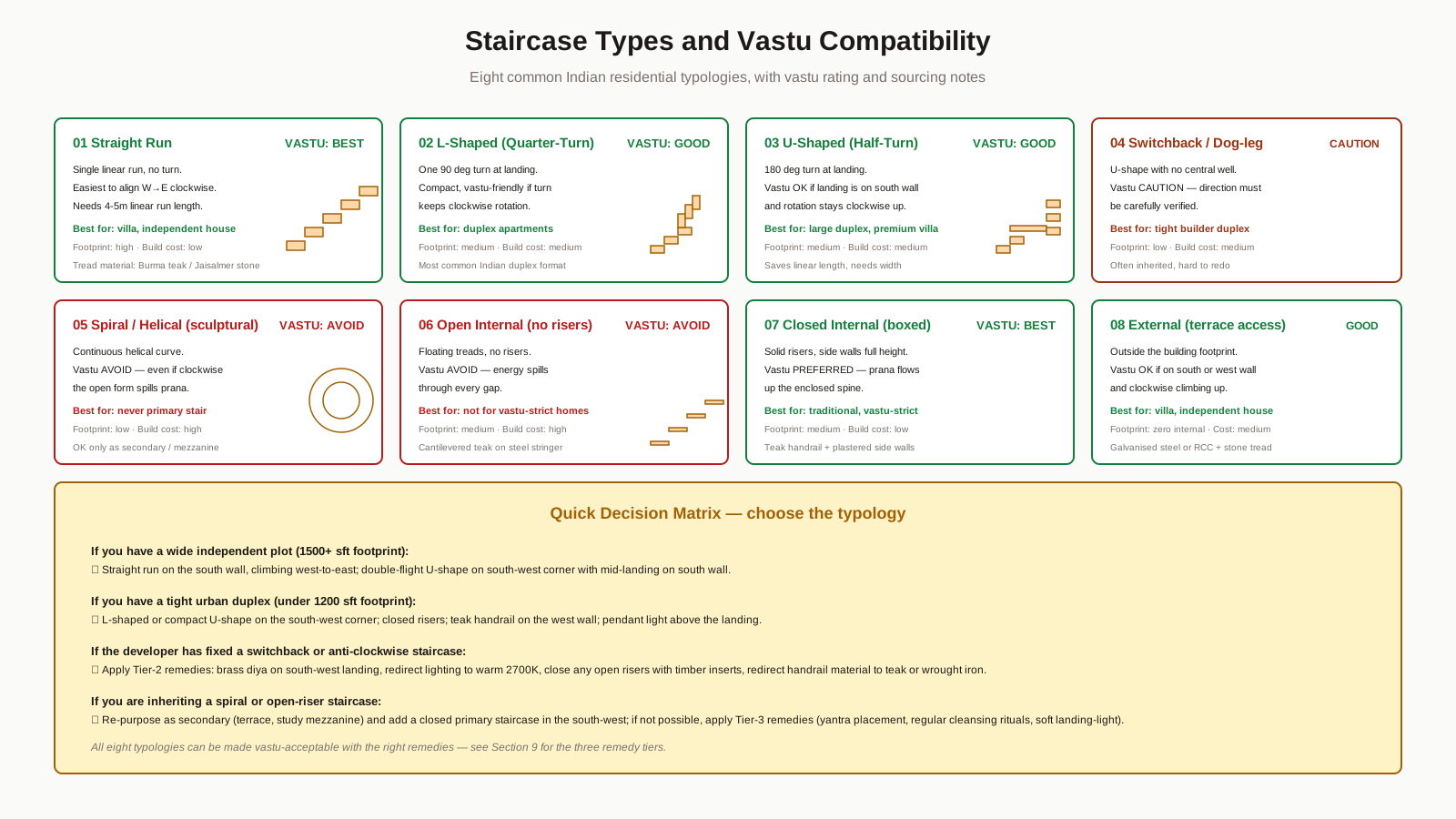
| Typology | Vastu rating | Best suited for | Build cost | Footprint |
|---|---|---|---|---|
| Straight run | Best | Villa, independent house | Low | High (4-5 m linear) |
| L-shaped (quarter-turn) | Good | Duplex apartments | Medium | Medium |
| U-shaped (half-turn) | Good | Large duplex, premium villa | Medium | Medium |
| Switchback / dog-leg | Caution | Tight builder duplex | Medium | Low |
| Spiral / helical | Avoid | Secondary access only | High | Low |
| Open internal (floating tread) | Avoid | Not for vastu-strict homes | High | Medium |
| Closed internal (boxed) | Best | Traditional, vastu-strict | Low | Medium |
| External (terrace access) | Good | Villa, independent house | Medium | Zero internal |
The two clearest preferences: closed-riser straight-run stairs running W→E on the south wall are the canonical vastu best case, and spiral or open-riser stairs are the canonical avoid case. Almost every other typology can be made vastu-acceptable with the right placement and remedy stack — the question is rarely "is this typology forbidden" and almost always "is this typology placed correctly and rotating correctly."
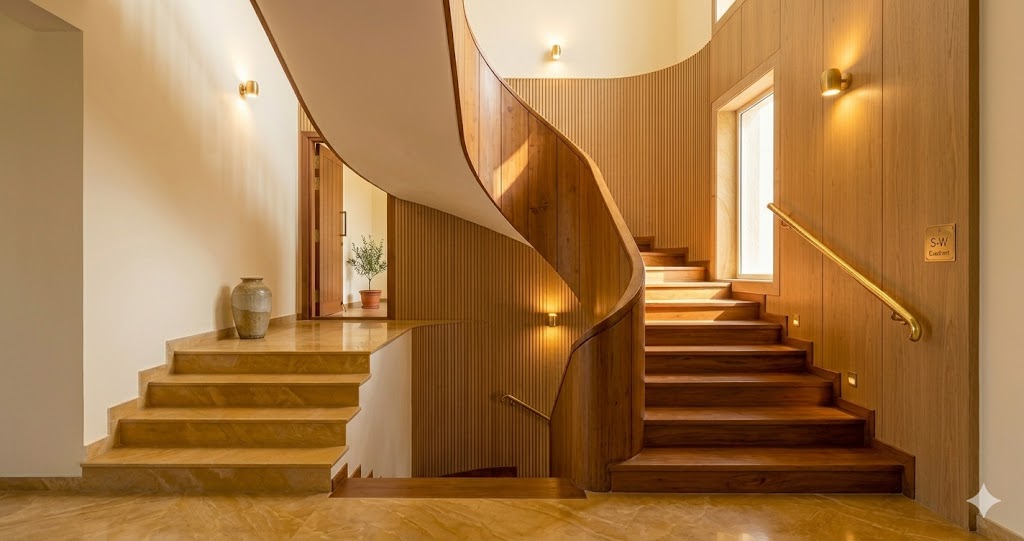
The Step-Count Rule — 5 / 7 / 9 / 11 / 13 / 15
The most numerically specific rule in staircase vastu: the number of steps per flight should be odd, and ideally one of the canonical sequence 5, 7, 9, 11, 13, or 15. The logic threads through several vastu texts, but the simplest reading: the foot that begins the ascent (typically the right foot, the dakshin pada) should also be the foot that lands at the top — and odd counts complete that loop.
| Total risers needed | Recommended split | Vastu logic |
|---|---|---|
| 5 to 15 | Single flight | Within canonical odd range |
| 16 to 18 | 9 + 7 or 9 + 9 with landing | Split keeps each flight odd |
| 19 to 22 | 11 + 9 or 11 + 11 with landing | Two odd flights, one mid-landing |
| 23 to 26 | 13 + 11 or 15 + 9 | Larger duplex with double landing |
| 27 to 30 | 15 + 13 with landing | Tall villa staircase, two odd flights |
Even counts (4, 6, 8, 10, 12, 14) are considered inauspicious as a single flight. If a floor-to-floor height + tread geometry calculation produces an even count, the fix is to insert a landing and split the run into two odd-count flights — never to forcibly adjust riser height beyond ergonomic safe limits (150-180 mm per riser per NBC 2016 Part 6 and IS 4838:1968).
Why the rule cares about the foot that lands
The tradition reads the staircase as a vertical mantra. Each step is a beat. An odd count means the closing beat lands on the same foot that started the climb — completing the rhythm. An even count means the closing beat lands on the opposite foot — leaving the rhythm open. Whether one accepts the metaphysics or not, the ergonomic reading is also defensible: odd counts produce a natural rest-pause at the top, while even counts can produce a micro-stumble.
Material and Finish Specifications
Tread material — what the foot meets on the way up
| Material | Vastu reading | Cost (per sft) | Notes |
|---|---|---|---|
| Solid Burma teak | Best | Rs 4,800-7,200 | Warm, grounded, long-life |
| Solid oak / sheesham | Best | Rs 3,200-5,400 | Warm Indian woods, regional |
| Jaisalmer / Dholpur sandstone | Excellent | Rs 380-720 | Earth element, ages well |
| Kota stone (honed, not polished) | Excellent | Rs 220-420 | Honest, budget-friendly |
| Italian marble | Acceptable | Rs 850-2,400 | Premium, but cold underfoot |
| Granite (rough finish) | Acceptable | Rs 320-680 | Avoid mirror-polished |
| Glass tread | Avoid | Rs 1,400-3,200 | Open-riser variant, vastu hostile |
| Metal grate / perforated steel | Avoid | Rs 1,800-3,800 | Industrial reading, energy spills |
Riser, handrail, and balustrade
- Risers: closed, minimum 16 mm timber or stone face, painted or finished to match treads
- Handrails: solid timber (teak preferred) or wrought iron with brass capping; never PVC or aluminium
- Balustrades: spaced verticals (Indian classical), turned wood, or wrought iron filigree
- Hardware (handrail brackets, fixings): brushed brass (Hettich, Hafele) preferred over chrome
- Tread material on wood: CenturyPly or Greenply teak veneer over 25 mm plywood substructure
- Stone tread anti-slip: etched or honed finish; never mirror-polish; carborundum strips at nosing for safety
The principle: the staircase should be touched with warmth, climbed with rhythm, and seen with intent. Materials that read cold, slippery, or industrial defeat the energetic purpose even when the geometry is correct.
Ten Common Pitfalls That Break Staircase Vastu
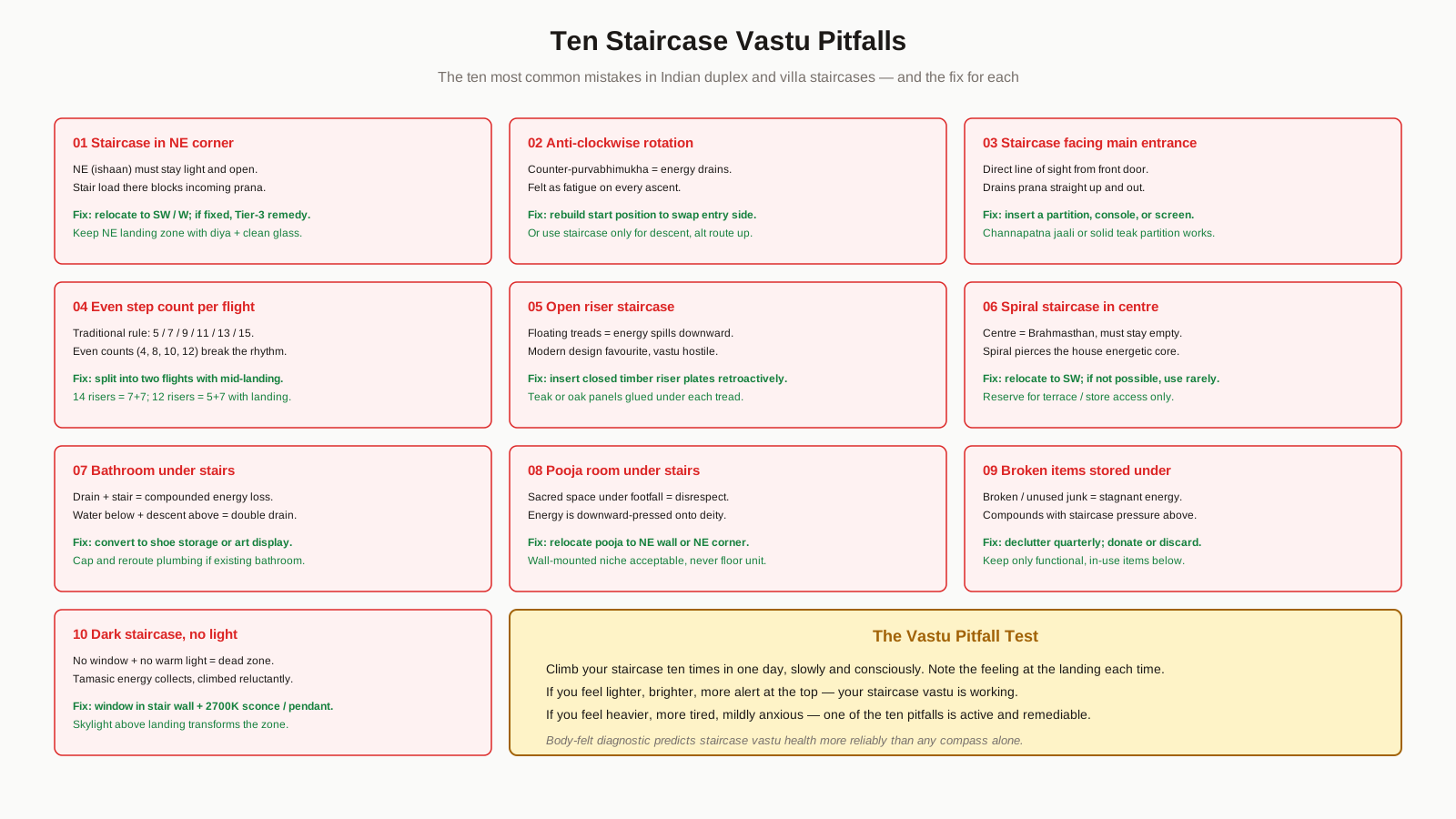
1. Staircase in the NE corner. The ishaan kona must stay light and open; staircase mass there blocks incoming prana. Fix: relocate to SW/W; if structurally fixed, apply Tier-3 remedies (brass diya at NE corner, glass cleansing weekly, clutter removal).
2. Anti-clockwise rotation (counter-purvabhimukha). Climb swept east-to-west drains energy downward; felt as fatigue on every ascent. Fix: rebuild the start position so the first step faces east or north — or if rebuild is impossible, use staircase only for descent and access the upper floor via an alternate route (often impractical, but documented as a remedy).
3. Staircase directly facing the main entrance. Direct line of sight from the front door pulls prana straight up and out. Fix: insert a partition, a console, a screen, or a Channapatna jaali between entrance and staircase.
4. Even step count per flight. Breaks the rhythmic close. Fix: split into two odd-count flights with a mid-landing; 14 risers becomes 7+7, 12 risers becomes 5+7.
5. Open riser staircase. Floating treads (modern designer favourite) let energy spill through every gap; vastu-hostile. Fix: insert closed timber riser plates retroactively — teak or oak panels glued under each tread.
6. Spiral staircase in the centre. Centre is Brahmasthan, must stay empty; spiral pierces the house energetic core. Fix: relocate to SW; if unavoidable, restrict use to terrace or store access only.
7. Bathroom under stairs. Water drainage + descent footfall = compounded prana loss; effect over time: chronic fatigue, financial leakage, plumbing failures. Fix: convert to shoe storage or art display; cap and reroute plumbing to a side wall.
8. Pooja room under stairs. The single strongest staircase vastu prohibition — sacred space under footfall. Fix: relocate pooja to NE wall niche or full NE room; never compromise.
9. Broken items / junk stored under stairs. Stagnant energy compounds with the compressed zone above. Fix: declutter quarterly; keep only functional, in-use items below.
10. Dark staircase with no light source. Tamasic energy collects; the upper floor reads as a reluctant destination. Fix: window on the stair wall + 2700K wall sconce or pendant; skylight above landing if structurally feasible.
The body-felt diagnostic
Climb your staircase ten times in one day, slowly and consciously. Note the feeling at the landing each time. If you feel lighter, brighter, more alert at the top — your staircase vastu is working. If you feel heavier, more tired, mildly anxious — one of the ten pitfalls is active and remediable. Body-felt diagnostic predicts staircase vastu health more reliably than any compass reading alone.
Under-Stair Space Rules
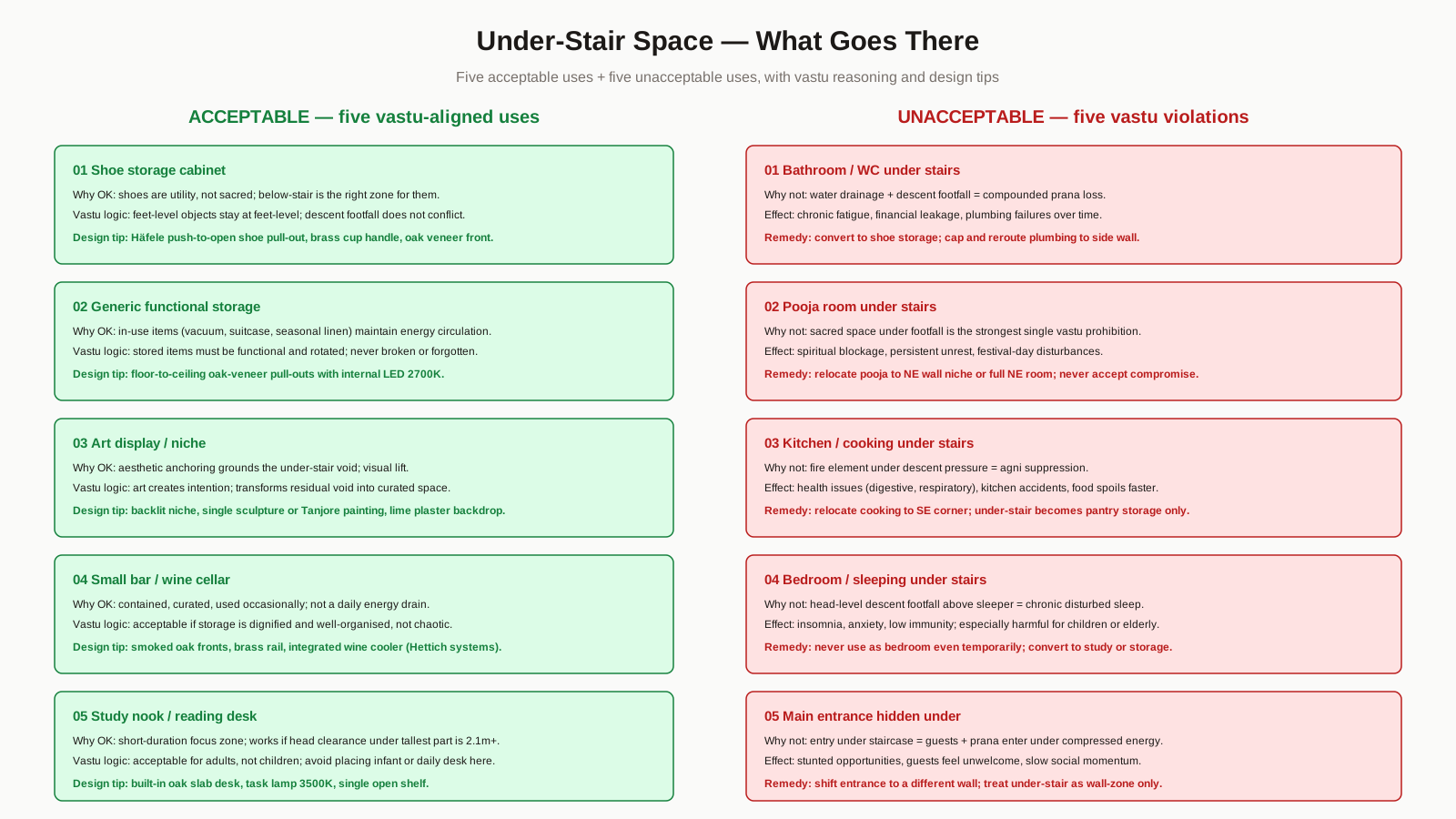
| Under-stair use | Vastu reading | Reasoning |
|---|---|---|
| Shoe storage cabinet | Acceptable | Utility item at foot level; descent footfall non-conflicting |
| Generic functional storage | Acceptable | In-use items maintain circulation |
| Art display / lit niche | Acceptable | Curated intent transforms residual void |
| Small bar / wine cellar | Acceptable | Contained, occasional-use storage |
| Study nook (adult) | Acceptable | Short-duration focus zone with 2.1 m clearance |
| Bathroom / WC | Never | Water drainage + footfall = compounded loss |
| Pooja room / shrine | Never | Sacred under footfall = strongest prohibition |
| Kitchen / cooking zone | Never | Fire element suppression under descent |
| Bedroom / sleeping space | Never | Disturbed sleep, chronic anxiety |
| Main entrance hidden under | Never | Guests + prana enter under compression |
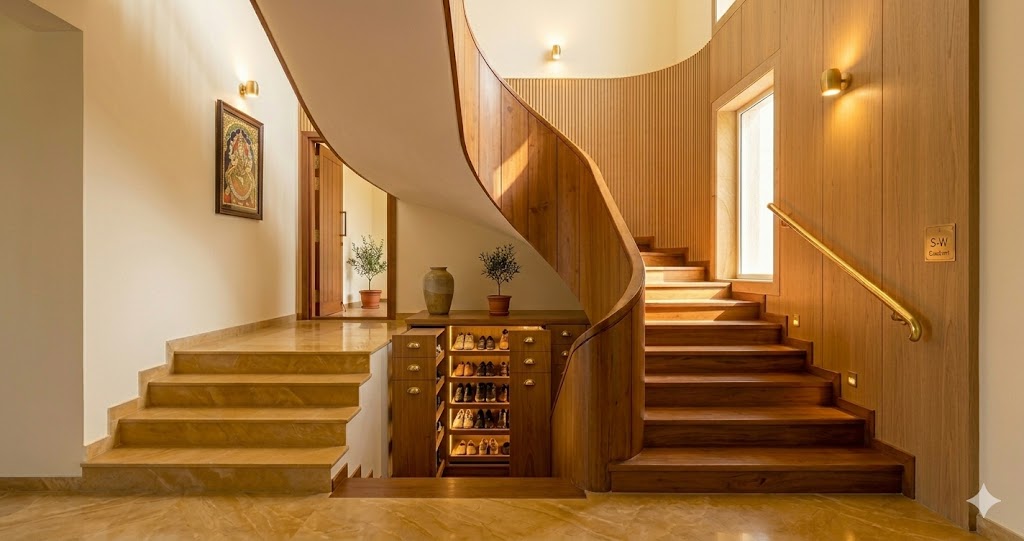
Design tips for the five acceptable uses
- Shoe storage: Hafele or Hettich push-to-open pull-outs; oak veneer front; brass cup handle; internal LED 2700K
- Generic storage: floor-to-ceiling oak-veneer pull-outs; minimum 60% in-use items; declutter quarterly
- Art niche: backlit recess; single sculpture or framed art; lime plaster or microcement backdrop
- Bar / cellar: smoked oak fronts; brass rail; integrated wine cooler (Hettich systems); soft 2700K
- Study nook: built-in oak slab desk; brass task lamp 3500K; one floating shelf; minimum 2.1 m head clearance
The Apartment Adaptation — When Stair Is Builder-Fixed
The reality for most duplex-apartment owners in Indian metros: the staircase is already built, the developer chose the location based on column geometry and floor plate efficiency rather than vastu, and demolition is impossible. The realistic question becomes: which of the original vastu rules can still be honoured, and which require Tier-2 or Tier-3 remedies?
| Builder-fixed condition | Realistic action |
|---|---|
| Staircase in N or NE | Apply Tier-3 remedies; keep zone aggressively light |
| Anti-clockwise rotation | Add brass diya at landing; redirect handrail material to teak |
| Open risers | Insert closed timber riser plates retroactively |
| Even step count | Cannot fix without rebuild; apply rhythmic remedies (mat at top step) |
| Spiral / sculptural form | Use sparingly; reserve for occasional access |
| Bathroom under | Convert and cap plumbing if possible; if not, Tier-3 |
| Dark, unlit | Add 2700K sconce + warm pendant; consider skylight retrofit |
| Direct entrance view | Insert console, jaali, or screen partition |
The honest position: a builder-fixed bad staircase cannot be made into a vastu-perfect staircase. But it can be made into a vastu-functional one — neutralised, dignified, and remediated to the point where its negative energetic load is contained. The goal is not perfection; it is containment.
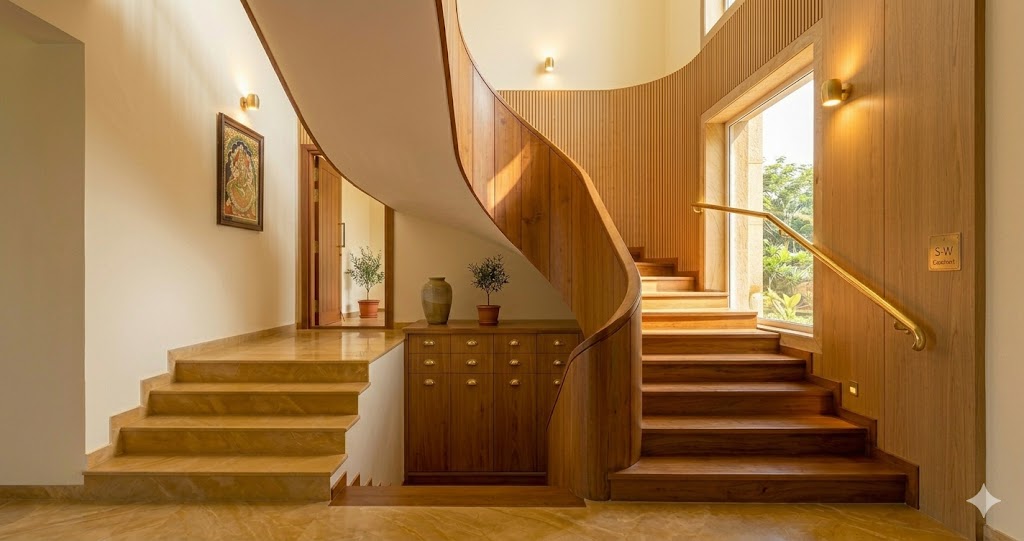
Three Remedy Tiers
Tier 1 — Geometric correction (best, expensive, often impossible post-construction)
- Rebuild the staircase in the south-west or south quadrant
- Reverse rotation by swapping start and end positions
- Split even-count flights into odd-count flights with a mid-landing
- Convert open risers to closed timber riser plates
- Reroute under-stair bathroom plumbing and convert to storage / display
Tier 2 — Material and lighting remediation (moderate, accessible)
- Replace synthetic handrail with teak or wrought iron
- Add warm 2700K wall sconces along the flight, plus a pendant at the landing
- Insert a skylight or stair-wall window if structurally feasible
- Cover open risers with timber inserts (no demolition)
- Replace cool tread material with warm wood overlay (teak veneer cap)
- Place a small brass diya in a niche at the landing — lit daily at dusk
Tier 3 — Energetic remediation (lightweight, ritual-based)
- Place a vastu pyramid or sphatik crystal at the south-west corner of the staircase landing
- Hang a brass bell or wind chime at the top of the staircase
- Perform a vastu shanti puja at occupation; repeat annually
- Keep the under-stair zone aggressively decluttered, sealed, and unused for storage of broken items
- Place a small Tulsi plant or Auroville pot at the staircase foot or landing for biophilic energy
- Daily wipe of the lowest tread with mildly turmeric-saline water (Khushdeep Bansal advised remedy)
The realistic mix for most builder-fixed Indian duplex stairs: 60% Tier 2 + 30% Tier 3 + occasional Tier 1 where structurally feasible. The pure-Tier-1 approach is available only to those building from scratch on an independent plot — perhaps 8-12% of premium Indian homeowners.
How Staircase Vastu Differs from Modern Stair Design Best Practice
Modern stair design — codified in NBC 2016 Part 6 (Structural Design), IS 4838:1968 (Recommendations for Building Staircases), and IS 875 (Loading Standards) — prioritises ergonomics, structural safety, and circulation efficiency. Vastu prioritises directional energy flow, rotational rhythm, and the cosmological grid. The two systems agree more than they disagree, but they diverge on a few specific points:
| Topic | Modern stair design (NBC / IS) | Staircase vastu |
|---|---|---|
| Riser height | 150-180 mm safe range | Same range acceptable |
| Tread depth | Minimum 250 mm | Minimum 250 mm, ideally 280-300 mm |
| Handrail height | 900 mm above tread nosing | Same range acceptable |
| Headroom clearance | Minimum 2.1 m above tread | Same range acceptable |
| Step count per flight | No upper limit (landing every 14-16) | Strict odd: 5 / 7 / 9 / 11 / 13 / 15 |
| Rotation direction | No preference | Strict clockwise climbing up |
| Placement on plan | Anywhere structurally efficient | SW / S / W strongly preferred |
| Open risers | Acceptable for natural light | Avoid — energy spills through |
| Material | Any code-compliant material | Warm wood / honed stone preferred |
| Under-stair use | Any code-compliant use | Restricted (no bathroom, pooja, kitchen, bedroom) |
The single most useful synthesis: build to modern code for safety, then optimise to vastu for direction and rhythm. Where the two systems disagree, modern code wins on safety (always) and vastu wins on direction and ritual (where structurally feasible). A well-built staircase satisfies both — closed risers, odd step counts per flight, ergonomic geometry, south-west placement, clockwise ascent, warm material, layered light.
When Staircase Vastu Doesn't Apply
Staircase vastu is the right framework for 25-30% of premium Indian homeowners. It is not the right framework — or simply not applicable — for:
- Single-floor flat owners (the entire 70-75% of urban Indian apartment dwellers) — no staircase, no rule
- Studio loft owners with ladder-style mezzanine access — ladders are treated differently in vastu, not as staircases
- Tenants in rental duplexes — direction and rotation are landlord-fixed, but Tier-2 lighting and Tier-3 ritual remedies remain accessible
- Heritage homes under conservation rules — structural changes may be prohibited; full Tier-3 remediation is the realistic path
- Co-living or PG accommodation — the shared staircase is a circulation element, not a residential vastu object
- Commercial / office spaces — staircase vastu is a residential framework; commercial vastu has separate rules around stair placement (typically around the load-bearing column grid)
For homeowners in any of the above categories, this guide remains useful as context — particularly if a future move to a duplex or villa is on the horizon — but the immediate prescriptive content does not apply to the current dwelling.
Where to Go Next
- For the full vastu modern home framework — Vastu for Modern Homes
- For the canonical 16-rule house-plan checklist — Vastu House Plan India
- For entrance and main door placement — Entrance Vastu
- For north-facing plot-specific guidance — North-Facing House Vastu
- For kitchen and cooking-zone rules — Vastu for Kitchen
- For bedroom and sleep-orientation rules — Vastu for Bedroom
- To audit your current plan — Vastu Compliance Checker
- To read true direction without a magnetic compass — Vastu Compass
References
1. Varahamihira (6th century CE). Brihat Samhita. (Foundational vastu text — chapters on residential planning, including staircase and mass placement.)
2. Anonymous (10th-11th century CE). Mayamatam — A Treatise on Indian Architecture and Iconography. IGNCA edition, ed. Bruno Dagens, 1994. (Canonical reference for residential vastu including stair placement.)
3. Vishwakarma. Vishwakarma Vastu Shastra. Traditional compilation. (Practical residential application including staircase rotation and step-count.)
4. Bansal, K. (2019). MahaVastu — The Revolutionary Vastu Code That Has Helped Change Lives. Hay House India. (Modern Indian vastu practitioner — staircase remedy tiers reflect his classification.)
5. Mohanlal, A. (2017). Vastu Shastra for the Modern Home. Penguin Random House India. (Applied vastu for contemporary apartment and villa contexts.)
6. Bureau of Indian Standards (1968). IS 4838:1968 — Recommendations for Building Staircases. (Tread, riser, handrail, and landing dimension standards.)
7. Bureau of Indian Standards. IS 875 (Part 1 to Part 5) — Code of Practice for Design Loads. (Live and dead load standards including stair loading.)
8. Bureau of Indian Standards (2016). National Building Code of India 2016 — Part 6 Structural Design. (Stair geometry, headroom, balustrade, and safety codes.)
9. Bureau of Indian Standards (2016). National Building Code of India 2016 — Part 4 Fire and Life Safety. (Escape staircase and circulation provisions.)
10. Boner, A., Sarma, S. + Baumer, B. (1996). Vastusutra Upanishad — The Essence of Form in Sacred Art. Motilal Banarsidass. (Theoretical underpinnings of vastu direction and form.)
11. Acharya, P.K. (1996). Indian Architecture According to Manasara-Silpasastra. Oxford University Press. (Foundational scholarly translation of vastu canon.)
12. Kramrisch, S. (1976). The Hindu Temple — Volume 1. Motilal Banarsidass. (Cosmological grid theory underlying vastu direction logic.)
13. Indian Institute of Architects + COA Practice Notes (2023). Vastu and Modern Building Code Reconciliation — Working Paper. (Practical reconciliation between vastu and NBC 2016.)
Author's note: Of the eight vastu topics I see most often misapplied in Indian premium homes, staircase placement is the second hardest to remediate post-construction (after main entrance direction). The reason is structural: a staircase is a cast-in-place RCC object, often integrated with the column grid, and almost impossible to relocate without demolishing 30-40% of the building. This guide is therefore deliberately layered — it tells the homeowner what to do when they have full control (Tier 1, plot-build from scratch), and what to do when they have almost none (Tier 3, builder-fixed duplex). The honest reading: a well-placed staircase from day one is worth more than any combination of Tier-2 and Tier-3 remedies applied afterward. If you are buying a duplex or villa in 2026, walk the staircase before you sign — it is one of the highest-leverage vastu decisions in the entire purchase.
Disclaimer: Staircase vastu is a traditional Indian architectural framework with cultural and ritual meaning that varies regionally and by school (North Indian, Dravidian, Kerala traditions diverge on some specifics). The guidance here represents a synthesis of canonical texts and contemporary Indian vastu practitioners — not absolute prescription. All staircase construction must comply with NBC 2016 Part 6, IS 4838:1968, and local municipal building codes regardless of vastu choices; where modern code and vastu disagree, modern code wins on safety. Material costs and brand references are 2026 indicative. Studio Matrx has no commercial relationship with any brand named (Hettich, Hafele, CenturyPly, Greenply, Asian Paints are illustrative only). Studio Matrx, its authors and contributors are not responsible for construction, remediation, or ritual outcomes based on this guide. For binding decisions, consult a licensed structural engineer for safety and a qualified vastu practitioner for tradition-specific guidance.
Export this guide
Related Guides — Deep-dive reading
Smart Storage Interiors — A 2026 Working Reference for Indian Homes
Inventory-driven · Floor-to-ceiling · Hardware-engineered · Zone-mapped
Room PlanningAngles, Curves and Breaking the Pattern Intentionally
Why an Indian home should mostly stay a grid of right angles — and how a single deliberate curve, angle or arch, placed where it eases circulation, resolves an awkward plot or breaks a rhythm, becomes the most powerful move in the room.
Design PrinciplesSpace-Efficient Homes — A 2026 Working Reference for Compact Indian Apartments
Five spatial multipliers · Floor plan tricks · Dual-purpose furniture
Room PlanningRelated Tools — Try Free
Cross-Ventilation Analyzer
Estimate airflow and air changes per hour (ACH) from room size, window areas, layout, and local wind — with NBC 2016 Part 8 compliance check.
Ventilation CalculatorVastu Shastra Compliance Checker
Score your home across 21 Vastu criteria with a weighted score, compliance band, and remedial guidance.
Vastu ScoringApartment Interior Planning Checklist
51-item checklist across structural, ceiling, lighting, furniture, storage, electrical, kitchen, bathroom.
Checklist