
Lift Pit Requirements Explained (India): Depth, Waterproofing and Pitless Options
How deep the pit must be by drive type, how to build it as a waterproof RCC box against earth pressure, and what to do when you cannot dig one at all.
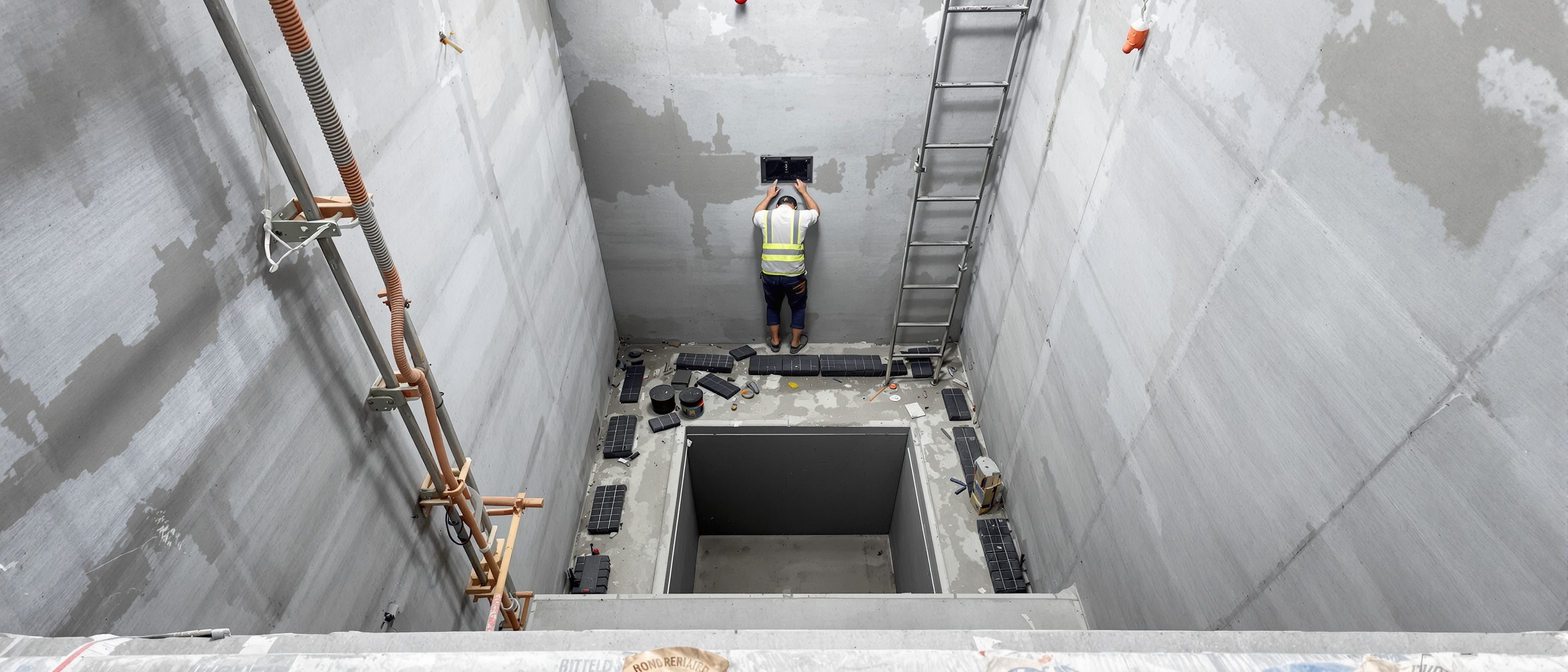
The pit is the part of a home lift everyone forgets until the structural engineer asks how deep to dig. It is the box of reinforced concrete that sits below the lowest served floor, and it does three jobs at once: it gives the car somewhere to land safely, it houses the buffers that absorb an overtravel, and it keeps groundwater out of the machinery for the next thirty years. Get it wrong and you get a flooded shaft, a cracked slab, or a lift that fails its first statutory inspection.
This guide goes deep on the pit alone — depth by drive type, the waterproof RCC box, designing the pit walls for the soil pushing in on them, dewatering, buffer impact, and the access ladder, lighting and stop-switch the inspector will look for. It also covers the low-pit, pitless and shaftless options for homes that simply cannot dig down. For the well above the pit see Lift Shaft Design Guide (India); for the full load path into the building see Home Lift Structural Design (India); and for the whole picture start at the Architect's Residential Elevator Handbook (India).
The pit is below ground in almost every Indian home installation. That single fact drives everything: lateral earth pressure on the walls, a high water table in the monsoon, and the need to make the box genuinely waterproof — not merely "painted with a waterproofing coat".
All depths, loads and prices below are indicative — confirm with your local municipal bye-laws, your structural engineer, and a licensed lift contractor, and design the pit only against the chosen vendor's general-arrangement (GA) drawing and reaction schedule.
Why the pit depth depends entirely on the drive type
There is no single "pit depth" for a home lift. The figure is set by the drive technology, because each one needs a different amount of space below the car for the buffers, the compensation, the safety gear and — for traction lifts — the counterweight assembly and its own buffer.
- Hydraulic lifts are pushed up by a piston, so there is no counterweight and very little hanging below the car. They need only a shallow pit, roughly 150 to 300 mm (about 6 to 12 inches). This is the easiest pit to build and the friendliest for a retrofit.
- Screw / winding-drum lifts climb a self-supporting threaded column. They are similarly low-pit, roughly 150 to 300 mm, which is one reason they suit homes where digging is awkward.
- Traction lifts (geared or gearless) run on steel ropes over a sheave with a counterweight. They need more room below for the counterweight buffer and runby, so the pit is typically 300 to 610 mm. This is the 2026 norm for machine-room-less (MRL) home traction lifts.
- Some modern gearless / geared models — particularly larger-capacity or higher-speed units — call for a deep pit of 1200 to 1500 mm (a few designs go to about 1750 mm). Always read the specific model's GA before assuming the shallow figure.
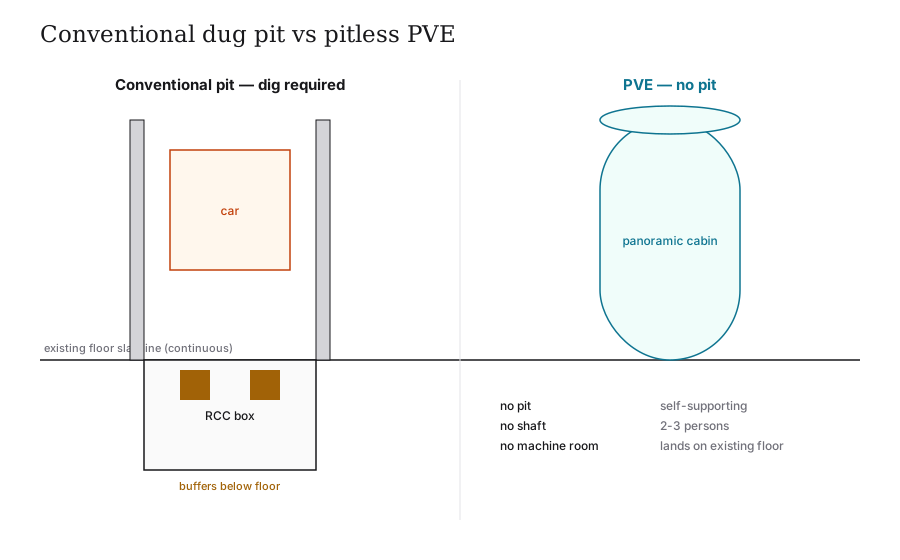
- Pneumatic Vacuum Elevators (PVE) are self-supporting and air-driven. They need no pit at all (and no shaft and no machine room), which makes them the simplest of all to drop into a finished house.
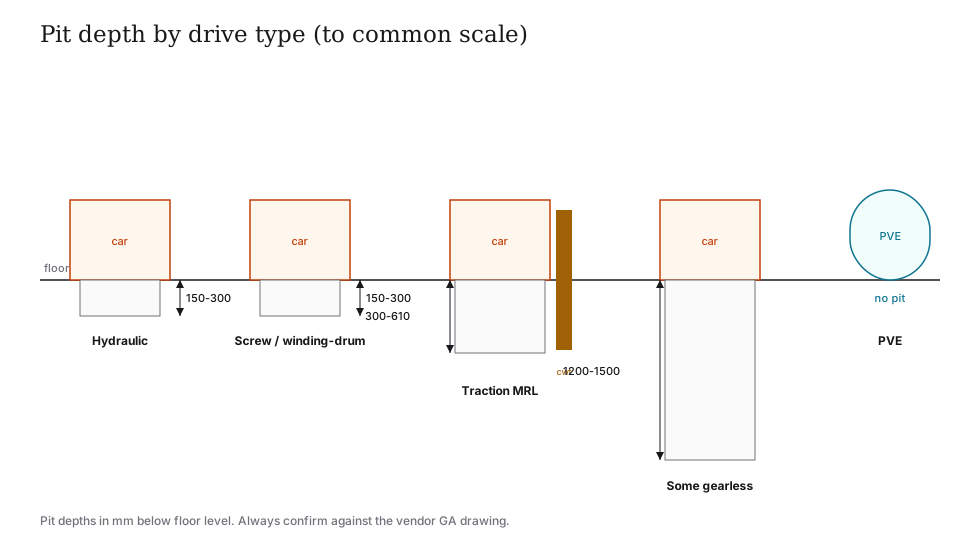
Pit depth by drive type — at a glance
| Drive type | Indicative pit depth | Counterweight in pit? | Typical home use | Notes |
|---|---|---|---|---|
| Hydraulic | 150–300 mm | No | 2–4 floors, retrofit-friendly | Power pack in adjacent cabinet; smooth, quiet |
| Screw / winding-drum | 150–300 mm | No | Compact homes, low maintenance | Self-supporting column |
| Traction MRL (most home models) | 300–610 mm | Yes | New-build, multi-stop | 2026 norm; needs counterweight buffer runby |
| Some gearless / geared models | 1200–1500 mm (up to ~1750 mm) | Yes | Larger / faster cars | Confirm against the exact model GA |
| Pneumatic Vacuum (PVE) | None (no pit) | No | Retrofit, panoramic, 2–3 persons | No shaft or machine room either |
If you are still choosing a drive type, the trade-offs of each — cost, speed, power phase, ARD — are set out in the Residential Elevator Buyer's Guide (India) and Home Lift Cost in India 2026. This guide assumes the type is chosen and you now have to build the pit it demands.
The pit is a waterproof RCC box, not a hole
The single most common pit failure in Indian homes is water. The pit floor sits below ground, the water table rises in the monsoon, and a damp pit corrodes the buffer springs, the safety-gear linkages and the bottom of the guide rails. The fix is to treat the pit as a continuous, monolithic reinforced-concrete box — base slab and walls cast to keep water out by construction, not by a surface coat alone.
Good practice for a residential pit:
- Cast the pit slab and walls as RCC, with a waterproof concrete mix and proper reinforcement detailing; integral (crystalline or admixture-based) waterproofing in the concrete is more durable than a paint-on membrane that can blister and peel below the water line.
- Leave the internal face of the shaft wall above the pit unplastered — plaster reduces clearances and can spall onto running gear — but the pit box itself must be sound and tanked.
- Lap the waterproofing continuously from the slab up the walls; the slab-to-wall construction joint is where pits leak, so use a water-bar and seal it.
- Provide a small fall in the pit floor toward a sump so any water that does enter collects in one place.
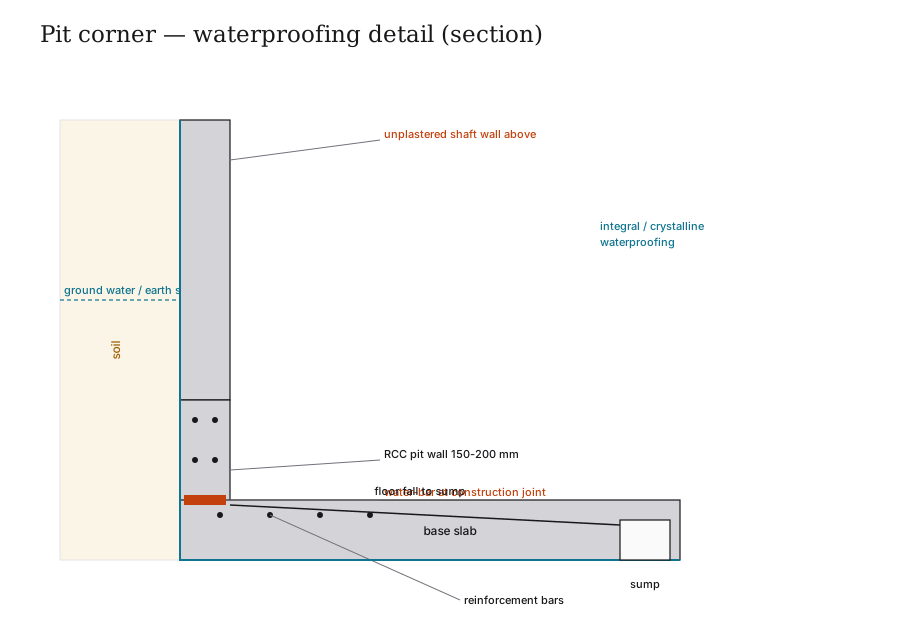
"Acts of God" such as pit flooding are commonly excluded even from a comprehensive AMC. The cost of a flooded pit lands on the homeowner, which is exactly why the waterproof box is worth the upfront spend. Read the AMC fine print — see the Lift Specification Checklist (India).
Designing the pit walls for lateral earth pressure
Because the pit is buried, its walls are retaining walls. The surrounding soil — and any groundwater — pushes inward on them, and the structural engineer must design the pit walls for this lateral earth pressure in addition to the vertical loads coming down the shaft. A shaft wall designed only for its own weight and the guide-rail bracket reactions can still bow or crack if the soil load below ground is ignored.
Key points the structural engineer will work through, to the vendor's GA:
- Lateral earth pressure on each buried wall, including the surcharge from anything bearing nearby (a footing, a driveway, parked vehicles), and hydrostatic pressure where the water table is high.
- Guide-rail bracket reactions — both vertical and horizontal forces — transmitted into the walls at intervals; the exact loads and bracket spacing come from the lift supplier and must be known before the walls are cast.
- A pit-wall thickness consistent with the shaft above (commonly 150 to 200 mm RCC), increased where earth and water pressure demand it.
- Continuity of reinforcement from the base slab into the walls so the box acts as one structure.
This is why the process rule is absolute: never finalise or cast the pit before the vendor's general-arrangement drawing and reaction schedule are fixed. The detailed load path — brackets, buffer impact, overhead hoist-beam force — is covered in Home Lift Structural Design (India).
Buffer impact provision in the pit slab
At the bottom of the pit sit the buffers — energy-absorbing devices (spring or oil/hydraulic) that catch the car (and, on a traction lift, the counterweight) if it travels below the lowest floor. When a buffer is struck, it dumps a large, short-duration impact force into the pit slab. Pit and overhead slabs commonly crack in the field precisely because these buffer/impact forces were underestimated at design.
So the pit slab must be designed for:
- The buffer-impact reaction as an unfactored load given by the lift supplier (do not guess it), plus the static dead load of the car at rest on its buffers.
- Where the design calls for it, steel bearing/shock plates inserted under the buffer locations and, on heavy installations, additional provision in the raft beneath the pit.
- The counterweight buffer position as well as the car buffer on traction lifts — both bear on the slab.
Get the supplier's reaction schedule and hand it to the structural engineer before pouring. A pit slab is cheap to thicken on paper and very expensive to repair once the lift is running over it.
Sump, dewatering, ladder, stop-switch and lighting
A compliant home pit is more than a watertight box. IS 14665 and NBC 2016 Part 8 Section 5 expect the pit to be maintainable and safe for a technician to enter. The fittings below are what a State Lift Inspectorate inspector will look for at commissioning.
- Sump and dewatering. A small sump in the low corner of the pit floor collects any ingress. In a high-water-table location, fit an automatic sump pump (with a non-return valve and its own power) so a monsoon surge cannot fill the pit. The sump is also where the floor's fall should drain.
- Pit access ladder. Where the pit is deep enough to require descent (broadly the traction and deep-gearless pits, not the 150 mm hydraulic pad), a fixed pit ladder lets a technician get in and out safely. Position it so it does not foul the car, counterweight or buffers.
- Pit stop-switch. A clearly reachable emergency stop switch in the pit lets anyone working there disable car movement before stepping in. It should be reachable from the access point before the technician's body is in the path of the car.
- Pit lighting and socket. Permanent pit lighting and a maintenance socket-outlet, switched from an accessible point, so no one works in a dark wet box by torchlight.
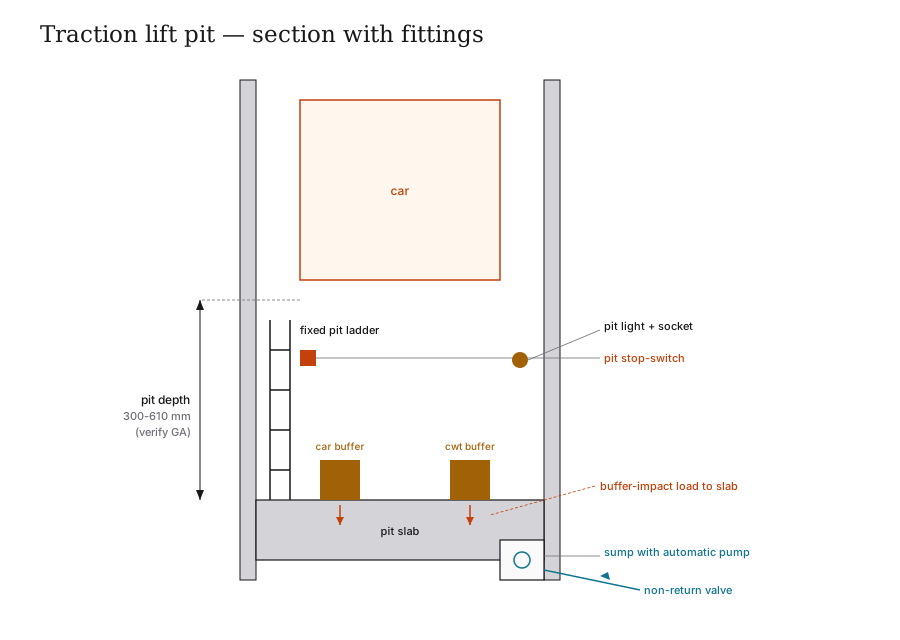
A shallow hydraulic or screw pit of 150 to 300 mm usually does not need an internal ladder or a person standing inside it, but it still needs to be dry, lit for inspection and provided with the stop and electrical safety the standard requires. Confirm the exact fitting list for your depth against the vendor GA and your state Lift Act.
When you cannot dig: low-pit, pitless and shaftless options
Plenty of Indian homes cannot accommodate a conventional pit — a ground-floor slab already cast on grade, a rocky or high-water-table site, a heritage floor that must not be cut, or simply no appetite for excavation. There is a graded set of answers, from a reduced pit to no pit at all.
- Low-pit lifts. Many hydraulic and screw-drive home models are happy with a shallow 150 to 300 mm pit, which can sometimes be formed as a small recess or even an above-floor ramp/platform rather than a dug pit. This is the least disruptive conventional route.
- Pitless / reduced-pit configurations. Some MRL and platform models are engineered for a minimal or near-zero pit, accepting a small step or a gently ramped entry at the lowest landing instead of a buried box. Check the model's homologation and your inspectorate's acceptance.
- Pneumatic Vacuum Elevator (PVE). The clean answer for a finished house: a PVE is self-supporting and needs no pit, no shaft and no machine room. The panoramic cylindrical cabin lands on the existing floor. It trades depth for capacity — typically 2 to 3 persons and limited travel — and draws more power on the ascent (it descends by controlled gravity). PVE is the most common true shaftless / pitless retrofit; Nibav is the best-known India-grown PVE brand.
These options are the heart of fitting a lift into an existing home — for the cutting-in, disruption and cost trade-offs see Retrofitting a Lift into an Existing Home (India), and for tight urban sites see Lift Design for Narrow Plots (India). If you are still at design stage, provisioning a proper pit now is far cheaper than cutting one later — see Lift-Ready, Future-Proof Home (India) and Designing a Lift into a New House (India).
A note on Vastu and the pit
Many Indian clients ask about direction. Lift-Vastu writers generally favour the north or east for the pit, in line with the lift itself sitting north or north-east, and away from the south-west (kept "heavy" and grounding) and the central Brahmasthan. Treat this as a cultural preference to reconcile with reality, not an engineering rule — where Vastu and the structural/waterproofing logic of the pit conflict, safety and the soil win. The fuller discussion is in Lift Placement and Vastu (India), alongside Staircase Vastu and Vastu House Plan (India).
Pit checklist before you pour
- Drive type chosen and its pit depth confirmed from the actual model GA, not a generic figure.
- Vendor reaction schedule in hand — buffer impact, guide-rail bracket loads — and handed to the structural engineer.
- Pit designed as a waterproof RCC box, walls checked for lateral earth and hydrostatic pressure.
- Sump formed, with an automatic pump if the water table is high.
- Pit ladder, stop-switch, lighting and socket provided where the depth requires them.
- State installation licence and inspection planned where your state has a Lift Act (Maharashtra, Karnataka, Tamil Nadu, Delhi and others).
Coordinate the pit, the shaft and the machine arrangement together — they are one structural problem. Continue with Lift Shaft Design Guide (India), Lift Machine Room Requirements (India) and Home Lift Space Requirements (India).
References
- IS 14665 (Part 1) — Electric Traction Lifts, Outline Dimensions (car, well/hoistway, pit, headroom), BIS: https://law.resource.org/pub/in/bis/S05/is.14665.1.2000.pdf
- IS 14665 (Part 2) — Code of Practice for Installation, Operation and Maintenance, BIS: https://law.resource.org/pub/in/bis/S05/is.14665.2.1-2.2000.pdf
- IS 15259 — Hydraulic Lifts (companion code for hydraulic installations), BIS — referenced by name.
- National Building Code of India 2016, Part 8 (Building Services), Section 5 — Installation of Lifts, Escalators and Moving Walks, BIS: https://www.bis.gov.in/standards/technical-department/national-building-code/
- Guide for Using NBC 2016, BIS: https://www.bis.gov.in/wp-content/uploads/2022/08/Booklet-Guide-for-Using-NBC-2016.pdf
- Structural requirement for lifts and lift pits, Civilera: https://www.civilera.com/post/structural-requirement-for-lifts-and-lift-pits
- Structural design of a lift well / RCC shaft, SketchUp 3D Construction: https://www.sketchup3dconstruction.com/const/guidelines-for-making-perfect-structural-design-of-a-lift.html
- Lift regulations in India (state Lift Acts overview), 99acres: https://www.99acres.com/articles/know-all-about-the-lift-regulations-in-india.html
- Maharashtra licence to operate a lift, National Government Services Portal: https://services.india.gov.in/service/detail/maharashtra-license-to-operate-lift
State Lift Acts referenced by name: Maharashtra Lifts, Escalators and Moving Walks Act 2017; Karnataka Lifts, Escalators and Passenger Conveyors Act 2015; Delhi Lifts and Escalators Act 2007; Tamil Nadu Lifts Act 1997. All figures indicative — verify with your local municipal bye-laws, a licensed lift contractor and your structural engineer.
Export this guide
Related Guides — Deep-dive reading
Home Lift Structural Design Considerations (India): Loads, Shaft and Coordination
The loads a home lift imposes, designing the shaft and pit as RCC elements, framed vs load-bearing implications, and the coordination workflow that ties structural design to the vendor's GA and reaction schedule.
Home Lifts & AccessibilityArchitect's Residential Elevator Planning Handbook (India): Shaft, Loads, Code & Coordination
The plan-stage reference for carrying a home lift through the drawing board — shaft, structure, pit, code, licensing and accessibility.
Home Lifts & AccessibilityMachine Room Requirements for Home Lifts (India): MRL vs Machine-Room, Space and Services
Why machine-room-less is the 2026 home default — and, when a separate machine room is still used, its size, location, ventilation, access, lighting and the supplier-given hoist-beam load.
Home Lifts & AccessibilityRelated Tools — Try Free
Home Lift Comparison Tool
Compare hydraulic, traction, pneumatic vacuum and screw lifts side by side for your home.
Lift ComparisonHome Lift Cost Calculator
All-in home lift cost by floors, type, capacity and city — equipment, civil, GST and AMC, with a drive-type comparison.
Lift CalculatorLift Headroom Calculator
Required overhead clearance for a home lift, checked against your top-floor height.
Lift Calculator