
Architect's Residential Elevator Planning Handbook (India): Shaft, Loads, Code & Coordination
The plan-stage reference for carrying a home lift through the drawing board — shaft, structure, pit, code, licensing and accessibility.
A residential lift is not a fitting you bolt on at the end — it is a vertical structural and services element that must be carried through the plan from the first sketch. By the time a client asks "can we add a lift later?", the cheap window has usually closed: the slab is poured, the grid is fixed, and the only honest answer is a pneumatic retrofit or a costly chase through finished floors. This handbook is the plan-stage reference for architects and designers in India. It assumes you already understand the lift options from the residential elevator buyer's guide; here we work at drawing-board rigour — shaft integration, structural loads, pit and headroom, the regulatory and licensing programme, accessibility geometry, electrical provisioning, and the tender language that prevents the coordination failures that show up on every snag list.
The discipline is simple to state and hard to honour: design the hoistway as a stacked, plumb, structurally-resolved void from foundation to overrun, and reserve it on every floor plate before anything else competes for the space.
1. When to provision or plan a lift at design stage
Three decisions sit on your desk: provision (leave a shaft-shaped void and structure for a future lift), plan (a lift is in the brief now), or omit. The cost asymmetry is brutal — a void left in the structural grid and floor plates costs a fraction of cutting one in later, so the default for any home of G+1 and above with ageing occupants, or any villa the client intends to hold for decades, is to at least provision. The deeper case for designing future-readiness into the shell, services and circulation is made in the lift-ready future-proof home guide; the family-level rationale sits in the future-proof home design guide.
Plan a lift outright when the brief names a wheelchair user or elderly resident, when the build is G+2 or taller, or when resale positioning demands it. Note also the regulatory trigger discussed in §5: NBC 2016 generally expects a lift where building height exceeds ~13 m (indicative — confirm against your local bye-laws), so for tall plots the lift is not optional. If you are weighing whether to commit now versus later, walk the client through the planning questionnaire and the planning checklist at concept stage, not after the structural drawings are issued.
2. Shaft and hoistway integration in the plan
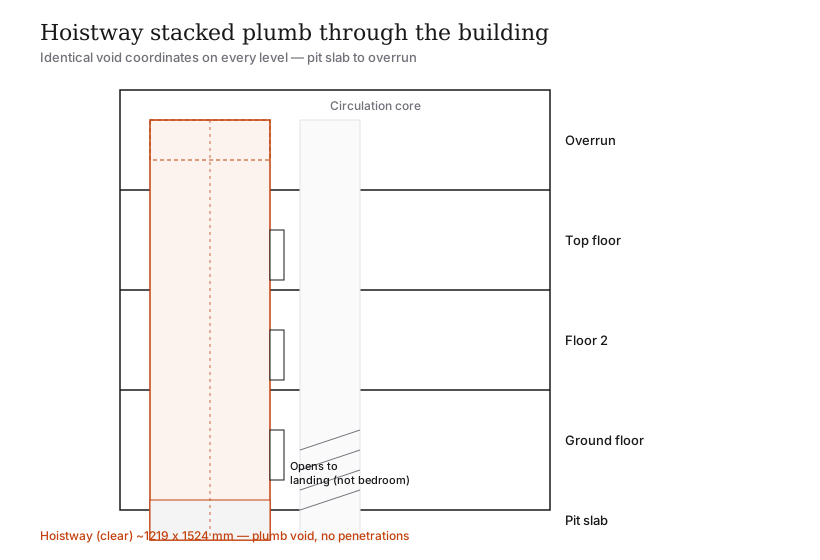
The hoistway is a continuous plumb void. The single most common architectural failure is a shaft that wanders — a column or beam intrudes on one floor, a duct crosses the overrun, a wall thickens at the lobby. Resolve it once, in plan and section, then lock it.
Stacking. Draw the hoistway on every floor plate at the same coordinates, including the pit slab below the lowest served floor and the overrun above the highest. Verify by overlaying floors that nothing — structure, plumbing stack, AC drain, electrical riser — penetrates the void at any level. The shaft should land beside a primary circulation core so the lift opens into a hall or landing, not a bedroom, and so the lobby can meet accessibility dimensions (§6).
Sizing. A small home car needs a hoistway from roughly 1219 × 1524 mm (4' × 5'), growing with capacity and door type. Automatic telescopic/sliding doors consume more clear opening logic than a manual swing door but are the only accessible choice (§6), so size the shaft for the door you will actually specify, not the cheapest. Reserve clear internal hoistway dimensions and treat finishes as additive.
Locating it in the grid. Place the shaft so its walls coincide with the structural grid wherever possible — a shaft that sits inside a structural bay, bounded by load-bearing walls or a frame, transfers loads cleanly. A shaft floating mid-bay forces transfer beams and complicates the pit and overrun. See the load path in §3.
3. Structural: loads the lift imposes
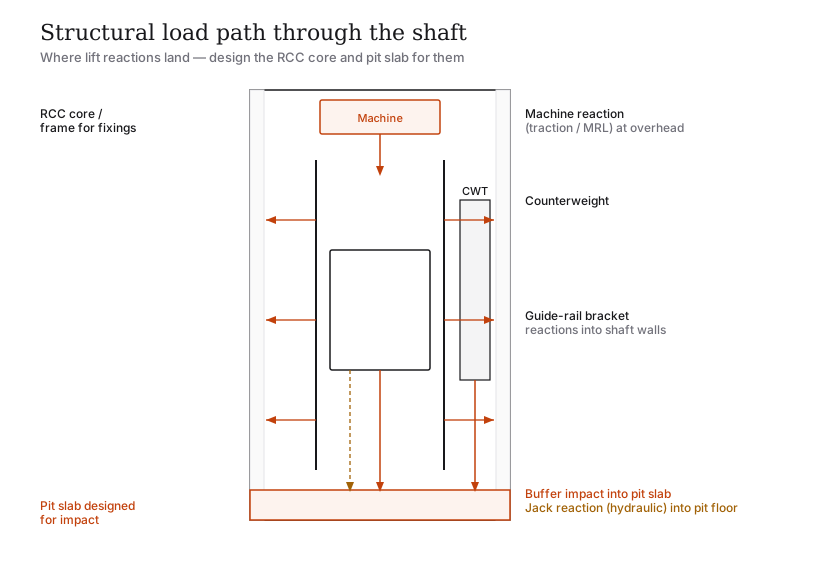
This is where the architect must talk to the structural engineer early and precisely. A lift does not impose a uniform load — it imposes concentrated reactions at specific points, and those points must be designed for.
Where the loads land. In a traction/MRL lift the machine and its sheave react against the hoistway structure (typically the top of the shaft or a top beam), and the guide rails transfer horizontal reactions into the shaft walls at their fixing brackets up the full height. In a hydraulic lift the jack reaction passes into the pit floor. In every type, two zones are critical: the pit slab (which takes the car, counterweight buffer impact and, for hydraulic, the jack) and the overhead/overrun (which takes machine and suspension reactions for traction).
Load-bearing versus framed. In a load-bearing masonry home the shaft walls themselves can carry guide-rail bracket reactions if specified and detailed for it, but you must confirm wall thickness and fixing capacity with the engineer — bracket pull-out from thin brickwork is a real failure. In an RCC framed building, design the shaft as an RCC core or provide a frame around the void so guide rails fix to concrete or steel, not infill blockwork. The pit slab is usually a thicker, separately-designed RCC raft sized for impact, not just static car weight.
Coordinating with the structural engineer. Give the engineer, at the structural-design stage: the lift type, rated load and car/counterweight masses, the buffer impact loads, the guide-rail reaction points and magnitudes, and the machine reaction location and value. These come from the vendor's general-arrangement (GA) drawing — which is why a provisional vendor must be on board before the structure is frozen (§8). If a vendor is not yet appointed, design the shaft and pit to the most demanding plausible case so a later vendor fits without a structural redesign.
4. Pit depth, headroom and MRL versus machine room
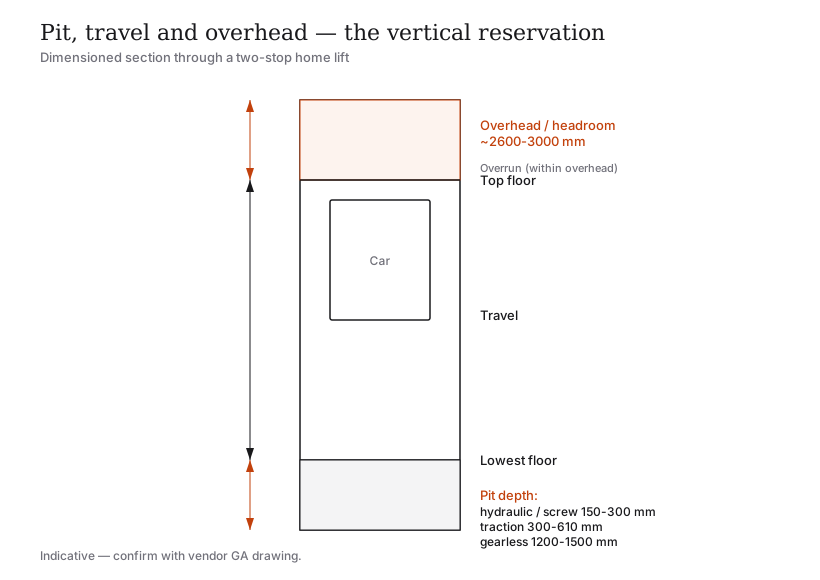
Pit depth and overhead headroom are the two dimensions clients and contractors most often shortchange, and they are the hardest to fix after the slab is cast. They vary by lift type — design to the type you intend to specify, and carry a tolerance.
| Parameter | Hydraulic | Screw / winding-drum | Traction (geared) | Traction / gearless MRL | PVE (pneumatic) |
|---|---|---|---|---|---|
| Typical pit depth | ≈150–300 mm | ≈150–300 mm | ≈300–610 mm | some modern gearless 1200–1500 mm | none (no pit) |
| Overhead / headroom | ≈2600–3000 mm | ≈2600–3000 mm | ≈2600–3000 mm | ≈2600–3000 mm (MRL trims the old machine-room-on-top) | self-contained, no separate overhead machine space |
| Separate machine room | small adjacent power-pack cabinet | minimal | traditionally yes | no — machinery inside hoistway | none |
| Suits low pit / retrofit | yes | yes | less so | varies | best — no pit, no shaft, self-supporting |
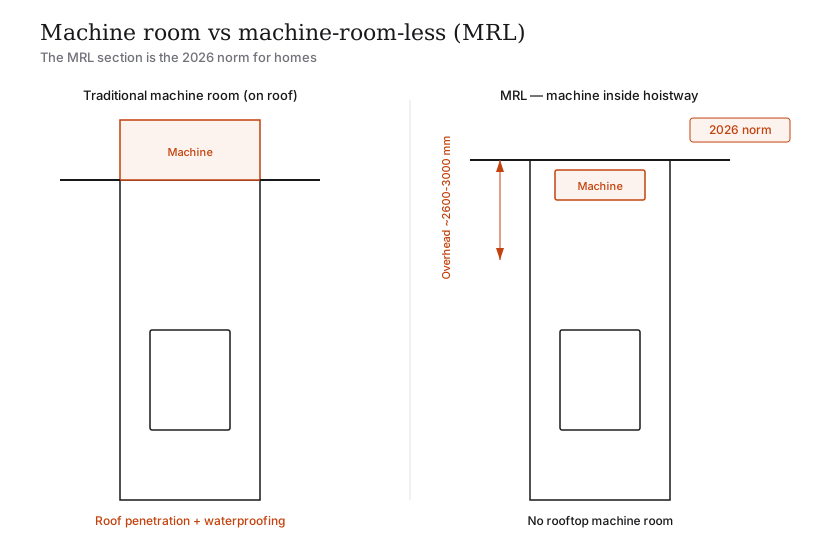
MRL versus machine room. The machine-room-less (MRL) traction lift is the 2026 norm: the machine sits inside the hoistway, eliminating the rooftop machine room that used to cost head height, waterproofing detail and a roof penetration. For most new Indian homes, MRL is the cleaner architectural answer — but it still needs adequate overhead (≈2600–3000 mm depending on model) and pit. Where pit depth is genuinely unavailable (existing slab, high water table, retrofit), a pitless/low-pit screw or hydraulic lift, or a PVE with no pit or shaft at all, becomes the design move. Always carry these as "indicative — confirm with your local municipal bye-laws and a licensed lift contractor," because the exact pit and overhead are model-specific and come off the vendor GA.
5. The regulatory frame, in detail
Two layers govern a residential lift in India: technical standards (national) and licensing law (state). The architect owns the programme that threads the licensing approvals into the construction timeline.
Technical standards.
- IS 14665 — Electric Traction Lifts (BIS, committee ETD 25, aligned to EN 81). It is multi-part: Part 1 sets outline dimensions (car, well/hoistway, pit, headroom, machine room, door types) and supersedes IS 3534:1976; Part 2 is the code of practice for installation, operation and maintenance; Part 3 covers safety rules; Part 4 covers components (buffers, guide rails and shoes, carframe/car/counterweight/suspension, safety gears and governors); Part 5 is the inspection manual. Part 1 is the part you draw to.
- IS 15259 — Hydraulic lifts is the companion code for hydraulic installations — cite it by name when the project uses a hydraulic lift.
- NBC 2016, Part 8 (Building Services), Section 5 — Installation of Lifts, Escalators and Moving Walks. Commonly cited triggers (verify against local bye-laws, which vary by state): a lift is generally required where building height exceeds ~13 m, with a ≥6-person ground-floor lift as the usual baseline; a fireman's lift is generally required above 15 m (some residential rules set 30 m), minimum ~8 persons / 544 kg, car ≈1100 × 1400 mm so it takes a stretcher, serving the full building height. The number of lifts is computed from occupancy and traffic per NBC plus IS 14665.
State Lift Acts and the licensing workflow. Lifts are state-regulated. Roughly ten states issue lift licences — Maharashtra, Gujarat, Karnataka, Kerala, Tamil Nadu, Assam, West Bengal, Delhi, Haryana and Himachal Pradesh. The acts the architect most often programmes around are:
| State | Governing Act | Architect's programme note |
|---|---|---|
| Maharashtra | Lifts, Escalators & Moving Walks Act, 2017 | Installation permission, then licence to operate from the Electrical Inspectorate; build approval lead time into commissioning |
| Karnataka | Lifts, Escalators & Passenger Conveyors Act, 2015 | Registration + inspection regime; confirm current fees and forms with the inspectorate |
| Delhi | Lifts & Escalators Act, 2007 | Licence before operation; periodic inspection |
| Tamil Nadu | Lifts Act, 1997 | Registration/permission; oldest of the four — verify current rules |
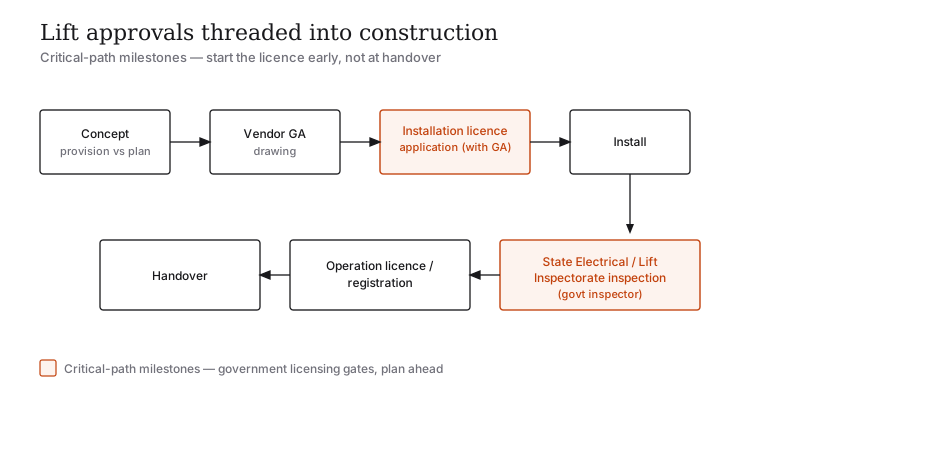
The typical owner obligations in a regulated state are an installation licence (granted before commissioning), an operation licence or registration, and periodic safety inspection by the State Electrical / Lift Inspectorate — and inspection is by government-appointed inspectors, not private companies. In states without an Act, registration may not be mandated but IS and NBC remain best practice. As the architect, fold three milestones into the construction programme: (a) submit the installation application with vendor GA drawings well before the lift is due to land; (b) schedule the inspectorate inspection ahead of handover; (c) hold the operation licence/registration as a gate before the client occupies. Treat these dates as critical-path items, because a lift cannot legally run on an unlicensed install.
6. Accessibility — designing to CPWD Harmonised Guidelines
The RPwD Act 2016 legally binds public buildings — Sec 40 (accessibility standards), Sec 44 (no building permission if plans fail accessibility norms) and Sec 45 (existing public buildings to be made accessible within five years). Private homes are not legally compelled, but the CPWD / MoHUA Harmonised Guidelines and Space Standards for a Barrier-Free Built Environment (2016; Harmonised Guidelines 2021) are the correct benchmark — and for any client with mobility needs they are non-negotiable. The companion accessible home design guide and the universal-design adaptable-homes reference carry the room-by-room detail; the lift-specific geometry is below.
| Element | Requirement (accessible home) |
|---|---|
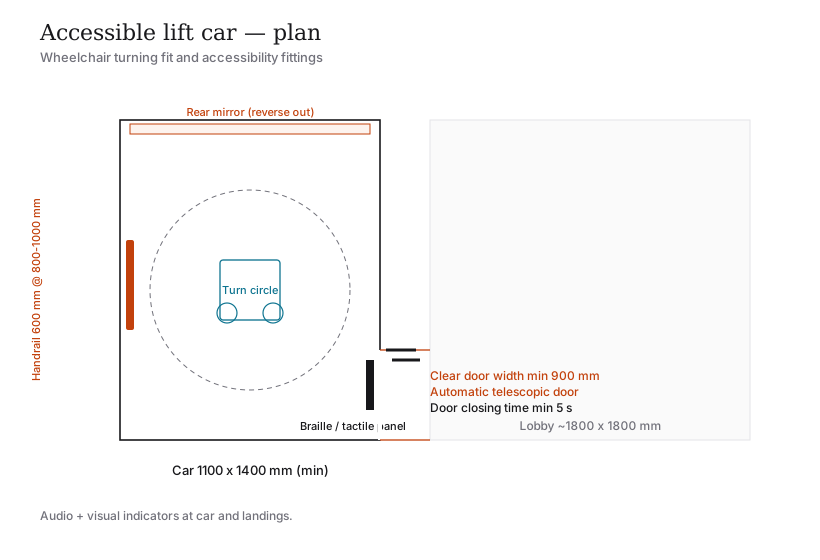
| Clear door width | ≥ 900 mm |
| Car size (wheelchair + attendant) | ≈ 1100 × 1400 mm minimum |
| Door type | automatic telescopic/sliding (manual swing doors are not wheelchair-friendly) |
| Automatic door closing time | ≥ 5 seconds |
| Handrail | ≥ 600 mm long, at 800–1000 mm above floor, near the control panel |
| Lift lobby (inside) | ≈ 1800 × 1800 mm |
| Controls | Braille / tactile buttons; audio + visual floor indicators |
| Rear wall | mirror so a wheelchair user can reverse out |
For reference, CPWD's worked example for a 13-person public lift is depth 1100, width 2000, door 900 mm — larger than a home car, which is why you size the home car to the ≈1100 × 1400 mm accessible minimum rather than scaling the public example down.
7. Electrical provisioning
Reserve the electrical scope at the SLD stage, not on site. Small home lifts (hydraulic, screw, smaller traction, PVE) can run on single-phase; larger traction lifts need three-phase — so the supply decision follows the lift type and must be confirmed against the vendor GA before the meter and DB are finalised. Provide a dedicated machine-power circuit and isolator at the hoistway, shaft lighting with a switch accessible for maintenance, and a power feed for the controller (in-hoistway for MRL).
Specify an Automatic Rescue Device (ARD) — a battery that brings the car to the nearest floor and opens the doors on a power cut. Given Indian outages, an ARD is essential, not optional; reserve space and a feed for it. Coordinate also the emergency alarm/intercom power, and on taller installations the fireman's-switch circuit. Speeds are modest (≈0.15–0.5 m/s for home lifts), so machine power is not large, but the dedicated circuit, ARD and shaft lighting must all appear on the electrical drawings.
8. Vendor and specification coordination — what to put in the tender
A lift is a design-and-build package, so the tender must pin down the architecturally load-bearing items and leave the vendor free on proprietary engineering. The detailed line-items belong in the lift specification checklist; compare brands and service reach against the vendor comparison and the AMC evaluation guide. India's home segment is served by Otis, KONE, Schindler, TK Elevator, the large indigenous maker Johnson Lifts, the pneumatic-vacuum specialist Nibav, home specialist Elite Elevators, and premium imports such as Aritco — confirm local service presence before specifying, because AMC response time matters more than badge.
Put these in the tender: lift type and drive; rated load and persons; car internal size and finish; door type (automatic telescopic for accessibility) and clear opening; travel, number of stops and openings; pit depth and overhead the vendor must work within (or a request for their GA so the structure matches); machine location (MRL vs room); single- vs three-phase supply; mandatory safety set — overspeed governor and safety gear, door sensors/light curtain, ARD battery backup, emergency alarm and intercom, manual lowering, overload sensor (and fireman's switch where applicable); accessibility set per §6; the GA drawing deliverable with guide-rail and machine reaction loads for the structural engineer; state licensing support (installation/operation licence documentation); and the AMC scope (comprehensive vs non-comprehensive). Note that GST at 18% applies and that civil work (shaft, pit, electricals) and installation are usually quoted separately — make that explicit so bids are comparable.
9. Design-stage checklist
- ☐ Provision vs plan decision made at concept, recorded in the brief
- ☐ Hoistway drawn at identical coordinates on every floor plate, pit and overrun
- ☐ Overlay check: no structure, plumbing, AC drain or riser penetrates the void at any level
- ☐ Shaft located beside circulation core; opens to hall/landing, not a habitable room
- ☐ Shaft walls coincide with structural grid; load path to engineer resolved
- ☐ Lift type chosen; pit depth and overhead reserved to that type's range, with tolerance
- ☐ Vendor GA obtained (or worst-case assumed) before structure frozen
- ☐ Guide-rail and machine reaction loads issued to structural engineer
- ☐ Pit slab designed for impact, not just static car weight
- ☐ Accessible car geometry confirmed (≥900 mm door, ≈1100 × 1400 mm car, 1800 × 1800 mm lobby)
- ☐ Single- vs three-phase decided; dedicated machine circuit, shaft lighting, ARD feed on the SLD
- ☐ State Lift Act identified; installation/operation licence + inspection milestones on the programme
- ☐ Tender carries type, loads, doors, safety set, accessibility set, GA deliverable, licensing support, AMC
- ☐ NBC/local-bye-law lift and fireman's-lift triggers checked against building height
10. Common coordination failures
- The wandering shaft — a column or beam intrudes on one floor only; resolve the stack in section before issuing structure.
- Pit cast too shallow / overhead too low — designed to a generic figure instead of the actual vendor GA; the lift won't fit and the slab is poured.
- Guide rails fixed to thin blockwork — bracket pull-out; specify an RCC core or frame for fixings.
- No three-phase reserved — a larger traction lift specified after a single-phase supply was sized; the DB and meter need redoing.
- No ARD — the family is trapped on the first outage; the device must be in the tender and have a reserved feed.
- Manual swing doors on an "accessible" lift — the car cannot take a wheelchair; specify automatic telescopic doors.
- Licensing left to the contractor at the end — the install is complete but cannot legally operate at handover; programme the installation/operation licence and inspection as critical-path items.
- Lift opening into a bedroom or against a narrow lobby — fails the 1800 × 1800 mm lobby and basic dignity; locate at the circulation core from the first plan.
Get the shaft, the loads, the pit, the licence and the door right at drawing stage and the lift becomes invisible — exactly as it should be. Every item on the failure list above is cheap to prevent on paper and expensive to fix in concrete.
For the wider decision and product context behind this handbook, start from the residential elevator buyer's guide, then run the planning checklist, price it with the cost guide, and lock the brief through the planning questionnaire.
References
- IS 14665 (Electric Traction Lifts) — Part 1, Outline dimensions: https://law.resource.org/pub/in/bis/S05/is.14665.1.2000.pdf
- IS 14665 — Part 2, Code of practice for installation, operation and maintenance: https://law.resource.org/pub/in/bis/S05/is.14665.2.1-2.2000.pdf
- IS 15259 — Hydraulic lifts (companion code; cited by name)
- NBC 2016, Part 8 Section 5 — Installation of Lifts, Escalators and Moving Walks (BIS National Building Code): https://www.bis.gov.in/standards/technical-department/national-building-code/
- BIS Guide for Using NBC 2016: https://www.bis.gov.in/wp-content/uploads/2022/08/Booklet-Guide-for-Using-NBC-2016.pdf
- RPwD Act 2016 (Rights of Persons with Disabilities), full text: https://ssepd.odisha.gov.in/sites/default/files/2024-01/RPWD%20ACT.pdf
- DEPwD (Department of Empowerment of Persons with Disabilities): https://depwd.gov.in/en/faqs-4/
- CPWD Harmonised Guidelines and Space Standards for a Barrier-Free Built Environment (2016): https://www.cpwd.gov.in/Publication/Harmonisedguidelinesdreleasedon23rdMarch2016.pdf
- Lift regulations in India (overview): https://www.99acres.com/articles/know-all-about-the-lift-regulations-in-india.html
- National Government Services Portal — Maharashtra licence to operate lift: https://services.india.gov.in/service/detail/maharashtra-license-to-operate-lift
Export this guide
Related Guides — Deep-dive reading
Designing Adaptable & Universal-Design Homes
Accessibility, Aging-in-Place, and the Multi-Stage Family — Code, Anthropometrics, and Plan-Stage Discipline for Indian Residential Architects
Room PlanningHome Lift Planning Checklist (India): Everything to Decide Before You Buy
A printable, ten-stage checklist that takes you from the first family conversation to a signed handover.
Home Lifts & AccessibilityLift-Ready & Future-Proof (India): Provisioning Your Home Now to Add a Lift Later
Leave the right empty box, slab openings and spare wiring now so a home lift is a clean install later, not a demolition.
Home Lifts & AccessibilityRelated Tools — Try Free
Elevator Capacity Calculator
Pick the right home-lift capacity — 2 to 8 person — with car size and wheelchair fit.
Lift CalculatorRainwater Tank Sizer
How big should your rainwater tank be? Computes annual harvest, recommended tank capacity in litres, water-bill savings, and payback — for 10 Indian cities.
RWH CalculatorAccessibility Compliance Calculator
Check a planned lift against the CPWD and RPwD accessible-lift benchmarks for a score.
Lift Checker