
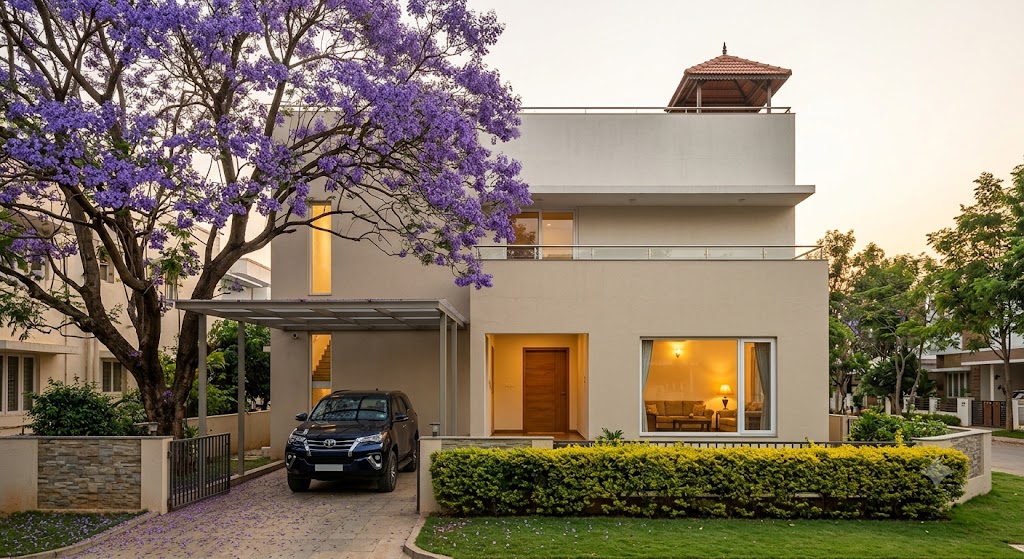
Duplex House Plans — Two-Storey Indian Layouts, Stairs, Zoning & Reference Plans
Vertical Section, Five Staircase Typologies, 30 × 40 and 30 × 50 Reference Plans, Vastu & The Decision to Go Duplex
The word duplex is used loosely across Indian real estate. To a broker in Mumbai, "duplex" most often means a two-storey apartment within a high-rise — two flats connected by an internal stair. To a builder in Bengaluru, "duplex" means a two-storey independent house on its own plot. To a buyer in Pune, "duplex" means whatever is in the brochure. The two usages have diverged in 2026 India, and most new construction in Tier-1 and Tier-2 markets uses duplex to mean a two-storey independent house. This guide addresses that usage.
A duplex house, in 2026 Indian residential vocabulary, is a two-storey freehold residence built on its own plot, with all rooms occupied by a single household. It is distinguished from:
- A simplex (single-storey house, sometimes called a "ground-only" or "bungalow"),
- A triplex (three-storey house, often G+2 or G+1+attic),
- A villa (which can be one, two, or three storey but carries premium plot and design vocabulary — see Villa Elevation Design in India),
- A row-house (party-wall sharing with neighbours on one or both sides),
- A duplex apartment (the legacy Mumbai/Kolkata usage — two flats stacked, internal stair).
This guide is the working layout reference for the freehold two-storey duplex. It covers programme stacking across floors, five staircase typologies with footprint dimensions, two complete reference plans (30 × 40 ft and 30 × 50 ft), the vertical zoning logic, Vastu rules specific to staircases and multi-floor houses, FAR and bylaw considerations, the cost comparison versus equivalent simplex, eight common mistakes, and a pre-construction checklist.
A duplex is not a simplex with another floor added. It is a different building — different circulation logic, different acoustic discipline, different Vastu reading, different family-flow choreography. Designing a duplex by adding a floor to a single-storey plan produces an awkward house in both directions.
What Duplex Means — and What It Doesn't
The vocabulary clarification matters because it determines what a buyer expects and what the architect should brief.
| Type | Definition | Typical scale | Plot size | Indian usage |
|---|---|---|---|---|
| Simplex | Single-storey freehold | 800–2,000 sft | 1,200–3,000 sft | "Bungalow" in older Tier-1 / Tier-2 |
| Duplex (this guide) | Two-storey freehold, single household | 1,600–3,500 sft | 1,200–3,600 sft | Dominant new-build in Tier-1 / Tier-2 |
| Duplex apartment (legacy) | Two flats stacked, internal stair, in a high-rise | 2,000–4,500 sft | n/a (apartment) | Mumbai / Kolkata premium high-rise |
| Triplex | Three-storey freehold, single household | 2,800–5,500 sft | 1,800–4,800 sft | Compact urban Tier-1 (Mumbai, Bengaluru) |
| Villa | Premium freehold; can be 1–3 storey | 2,400–10,000 sft | 2,400–10,000 sft | Gated community + signature plots |
| Row-house | Party-wall sharing on one or both sides | 1,200–2,400 sft | 800–1,800 sft frontage | All Tier-1 / Tier-2 dense markets |
The duplex form occupies the mid-density sweet spot in Indian residential construction: enough vertical to fit a 3BHK + study programme on a 30 × 40 plot; enough horizontal to provide each room with light and ventilation on two walls; compact enough for younger nuclear families; large enough for joint families with elders on the ground floor.
The Vertical Section — Programme Stacking and Heights
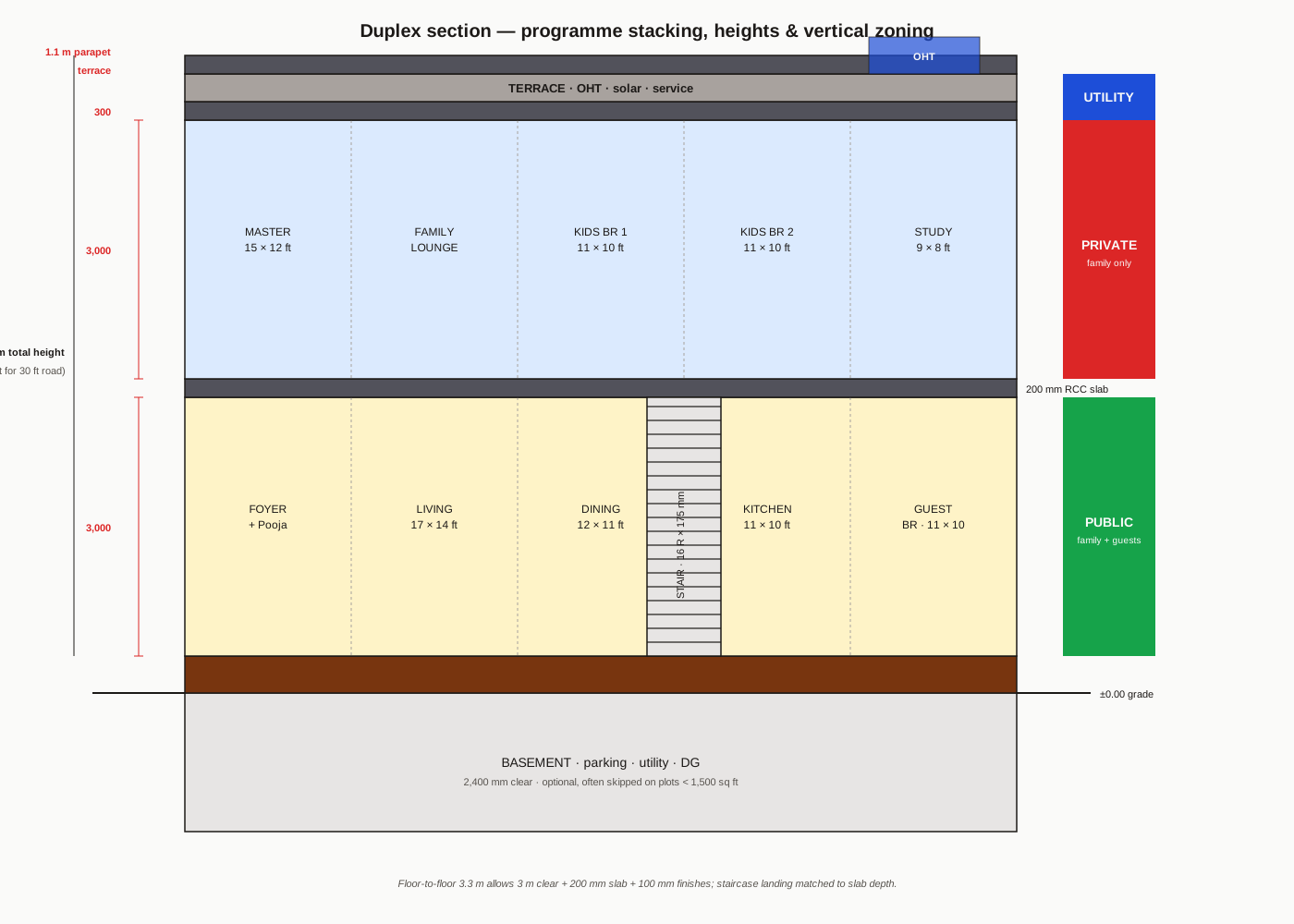
The section above is the working dimensional reference. Every height, slab thickness, and stair dimension in a duplex flows from this diagram.
Floor-to-Floor Heights
The standard floor-to-floor for an Indian duplex is 3.3 m — composed of 3.0 m clear ceiling height + 200 mm RCC slab + 100 mm finishes (false ceiling, floor finish, deck). Lower than 3.0 m clear feels cramped; higher than 3.2 m clear is luxury territory. Some Tier-1 luxury duplexes carry 3.6 m clear on the ground floor with 3.0 m on the first floor — a deliberate hierarchy that signals formality on the public floor and intimacy upstairs.
The plinth course adds another 600 mm above grade (DPC, termite, flood-safety). Total building height from grade to parapet:
- Plinth 600 mm + GF 3,300 + FF 3,300 + parapet 1,100 = 8.3 m (without basement)
- Add basement 2,400 below grade if present.
This 8.3 m sits comfortably under the 11.5 m limit for a 30 ft road in most Indian Tier-1 municipalities. Going to triplex (G+2) takes you to ~11.6 m — exactly at the limit, with no headroom for a roof-pavilion or pergola.
Slab Thickness
Standard RCC slab for residential duplex: 150–200 mm, with 200 mm being the safer default for spans 4.5–6.0 m. Slab thickness above 200 mm carries premium cost without commensurate benefit unless the span is exceptional (> 6.5 m).
The slab is the most-critical structural element in a duplex — it isolates the ground-floor public zone from the first-floor private zone acoustically and (if sized correctly) provides the load-bearing platform for upper-floor finishes including dry-area partitions and storage.
The Three Vertical Zones
A duplex divides the dwelling into three vertical zones by privacy and use:
- Public (Ground floor): foyer, living, dining, kitchen, guest bedroom, powder room — where visitors are received
- Private (First floor): master bedroom, kids bedrooms, family lounge, study — family-only
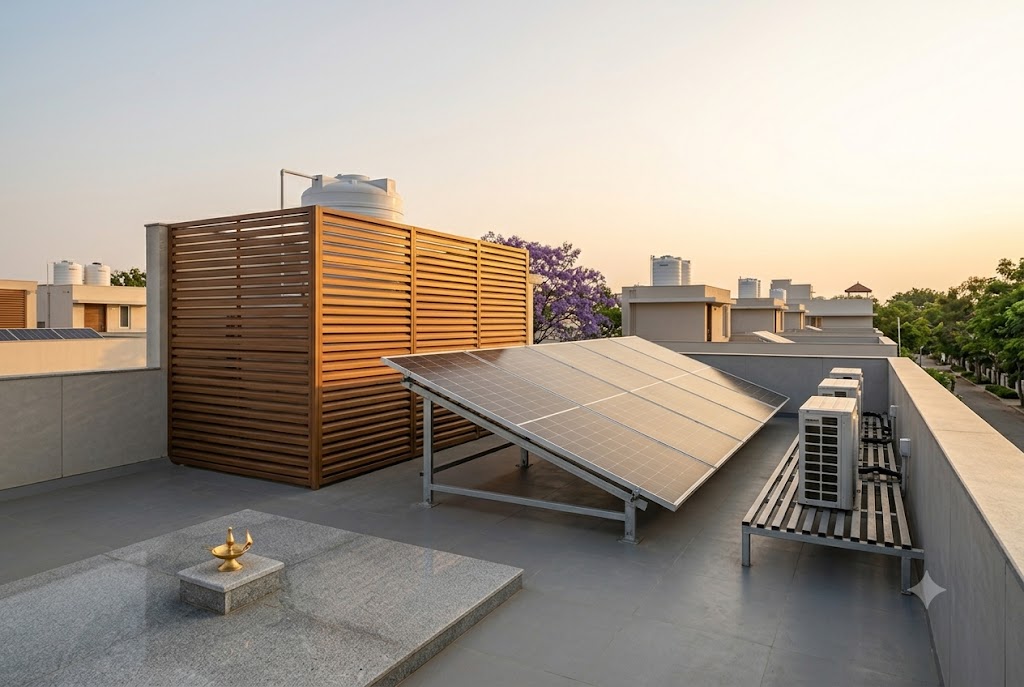
- Utility (Terrace): OHT, solar panels, AC outdoor units, DG enclosure, laundry, optional pooja terrace — service equipment
This three-zone discipline is the foundational logic of duplex planning. Every programme decision tests against this framework: where does this room belong, and why.
For the equivalent zoning logic on single-floor 2BHK and 3BHK plans, cross-reference 2BHK House Plan and 3BHK House Design.
The Five Staircase Typologies
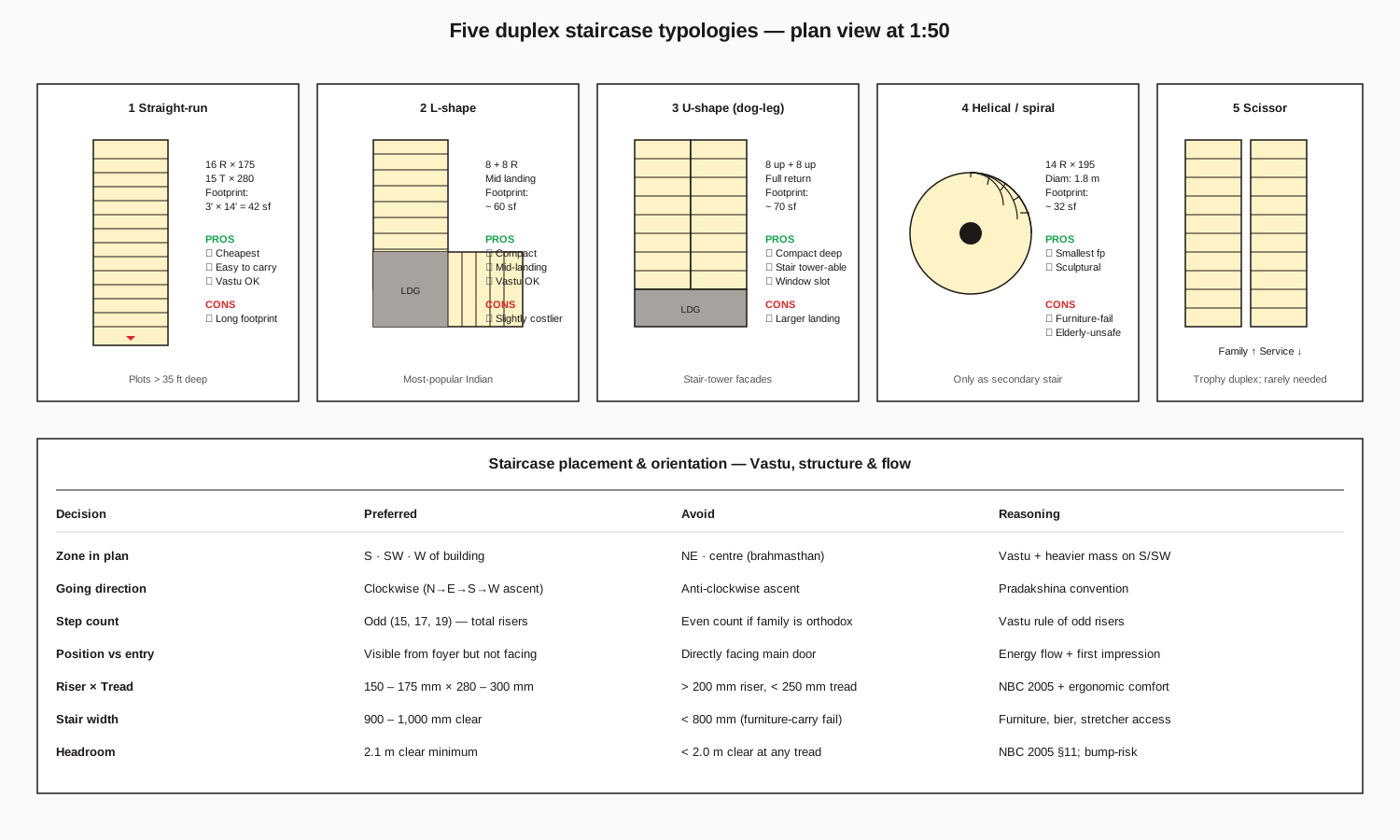
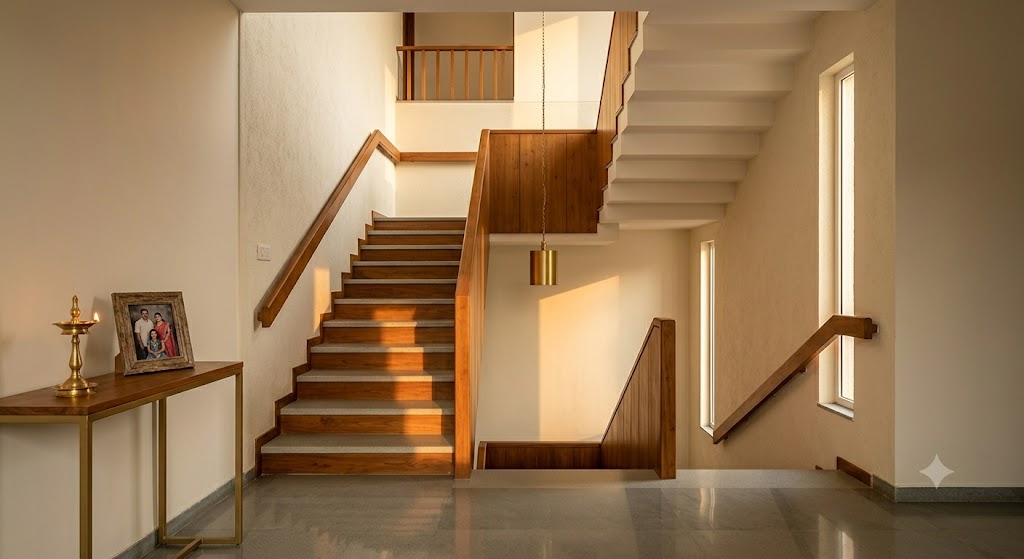
The staircase is the most-consequential single decision in duplex planning. It determines the public-private circulation, the Vastu reading, the construction cost ceiling, and the daily ergonomic experience of the family for the building's lifetime.
1. Straight-Run — Cheapest, Largest Footprint
Single flight, no landing, typically 16 risers from ground to first floor. Footprint: 3 ft wide × 14 ft long = 42 sq ft. Pros: cheapest, easiest to carry furniture, Vastu-acceptable. Cons: long footprint requires 35+ ft of plot depth in one direction.
Use when: plot is deep enough (40 ft+), and the stair can run along a side wall without dividing the plan.
2. L-Shape with Landing — Most Popular Indian
The dominant typology in 2026 Indian duplex construction. 8 risers up, intermediate landing, 8 more risers up at right angles. Footprint: ~60 sq ft. Pros: compact, mid-landing provides safety break, Vastu-acceptable, fits within a 6 × 10 ft stair core. Cons: slightly more expensive than straight (extra structural turn).
Use when: plot depth is constrained to 30–35 ft (most 30 × 40 and 30 × 50 plots).
3. U-Shape (Dog-Leg)
Two flights returning on each other, full 180° turn, full landing between. Footprint: ~70 sq ft. Pros: most compact in depth direction (occupies one bay), creates a vertical stair-tower that can be expressed as a facade element with slot windows. Cons: slightly larger landing area, slightly more structural complexity.
Use when: you want the stair as an architectural feature with slot-window stair tower; particularly compelling on west-facing facade where the slot-window admits afternoon light without heat-loading bedrooms.
4. Helical / Spiral
Compact circular stair, typically 1.8 m diameter, 14 risers per full turn. Footprint: ~32 sq ft (smallest). Pros: smallest footprint, sculptural feature. Cons: furniture cannot be carried up (king-size mattress, sofa, double-bed); elderly find the wedge treads unsafe; not suitable as the primary stair in a family home.
Use when: as a secondary stair from first floor to terrace, where furniture carry is not a daily concern. Never as the primary stair in a family home.
5. Scissor Double-Flight
Two interlocking flights, allowing separate circulation paths (family up the main, service up the secondary). Footprint: ~120 sq ft (largest). Pros: separation of family and service circulation. Cons: large footprint, expensive structural detail, only justified at trophy-duplex scale.
Use when: budget is luxury (₹ 7,500+ /sft built-up), and the service-separation argument is real (live-in staff, frequent catering events).
Staircase Vastu and Ergonomics — The Decision Matrix
| Decision | Preferred | Avoid | Reasoning |
|---|---|---|---|
| Zone in plan | S · SW · W of building | NE · centre (brahmasthan) | Vastu + heavier mass on S/SW |
| Going direction | Clockwise (N→E→S→W ascent) | Anti-clockwise ascent | Pradakshina convention |
| Step count | Odd (15, 17, 19) — total risers | Even count if family is orthodox | Vastu rule of odd risers |
| Position vs entry | Visible from foyer but not facing | Directly facing main door | Energy flow + first impression |
| Riser × Tread | 150 – 175 mm × 280 – 300 mm | > 200 mm riser, < 250 mm tread | NBC 2005 + ergonomic comfort |
| Stair width | 900 – 1,000 mm clear | < 800 mm clear | Furniture, bier, stretcher access |
| Headroom | 2.1 m clear minimum | < 2.0 m clear at any tread | NBC 2005 §11; bump-risk |
The matrix above is non-negotiable for Indian residential duplex work. The most-common mistake is width — a 750 mm stair fits in the BoQ and the plan but fails the day the first king-size mattress arrives. Specify 900 mm minimum.
For the full Vastu reference covering the broader plan-level rules, see Vastu House Plan — Complete Indian Layout Reference.
Reference Plan 1 — 30 × 40 ft Duplex (3BHK + Study, ~2,100 sft)
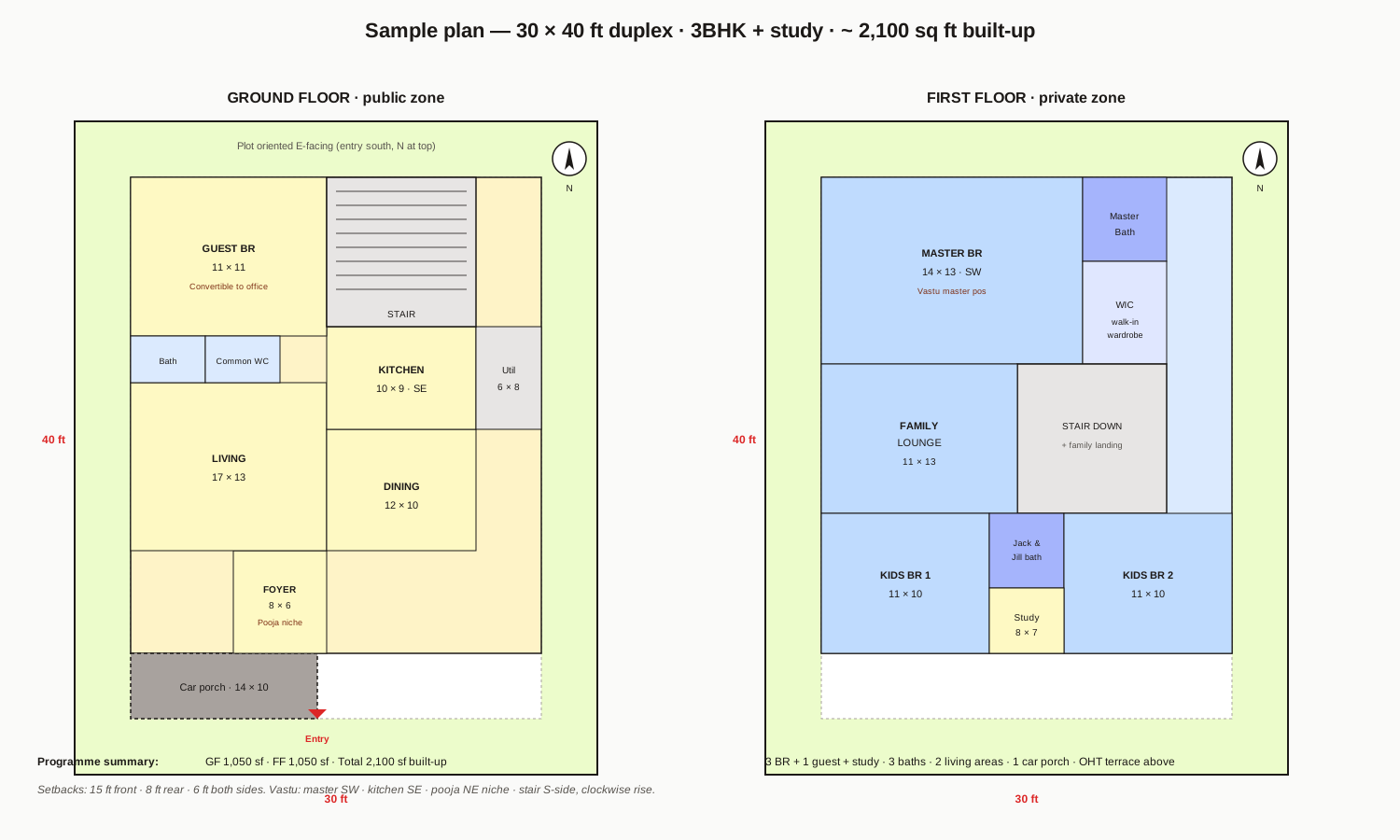
The figure above is a working reference plan for the most-common Indian duplex plot — 30 × 40 feet (1,200 sq ft plot), supporting a 3BHK + study programme totalling ~2,100 sq ft built-up area.
Programme Summary
- Ground floor (1,050 sft): foyer, living, dining, kitchen, utility, guest BR, guest bath, common WC, stair
- First floor (1,050 sft): master BR with attached bath and WIC, family lounge, kids BR 1 + 2 with Jack-and-Jill bath, study
- Plot orientation: East-facing (entry on south road, north at top of plan)
- Setbacks: 15 ft front, 8 ft rear, 6 ft both sides
- Buildable footprint: 24 × 26 ft = 624 sft per floor (well within 60% coverage)
- Stair: L-shape, 16 risers × 175 mm × 280 mm, oriented south side, rising clockwise
- Vastu: master SW, kitchen SE, pooja NE niche in foyer, stair S-side
Why This Plan Works
The bedroom hierarchy. Three bedrooms on the first floor — master (SW), kids 1 (E), kids 2 (E) — plus a fourth bedroom on the ground floor (guest, NW) that doubles as a home office. The ground-floor bedroom is the multi-purpose flex room that adapts to elderly parent care, WFH office, or guest accommodation as the family's needs evolve.
The stair-and-utility spine. The L-shape stair and the utility room sit on the south wall — heavier mass on the heavier direction per Vastu, and the stair-back wall provides acoustic isolation between the dining and the guest bedroom.
The Jack-and-Jill bath. Two kids bedrooms share a single bath with two basin counters, accessed by doors from each bedroom. Saves one bath worth of plumbing (₹ 1.5–2 L) and 50 sft of floor area — meaningful on a 1,050 sft floor plate.
The family lounge. The first-floor central space provides a private-zone gathering room separate from the ground-floor living. Critical for joint families where elders use the ground-floor living and the younger generation uses the upstairs lounge.
Variants on This Plan
- For senior care: convert the ground-floor guest BR into a permanent senior suite with grab bars, walk-in shower, and direct foyer access
- For dual-WFH couples: convert the study into a second home office; place the primary office in the guest BR
- For Vastu-strict families: add a dedicated pooja room (8 × 6 ft) on the NE corner of the ground floor — moves the foyer to centre slightly and reduces living room by 8%
- For terrace garden: the rear of the first floor can be pulled back 3 ft to create a 24 × 3 ft balcony garden facing east
Reference Plan 2 — 30 × 50 ft Duplex (4BHK + Office, ~2,650 sft)
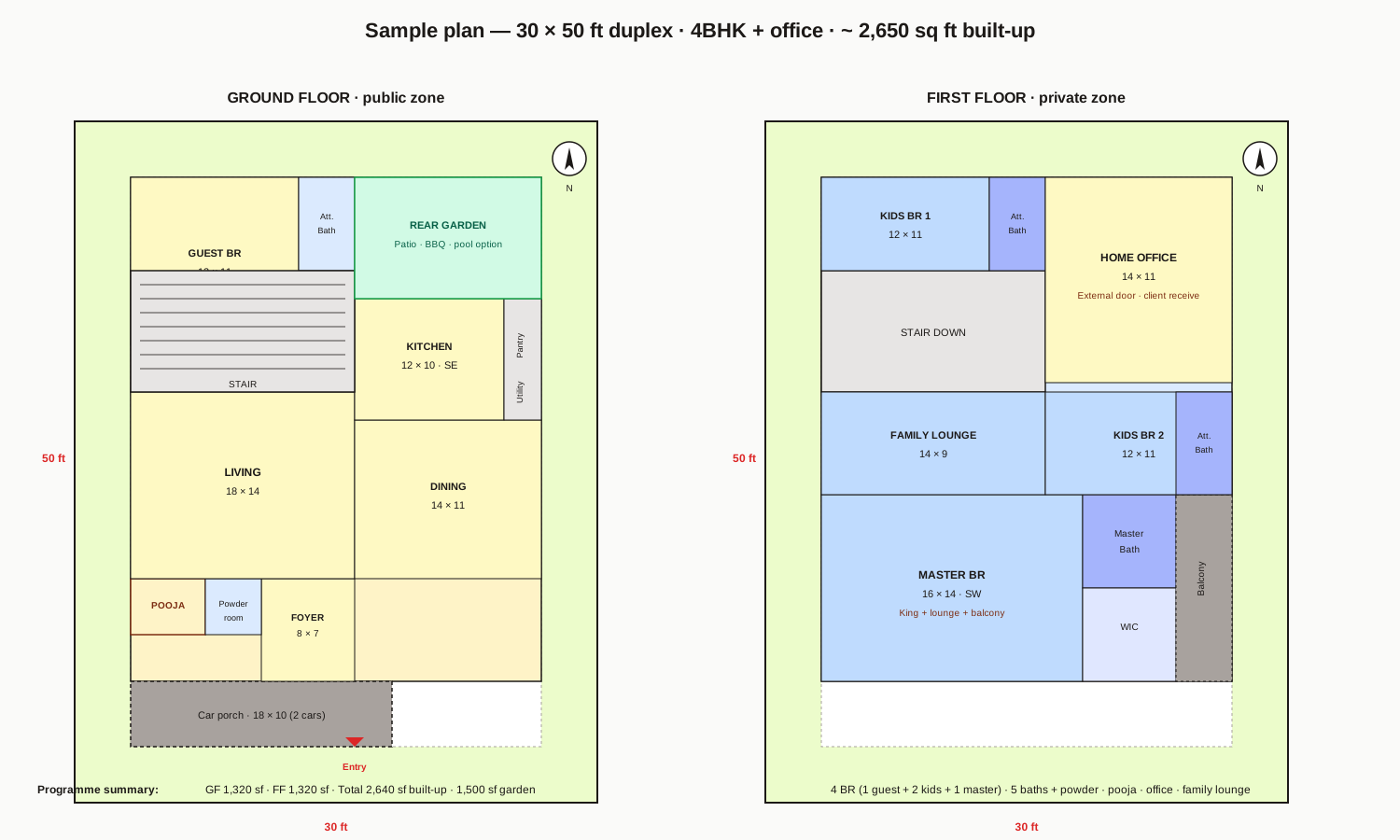
The 30 × 50 ft plot (1,500 sq ft) supports a generously proportioned 4BHK + office duplex totalling ~2,650 sft built-up. This is the comfortable plot size for joint families or for nuclear families with WFH lifestyles.
Programme Summary
- Ground floor (1,320 sft): foyer, pooja room (dedicated), powder, living, dining, kitchen with pantry/utility, guest BR with attached bath, car porch (2 cars), rear garden
- First floor (1,320 sft): master BR with attached bath/WIC/balcony, kids BR 1 with attached bath, kids BR 2 with attached bath, family lounge, home office (with external door)
- Plot: 30 × 50 ft with 1,500 sft rear garden
- Setbacks: 15 ft front, 8 ft rear, 6 ft both sides
- Stair: straight-run plus landing variant, 17 risers, oriented south-east side
- Vastu: master SW · kitchen SE · pooja NE (dedicated room not niche) · stair S/SE side
Why This Plan Works
The dedicated pooja room. On a smaller 30 × 40 plot, the pooja is a niche in the foyer. On 30 × 50, a dedicated 6 × 8 pooja room becomes feasible — significant for orthodox families.
The home office with separate entry. The first-floor office has an external door accessible via a small spiral stair from the side passage — allowing client receiving without visitors entering the family zones. Critical for architects, doctors, lawyers, and family-business owners working from home.
The rear garden. The 8 ft rear setback expands to a full 1,500 sft rear garden by setting the building 12 ft behind the front line. Pool option, BBQ, family party space.
Three attached baths upstairs. Master + 2 kids — each bedroom with its own bath. The premium-tier convention for 2026 Indian duplex work; eliminates morning bath queuing and accommodates teenage children's privacy preferences.
Cost Differential vs Plan 1
Going from 30 × 40 (Plan 1) to 30 × 50 (Plan 2) increases built-up area by 26% (2,100 → 2,650 sft) but increases shell cost by approximately 35% — due to the additional kitchen pantry, additional bathrooms, dedicated pooja, and master balcony. The marginal cost per additional sft is ~₹ 3,200–4,200, slightly above the base ₹ 2,500–3,500 rate, because the additions are room-heavy (plumbing + finishes) rather than open-area-heavy.
The Vertical Zoning Logic
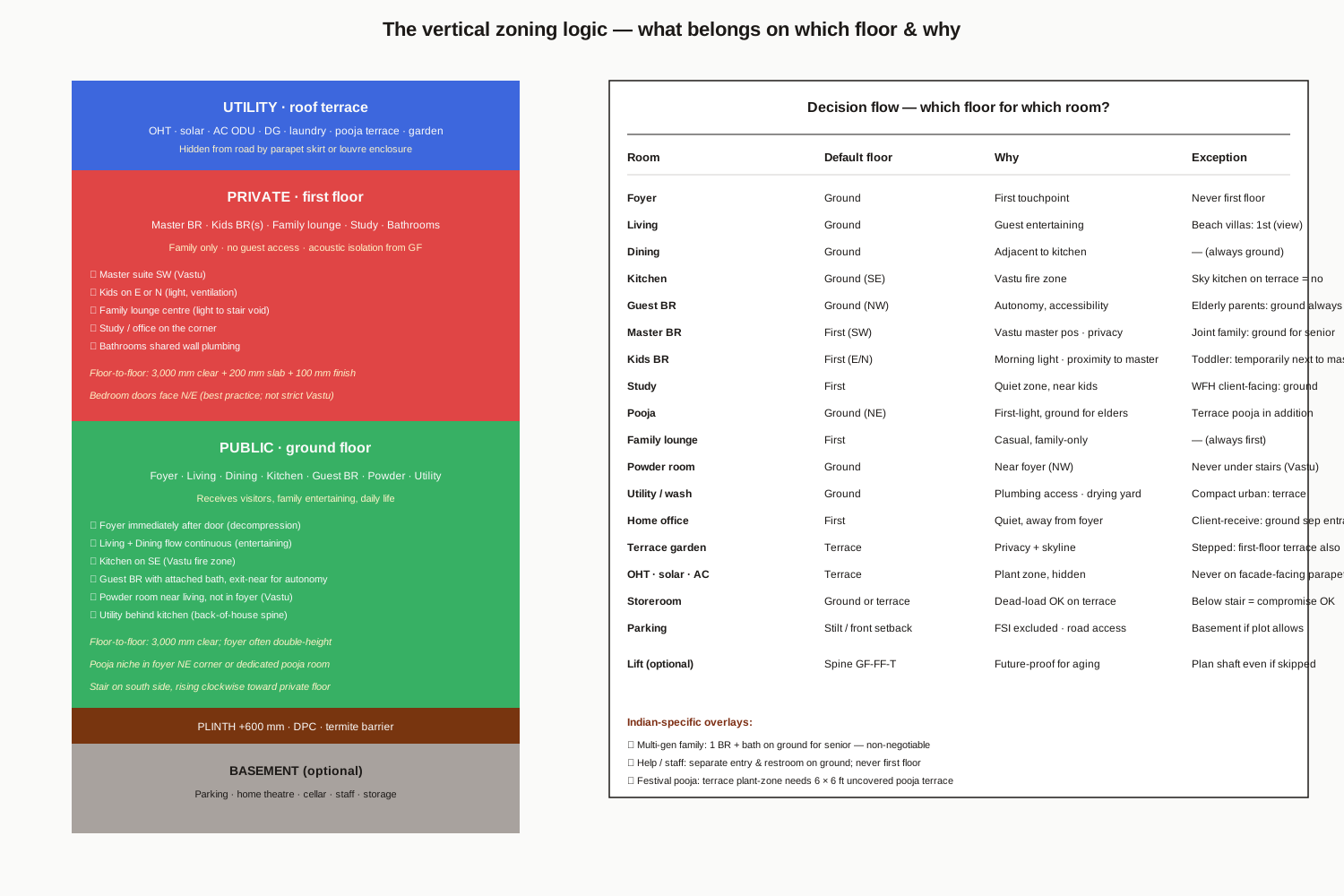
The figure above is the decision flow for every room programmed into a duplex. Use it as the working filter: for each room in the brief, ask which zone it belongs to and why.
The Three Vertical Zones
- Public (Ground): receives visitors, family entertaining, daily life — open to broader access
- Private (First): family-only, no guest access, acoustic isolation from ground
- Utility (Terrace): plant zone, service equipment, hidden from road view by parapet skirt or louvre enclosure
The Eighteen-Room Decision Table
| Room | Default floor | Why | Exception |
|---|---|---|---|
| Foyer | Ground | First touchpoint | Never first floor |
| Living | Ground | Guest entertaining | Beach villas: 1st (view) |
| Dining | Ground | Adjacent to kitchen | — (always ground) |
| Kitchen | Ground (SE) | Vastu fire zone | Sky kitchen on terrace = no |
| Guest BR | Ground (NW) | Autonomy, accessibility | Elderly parents: ground always |
| Master BR | First (SW) | Vastu master pos · privacy | Joint family: ground for senior |
| Kids BR | First (E/N) | Morning light · proximity to master | Toddler: temporarily next to master |
| Study | First | Quiet zone, near kids | WFH client-facing: ground |
| Pooja | Ground (NE) | First-light, ground for elders | Terrace pooja in addition |
| Family lounge | First | Casual, family-only | — (always first) |
| Powder room | Ground | Near foyer (NW) | Never under stairs (Vastu) |
| Utility / wash | Ground | Plumbing access · drying yard | Compact urban: terrace |
| Home office | First | Quiet, away from foyer | Client-receive: ground sep entrance |
| Terrace garden | Terrace | Privacy + skyline | Stepped: first-floor terrace also |
| OHT · solar · AC | Terrace | Plant zone, hidden | Never on facade-facing parapet |
| Storeroom | Ground or terrace | Dead-load OK on terrace | Below stair = compromise OK |
| Parking | Stilt / front setback | FSI excluded · road access | Basement if plot allows |
| Lift (optional) | Spine GF-FF-T | Future-proof for aging | Plan shaft even if skipped |
Indian-Specific Overlays
Three overlays modify the default table in ways foreign frameworks don't capture:
- Multi-generational family: 1 BR + bath on ground for senior — non-negotiable. The senior never climbs the stair daily. If the brief mentions joint family, the ground-floor bedroom is locked.
- Help / domestic staff: separate entry and restroom on ground floor; never first floor. The "back-of-house" spine — utility, staff WC, kitchen rear — runs along one wall on the ground floor.
- Festival pooja: the terrace pooja space needs to accommodate 6–8 family members during major festivals (Diwali, Ganesh Chaturthi, Navratri). Plan a 6 × 6 ft uncovered pooja terrace at the NE corner of the roof in addition to the ground-floor pooja.
These overlays differentiate Indian duplex programme from generic Western two-storey house layouts.
Vastu for Duplex — The Multi-Floor Considerations
The eight authoritative Vastu rules (covered exhaustively in Vastu House Plan — Complete Indian Layout Reference) apply to a duplex floor by floor. The Vastu Purusha Mandala overlays each floor independently. The vertical alignment across floors strengthens the reading.
Floor-by-Floor Vastu Stacking
The classic Vastu-aligned duplex has:
- Ground floor: pooja NE · kitchen SE · master SW (if senior) · entry E/N
- First floor: master SW · kids E/N · family lounge centre/W · stair-arrival landing S/W
- Terrace: OHT NE · solar S · pooja terrace NE corner · DG/AC enclosure SW
When the vertical stack respects the zones — NE pooja and OHT vertically aligned, SW master and SW stair vertically aligned, SE kitchen below an SE service zone above — the duplex reads as Vastu-coherent even to a strict consultant.
Staircase Vastu — The Six Rules
Repeated from the staircase section because it is the single most-asked Vastu question for duplex:
1. Position: S, SW, or W side of the building plan
2. Rising direction: clockwise (N → E → S → W ascending)
3. Step count: odd total risers (15, 17, 19) — never even
4. Visibility from entry: visible but not directly facing the main door
5. Brahmasthan rule: does not cross the geometric centre of the plan
6. Below-stair void: not used as toilet or kitchen; storeroom OK
A duplex with the stair in the NE corner, rising anti-clockwise, with 16 risers, and a toilet underneath — fails all five orthodox tests. Most older Indian duplex builds carry one or two violations; correcting them at the concept stage of a new build is essentially free.
Pooja Placement in a Duplex
Two common configurations:
- Single pooja, ground floor NE — the dominant pattern. One dedicated pooja room or NE niche in the foyer.
- Dual pooja — ground floor pooja + terrace pooja — for orthodox families. The ground pooja serves daily rituals (suitable for elderly); the terrace pooja serves festival rituals (when the joint family gathers).
The terrace pooja need not be enclosed — a 6 × 6 ft open platform with a small mandap/shamiana is acceptable and traditional for major festivals.
FAR, Ground Coverage, Height — Bylaw Considerations for Duplex
A duplex consumes two floors of FAR. On a typical Tier-1 plot with FAR 2.0 and ground coverage 60%, a 30 × 40 ft plot (1,200 sft) supports:
- Maximum ground coverage: 60% × (1,200 - setbacks 425) = 465 sft footprint
- Maximum FAR: 2.0 × 1,200 = 2,400 sft total built-up
- Duplex (G+1): 465 + 465 = 930 sft → uses 39% of FAR (well within limits)
Most duplex builds do not consume their full FAR — the bylaw constraint is ground coverage (footprint) rather than FAR (total built-up). This means most duplex plots could in principle add a third floor without violating FAR, but typically don't because:
- Height limit on a 30 ft road is 11.5 m — G+2 plus parapet just touches this
- Stair count grows linearly with floors — the stair real estate becomes prohibitive
- Acoustic discipline gets harder with each additional floor
The Triplex Question
If FAR allows G+2, should the build be triplex instead of duplex? The Indian market consensus is no, unless plot size constraints force it. Reasons:
- A duplex with 4–5 bedrooms over 2 floors costs less to build than a triplex with 5 bedrooms over 3 floors (the third stair flight + roof terrace re-organisation add ~₹ 15–25 L)
- Stair-fatigue grows significantly between 2 floors and 3 floors of daily climbing
- Resale value of a duplex tends to be higher per sft than equivalent triplex in most micro-markets (buyers prefer 2 floors)
The exception: dense urban Tier-1 plots (Mumbai, central Bengaluru, central Pune) where plot size is constrained to 800–1,200 sft and triplex is the only way to fit a 3BHK + utility programme. There, G+2 is necessary.
Parking
A duplex typically requires 1 to 2 covered parking spaces, depending on bylaws:
- BBMP / HMDA: 1 car per 100 sq m built-up → typically 1 car for 2BHK duplex, 2 cars for 3BHK+ duplex
- MMRDA / PMC: 1 car per 80 sq m built-up → typically 2 cars for any duplex > 2,000 sft
- DDA: similar to BBMP
Parking sits in the front setback (covered car porch) or in stilt parking (excluded from FAR in most ULBs). The car porch doubles as the porte-cochère — see Indian House Front Elevation Design for the front-of-house composition.
For the broader approval and OC process, cross-link to Building a House in India — Step-by-Step Guide.
Duplex vs Simplex — When Does Going Two-Storey Pay Off?
The owner's question early in design: "Should we build a simplex or a duplex?" The decision involves four factors.
Factor 1 — Plot Size
| Plot size | Recommendation |
|---|---|
| < 1,000 sft | Simplex (1BHK or 2BHK) — stair eats too much |
| 1,000–1,500 sft | Duplex (3BHK + study) — ideal sweet spot |
| 1,500–2,400 sft | Duplex (4BHK + office) — comfortable |
| > 2,400 sft | Either — owner preference; duplex still common |
Factor 2 — Programme
A 3BHK + utility programme on a 30 × 40 plot cannot fit on a single floor within bylaw setbacks. Once 4 bedrooms or 3 BHK + study + office is on the brief, duplex is forced.
Factor 3 — Cost
Duplex cost premium over equivalent-area simplex: roughly 8–15%, broken down as:
- Stair structure + finishes: ₹ 4–8 L
- Slab thickening for stair openings: ₹ 1–2 L
- Additional finishes on stair walls: ₹ 1–2 L
- Extra plumbing for upstairs bathrooms: ₹ 2–4 L
- Total additional: ~₹ 8–16 L on a 2,000 sft duplex
But the duplex frees up garden area (typically 30–50% more open ground for the same built-up), which improves the resale value disproportionately. The net effect is approximately revenue-neutral; the choice is therefore driven by Factor 1 (plot) and Factor 2 (programme), not by cost.
Factor 4 — Family Profile
- Nuclear young family: duplex (energetic, climbs stairs)
- Senior-led joint family: ground-floor master suite mandatory; second floor optional
- Elderly couple: simplex preferred (no stair daily)
- Multi-generational with young children: duplex with senior suite on ground
The family lifecycle drives the decision more than any single technical factor.
Eight Common Duplex Mistakes
1. Undersized Stair
The 750 mm wide stair is the most-common error. Fits the BoQ, fits the plan, fails the day the king-size mattress arrives. Fix: 900 mm minimum clear width; 1,000 mm for premium-tier duplexes.
2. Acoustic Leak Through the Slab
A 100 mm thin slab transmits footfall, voices, and music from first floor to ground floor — destroying the privacy of the upstairs bedrooms and the formality of the downstairs living. Fix: 200 mm slab + 50 mm screed + acoustic underlay + suspended ceiling with mineral wool in ground-floor public spaces.
3. Master Bedroom Above Living Room
The master bedroom sitting directly above the formal living room causes acoustic conflicts (TV downstairs, sleeping upstairs, and vice versa). Fix: master above a more-tolerant zone — dining or kitchen, not living.
4. Toilet Above Pooja
The first-floor master bathroom positioned directly above the ground-floor pooja niche/room is a major Vastu violation (and a plumbing risk: leaks soak the pooja). Fix: vertically align toilets above toilets; never above pooja.
5. Stair Landing Without Window
The mid-landing of an L-shape stair feels claustrophobic without a window. A 600 mm × 1,800 mm slot window at the landing transforms the stair experience. Fix: plan a slot window at every stair landing.
6. No Future Lift Shaft
The duplex owner at 45 years old does not plan for the lift they will want at 65. Retrofitting a lift in a built duplex costs ₹ 6–12 L plus structural surgery. Fix: plan a 1.2 × 1.4 m shaft at construction stage; close it as a storeroom; install the lift later when needed. The cost of building the shaft is ₹ 1.5 L; installing the lift later is ₹ 6–8 L. Total ₹ 8–10 L instead of ₹ 18–20 L for full retrofit.
7. Helical Stair as Primary
The visually-striking helical stair as the only stair fails the furniture-carry test on day one. Fix: helical as secondary stair only (first floor to terrace, or basement to ground); never primary.
8. No Privacy on Stair-Tower Window
The U-shape stair-tower window facing the neighbour's bedroom creates a privacy issue. Fix: slot windows above 1.8 m sill, or frosted glass, or perforated screen on the stair-tower face.
Pre-Construction Checklist for Duplex Owners
Programme & layout
- [ ] Decision logged: duplex vs simplex vs triplex (per the four-factor framework)
- [ ] Ground-floor senior suite included if multi-generational family
- [ ] Pooja location chosen — niche, dedicated room, or dedicated + terrace
- [ ] Stair typology selected from the five — straight, L, U, helical-as-secondary, scissor
- [ ] Stair Vastu rules satisfied (zone, direction, count, visibility, brahmasthan)
- [ ] Vertical zoning plan tested against the 18-room decision table
- [ ] Future lift shaft planned (even if not installed)
Engineering
- [ ] Slab thickness 200 mm minimum
- [ ] Acoustic underlay specified for first-floor finishes
- [ ] Plumbing vertical alignment (toilets above toilets)
- [ ] Structural engineer's note on stair opening in slab
- [ ] MEP coordinated (electrical load, water tank size, drainage)
Approvals
- [ ] Setbacks confirmed (15 / 8 / 6 / 6 typical)
- [ ] Ground coverage within 60% (post-setback)
- [ ] FAR within 2.0 (or local limit)
- [ ] Height within 11.5 m for 30 ft road
- [ ] Parking spaces meet bylaw count
- [ ] Rainwater harvesting pit positioned
Commercial
- [ ] BoQ matched to plot size and programme reference plan
- [ ] Stair cost line-item identified (4–8 L bracket)
- [ ] Contingency 8–10%
- [ ] Lift shaft budget reserved even if deferred
For the broader build process, cross-link to Building a House in India — Step-by-Step Guide and Indian House Front Elevation Design for the facade conversation that pairs with this duplex plan reference.
References
1. National Building Code of India (2016). NBC 2016, Part 4 (Fire and Life Safety) — including stair, headroom, riser-tread dimensions. Bureau of Indian Standards.
2. NBC 2016, Part 11. Approach to Sustainability — Residential.
3. Bureau of Indian Standards (1987). SP 41 — Handbook on Functional Requirements of Buildings. BIS.
4. Council of Architecture (2020). Architectural Practice Bylaws — Revised. New Delhi: CoA.
5. BBMP Revised Bye-Laws (2024). Building Bye-Laws — Residential. Bengaluru Mahanagara Palike.
6. HMDA (2023). Hyderabad Metropolitan Development Authority — Development Control Rules.
7. MMRDA / MCGM (2023). Development Control and Promotion Regulations, Greater Mumbai.
8. DDA (2021). Master Plan for Delhi — 2041 (Draft). Delhi Development Authority.
9. Acharya, P.K. (1933-46). Manasara on Architecture and Sculpture — Sanskrit text with English translation, 7 volumes. Oxford University Press. (Stair Vastu rules.)
10. Pandya, Y. (2014). The Grammar of Hindu Architecture. Mapin Publishing.
11. Krishan, A. (2017). Climate Responsive Architecture. TERI Press. (Acoustic and thermal considerations for multi-floor residential.)
12. JLL India (2025). Residential Format Mix — Tier-1 and Tier-2 Indian Cities.
Author's note: A duplex in 2026 India is the dominant new-build residential format for plot sizes 1,000–2,400 sft, and increasingly the default brief for younger nuclear families. It earns this position because it accommodates a 3–4 bedroom programme on a plot small enough to be acquired within middle-class affordability, while preserving a respectable rear garden and a private terrace. The design discipline is harder than a simplex — three vertical zones to keep separate, a stair to position correctly for Vastu and ergonomics, slab acoustics to manage, vertical plumbing alignment to maintain, future lift accommodation to plan. Done well, the result is a house that ages with the family — adapting from young-couple to family-with-kids to empty-nest to elderly-with-lift over a 50-year lifecycle. Done badly, it becomes an inconvenient two-floor walk-up that the owners are eager to leave by year 12.
Disclaimer: Bylaw figures cited reflect 2023-24 ULB regulations; verify against your local municipal byelaws before design freeze. Cost ranges are 2025-26 indicative for Tier-1 and Tier-2 Indian cities and vary by micro-market and procurement channel. Vastu rules follow the framework in Vastu House Plan — Complete Indian Layout Reference; regional practitioner schools may apply additional rules consistent with their tradition. Stair dimensions cited follow NBC 2016, Part 4 — verify against local fire code amendments. The reference plans (30 × 40 and 30 × 50) are illustrative layouts demonstrating principles, not site-specific designs — every duplex must be designed by a licensed architect for its specific plot, brief, and soil conditions. Studio Matrx, its authors and contributors accept no liability for decisions made on the basis of this guide; engage a licensed architect, structural engineer, MEP consultant, and (if orthodox) a qualified Vastu consultant from your family's tradition for site-specific application.
Interactive · Size your plot
30×40 ft plot · G+1
Floors
Usable carpet area (all floors)
1,152 sqft
Comfortably supports 3 BHK.
Filled bars = configurations your carpet area can support.
Rough massing estimate. Real buildable area is set by your local setbacks, FSI/FAR limit and byelaws — always confirm against the sanctioned plan. See the FSI/FAR and setback guides.
Export this guide
Related Guides — Deep-dive reading
How to Plan a Home for Multi-Generational Living
Designing for grandparents, parents and children under one roof — privacy, accessibility and harmony
Home PlanningEast-Facing House Plan — Complete Guide for India
Vastu Logic, Sun-Path, Room-Direction Matrix & Reference Plans for the Most-Asked Orientation in Indian Homes
Room PlanningDesigning Adaptable & Universal-Design Homes
Accessibility, Aging-in-Place, and the Multi-Stage Family — Code, Anthropometrics, and Plan-Stage Discipline for Indian Residential Architects
Room PlanningRelated Tools — Try Free
Cross-Ventilation Analyzer
Estimate airflow and air changes per hour (ACH) from room size, window areas, layout, and local wind — with NBC 2016 Part 8 compliance check.
Ventilation CalculatorBrise-Soleil Visualizer
Interactive horizontal-louvre cut-off angle calculator — sun altitude, louvre depth, and spacing inputs with a live shadow preview. Computes θ = arctan(spacing/depth) for façade shading, ECBC envelope compliance, hospital daylight design, and tropical sun-control detailing.
Sun Shading ToolRainwater Tank Sizer
How big should your rainwater tank be? Computes annual harvest, recommended tank capacity in litres, water-bill savings, and payback — for 10 Indian cities.
RWH Calculator