
Residential Elevator Buyer's Guide (India 2026): Types, Cost, Sizing, Regulation & How to Choose
Everything an Indian homeowner needs to choose, size, budget, license and maintain a home lift the right way.
A home lift used to be a status symbol. In 2026 it is increasingly a practical fixture in Indian houses — for ageing parents who can no longer manage stairs, for narrow G+2 and G+3 plots where living space is stacked vertically, and for families who simply want their home to stay liveable for the next forty years. Prices have fallen, retrofit-friendly types now exist, and a handful of strong India-grown brands compete with the global majors.
But a lift is also a permanent piece of building services. Get the shaft, the pit, the doors, the power backup or the maintenance contract wrong and you are living with the mistake — and the cost — for a very long time. This pillar guide walks the entire decision journey: whether you need a lift at all, the four lift types and which suits a 2–4 floor Indian home, the space and sizing it demands, what it costs, the regulatory and licensing path, the safety must-haves, accessibility basics, the maintenance contract, the step-by-step buying process, and the mistakes that catch first-time buyers.
Every regulatory and price figure in this guide is indicative — lifts are state-regulated and bye-laws vary. Always confirm against your local municipal bye-laws and a licensed lift contractor before you commit.
1. Do You Actually Need a Lift — and When Is It Worth It?
Start with the honest question, because a lift is a six-to-thirty-lakh decision plus annual maintenance for life. A home lift earns its keep when one or more of these is true:
- You have ageing parents or a family member with mobility limits. Stairs are the single biggest reason older Indians end up confined to one floor of their own home. A lift restores the whole house to them.
- Your home is genuinely vertical — a G+2 or G+3 on a small urban plot where bedrooms, kitchen and living are on different levels and you climb several times a day.
- You are building or doing a major renovation now. Adding a lift during construction is dramatically cheaper and cleaner than retrofitting later. Even if you do not install today, leaving a "lift-ready" provision is cheap insurance — see our lift-ready future-proofing guide.
- You intend to age in place. If the plan is to stay in this house into your seventies and eighties, the lift is part of a broader accessible-home design and future-proofing strategy, not a luxury.
A lift is harder to justify for a simple G+1 with occupants in good health, or where a well-designed stair plus a ground-floor bedroom solves the same problem for a fraction of the cost. If you are genuinely unsure, work through our home-lift planning questionnaire — it turns the "do I need one" question into a structured score.
Rule of thumb: if anyone in the household struggles with stairs today, or plausibly will within ten years, and the home is two floors or more, a lift is worth costing properly rather than dismissing.
2. The Lift Types Explained
There are four lift technologies sold into Indian homes. They differ in how they move the car, how much building work they need, how easily they retrofit, and what they cost.
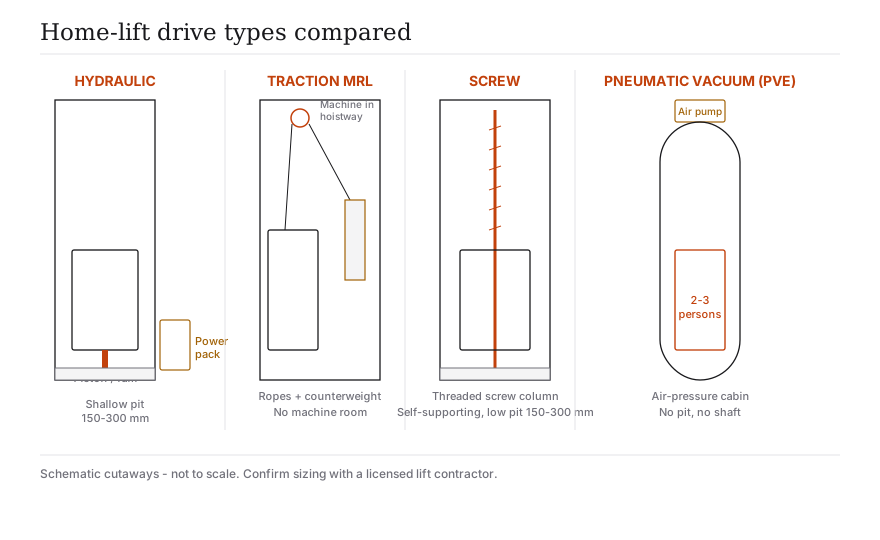
Hydraulic. A piston (ram) pushes the car up; it lowers under controlled release. Smooth, quiet and well-suited to low-rise homes of 2–4 floors. The pit is shallow (≈150–300 mm) and the power pack can sit in a small adjacent cabinet rather than a full machine room. It is slower than traction and has oil/temperature considerations, but it is cost-effective and forgiving. Indicative: ₹8–20 lakh.
Traction (geared / gearless), usually MRL. Steel ropes run over a sheave with a counterweight. The 2026 norm for homes is machine-room-less (MRL) — the machine sits inside the hoistway, so there is no separate machine room to find space for. Traction is energy-efficient, faster and very smooth, but needs a little more pit and headroom than hydraulic. Indicative: ₹10–25 lakh+.
Screw / winding-drum. The car climbs a threaded screw column and is self-supporting, so it needs only a low pit (≈150–300 mm), little headroom and minimal maintenance. It is compact and a popular dedicated home-lift format. Indicative: ₹14–30 lakh.
Pneumatic Vacuum Elevator (PVE). Air-pressure difference lifts a panoramic cylindrical cabin; it descends by controlled gravity. Crucially it needs no pit, no shaft and no machine room and is self-supporting — which makes it the easiest type to retrofit into an existing home. The trade-offs are limited capacity (≈2–3 persons) and travel, and higher power draw on the way up. The look is a striking glass tube. Nibav is the best-known India-grown PVE brand. Indicative: ₹11–22 lakh.
| Type | How it moves | Pit / shaft demand | Retrofit ease | Capacity | Indicative cost | Best for |
|---|---|---|---|---|---|---|
| Hydraulic | Piston/ram | Shallow pit ≈150–300 mm; small adjacent power pack | Moderate | 2–8 persons | ₹8–20 lakh | Budget-friendly 2–4 floor homes |
| Traction MRL | Ropes + counterweight, machine in hoistway | More pit + headroom; no machine room | Moderate | 2–8 persons | ₹10–25 lakh+ | Frequent use, energy efficiency, taller homes |
| Screw | Threaded screw column, self-supporting | Low pit ≈150–300 mm; low headroom | Good | 2–6 persons | ₹14–30 lakh | Compact, low-maintenance dedicated home lift |
| Pneumatic vacuum (PVE) | Air-pressure differential | None — no pit/shaft/machine room | Easiest | 2–3 persons | ₹11–22 lakh | Retrofit into a finished house; panoramic look |
Which suits a 2–4 floor Indian home? For most new builds of 2–4 floors with regular family use, hydraulic or traction MRL is the workhorse choice — hydraulic if budget and simplicity lead, MRL if you value efficiency and a smoother ride and can give it the pit/headroom. Screw is excellent where you want a compact, low-maintenance dedicated lift. PVE wins when the house is already built and you cannot dig a pit or build a shaft — accepting the lower capacity. Match drive type to your space and use pattern before you fall in love with a brand; the vendor comparison guide helps you weigh brands once the type is settled.
3. Sizing and Space
The most expensive mistakes are made here, before a single rupee is spent on the lift itself, because shaft and pit dimensions are baked into the building. Five numbers govern the design: shaft (hoistway), pit depth, headroom (overhead), car capacity, and door type.
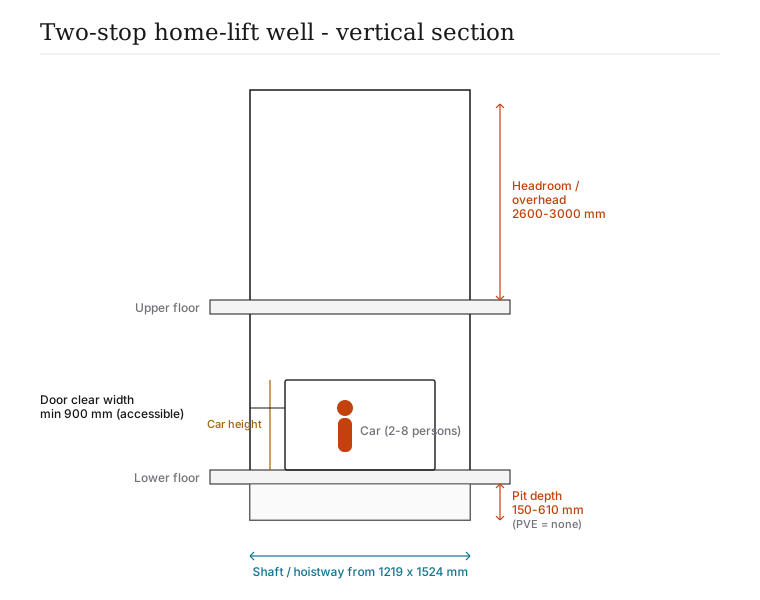
- Shaft / hoistway. A small home car starts from about 1219 × 1524 mm (4' × 5') and grows with capacity and door type. The structural opening must be planned with your architect — see the architect's residential-elevator handbook.
- Pit depth. Hydraulic and screw need only ≈150–300 mm; traction needs ≈300–610 mm, and some modern gearless installs want 1200–1500 mm. Pitless / low-pit options and PVE (no pit at all) exist for retrofits where you cannot dig.
- Headroom / overhead. Typically ≈2600–3000 mm. MRL removes the old machine-room-on-top requirement, which is why it suits Indian terraces.
- Car capacity. Home range ≈2–8 persons; a 2-person car carries about 150–204 kg. Size for a wheelchair plus attendant if accessibility matters (Section 7).
- Doors. Manual swing doors are cheapest but not wheelchair-friendly; automatic telescopic/sliding doors are smoother, safer and accessible. For an accessible home, insist on automatic doors.
| Parameter | Hydraulic | Traction MRL | Screw | PVE |
|---|---|---|---|---|
| Pit depth | ≈150–300 mm | ≈300–610 mm (up to 1200–1500 mm gearless) | ≈150–300 mm | None |
| Headroom | ≈2600–3000 mm | ≈2600–3000 mm | Low | Self-contained tube |
| Shaft (small car) | from ≈1219 × 1524 mm | from ≈1219 × 1524 mm | Compact | Cylinder, no shaft |
| Capacity | 2–8 persons | 2–8 persons | 2–6 persons | 2–3 persons |
| Door options | Manual or automatic | Manual or automatic | Automatic | Automatic |
Capture every one of these figures on paper before you sign — our planning checklist and the more technical specification checklist exist precisely so nothing in this list is left to "we'll sort it on site."
4. Cost Overview
Budget for the lift in three layers: the lift equipment, the civil work (shaft, pit, electricals) and installation — which are usually quoted separately — plus 18% GST. Then add the recurring AMC (Section 9). The figures below are indicative for India in 2026; for the full breakdown including civil and running costs see the dedicated home-lift cost guide.
| Cost driver | Indicative figure (₹) | Notes |
|---|---|---|
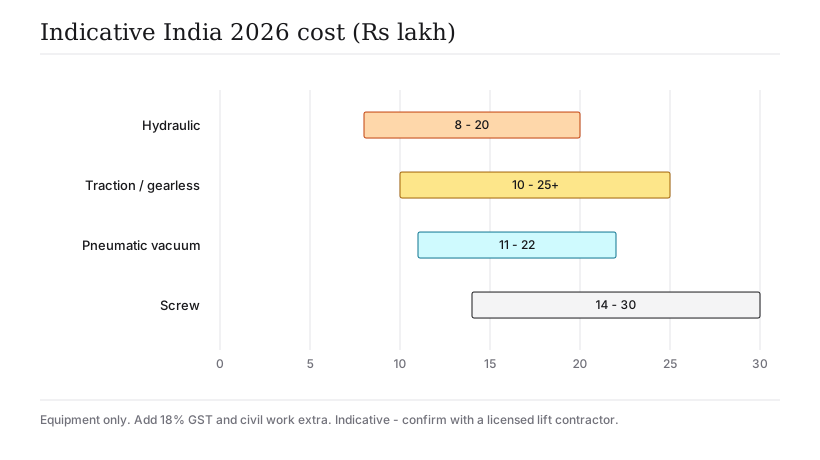
| Hydraulic | 8–20 lakh | Most budget-friendly |
| Traction / gearless | 10–25 lakh+ | Efficiency, smoother ride |
| Pneumatic vacuum (PVE) | 11–22 lakh | Higher ascent power draw |
| Screw-driven | 14–30 lakh | Low maintenance |
| 2-floor / G+1 | ≈11.99–18 lakh | Rises with each added floor |
| 2-person car | ≈11–22 lakh | Typical small-home car |
| GST | 18% | Applies on top |
| Civil work + installation | Extra | Usually not in the headline quote |
The headline brochure price is rarely the price you pay. Always get the quote broken into equipment, civil work, installation, GST and first-year AMC — a tactic the cost guide and vendor comparison both insist on.
5. Regulation and Approvals — the Homeowner's Path
Two things are true at once in India: there is a clear national technical framework, and the licensing is state-by-state. You need to understand both.
The standards. The technical bible is IS 14665 — Electric Traction Lifts (BIS), aligned to the European EN 81 family. Its parts cover outline dimensions (Part 1: car, well, pit, headroom, doors), installation and maintenance code of practice (Part 2), safety rules (Part 3), components such as buffers, guide rails and safety gears (Part 4) and an inspection manual (Part 5). Hydraulic lifts have a companion code, IS 15259. At building level, NBC 2016, Part 8 (Building Services), Section 5 — Installation of Lifts, Escalators and Moving Walks governs when and how many lifts are required. Common (state-varying) triggers: a lift is generally expected once building height exceeds ~13 m, with a ≥6-person lift from ground as the usual baseline; a fireman's lift (≈8 persons / 544 kg, car ≈1100 × 1400 mm to take a stretcher, serving the full height) is generally required above 15 m — some residential rules set 30 m.
The licence path. Lifts are state-regulated, and roughly ten states issue lift licences: Maharashtra, Gujarat, Karnataka, Kerala, Tamil Nadu, Assam, West Bengal, Delhi, Haryana and Himachal Pradesh. Each has its own Act — for example the Maharashtra Lifts, Escalators & Moving Walks Act, 2017; the Karnataka Lifts, Escalators & Passenger Conveyors Act, 2015; the Delhi Lifts & Escalators Act, 2007; and the Tamil Nadu Lifts Act, 1997. In these states a homeowner typically faces three obligations:
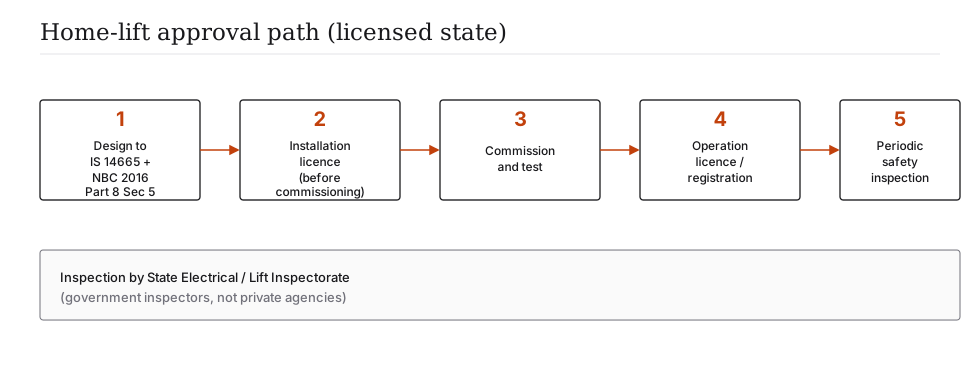
1. Installation licence — obtained before commissioning the lift.
2. Operation licence / registration — to legally run the lift once installed.
3. Periodic safety inspection — by the State Electrical / Lift Inspectorate, i.e. government-appointed inspectors, not private companies.
In states without a Lift Act, registration may not be mandated — but IS 14665 and NBC 2016 remain the right best-practice benchmark, and a reputable vendor will install to them anyway. Confirm your exact obligations with your local municipal bye-laws and your licensed contractor before commissioning. The planning checklist carries the approvals as line items so they are not forgotten until the inspector arrives.
6. Safety Must-Haves (Including ARD)
Never let a vendor "value-engineer" safety out of the quote to hit a price. At minimum, insist on:
- Overspeed governor + safety gear — grips the rails if the car descends too fast.
- Door sensors / light curtain — stops doors closing on a person or a wheelchair.
- ARD (Automatic Rescue Device) — a battery that brings the car to the nearest floor and opens the doors on a power cut. Given Indian power outages this is essential — do not buy a lift without it.
- Emergency alarm + intercom, manual lowering, and an overload sensor.
- Fireman's switch on taller installations as required by NBC.
If the household includes children or older adults, the ARD and the light-curtain doors are not optional extras — they are the difference between an inconvenience and a trapped, frightened relative during a routine power cut.
7. Accessibility Basics
If the lift exists partly to serve someone with mobility limits, size and specify it as an accessible lift from day one — retrofitting accessibility is far harder than building it in. The benchmark is the CPWD / MoHUA Harmonised Guidelines & Space Standards for a Barrier-Free Built Environment (2016; Harmonised Guidelines 2021), which operationalise the RPwD Act 2016. The Act legally binds public buildings (Sections 40, 44 and 45); private homes are not legally compelled, but the standards are exactly the right target. Accessible-lift essentials:
- Door clear width ≥ 900 mm and a car large enough for a wheelchair plus attendant — about 1100 × 1400 mm minimum for a home.
- A handrail ≥ 600 mm long, mounted 800–1000 mm above floor, near the control panel.
- A lift lobby of about 1800 × 1800 mm inside the home.
- Automatic door closing time ≥ 5 seconds.
- Braille / tactile buttons, audio + visual floor indicators, and a mirror on the rear wall so a wheelchair user can reverse out.
These dovetail with the wider accessible-home design guide and the professional universal-design and adaptable-homes reference. Specify the lift as one component of a barrier-free home, not in isolation.
8. AMC — Maintenance Over the Lift's Life
A lift is mechanical and must be maintained for its entire life; the AMC is therefore part of the true cost of ownership, not an afterthought. There are two contract shapes:
- Non-comprehensive (semi): covers routine inspection, lubrication, adjustment and labour. Major parts (motor, controller, etc.) are billed separately — so a big failure is a big surprise bill.
- Comprehensive ("bumper-to-bumper"): includes most spare parts and major repairs. It costs roughly 60–70% more than non-comprehensive but caps the surprise bills.
A standard service is about 12 monthly preventive visits a year plus emergency breakdown calls. Indicative cost for a small residential lift is ₹20,000–38,500 per year (one example contract runs ₹38,500 with ~5% annual escalation). Read the fine print: even "comprehensive" contracts commonly exclude acts of God (pit flooding), vandalism and aesthetic modernisation, and some exclude the motor, controller, machine, pulley or rope. Choosing and comparing AMCs is a guide in itself — the AMC evaluation guide shows you how to read a contract clause by clause.
9. The Step-by-Step Buying Process
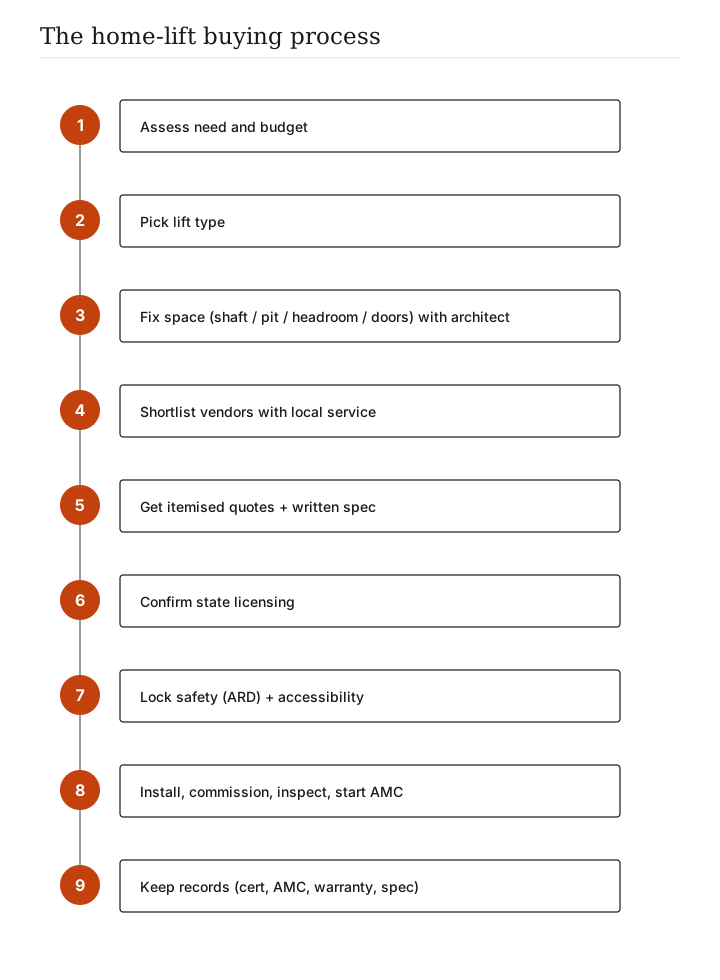
1. Assess the need and budget. Decide whether a lift is justified and set a realistic all-in budget including civil work, GST and AMC. Use the questionnaire.
2. Pick the lift type to suit your floors, use pattern and whether it is a new build or retrofit (Section 2).
3. Fix the space — shaft, pit, headroom, car size and door type — with your architect (Section 3 and the architect handbook).
4. Shortlist vendors with a local service presence; compare them using the vendor comparison guide.
5. Get itemised quotes — equipment, civil, installation, GST, first-year AMC — and a written specification (the specification checklist).
6. Confirm regulatory obligations — installation licence, operation licence/registration, inspection — for your state (Section 5).
7. Lock safety and accessibility features in writing: ARD, light-curtain doors, governor/safety gear, and accessibility specs if needed (Sections 6–7).
8. Sign, install, commission and inspect, obtain the operation licence, and start the AMC.
9. Keep records — the inspection certificate, AMC, warranty and the spec sheet — for resale and future service.
Run the entire process against the planning checklist so each step has a tick beside it.
10. Common Mistakes to Avoid
- Undersizing the shaft — then discovering the car you want will not fit.
- Ignoring pit and headroom until the structure is poured.
- No power backup (ARD) — a guaranteed problem in India's grid.
- A weak AMC or no local service — a lift with a three-day response time is a liability.
- Manual doors that block wheelchairs — false economy if accessibility is the point.
- Skipping the state licence / registration — illegal in licensed states and a resale headache.
- No future-proofing or accessibility provision — even if you do not install today, leave the lift-ready provision.
The cheapest lift you can buy is the right-sized, fully-specified, properly-maintained one you only buy once. Spend the planning effort up front — it is far cheaper than fixing concrete later.
References
- IS 14665 — Electric Traction Lifts (Bureau of Indian Standards) — Part 1 (outline dimensions) and Part 2 (installation, operation & maintenance code of practice).
- IS 15259 — Hydraulic Lifts (companion code, by name).
- National Building Code of India 2016, Part 8 (Building Services), Section 5 — Installation of Lifts, Escalators and Moving Walks (BIS).
- Rights of Persons with Disabilities (RPwD) Act 2016 — Sections 40, 44 and 45.
- CPWD / MoHUA Harmonised Guidelines & Space Standards for a Barrier-Free Built Environment (2016; Harmonised Guidelines 2021).
- State Lift Acts — Maharashtra (2017), Karnataka (2015), Delhi (2007), Tamil Nadu (1997).
URLs:
- IS 14665 Part 1 (BIS): https://law.resource.org/pub/in/bis/S05/is.14665.1.2000.pdf
- IS 14665 Part 2 (BIS): https://law.resource.org/pub/in/bis/S05/is.14665.2.1-2.2000.pdf
- BIS National Building Code 2016: https://www.bis.gov.in/standards/technical-department/national-building-code/
- BIS Guide for Using NBC 2016: https://www.bis.gov.in/wp-content/uploads/2022/08/Booklet-Guide-for-Using-NBC-2016.pdf
- RPwD Act 2016 (full text, Odisha SSEPD): https://ssepd.odisha.gov.in/sites/default/files/2024-01/RPWD%20ACT.pdf
- DEPwD (Dept of Empowerment of Persons with Disabilities): https://depwd.gov.in/en/faqs-4/
- CPWD Harmonised Guidelines: https://www.cpwd.gov.in/Publication/Harmonisedguidelinesdreleasedon23rdMarch2016.pdf
- Lift regulations in India (99acres): https://www.99acres.com/articles/know-all-about-the-lift-regulations-in-india.html
- Maharashtra licence to operate lift (National Govt Services Portal): https://services.india.gov.in/service/detail/maharashtra-license-to-operate-lift
Export this guide
Related Guides — Deep-dive reading
Home Lift Planning Checklist (India): Everything to Decide Before You Buy
A printable, ten-stage checklist that takes you from the first family conversation to a signed handover.
Home Lifts & AccessibilityHow Home Lifts Work (India): Hydraulic, Traction, Screw and Vacuum Explained
A plain-language look inside the four drive types that lift a home elevator, plus the core components and safety systems every homeowner should be able to name.
Home Lifts & AccessibilityDesigning Adaptable & Universal-Design Homes
Accessibility, Aging-in-Place, and the Multi-Stage Family — Code, Anthropometrics, and Plan-Stage Discipline for Indian Residential Architects
Room PlanningRelated Tools — Try Free
Home Lift Cost Calculator
All-in home lift cost by floors, type, capacity and city — equipment, civil, GST and AMC, with a drive-type comparison.
Lift CalculatorHome Lift Comparison Tool
Compare hydraulic, traction, pneumatic vacuum and screw lifts side by side for your home.
Lift ComparisonElevator Capacity Calculator
Pick the right home-lift capacity — 2 to 8 person — with car size and wheelchair fit.
Lift Calculator