
Building Codes for Residential Elevators (India): NBC 2016 and Local Bye-Laws
How NBC 2016 Part 8 Section 5 and your municipal building bye-laws decide when a home lift is required, where its shaft goes, and how it must be built and fire-protected.
When you decide to put a lift in your home, three different rulebooks quietly come into play, and homeowners routinely confuse them. The building codes — the National Building Code (NBC) 2016 and your city's municipal building bye-laws — decide when a lift is required, where its shaft sits in the building, and how that shaft is built and fire-protected. A separate Indian Standard, IS 17900, governs the lift machine itself. And your state's Lift Act governs licensing the lift to run. This guide is the building-code lens: what NBC 2016 and your local bye-laws say about a residential elevator, and how those rules slot together with the other two layers.
All triggers, heights and dimensions here are indicative. NBC is a national code; the numbers that legally bind you are in your municipal building bye-laws / development-control rules, which vary city to city and are checked at building-plan approval. Always confirm the current rule with your municipal corporation, BIS, your State Lift Inspectorate and a licensed lift contractor.
The three layers: who governs what
This is the single most useful thing to understand before you read another word. A home lift in India is not regulated by one law — it sits at the intersection of three:
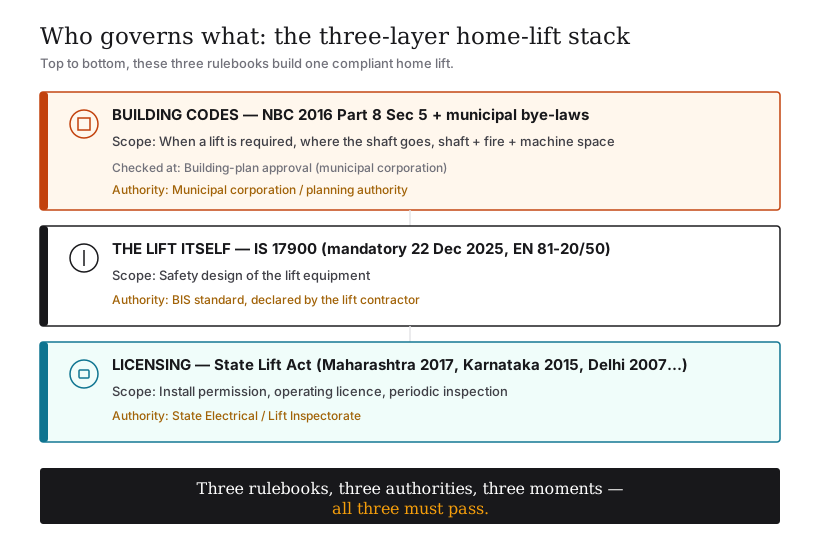
| Layer | Instrument | Governs | Where it bites | This guide |
|---|---|---|---|---|
| Building | NBC 2016 Part 8 Section 5 + municipal building bye-laws / DCR | When a lift is required, where the shaft goes, shaft/structural/fire provisions, machine space, ventilation | At building-plan approval by the municipal corporation | Yes — this is the focus |
| The lift itself | IS 17900 (BIS, mandatory since 22 Dec 2025; EN 81-20/50 based) | Safety design and construction of the lift equipment | At vendor manufacture, installation and inspection | See Residential Elevator Standards (India) |
| Licensing | State Lift Act (Maharashtra 2017, Karnataka 2015, Delhi 2007, Tamil Nadu 1997, etc.) | Installation permission, operating licence/registration, periodic inspection | At the State Lift / Electrical Inspectorate | See Home Lift Approvals and Regulations (India) |
In one sentence: building codes decide whether and where you build a lift shaft; IS 17900 decides how the lift inside it is made; the Lift Act decides whether you may switch it on. They are designed to work together, but they are issued by different authorities and checked at different moments. Miss any one and your lift is non-compliant even if the other two are perfect.
This guide stays in the first lane. For the lift-equipment standard read the standards guide; for the licensing workflow read the approvals guide; for the safety features a homeowner should verify read Lift Safety Standards for Homeowners.
NBC 2016 Part 8 Section 5: what it is and what it covers
The National Building Code of India 2016 is published by the Bureau of Indian Standards (BIS). Part 8 deals with Building Services; Section 5 is titled "Installation of Lifts, Escalators and Moving Walks." It is the building-side rulebook for vertical transport: it tells the building designer when a lift is needed, how to calculate the number and size of lifts from occupancy and traffic, and how the shaft, machine space, lobbies and fire provisions must be detailed.
The crucial legal nuance: NBC is a recommendatory code, not a self-executing law. It becomes mandatory only where a state or municipal authority adopts it into its building bye-laws or development-control regulations (DCR). Most Indian cities have done exactly that — wholly or in part — so in practice the NBC's lift provisions reach you through your municipal building bye-laws, and they are enforced at building-plan approval. If your sanctioned plan does not satisfy the lift, shaft and fire provisions your bye-laws import from NBC, your plan is not approved.
For a private home, the architect's regulatory treatment of all this is covered in depth in the Architect's Residential Elevator Handbook — this guide gives the homeowner the working summary.
When is a lift required?
For most independent houses (G+1, G+2) a lift is a choice, not a code requirement. The NBC/bye-law triggers bite as the building gets taller — which matters for the duplexes, stilt-plus-multiple-floor homes and small apartment blocks many families now build.
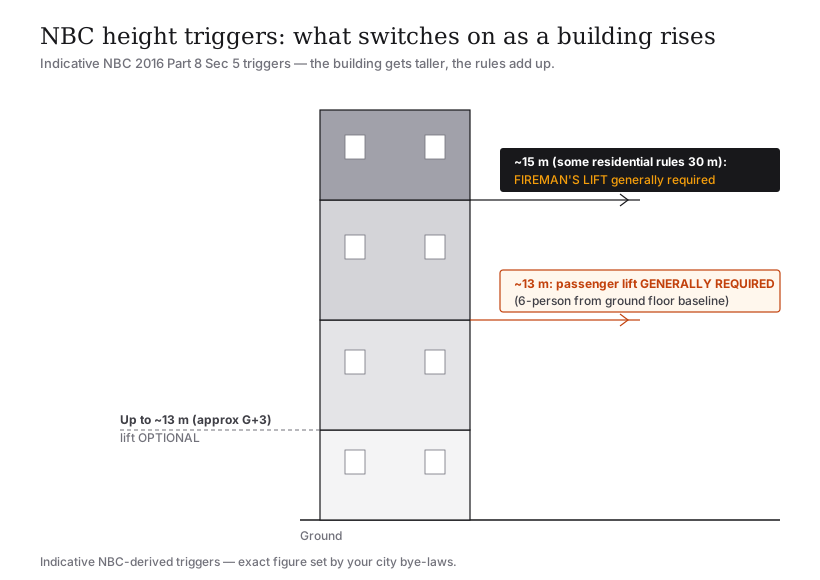
| Building height (indicative) | What the code generally expects | Notes |
|---|---|---|
| Up to ~13 m (roughly G+3) | Lift usually optional | Owner's choice; accessibility still good practice |
| Above ~13 m | A passenger lift generally required; a 6-person lift from the ground floor is the usual baseline | Number and size computed from occupancy/traffic per NBC + the equipment standard |
| Above ~15 m (some residential rules set 30 m) | A fireman's lift generally required, in addition to passenger lifts | The high-rise/fire-safety threshold; see below |
These heights are the commonly cited NBC-derived triggers. The exact number that binds you — and how "height" is measured — is set by your city's bye-laws, and thresholds genuinely differ between municipalities. Treat ~13 m and ~15 m as planning rules of thumb, then verify the figure for your plot with your municipal corporation before you finalise the design.
The number of lifts is not a single fixed rule either — NBC, read with the lift-equipment standard, computes it from the building's occupancy and expected traffic (number of dwelling units, floors, peak demand). For a single home this almost always resolves to one lift; the calculation matters more for apartment blocks.
The fireman's lift
Once a building crosses the high-rise threshold (commonly above 15 m, with some residential bye-laws using 30 m), the code requires a fireman's lift — a designated lift that firefighters can commandeer to reach upper floors and evacuate people, including on a stretcher.
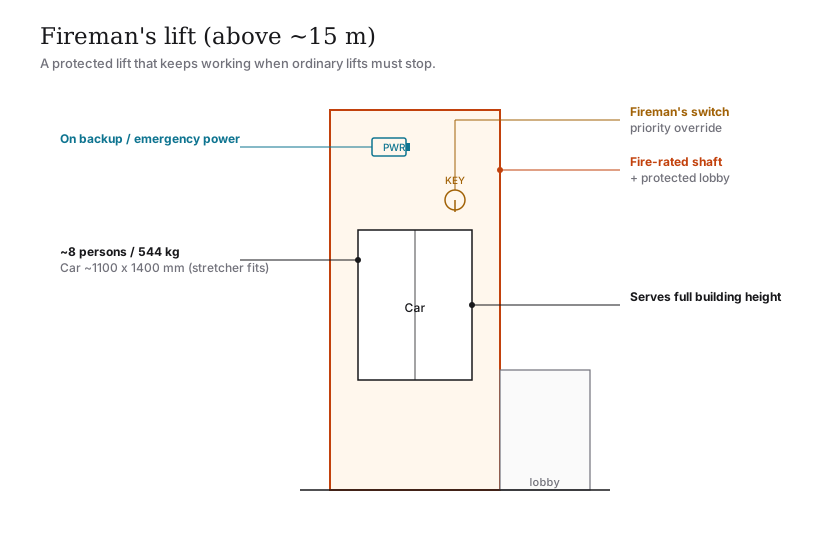
The commonly cited NBC specification for a fireman's lift:
| Provision | Requirement (indicative) |
|---|---|
| Minimum capacity | About 8 persons / 544 kg |
| Minimum car size | About 1100 mm x 1400 mm — sized so a stretcher fits |
| Travel | Must serve the full building height (lowest to topmost floor) |
| Power | On backup / emergency power supply so it works during a fire or outage |
| Control | A fireman's switch / override giving firefighters priority control |
| Enclosure | Fire-rated shaft and lobby (see fire-compartmentation below) |
For most private homes you will never hit the fireman's-lift threshold — it is a high-rise apartment provision. But if you are building a tall individual home or a small residential block, this is one of the first things plan approval will check. The deeper fire-engineering of refuge areas, pressurisation and fire lifts is covered in the fire-safety-planning guide rather than repeated here.
Shaft, structure, fire-compartmentation, machine space and ventilation
Beyond "is a lift required," NBC Part 8 Section 5 and your bye-laws set out how the lift is built into the building fabric. These are the provisions your structural engineer and architect design to, and your plan must reflect them.
- Shaft / hoistway (the well). The vertical enclosure must be sized for the chosen car and door type and built true and plumb. Small home-car shafts start from roughly 1219 x 1524 mm (4' x 5') and grow with capacity. The shaft must be a continuous fire-resisting enclosure — it cannot double as a duct for other services, and openings (landing doors) are the only permitted penetrations.
- Structural provisions. The shaft walls and the pit and overhead must carry the lift's static and dynamic loads, guide-rail reactions and buffer impact loads. The pit floor and the machine/overhead support are designed for these forces — this is why a lift cannot simply be "added later" without structural input.
- Fire compartmentation. The lift shaft is a vertical opening through every floor, so the code treats it as a fire-safety risk to be compartmentalised: fire-rated shaft enclosure, fire-rated landing doors, and (above the high-rise threshold) a protected/pressurised lift lobby so smoke does not travel floor to floor through the well.
- Machine space. Traditional lifts needed a separate machine room; modern machine-room-less (MRL) lifts place the machine inside the hoistway, which is now the residential norm and changes the headroom and space the bye-laws expect. The code still requires safe access to, and adequate space and clearances around, whatever machine space the design uses.
- Ventilation. The shaft (and any machine space) must be ventilated — both for equipment heat and, in a fire, to vent smoke — typically via openings at the top of the well.
- Pit and headroom. The code requires a safe pit below the lowest floor and overhead/headroom above the top floor, sized to the lift type. (Hydraulic and screw lifts need shallow pits; some gearless designs need more.)
The point for a homeowner: these are design-stage decisions. Choosing the lift type, location and shaft size after the structure is built is the most expensive mistake you can make. The structural detail of shafts and pits is treated more fully in the structural guide and the Architect's Handbook; the Lift Specification Checklist helps you nail the dimensions before you commit.
How the bye-laws bite: at building-plan approval
Here is the practical mechanism. NBC's lift provisions reach you through your municipal building bye-laws, and the test moment is plan sanction.
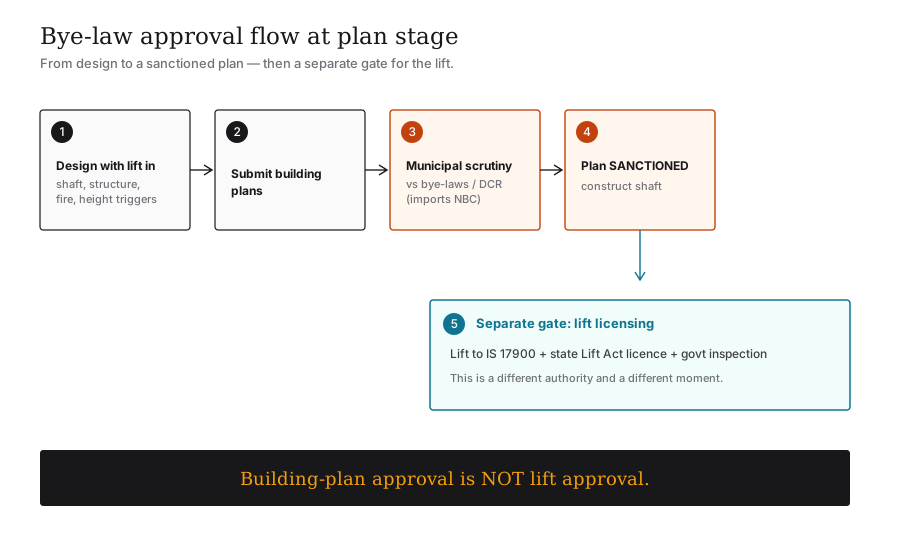
1. Design with the lift in. Your architect places the shaft, sizes it, and provides the structural and fire detailing — checking the bye-law triggers (height, fireman's lift) for your plot.
2. Submit building plans. The lift shaft, machine space, lobbies and fire provisions are part of the plan set submitted to the municipal corporation.
3. Municipal scrutiny. The plan is checked against the bye-laws / DCR — which import the relevant NBC provisions. If the lift, shaft or fire detailing fails, the plan is not sanctioned.
4. Sanction and construct. With the plan approved, the shaft is built as drawn.
5. Then licensing. Building approval is not lift approval. After (or alongside) construction, the lift itself is installed to IS 17900 and licensed under your state Lift Act — installation permission, then operating licence/registration after a government inspection. That is a separate process at a separate authority — see the approvals guide.
So building-plan approval and lift licensing are two distinct gates. Clearing the bye-laws at plan sanction gets your shaft built legally; it does not let you switch the lift on. And note: for accessibility, the RPwD Act 2016 (Section 44) bars building permission for public buildings whose plans do not meet accessibility norms — private homes are not legally compelled, but the accessibility standards are the right benchmark to design to.
Where the building code stops and the other layers begin
It is worth restating the handoff, because the line is exactly where homeowners trip:
- NBC + bye-laws told you whether you need a lift, where the shaft goes, and how it is built and fire-protected. They do not certify the lift machine.
- IS 17900 — mandatory for all new lift installations since 22 December 2025 and based on EN 81-20/50 — governs the lift equipment: door interlocks, UCMP (no movement with doors open), overspeed governor and safety gear, ascending-car overspeed protection, buffers, and so on. It replaced the older IS 14665 / IS 15785 / IS 14671 (still seen on older lifts). The building code does not duplicate this — it assumes the lift you install meets the current equipment standard. See the standards guide and Lift Safety Standards for Homeowners.
- The state Lift Act then licenses that compliant lift to operate and mandates periodic inspection — see approvals.
A lift that satisfies all three is a compliant home lift. The building code is your first gate, settled at design and plan approval, and it is the one most likely to constrain your architecture — so handle it before you pour the structure.
References
- NBC 2016, Part 8 (Building Services), Section 5 — Installation of Lifts, Escalators and Moving Walks, Bureau of Indian Standards: https://www.bis.gov.in/standards/technical-department/national-building-code/
- BIS — Guide for Using NBC 2016: https://www.bis.gov.in/wp-content/uploads/2022/08/Booklet-Guide-for-Using-NBC-2016.pdf
- IS 17900 (2025) — current mandatory lift safety standard (EN 81-20/50 based), superseding IS 14665 / IS 15785 / IS 14671. Background: https://elevatorworld.com/article/indias-elevator-revolution-why-is-17900-is-the-biggest-market-opportunity-since-eu-harmonization/
- IS 14665 (legacy) — Electric Traction Lifts, Part 1 (BIS): https://law.resource.org/pub/in/bis/S05/is.14665.1.2000.pdf ; Part 2: https://law.resource.org/pub/in/bis/S05/is.14665.2.1-2.2000.pdf
- IS 17515 — Energy performance of lifts, escalators and moving walks: https://elevatorworld.com/article/new-indian-standard-is-17515-on-energy-performance-of-lifts-escalators-moving-walks/
- RPwD Act 2016 (Rights of Persons with Disabilities; Sections 40, 44, 45): https://ssepd.odisha.gov.in/sites/default/files/2024-01/RPWD%20ACT.pdf
- CPWD / MoHUA Harmonised Guidelines and Space Standards for a Barrier-Free Built Environment (2016): https://www.cpwd.gov.in/Publication/Harmonisedguidelinesdreleasedon23rdMarch2016.pdf
- State Lift Acts (Maharashtra Lifts, Escalators and Moving Walks Act 2017; Karnataka 2015; Delhi 2007; Tamil Nadu 1997, etc.) — Maharashtra licence portal: https://services.india.gov.in/service/detail/maharashtra-license-to-operate-lift
- Lift regulations in India (overview): https://www.99acres.com/articles/know-all-about-the-lift-regulations-in-india.html
All triggers, heights and dimensions above are indicative and vary by state and municipality. Confirm the current rule with your municipal corporation, BIS, your State Lift Inspectorate and a licensed lift contractor.
Export this guide
Related Guides — Deep-dive reading
Lift and Fire Safety Planning (India): What Home Lifts Must Do When There's a Fire
Why your home lift is never the escape route, how fire recall works, when a fireman's lift is required, and the local fire NOC and bye-law checks every Indian homeowner should make.
Home Lifts & AccessibilityArchitect's Residential Elevator Planning Handbook (India): Shaft, Loads, Code & Coordination
The plan-stage reference for carrying a home lift through the drawing board — shaft, structure, pit, code, licensing and accessibility.
Home Lifts & AccessibilityResidential Elevator Standards in India (2026): IS 17900, NBC and What Governs a Home Lift
The consolidated standards map for a home lift — IS 17900 (mandatory since 22 December 2025), IS 17515, NBC 2016 Part 8 Section 5, the RPwD/CPWD accessibility rules, the state Lift Acts and the EN 81-20/50 / ISO 8100 lineage, and which one governs what.
Home Lifts & AccessibilityRelated Tools — Try Free
Lift Shaft Size Calculator
Required hoistway, pit and headroom dimensions for a home lift by capacity and drive type.
Lift CalculatorLift Safety Audit Checklist
Interactive checklist that scores your home lift on safety devices, compliance and upkeep.
ChecklistLift Headroom Calculator
Required overhead clearance for a home lift, checked against your top-floor height.
Lift Calculator