
Retrofitting a Lift into an Existing Home (India): Options, Structure, Disruption and Cost
How to add a lift to a finished house — the shaftless and compact routes, where it can go, cutting and framing slab openings, living through the work, and what the retrofit premium really costs.
Putting a lift into a house that is still on paper is a planning problem. Putting one into a house where people already live is a surgery. The slab you must cut is carrying furniture, the walls you must open are plastered and painted, and the family has to keep using the stair while the work happens. This guide is about that second case — the genuine retrofit — and about choosing the route that does the least damage for the money.
If your home is not yet built, or you are leaving a column-and-cupboard provision for "one day", you want the companion guide Lift-ready: future-proofing your home for a lift instead. That is the cheap path. This is the path you take when that decision was never made and the need has now arrived — ageing parents, a knee that will not climb, a buyer market that rewards step-free homes.
A retrofit is rarely about whether a lift will physically fit. It almost always is. The real questions are: how much structure must you cut, how long will the house be a building site, and how much more does all that cost than if you had planned for it.
This sits under the Architect's residential elevator handbook (the pillar) and goes deep on retrofitting only. For sizing, shaft, pit and machine-room basics, follow the cluster links as they come up.
Start by assessing the house honestly
Before any vendor visits, walk the house with three questions in mind.
Where is there a vertical void that already runs floor to floor? The two classic ones are the open well in the centre of a dog-leg or spiral stair, and a stack of cupboards/store rooms that happen to sit one above another. A void you can use is worth more than any other factor, because it means little or no slab cutting.
What is the structure made of, and where does load travel? A reinforced-concrete (RCC) frame house — columns and beams with infill walls — is far more forgiving than load-bearing masonry, because you can usually cut a floor opening between beams without touching the columns that hold the building up. In a load-bearing house every wall may be structural, and cutting a slab opening is a more serious intervention that needs an engineer's design from the start. Either way, this is not a DIY judgement: read Structural design for a home lift and get a structural engineer to confirm the load path before you commit.
How tall, how many stops, who will use it? Most independent Indian homes are G+1 or G+2 — two or three stops, well under the heights that trigger a fireman's lift (generally above 15 m, some residential rules 30 m — see Lift fire-safety planning). Short travel and few stops widen your retrofit options, especially toward the shaftless types below.
These three answers — void, structure, travel — decide everything that follows.
The two easiest retrofit routes
When the brief is "least disruption", two technologies dominate.
Shaftless pneumatic vacuum (PVE)
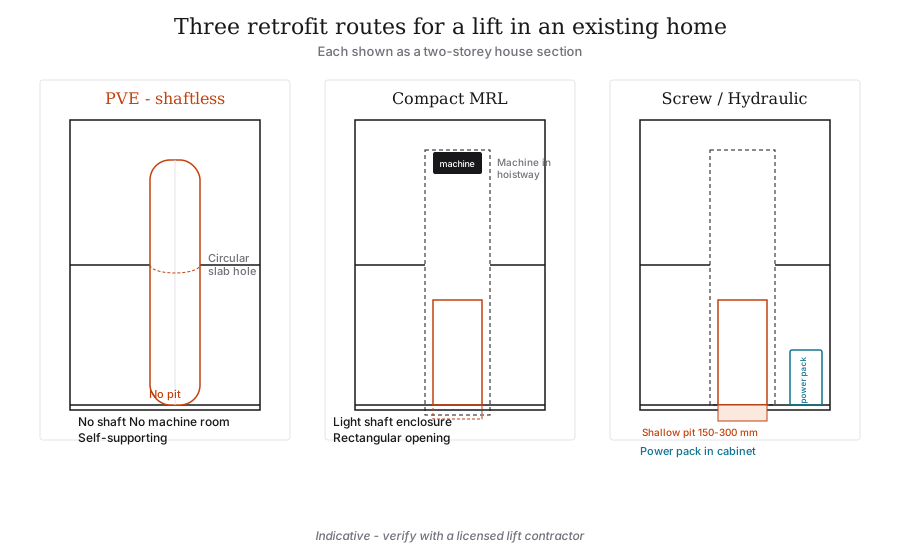
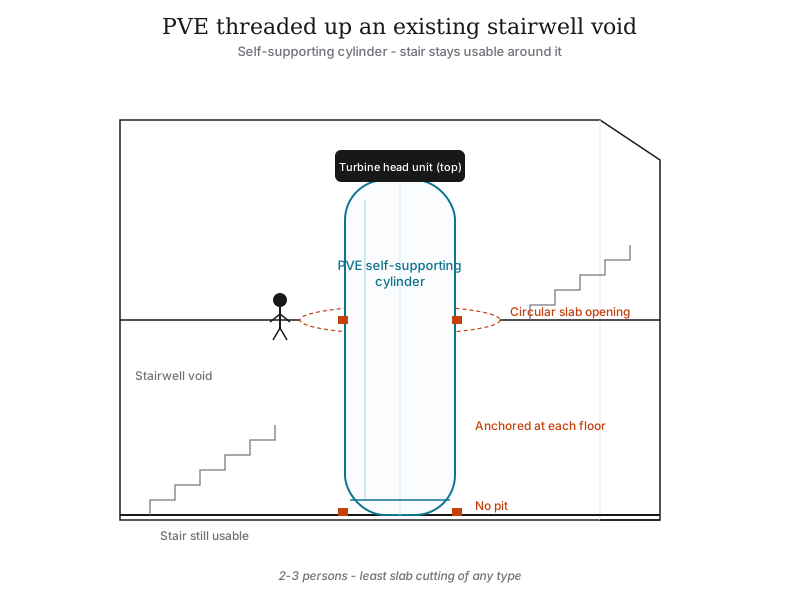
A pneumatic vacuum elevator lifts a cylindrical, usually panoramic cabin by air-pressure difference — a turbine evacuates air above the cabin to draw it up, and it descends by controlled gravity. The defining fact for retrofits: no pit, no shaft wall, no machine room, and it is self-supporting. It bolts to the floors it serves and needs only a circular hole through each intermediate slab. That is the smallest structural intervention of any lift type, which is why the fact base calls it the easiest retrofit into an existing home.
The trade-offs are real. Capacity is limited (roughly two to three persons), travel and speed are modest, and it draws more power on the way up than a counterweighted lift. The panoramic glass look is either a feature or an intrusion depending on the room. Indicative price is ₹11–22 lakh. Nibav is the best-known India-grown PVE brand; Elite and others also work this segment.
Compact machine-room-less (MRL) traction or screw/hydraulic
If you have a usable void large enough for a small enclosed car, a compact MRL traction lift is the 2026 mainstream choice: the machine lives inside the hoistway, so there is no separate machine room to find. Screw-driven and hydraulic units are also strong retrofit candidates because they need only a shallow pit (roughly 150–300 mm), which is far easier to form in a finished house than the deeper pit a conventional geared lift wants.
These give you a proper enclosed car, more capacity (typically up to a small family), and lower running cost than PVE — at the price of building a light shaft enclosure and forming at least a shallow pit. See Lift machine-room requirements and Lift pit requirements for what each demands.
Where it can actually go
Three locations cover almost every retrofit.
The stairwell void. The space inside a dog-leg or spiral stair is the prize: it is already a clear vertical run, often lit, and central to the plan. A PVE or a slim MRL car drops in with minimal cutting. The constraints are the well's diameter and the head clearance under the top flight. See Lift–staircase integration for working the two together.
Stacked cupboards / store rooms. When a wardrobe, store or toilet sits in the same position on each floor, you have a hidden vertical column you can sacrifice for a shaft. You lose that storage but gain a tidy, enclosed location without disturbing living spaces.
An external shaft. Where there is no internal void, a lift can be built as a small tower on an external wall — often a balcony stack, a setback, or the rear face — with new landing doors cut into each floor. This keeps almost all the noise and dust outside the lived-in house, but you must respect plot setbacks and bye-laws, and it changes the elevation. On a narrow plot the setback margin may simply not exist.
For how much clear footprint each option actually needs, Home-lift space requirements is the reference.
| Retrofit route | Where it goes | Pit / shaft / machine room | Slab work | Disruption | Capacity | Indicative cost |
|---|---|---|---|---|---|---|
| Pneumatic vacuum (PVE) | Stairwell void or any corner | No pit, no shaft, no machine room; self-supporting | One circular hole per intermediate slab | Lowest | 2–3 persons | ₹11–22 lakh |
| Compact MRL traction | Stairwell void or stacked cupboards | Shallow-to-modest pit; light shaft; machine in hoistway | Rectangular opening per floor + light enclosure | Medium | Small family | ₹10–25 lakh+ |
| Screw / winding-drum | Stacked cupboards, corner | Shallow pit (150–300 mm); compact; no machine room | Rectangular opening per floor | Medium | 2–6 persons | ₹14–30 lakh |
| Hydraulic | Corner with adjacent cabinet | Shallow pit (150–300 mm); power pack in small cabinet | Rectangular opening per floor | Medium | 2–6 persons | ₹8–20 lakh |
| External tower shaft | Balcony stack / rear face | Built fresh; needs setback room | Landing doors cut per floor; structure mostly outside | Lower indoors, changes elevation | Small family | Type cost + new shaft civils |
All figures are indicative and exclude 18% GST plus civil and installation work — confirm with your local bye-laws and a licensed lift contractor.
Cutting the slab — and why it is a structural decision, not a demolition one
This is the heart of a retrofit and where homeowners most often underestimate the work.
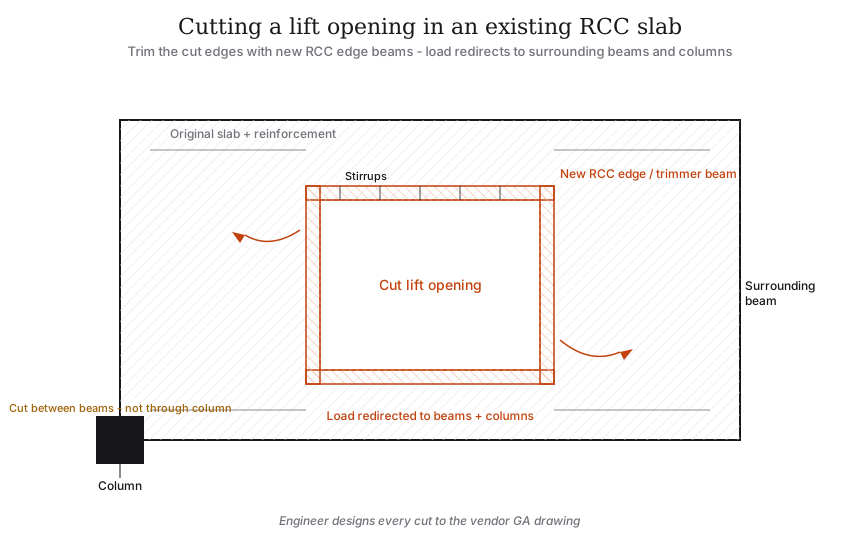
A floor slab is part of the building's structure. It spans between beams, and its reinforcement runs in continuous bands across that span. Punching a rectangular hole through it cuts those reinforcing bars and removes a piece of a working structural element. You cannot simply break the concrete out and expect the rest of the slab to behave.
The correct method is to frame the opening. The cut edges are reinforced with new edge (trimmer) beams that pick up the load the removed slab used to carry and deliver it safely back to the beams and columns around the opening — re-establishing a clean load path. For a PVE you need only a circular hole, far smaller and easier to trim; for an enclosed car you need a full rectangular opening on each floor, which is the more demanding cut. Where the opening lands matters too: cutting between beams in an RCC frame is routine engineering, but cutting near or through a column or a primary beam changes the whole calculation.
Two more structural realities for retrofits:
- The shaft walls (if you build an enclosed type) carry guide-rail bracket reactions. Those brackets push both vertical and horizontal forces into the walls at intervals, and the exact loads and locations come from the lift supplier's general-arrangement (GA) drawing. Never finalise the enclosure before the GA is fixed.
- Pit and overhead slabs must take buffer/impact forces. These commonly crack when the buffer-impact loads are underestimated — get the supplier's reaction schedule and design to it.
The non-negotiable process: the structural engineer designs every cut, the trimming, the pit and the shaft enclosure to the vendor's GA and reaction loads — not the other way round, and not after the concrete is broken. The full method is in Structural design for a home lift.
Living through the work — disruption and timeline
A retrofit is the part of a lift project the family feels most, so plan it like a renovation, not a delivery.
Dust and noise are unavoidable when cutting concrete. Slab cutting uses water and diamond blades but still produces slurry, vibration and noise. Seal off the work zone, protect floors and furniture on the route, and expect the affected rooms to be unusable for the cutting phase.
You will lose a stair or a route temporarily. If the lift goes into the stairwell void, the stair may be partly obstructed during installation; if it goes through stacked cupboards, those rooms come out of use. Map a workable circulation through the house for the duration before work starts.
Sequence, roughly: assessment and structural design to the vendor GA → forming the pit (if any) and cutting/trimming the slab openings → erecting the shaft enclosure (enclosed types) → installing the car, rails, doors and machine → electrical connection (small home lifts can run single-phase; larger traction needs three-phase) → testing and commissioning → state licence and inspection where applicable. A PVE compresses several of these because there is no shaft to build and no pit to form.
Get the licence and inspection right. Lifts are state-regulated; roughly ten states (Maharashtra, Gujarat, Karnataka, Kerala, Tamil Nadu, Assam, West Bengal, Delhi, Haryana, Himachal Pradesh) require an installation licence before commissioning, an operation licence/registration, and periodic safety inspection by a government inspector. In other states registration may not be mandated, but IS 14665 and NBC remain best practice. See the residential elevator buyer's guide for the procurement and paperwork checklist.
And whatever the type, specify the Automatic Rescue Device (ARD) — battery backup that brings the car to the nearest floor and opens the doors on a power cut. In India this is essential, not optional.
What it costs versus provisioning or building new
The lift hardware itself costs the same whether you fit it new or retrofit — the type-by-type ranges (hydraulic ₹8–20 lakh, traction/gearless ₹10–25 lakh+, PVE ₹11–22 lakh, screw ₹14–30 lakh) do not change.
The retrofit premium is everything around the hardware:
- Structural cutting and trimming — forming and reinforcing slab openings, edge beams, a formed pit — work that simply does not exist when a shaft is cast with the building.
- Making good — replastering, flooring, finishing the new landing thresholds and the disturbed rooms.
- Disruption cost — temporary alternative arrangements, slower work because the house is occupied, and protection of existing finishes.
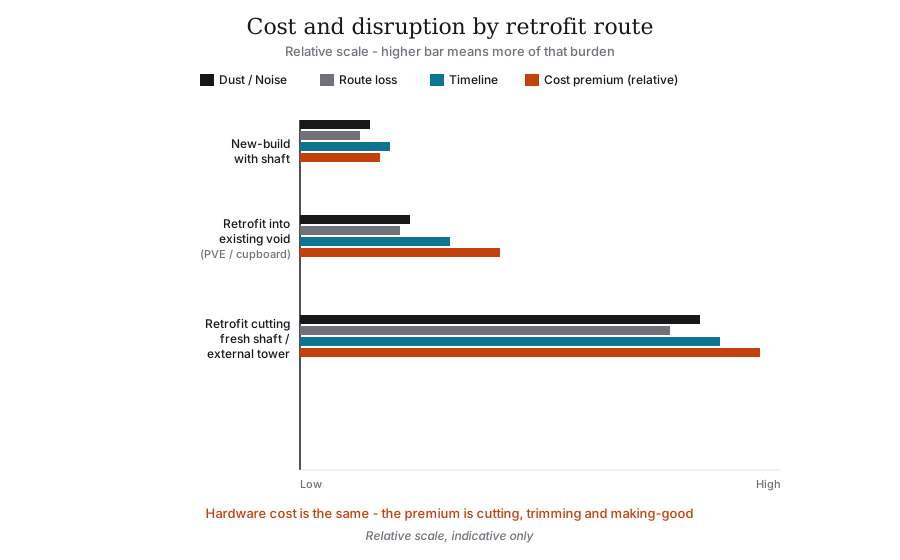
A shaft provisioned at design stage is far cheaper than one cut later. The cheapest order is: build it new with the shaft; next, leave a lift-ready provision and fit later into a ready void; most expensive, cut a fresh opening into a finished house. The retrofit premium is the price of not having decided earlier.
The single biggest lever on that premium is finding an existing void. A PVE through a stairwell, or an enclosed car through stacked cupboards, can approach new-build economics because there is little to cut and little to make good. An external tower or a fresh internal shaft punched through every slab sits at the top end. Choose the route by how much structure it spares, not by the cabin you like best.
For the full price breakdown by type, floors and car size, see Home-lift cost in India 2026 and the lift specification checklist.
A short retrofit checklist
- Find the void first — stairwell or stacked cupboards beat any fresh cut.
- Confirm the structure and load path with an engineer before choosing a type.
- For least disruption and least cutting, shortlist PVE; for an enclosed car, compact MRL or shallow-pit screw/hydraulic.
- Never finalise any opening or enclosure before the vendor's GA drawing and reaction loads are in hand.
- Frame every slab opening with designed edge beams — no unframed cuts.
- Budget for cutting, trimming, making-good and disruption on top of the hardware and 18% GST.
- Specify the ARD; settle the state licence and inspection.
- Plan the family's circulation through the build, and seal off the cutting zone.
If you can age in place or sell a step-free home for the price of one careful retrofit, it is usually worth it — provided you choose the route that respects the structure you already have.
References
- IS 14665 (Electric Traction Lifts) Part 1 — Outline dimensions, BIS: https://law.resource.org/pub/in/bis/S05/is.14665.1.2000.pdf
- IS 14665 Part 2 — Code of practice for installation, operation and maintenance, BIS: https://law.resource.org/pub/in/bis/S05/is.14665.2.1-2.2000.pdf
- IS 15259 — Hydraulic lifts (companion code, by name).
- National Building Code of India 2016, Part 8 (Building Services) Section 5 — Installation of Lifts, Escalators and Moving Walks, BIS: https://www.bis.gov.in/standards/technical-department/national-building-code/
- BIS Guide for Using NBC 2016: https://www.bis.gov.in/wp-content/uploads/2022/08/Booklet-Guide-for-Using-NBC-2016.pdf
- Rights of Persons with Disabilities (RPwD) Act 2016: https://ssepd.odisha.gov.in/sites/default/files/2024-01/RPWD%20ACT.pdf
- CPWD / MoHUA Harmonised Guidelines and Space Standards for a Barrier-Free Built Environment: https://www.cpwd.gov.in/Publication/Harmonisedguidelinesdreleasedon23rdMarch2016.pdf
- Structural requirement for lifts and lift pits (Civilera): https://www.civilera.com/post/structural-requirement-for-lifts-and-lift-pits
- Guidelines for structural design of a lift well/shaft: https://www.sketchup3dconstruction.com/const/guidelines-for-making-perfect-structural-design-of-a-lift.html
- Lift regulations in India (99acres): https://www.99acres.com/articles/know-all-about-the-lift-regulations-in-india.html
- State lift acts (Maharashtra 2017, Karnataka 2015, Delhi 2007, Tamil Nadu 1997) — confirm the current text with your state lift inspectorate.
All regulatory triggers, dimensions and prices in this guide are indicative and vary by state, vendor and year. Confirm with your local municipal bye-laws, a licensed lift contractor and your structural engineer before committing.
Export this guide
Related Guides — Deep-dive reading
Lift-Ready & Future-Proof (India): Provisioning Your Home Now to Add a Lift Later
Leave the right empty box, slab openings and spare wiring now so a home lift is a clean install later, not a demolition.
Home Lifts & AccessibilityArchitect's Residential Elevator Planning Handbook (India): Shaft, Loads, Code & Coordination
The plan-stage reference for carrying a home lift through the drawing board — shaft, structure, pit, code, licensing and accessibility.
Home Lifts & AccessibilityHome Lift Planning Checklist (India): Everything to Decide Before You Buy
A printable, ten-stage checklist that takes you from the first family conversation to a signed handover.
Home Lifts & AccessibilityRelated Tools — Try Free
Home Lift Comparison Tool
Compare hydraulic, traction, pneumatic vacuum and screw lifts side by side for your home.
Lift ComparisonHome Lift Budget Planner
Full line-item budget for a home lift — equipment, finishes, civil, GST, AMC and contingency.
Lift PlannerHome Lift Cost Calculator
All-in home lift cost by floors, type, capacity and city — equipment, civil, GST and AMC, with a drive-type comparison.
Lift Calculator