
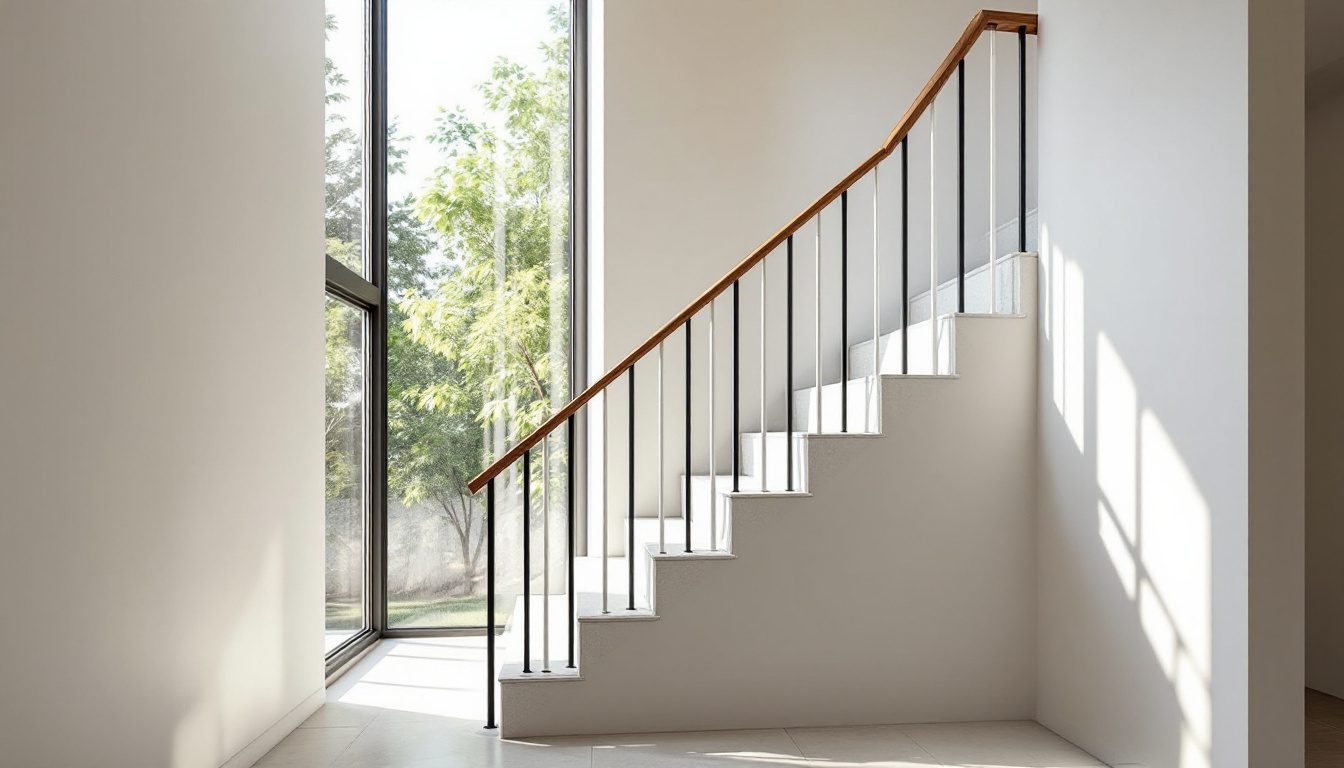
Staircase Design in India: Safe, Beautiful, and Saying the Right Thing
Why a grand central stair sends the wrong message, straight vs dog-leg vs curved, the riser-tread rules that decide comfort, and under-stair uses
The staircase does three demanding jobs at once. It must be safe — a place children sprint up and elderly parents come down slowly, where a single badly judged riser becomes a fall. It must be beautiful — a stair is the largest piece of sculpture most homes will ever own, climbing through two or three storeys in full view. And, more quietly, it must send the right message, telling everyone who walks through your front door where they are meant to go.
Most Indian homeowners building an independent house or a duplex think about the stair far too late, slotting it in after the rooms are fixed. But a staircase eats nearly as much floor area as a small bedroom and anchors the vertical circulation of the whole house. This guide covers placement, shape, the non-negotiable dimensions from the National Building Code (NBC) 2016, materials and 2026 rupee costs, lighting, and a brief Vastu lens — so the stair you build is safe, handsome, and says exactly what you intend.
The hidden message: a central stair invites guests upstairs
Picture the classic set-piece: a grand staircase rising straight out of the entrance hall, the first thing you see as the front door opens. It is one of the oldest images in home design, and it is very often in the wrong place.
Here is the unexpected part. A large, central staircase facing the front door does not merely show off the joinery. At a subconscious level it issues an invitation — it pulls the visitor's eye and feet upward, toward the bedrooms. That is almost never the invitation you want to extend. You meant to display craftsmanship; the architecture is quietly saying, this way, upstairs, to the private heart of the house.
A grand stair aimed straight at the front door is a host who, before you have taken off your shoes, points up toward the bedrooms. Charming joinery, wrong message.
Why is this layout so stubbornly common? It is a holdover from grand European houses, where the family lived on the upper floors — above the noise and smell of the street, with service rooms below — and the central stair existed to usher guests up to the family's receiving rooms. We no longer live in that upstairs-and-downstairs world. In the contemporary Indian house, the ground floor holds the living and dining rooms where guests are received, and the bedrooms sit above as the private zone. Yet the front-and-centre stair survives out of habit, working against the very privacy you want for the floor above.
Where guests actually belong
The job of the entry is to lead a visitor toward the living spaces — the sofa, the dining table, the verandah — not toward the staircase. When the stair dominates the foyer, every arriving guest is drawn the wrong way, and the family loses the separation between public ground floor and private upper floor that makes a multi-level home livable. Thinking about which spaces face the door, and in what order a visitor meets them, is the same instinct that drives good room planning — our room programming worksheet helps you map the public-to-private gradient before walls are fixed.
A better instinct: move the stair just off-centre
The fix is simple and freeing. Place the staircase in a handsome spot that is not quite front and centre — beside the foyer rather than dominating it — or turn it so the bottom step does not face the front door head-on. Many homeowners go further and put the main stair nearer the family's everyday entrance, by the kitchen and the parking, where the household actually moves between floors a dozen times a day. Such a stair can still be beautifully built and serve as the principal staircase. It simply is not the first thing a guest is invited up.
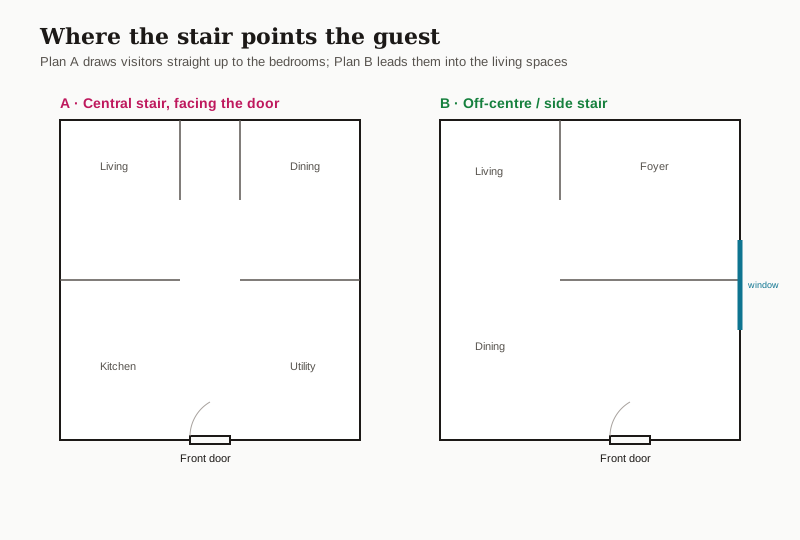
Wherever it lands, hold on to one practical anchor: aim for the top of the stair to arrive near the centre of the upper floor, so every bedroom is reached with a short, even walk rather than a long corridor. A stair that lands in a far corner forces a passage to eat into bedroom area upstairs. Treat the stair as a major planning element, decided early, not a leftover slotted in at the end.
Set a little off the foyer, a stair still reads as a signature — but now the front door leads guests toward the living spaces, the way a good host would.
A side or off-centre stair also frees the foyer to be its own gracious moment, and it lets the stair sit against an external wall — the single best gift you can give a staircase, because that wall can carry a window.
Shape and budget: straight, dog-leg, or curved?
The staircase is a place to have genuine fun, and a well-considered railing is a statement about the craftsmanship of the whole house. But shape carries real cost, real footprint, and real consequences for comfort. There are three broad families.
A straight flight is the cheapest and simplest — a single run from floor to floor, easy to build, climb, and move furniture along. Its weakness is footprint: it needs a long uninterrupted run, roughly 3.5 to 4.5 metres, which on a compact urban plot is often more length than you can spare. It also offers no rest and no landing to break a fall.
A dog-leg or U-shaped stair with a mid-landing folds the climb back on itself around a half-landing. This is the Indian workhorse — compact, economical, and safe, packing the same number of steps into roughly half the plan length.
A curved or helical (spiral) stair is dramatic and sculptural — and significantly more expensive, often two to four times the cost of a straight or dog-leg stair, because of the custom formwork, tapering treads, and specialist fabrication. A tight spiral is genuinely difficult for the elderly, for carrying a child, or for moving a mattress. Reserve it for when it is honestly the centrepiece and the budget agrees.
| Stair type | Relative footprint | Relative cost | Comfort and safety | Best for |
|---|---|---|---|---|
| Straight flight | Long, narrow run (3.5–4.5 m) | Lowest (baseline) | Easy climb; no landing rest; long fall if no break | Larger plots, lofts, basements |
| Dog-leg / U-shape with mid-landing | Compact (about half the length) | Low to moderate (1.1–1.4× straight) | Mid-landing gives rest and breaks a fall | Most Indian homes and duplex flats |
| Open-well (square spiral around a void) | Moderate; central light-well | Moderate (1.3–1.6×) | Comfortable; light-well brings daylight down | Three-storey homes wanting a daylight core |
| Curved / sweeping | Large, generous radius | High (1.8–3×) | Comfortable if radius is generous; costly | Feature stair, ample budget |
| Helical / spiral (compact) | Smallest footprint | Moderate to high (custom steel) | Tight; hard for elderly, carrying, moving furniture | Secondary access, terrace stairs |
To pressure-test a shape against your actual rupees per square foot and plot dimensions, run the numbers through our cost calculator before you commit the formwork.
Why the dog-leg is the Indian workhorse
For the typical Indian plot — a 30 by 40, a 40 by 60, a duplex flat — the dog-leg with a mid-landing wins on nearly every axis. It is compact, fitting a full floor-to-floor rise into a short span. It is economical in both material and area. And it is safe: the half-landing breaks the flight into two shorter runs, so a stumble at the top cannot become a fall all the way down. That landing also creates a natural pause and, crucially, a place for light. When the dog-leg sits against an external wall, a tall window or a jaali at the landing floods the core of the house with daylight and cross-ventilation — two things compact Indian homes are always short of. You get most of the drama of a sculptural stair for a fraction of the cost of a curve.
The non-negotiable dimensions
Nothing spoils an otherwise lovely home like a staircase that is too steep, too tight, or simply awkward underfoot. Comfort and safety come down to a handful of numbers, and they are not negotiable — get the riser and the tread wrong and the stair is never comfortable, no matter how fine the railing. The figures below follow NBC 2016 and long-established ergonomic practice; always confirm against your municipal bye-laws, which sometimes set their own minimums.

The two numbers that decide everything are the riser (the vertical face of each step) and the tread or going (the horizontal depth your foot lands on; strictly the tread is the visible step and the going is the horizontal distance between two riser faces, but in homes they are used interchangeably). For a comfortable main stair, the riser should sit between about 150 and 190 mm, and the going between about 250 and 300 mm. A taller riser is permissible in codes but feels steep; a shallower going feels mean and trips the heel.
The relationship is captured by an old, reliable rule of thumb — the 2R + G comfort rule — which says twice the riser plus the going should fall in a band of roughly 550 to 650 mm. This encodes the natural geometry of a human stride climbing a slope: as steps get taller they must get shallower, and vice versa. A stair where 2R + G lands near 600 mm will feel right to almost everyone.
| Element | Comfortable range | NBC / good practice note |
|---|---|---|
| Riser (R) | 150–190 mm | Keep below 190 mm on a main stair; 150–175 mm is ideal for homes |
| Tread / going (G) | 250–300 mm | 280 mm is a comfortable target; never below 250 mm |
| 2R + G comfort rule | 550–650 mm | Aim near 600 mm; a stair near this value feels natural |
| Riser consistency | Identical to within ~5 mm | Inconsistent risers are the leading cause of trips and falls |
| Number of steps per flight | 12–15 max before a landing | Break longer climbs with a landing for rest and safety |
The most under-appreciated rule here is consistency. Every riser in a flight must be the same height, and every going the same depth, to within a few millimetres. The foot calibrates to the first step and then climbs on autopilot; a single riser 20 mm taller or shorter than its neighbours is precisely where people trip — most often at the bottom or top, where a builder has fudged the floor finish. Insist the finished-floor-to-finished-floor height is divided into equal risers after the flooring thickness is accounted for, not before.
The other dimensions that keep it safe
Beyond riser and going, a clutch of NBC minimums guard against hidden hazards. Headroom — the clear height from the nosing of a step up to any beam, slab or landing above — must be at least 2,100 mm so nobody, including a tall guest descending, cracks their head where the flight passes under the landing. The clear width in a dwelling should be at least 900 mm under NBC; 1,000 mm or more lets two people pass or a mattress turn. The handrail should sit at about 900 mm above the line of the nosings, where a hand naturally rests.
Then there is the railing infill — the most important child-safety dimension in the house. The gaps between balusters (the vertical bars) must be small enough that a child cannot slip through or get a head stuck: keep the clear gap below 100 mm, including under the bottom rail. Winders — the wedge-shaped steps used to turn a corner without a full landing — deserve real caution: their going narrows dangerously toward the inside of the turn, exactly where a foot wants to be on the way down. Use a proper landing wherever you can; if winders are unavoidable, make sure the going at the centre walking line still meets the comfort minimum.
| NBC 2016 element | Residential minimum | Comfortable target |
|---|---|---|
| Clear stair width (dwelling) | 900 mm | 1,000–1,200 mm |
| Headroom (vertical clearance) | 2,100 mm | 2,150 mm or more |
| Handrail height (above nosing) | ~900 mm | 850–950 mm |
| Baluster / infill clear gap | Below 100 mm | 90 mm or less |
| Landing depth (in line of travel) | At least the stair width | Equal to width, never less |
| Flight before a landing | Max ~12–15 risers | 12 risers |
To sanity-check the proportions of your own design — riser, going, the 2R + G value, and how the flight fits the available run — our scale and proportion calculator does the arithmetic and flags anything outside the comfortable bands.
Landings, and the mid-landing compromise
A landing is far more than a place to turn. It breaks the climb into manageable runs, gives a genuine rest on a tall flight, and — most importantly — interrupts a fall, so a stumble travels half a flight rather than the whole height. NBC and good practice cap a flight at roughly 12 to 15 risers before a landing is required; on a typical floor-to-floor height of 3,000 to 3,300 mm, that usually means one mid-landing splitting the climb.
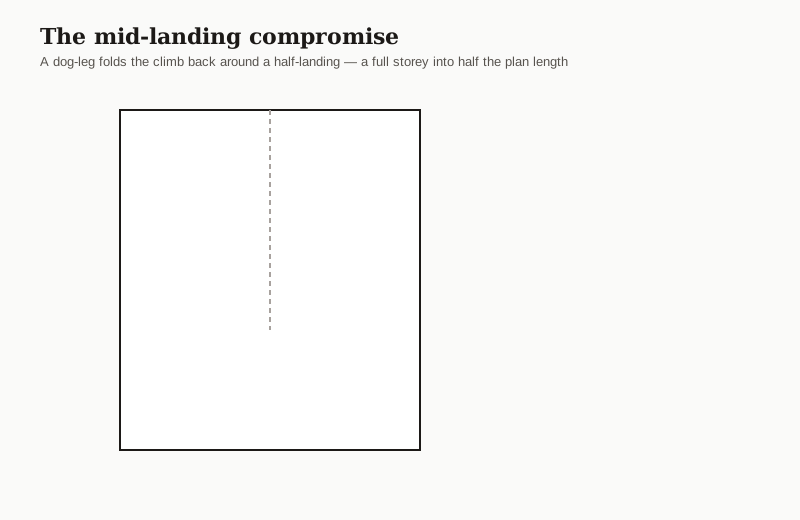
The mid-landing is the heart of the dog-leg's efficiency. By turning the flight 180 degrees around a half-landing, the stair fits a full storey rise into roughly half the plan length a straight run would demand — the reason it suits short urban spans so well. The one rule that matters: a landing must be at least as deep, in the line of travel, as the stair is wide, so a person stepping onto it has a full, flat pace before the next flight. A pinched landing shallower than the stair width is both uncomfortable and unsafe. And never let a door swing out over a descending step — a door at the top of a flight needs a full landing in front of it before the first riser.

Don't waste the space under the stair
A staircase creates a wedge of space beneath it that, in a compact home, is too valuable to leave as a dusty void. The dog-leg in particular tucks a generous triangular volume under its upper flight. How you use it depends on the headroom available at each point and how the stair faces the rooms around it.
| Under-stair use | What it needs | Notes for Indian homes |
|---|---|---|
| Storage (pull-outs, cabinets) | Any headroom; joinery | The default win — shoes, suitcases, cleaning kit; bespoke drawers beat a single deep cupboard |
| Powder room (half-bath / WC) | ~2,100 mm at the WC, plumbing nearby | A guest WC off the foyer is gold; place the WC under the high end of the wedge |
| Pooja niche or mandir | Calm corner, a little height, light | A small framed niche suits homes that prefer the mandir away from bedrooms |
| Reading nook / study seat | Headroom for a seated person | A window or step light makes the corner usable |
| Display / open shelving | None special | Books, art, plants — turns dead space into a feature |
| Pet corner | Low headroom is fine | A tucked, sheltered spot for a dog bed or crate |
A powder room under the stair is especially smart here, because it gives guests a WC near the foyer without sending them into the private bathrooms upstairs — reinforcing exactly the public-private separation this guide has argued for. Just make sure the WC sits where the slab gives the full 2,100 mm of headroom, and that plumbing reaches it without ugly exposed runs.
Materials, finishes, and a 2026 cost band
The structure of most Indian house stairs is reinforced cement concrete (RCC) — a cast waist-slab that is then clad. The cladding and railing are where the budget and the character live. Below are typical 2026 supply-and-fix bands; they vary by city, stone or timber grade, and design complexity, so treat them as planning figures rather than quotes.
| Element / material | Typical 2026 cost band | Character and notes |
|---|---|---|
| RCC structure (waist slab, steps cast) | 250–450 per sq ft of plan area | The base everyone builds on; cladding is extra |
| Granite cladding on treads and risers | 1,200–2,500 per running ft of step | Hard-wearing, classic, easy to clean; the Indian default |
| Marble / engineered marble cladding | 1,800–4,000 per running ft | Luxurious, softer, needs sealing and care |
| Vitrified / porcelain tile cladding | 600–1,400 per running ft | Economical; choose anti-skid for safety |
| Solid timber treads (teak, sal) on RCC or steel | 2,500–6,000 per running ft | Warm, premium; teak ages beautifully |
| MS stringer with timber or stone treads | 2,000–5,000 per running ft | Lighter look, factory-fabricated, good for open feel |
| MS / mild-steel railing (powder-coated) | 350–900 per running ft | Workhorse, endlessly customisable |
| Stainless-steel railing | 900–2,200 per running ft | Low maintenance, contemporary |
| Toughened-glass balustrade with SS / patch fittings | 1,200–3,000 per running ft | Minimal, light-filled, premium; needs careful detailing |
| Step (riser) LED lighting | 400–1,200 per step | Safety and drama; recess into the riser or the side wall |
A few pairings make sense in our climate. RCC clad in granite with a powder-coated MS railing is the dependable value workhorse — tough, cleanable, and forgiving of monsoon-wet feet if you pick a leather or flamed finish for grip. Timber treads on an MS stringer give a lighter, more contemporary stair that suits a daylight-filled core. Glass and stainless-steel railings open up the flight visually but show every fingerprint and demand precise detailing, so budget for good fabrication. Whatever the finish, insist on an anti-skid surface or a nosing groove on the treads — a polished stone stair is a hazard the first time someone climbs it with wet feet.
Lighting the stair — for safety and for drama
A stair is the one place where bad lighting is genuinely dangerous, because the eye must read the edge of every tread. Aim for even, glare-free light that falls across the nosings without throwing the steps into confusing shadow. A window or jaali at the landing is the best light there is — free, soft, changing through the day — another argument for setting the stair against an external wall.
For evenings, layer three things. A general source — a pendant dropping down the well, or recessed ceiling lights — gives overall brightness. Step lights, recessed into the riser or side wall every few steps, wash each nosing and turn the stair into quiet theatre at night while making the edges unmistakable; they are the single best safety-plus-drama upgrade you can make. And a wall-washer or LED run under the handrail can graze a textured feature wall beside the flight. Put the stair on a two-way switch at top and bottom so nobody ever climbs in the dark, and consider a motion sensor for the small hours.
A Vastu lens, not a rulebook
Many Indian families weigh Vastu when placing a staircase, and it is worth understanding as one lens rather than an iron law. The most commonly cited belief is that a staircase should rise clockwise — you turn to your right as you climb — and that stairs are best placed in the south, west, or south-west, away from the north-east, which is traditionally kept light and open. Some also avoid a stair facing the main door directly, which aligns neatly with the design argument we opened with: a stair aimed at the front door sends the wrong message whether or not you read it through Vastu.
Treat these as inputs to weigh against daylight, structure, circulation, and cost — not constraints that override a safe, comfortable, well-placed stair. To reconcile a Vastu direction with your actual site, our Vastu compass tool lets you overlay the directions on your plan and see where a clockwise, south-west stair can sit without fighting the daylight or the structure. Usually there is a placement that satisfies the head, the building code, and the family's beliefs at once.
Bring it to life with Studio Matrx
A staircase is never just a way up. It is a sculptural object, a major chunk of the floor plan, and a quiet host that points your guests one way or another. Set it a little off the foyer, give it a landing, get the risers and going right, light the nosings, and let the railing be beautiful — and it will say exactly what you mean: welcome, this way, to the living of the house.
Tell Studio Matrx about your levels, your plot, and your budget, and get staircase options placed for sensible circulation, sized to NBC for comfort and safety, and styled to be a genuine signature. Design your staircase with Studio Matrx and see the flight, the landing, the railing, and the light before a single rod is bent.
References
- Bureau of Indian Standards. National Building Code of India 2016 (NBC 2016), Part 4: Fire and Life Safety — provisions for stairways, means of egress, minimum width, headroom, and landings. BIS, New Delhi.
- Bureau of Indian Standards. National Building Code of India 2016, Part 3: Development, Planning, Buildings and General Requirements — circulation and staircase general requirements. BIS, New Delhi.
- Bureau of Indian Standards. IS 1893 and allied structural codes — reinforced concrete staircase and waist-slab design references. BIS, New Delhi.
- Central Public Works Department (CPWD). CPWD Specifications and Handbook on Barrier-Free and Accessible Built Environment — handrail heights, riser and tread limits, and accessible stair guidance. Government of India.
- Ministry of Housing and Urban Affairs. Harmonised Guidelines and Standards for Universal Accessibility in India (2021) — stair, ramp, and handrail dimensions for inclusive design.
- Panero, Julius, and Martin Zelnik. Human Dimension and Interior Space: A Source Book of Design Reference Standards. Watson-Guptill — ergonomic data for stair riser, tread, and clearance dimensions.
- Ching, Francis D. K. Building Construction Illustrated. Wiley — staircase types, geometry, and the riser-tread relationship explained graphically.
- Hirsch, William J. Jr. Designing Your Perfect House: Lessons from an Architect. Dalsimer Press. (A general inspiration for this series' approach to staircases that communicate correctly.)
Export this guide
Related Guides — Deep-dive reading
Designing Adaptable & Universal-Design Homes
Accessibility, Aging-in-Place, and the Multi-Stage Family — Code, Anthropometrics, and Plan-Stage Discipline for Indian Residential Architects
Room PlanningWhy Corridor Width Matters
The most overlooked dimension in your home — how passage width decides comfort, flow and wasted space
Design EducationHow to Plan a Home for Multi-Generational Living
Designing for grandparents, parents and children under one roof — privacy, accessibility and harmony
Home PlanningRelated Tools — Try Free
Cross-Ventilation Analyzer
Estimate airflow and air changes per hour (ACH) from room size, window areas, layout, and local wind — with NBC 2016 Part 8 compliance check.
Ventilation CalculatorVastu Window Planner
Vastu guidance for window placement and size by wall direction and room — rating and remedies.
VastuFlooring Cost Calculator
Estimate the all-in cost of a floor — material, laying, wastage, skirting and GST — by area and material.
Flooring Calculator