
Lift Design for Narrow Plots (India): Fitting an Elevator into a Tight Urban Home
Compact, shaftless and stack-over-cupboard strategies for putting a home lift into a 20x40 or 25x40 plot without losing daylight or circulation.
On a 20 by 40 or 25 by 40 plot, every square foot is contested. Setbacks eat the perimeter, the staircase eats the core, and bedrooms want light from the only two free faces. So when a family asks whether they can still have a lift, the honest answer is: almost always yes — but only if the lift is planned as a structural decision on day one, not squeezed in as an afterthought. This guide is about the geometry and the trade-offs of fitting an elevator into a tight urban home, and about the most compact options that make it possible without surrendering daylight or circulation.
This is a deeper, narrower spoke of our Residential Elevator Handbook (India). For the full dimensional tables read Home Lift Space Requirements; for the shaft, pit and structure read Lift Shaft Design, Lift Pit Requirements and Home Lift Structural Design. Here we stay with the one problem a narrow plot forces on you: where does the box go, and how small can it be.
On a narrow plot the lift is not a product you buy at the end. It is a column of reserved space you defend from the first plan sketch — because nothing on a 20-foot-wide house is easy to move later.
Why narrow plots are a special case
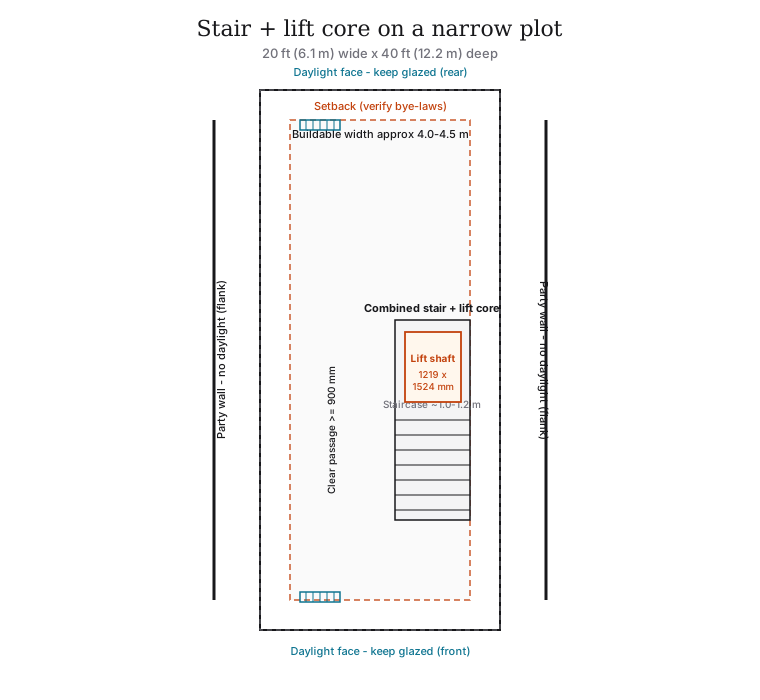
A 20 by 40 plot is roughly 6.1 m wide and 12.2 m deep — about 74 sq m before setbacks. Subtract the front, rear and side margins your municipal bye-laws demand (commonly 1.0 to 1.5 m on the sides for such plots, but indicative — confirm with your local municipal bye-laws) and the buildable footprint can drop to 4.0 to 4.5 m of usable width. Into that strip you must fit a staircase, a passage, a toilet stack and the rooms that actually pay for the house. The staircase alone, designed properly, claims roughly 1.0 to 1.2 m of width and 3.5 to 4.0 m of run; see Designing a Staircase (India).
Three forces collide on these plots:
- Width is the scarce dimension. A standard small home-lift shaft of about 1219 by 1524 mm (4 by 5 feet) consumes a fifth of a 6.1 m frontage. You cannot afford a generous shaft, so you must choose the smallest car your family genuinely needs.
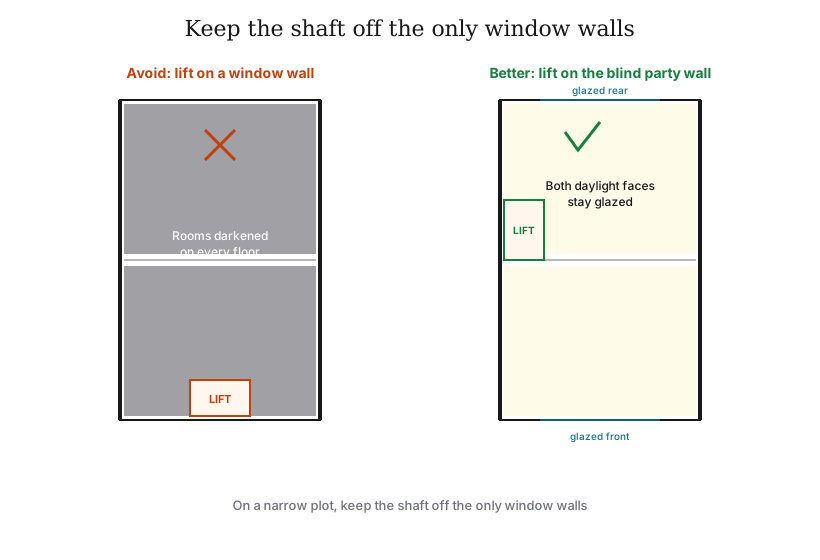
- Daylight comes from only two faces. Front and rear are usually the only open sides; the long flanks abut neighbours. A lift placed against a window wall steals light from every floor at once.
- The staircase is non-negotiable. A lift never replaces the stair in a home — it sits beside it. The smart narrow-plot move is to treat stair and lift as one combined core; see Lift and Staircase Integration.
The compact-options table
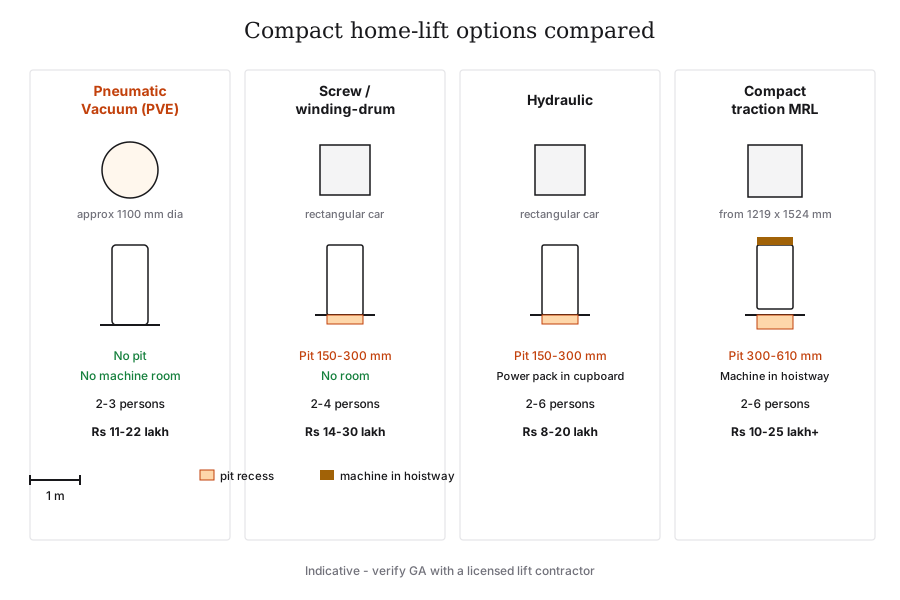
The fastest way to fit a lift into a tight plot is to pick a technology with a small footprint, a shallow (or no) pit, and machinery that does not demand a separate room. The four families below, all drawn from the home segment, differ sharply in how much building they consume. All figures are indicative — confirm the general-arrangement (GA) drawing with a licensed lift contractor before you finalise any wall.
| Option | Typical car / capacity | Shaft / footprint | Pit depth | Machine room | Power | Indicative cost | Best for |
|---|---|---|---|---|---|---|---|
| Shaftless pneumatic vacuum (PVE) | 2–3 persons, panoramic cylinder | Self-supporting cylinder ~1100 mm dia; NO shaft | None | None | Single-phase | ₹11–22 lakh | Tightest plots, retrofit, no civil shaft possible |
| Screw / winding-drum | 2–4 persons | Compact, self-supporting; small well | ~150–300 mm | None | Single-phase (small) | ₹14–30 lakh | Low pit, minimal civil work, 2–3 stops |
| Hydraulic | 2–6 persons | Small well; power pack in adjacent cabinet | ~150–300 mm | No room (power pack in cupboard) | Single/three-phase | ₹8–20 lakh | Low rise, shallow pit, cost-sensitive |
| Compact traction MRL | 2–6 persons | From ~1219 × 1524 mm (4 × 5 ft) well | ~300–610 mm | None (machine in hoistway) | Single/three-phase | ₹10–25 lakh+ | Smoothest ride, the 2026 default where a shaft fits |
GST at 18 percent applies, and civil work and installation are usually extra to these figures.
A few honest caveats behind the table. The pneumatic vacuum lift is the only one that needs no pit, no shaft and no machine room — it is self-supporting and stands almost anywhere — but it is limited to roughly 2 to 3 persons and modest travel, and it draws more power on ascent (it descends by controlled gravity). The screw-driven lift is compact and low-maintenance with a tiny pit, but sits at the upper end of cost. The hydraulic lift is the cheapest and keeps its power pack in a small adjacent cabinet rather than a room. The compact MRL traction lift gives the smoothest ride and is the 2026 norm, but it needs a real masonry or RCC shaft and a deeper pit, so it only suits a narrow plot if you can reserve the well from the start.
Working around setbacks and the staircase
On a tight plot the lift wants to live in dead space — the volume that was never going to be a room anyway. Three positions repay study.
1. In the stairwell void
A dog-legged or open-well staircase leaves a slot down its centre. A small shaftless PVE or a slim screw lift can drop straight into that void, so the lift costs you almost no extra floor area. The constraint is the stair geometry: you need a clear vertical column free of landings and soffits. This works best when stair and lift are designed together from the outset — read Lift and Staircase Integration for the detailing.
2. Against the party (blind) wall
Place the shaft against a side wall that abuts the neighbour — the face that gives no daylight anyway. This keeps the front and rear faces clear for windows on every floor, protecting the thing a narrow house can least spare: light. It also lets the shaft wall double as a guide-rail support; the lift supplier's reaction loads transfer into a wall you were building regardless. Coordinate this with Home Lift Structural Design.
3. Outside the conditioned envelope, inside the setback — carefully
Some owners are tempted to project the shaft into the side setback. Do not assume this is permitted. Setbacks are statutory and a lift shaft is usually counted as built area; encroaching can void your completion certificate. Treat the setback as off-limits unless your bye-laws and architect explicitly allow a projection — verify locally. The PVE, being self-supporting and slim, sometimes fits a tiny internal niche that a shafted lift cannot, which is its real narrow-plot advantage.
Whatever the position, keep the lift off the only window walls, and do not place it directly opposite the main entrance if Vastu matters to the family — see Lift Placement and Vastu, which reconciles the traditional north/north-east preference with the spatial reality of a narrow plot, and the existing Staircase Vastu and Vastu House Plan (India) guides.
The stack-over-cupboard strategy
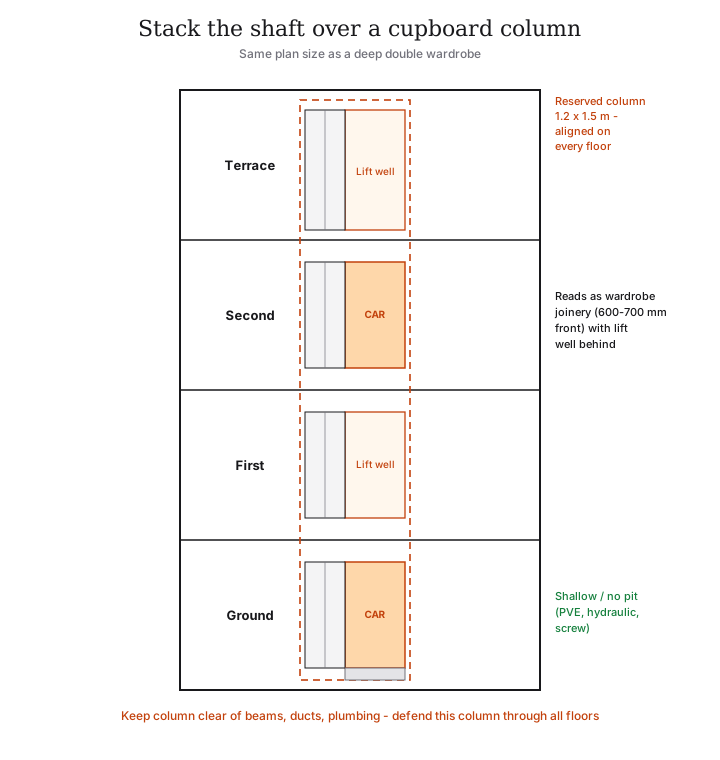
The most space-efficient idea for narrow homes is to stack the lift shaft vertically over a column of cupboards or a service stack, so the lift occupies floor area that was already committed to storage on the floors it does not stop at — or, more powerfully, to align the shaft with a built-in wardrobe footprint repeated on every level. Because a 1100 mm diameter PVE or a 1219 mm shaft has roughly the plan size of a deep double wardrobe, a homeowner can reserve a single 1.2 by 1.5 m column from ground to terrace and let it read as joinery on every floor while carrying the lift through the middle.
The discipline this demands:
- Align the column on every floor. The whole saving disappears if the wardrobe sits in a different corner upstairs. Decide the stack location once, at plan stage, and repeat it slavishly.
- Reserve the full vertical run. Even floors the lift does not serve must keep the column clear of beams, ducts and plumbing crossing the shaft.
- Match shaft and wardrobe depths. A 600 to 700 mm wardrobe is shallower than a lift well; design the joinery as a 1.2 to 1.5 m deep recess so the two reconcile, or pick a PVE whose slim cylinder fits the wardrobe footprint more naturally.
- Pick a pitless or shallow-pit lift. A 1500 mm pit under a wardrobe column is awkward to waterproof on a tight ground floor; hydraulic, screw and PVE options need little or no pit. See Lift Pit Requirements.
This is the narrow-plot equivalent of provisioning a shaft in advance — the same logic the Lift-Ready Future-Proof Home guide applies to homes that may add a lift years later.
Minimal-pit and pitless choices
A deep RCC pit is expensive and intrusive on a small plot, where the ground floor is precious and the water table may be high. The pit is effectively a waterproof concrete box designed for lateral earth pressure and buffer-impact loads, and on a narrow site it competes with the very rooms you are trying to protect. Choosing a low-pit technology removes that whole problem.
- No pit: pneumatic vacuum lifts need none — they are self-supporting and stand on the finished floor.
- Shallow pit (about 150 to 300 mm): hydraulic and screw/winding-drum lifts. A 150 to 300 mm recess is a modest slab detail, not an excavation.
- Deeper pit (about 300 to 610 mm, some gearless 1200 to 1500 mm): traction MRL. Only worth it if the smooth ride justifies the civil work, and only where the water table allows a waterproof box.
If a retrofit or a high water table makes any pit impractical, the PVE or a low-pit screw lift is your route. The trade-off detail lives in Lift Pit Requirements, and the retrofit case (cutting a lift into a finished narrow house) is covered in Retrofitting a Lift into an Existing Home.
Protecting daylight and circulation
The whole point of a narrow house is to make a slender plan feel generous. A badly placed lift undoes that in one move. Guard three things:
- Daylight. Keep the shaft on the blind party-wall side. A solid 1.5 m box on a window wall darkens every floor; on the party wall it costs nothing the rooms wanted.
- Circulation width. The passage past the lift landing must stay walkable — aim to keep a clear 900 mm or more, and remember an accessible car wants a 900 mm clear door and ideally a lobby approaching 1800 by 1800 mm where the plan can spare it (it rarely can on a 20-footer, so prioritise the door width). See Accessible Home Design (India) and Home Lift Space Requirements.
- Sightlines. A panoramic PVE or a glass-shaft lift, counter-intuitively, can help a narrow plan feel less boxed-in because you see through it; a solid masonry shaft reads as a heavy wall. On daylight-starved plots this is a real argument for glass.
A planning sequence for the narrow plot
1. Decide the family need first. Two persons or a wheelchair-plus-attendant? That single answer sets your minimum car, and on a narrow plot the smallest honest car wins.
2. Get the vendor GA drawing before you cast anything. The structural engineer designs the shaft, pit and overhead to the vendor's general-arrangement and reaction loads — never the reverse. See Lift Shaft Design and Home Lift Structural Design.
3. Lock the column position on the plan and repeat it on every floor. This is the move that makes a narrow plot work.
4. Specify the essentials. An ARD battery backup is non-negotiable in India given power cuts; automatic doors over manual swing doors; door sensors, overload sensor and intercom. Use the Lift Specification Checklist.
5. Check your state's lift licence. Roughly ten states (including Maharashtra, Karnataka, Tamil Nadu, Delhi, Gujarat, Kerala) require an installation and operation licence plus periodic government inspection — verify your state's Lift Act.
For the new-build version of this whole journey see Designing a Lift into a New House; for cost see Home Lift Cost (India 2026) and the Residential Elevator Buyer's Guide.
The compact lift that fits a 20-foot house is the one you reserve as a column on the first plan, place against the blind wall, and serve with the smallest car your family truly needs. Everything else is detailing.
References
- IS 14665 (Electric Traction Lifts), Part 1 — Outline Dimensions (BIS): https://law.resource.org/pub/in/bis/S05/is.14665.1.2000.pdf
- IS 14665, Part 2 — Code of practice for installation, operation and maintenance (BIS): https://law.resource.org/pub/in/bis/S05/is.14665.2.1-2.2000.pdf
- IS 15259 — Hydraulic Lifts (companion code; cited by name).
- National Building Code of India 2016, Part 8 (Building Services), Section 5 — Installation of Lifts, Escalators and Moving Walks (BIS): https://www.bis.gov.in/standards/technical-department/national-building-code/
- BIS Guide for Using NBC 2016: https://www.bis.gov.in/wp-content/uploads/2022/08/Booklet-Guide-for-Using-NBC-2016.pdf
- Rights of Persons with Disabilities Act 2016 (Sec 40, 44, 45): https://ssepd.odisha.gov.in/sites/default/files/2024-01/RPWD%20ACT.pdf
- CPWD / MoHUA Harmonised Guidelines and Space Standards for a Barrier-Free Built Environment: https://www.cpwd.gov.in/Publication/Harmonisedguidelinesdreleasedon23rdMarch2016.pdf
- State Lift Acts (e.g. Maharashtra Lifts, Escalators and Moving Walks Act 2017; Karnataka Lifts Act 2015; Delhi Lifts and Escalators Act 2007; Tamil Nadu Lifts Act 1997). Maharashtra licence to operate: https://services.india.gov.in/service/detail/maharashtra-license-to-operate-lift
- Lift regulations in India (overview): https://www.99acres.com/articles/know-all-about-the-lift-regulations-in-india.html
- Structural requirement for lifts and lift pits (Civilera): https://www.civilera.com/post/structural-requirement-for-lifts-and-lift-pits
All dimensions, costs and regulatory triggers above are indicative and vary by state, vendor and year. Confirm with your local municipal bye-laws, your state's Lift Act, a licensed lift contractor and your structural engineer before building.
Export this guide
Related Guides — Deep-dive reading
Architect's Residential Elevator Planning Handbook (India): Shaft, Loads, Code & Coordination
The plan-stage reference for carrying a home lift through the drawing board — shaft, structure, pit, code, licensing and accessibility.
Home Lifts & AccessibilityDesigning Adaptable & Universal-Design Homes
Accessibility, Aging-in-Place, and the Multi-Stage Family — Code, Anthropometrics, and Plan-Stage Discipline for Indian Residential Architects
Room PlanningLift Integration with Staircase Design (India): The Stair-and-Lift Core Done Well
Putting the lift in the stair void or beside the stair as one vertical-circulation core — void sizes, shared walls and landings, daylight, and landing at the same levels.
Home Lifts & AccessibilityRelated Tools — Try Free
Cross-Ventilation Analyzer
Estimate airflow and air changes per hour (ACH) from room size, window areas, layout, and local wind — with NBC 2016 Part 8 compliance check.
Ventilation CalculatorHome Lift Comparison Tool
Compare hydraulic, traction, pneumatic vacuum and screw lifts side by side for your home.
Lift ComparisonHome Lift Cost Calculator
All-in home lift cost by floors, type, capacity and city — equipment, civil, GST and AMC, with a drive-type comparison.
Lift Calculator