
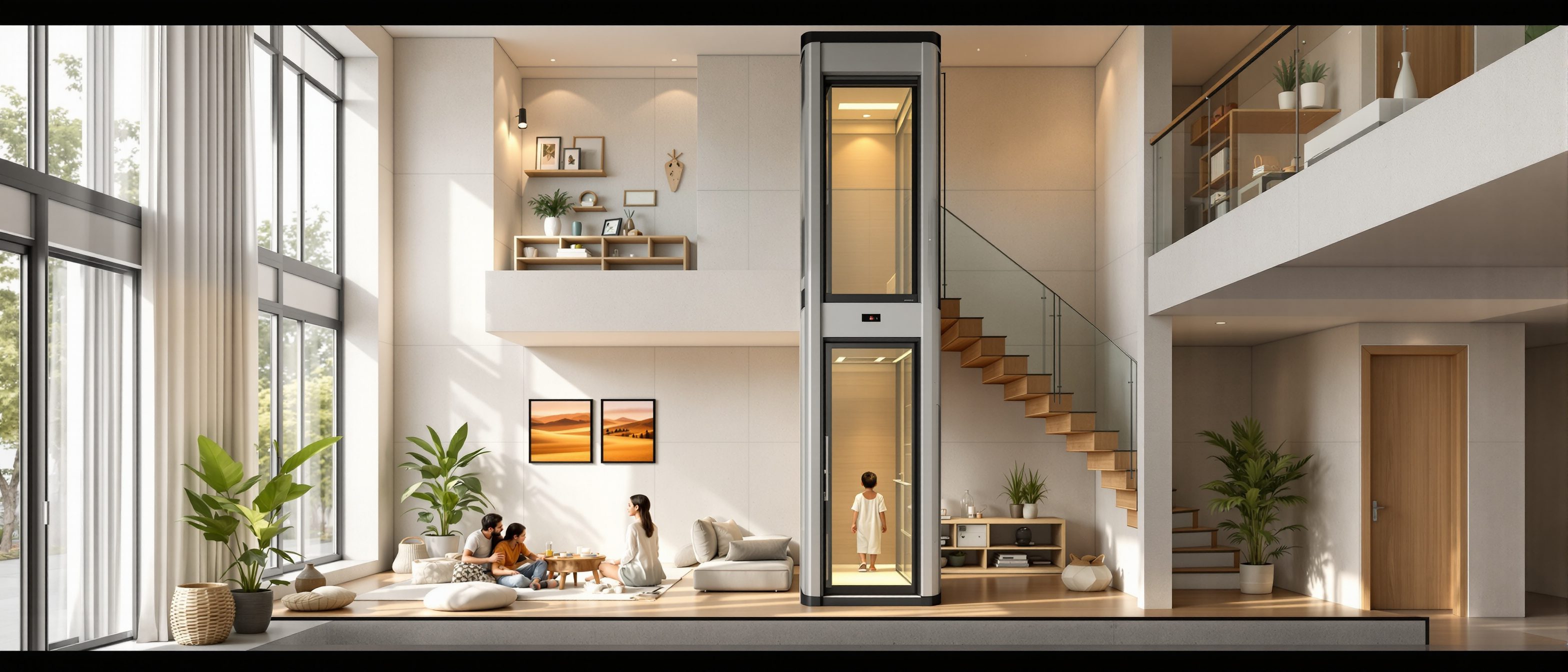
Lift Planning for Duplex Homes (India): Two-Level Living, One Smart Lift
Planning a 2-stop lift for a duplex apartment or two-storey unit — placement beside the stair, the best lift types over two levels, apartment space and headroom, slab-cutting and society permissions, and finish.
A duplex changes the lift conversation entirely. In a four- or five-storey independent house, the lift is about reaching the roof; in a duplex — whether it is a two-storey apartment carved out of a high-rise floor plate, or a two-storey independent unit — the lift exists to join just two levels that one family already lives across. That sounds trivial, and the marketing photos make it look effortless. The reality is that a duplex lift is one of the most constrained installations you can attempt: you usually have one short rise, an internal staircase you do not want to lose, a slab between the floors that someone else owns the structural rights to, and a society or builder whose permission you need before a single core is drilled.
This guide goes narrow on exactly that problem — planning a two-stop lift for a duplex in the Indian context. For everything common to all home lifts (types, codes, costs, AMC) lean on the Architect's Residential Elevator Handbook, which is the pillar for this whole cluster. Here we stay on the duplex: where the lift goes relative to the stair, which lift type actually fits two levels, how much room and headroom you realistically need inside an apartment, the slab-cutting and permission problem, and how to integrate the finished thing so it reads as architecture, not an afterthought.
A duplex lift is not a small building lift. It is a piece of furniture that happens to move — plan it like joinery first and machinery second.
What "duplex" means for the lift
Two physical situations get called "duplex" in India, and they behave very differently for a lift:
- The duplex apartment — two floors of a multi-storey building combined into one unit (very common in metros and in builder "4BHK duplex" offerings). The slab between your two floors is part of the building's structure; the shaft, if any, drops through floors that other flats sit above and below. Here the permission problem dominates.
- The duplex / two-storey independent unit — a stand-alone house of ground plus one upper floor, or a row/villa unit. The slab is yours, the roof is yours, and the constraint is mostly space and structure rather than permission.
In both cases the lift is almost always a 2-stop machine: lower level and upper level, full stop. That single fact is the most useful planning input you have. Two stops means a short rise (typically a single floor-to-floor height of roughly 3.0 to 3.6 m, so a travel of around 3 m), a small motor duty cycle, and — crucially — that shaftless and low-pit lift types become genuinely viable, which they are not once you climb to four or five stops.
Where the lift goes: the lift–stair relationship
In a duplex, the lift and the staircase are partners, not rivals. You are not removing the stair — building bye-laws and basic fire sense require a usable stair regardless — so the question is always how the lift sits next to the stair you are keeping. Three placement patterns cover almost every duplex.
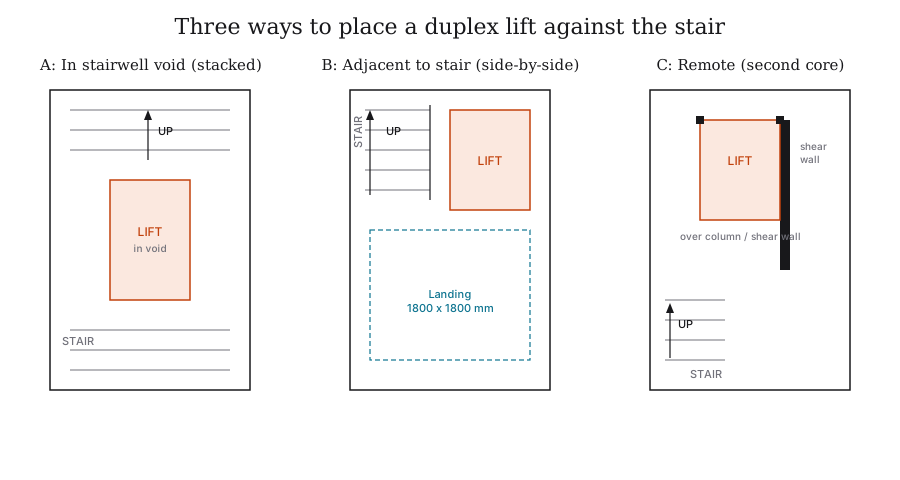
1. In the stairwell void (the "stacked" option). Many duplex stairs — especially dog-leg or U-return stairs — enclose a rectangular void in the middle. A compact shaftless lift, or a slim PVE cylinder, can drop straight into that void. It is the most space-efficient option because the lift uses footprint the stair has already "spent". The catch: the void is rarely a clean 1100 mm square, and the stair structure and handrail must clear the cabin's swing and doors.
2. Adjacent to the stair (the "side-by-side" option). The lift sits in its own pocket immediately beside the stair flight, sharing the circulation core. This is the cleanest option architecturally — arrive at one core, choose stair or lift — and it is the easiest to make wheelchair-friendly because the landing in front of the lift can be sized properly. It costs the most floor area.
3. Remote from the stair (the "second core" option). Occasionally the only structurally sound place to cut the slab is away from the stair — over a column line, against a shear wall, or in a corner that avoids beams. The lift then becomes a second vertical route. This is common in retrofit duplexes where you take what the structure allows; see the retrofitting a lift into an existing home guide for the cut-in mechanics, and the dedicated lift and staircase integration guide for combining the two routes gracefully.
A traditional Vastu layer often sits on top of this. Many Indian clients prefer the lift in the north or north-east, with south-east or north-west acceptable, and want to avoid the south-west corner and the exact centre (Brahmasthan). The staircase is itself traditionally pushed to the south-west, and the lift is then kept adjacent to it. Treat all of this as a cultural preference to reconcile with the structure, not a rule that overrides where the slab can safely be cut — engineering wins where they conflict. The staircase Vastu and Vastu house plan guides go deeper, as does lift placement and Vastu in this cluster.
Best lift types for a duplex
Because a duplex is a 2-stop, short-travel job, you have more good options than a multi-storey house does — the very types that struggle with height shine over two levels.
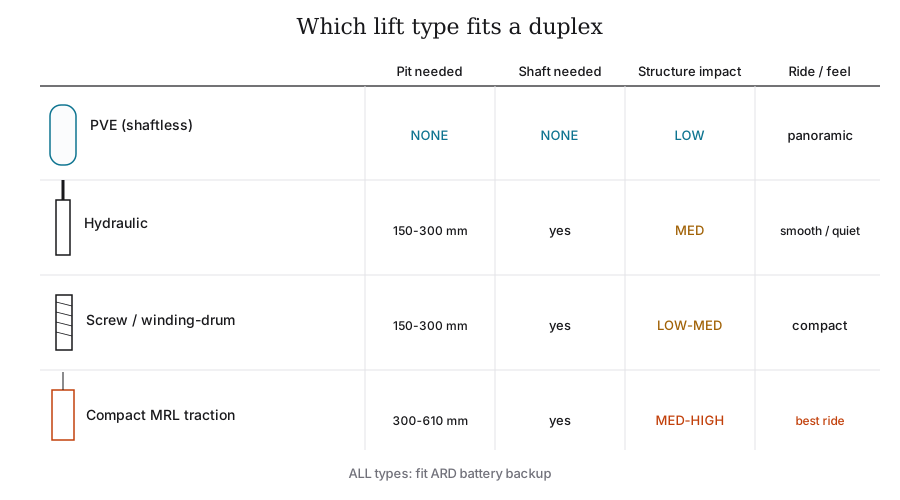
- Pneumatic Vacuum Elevator (PVE / shaftless). Air pressure lifts a panoramic cylindrical cabin. No pit, no shaft, no machine room, self-supporting — it bolts to the floors and stands on its own. For a duplex apartment where you cannot easily build an RCC shaft or cut a deep pit, this is often the single most practical answer. Capacity is limited (about 2 to 3 persons) and it draws more power on the way up (it descends on controlled gravity), but over a 2-stop duplex those limits barely bite. Indicative ₹11–22 lakh. Nibav is the best-known India-grown PVE brand.
- Compact MRL traction. Machine-room-less traction puts the motor inside the hoistway — the 2026 norm. Smooth, energy-efficient and the nicest ride, it needs a proper (if small) shaft and a little more pit and headroom than the shaftless types. Best where you are building or can build a clean RCC well. Indicative ₹10–25 lakh+.
- Hydraulic. A ram pushes the car; quiet, smooth and genuinely happy at 2 stops, with a shallow pit of only ~150–300 mm and a power pack that hides in a small adjacent cabinet. Cost-effective at ₹8–20 lakh. The mild oil/temperature considerations are easy to manage in a home.
- Screw / winding-drum. Self-supporting, low pit (~150–300 mm), compact and low-maintenance — another strong fit for a duplex where pit depth is the headache. Indicative ₹14–30 lakh.
For a duplex apartment, the decision usually collapses to PVE if you cannot build a shaft, hydraulic or screw if you can manage a shallow pit, and MRL if you are building the well from scratch and want the best ride. Always fit an Automatic Rescue Device (ARD) battery backup whatever you choose — Indian power cuts make it non-negotiable, so it brings the car to a floor and opens the doors during an outage.
All figures are indicative — confirm with your local municipal bye-laws and a licensed lift contractor. For the full type comparison and cost build-up, see the residential elevator buyer's guide and home lift cost in India 2026.
Duplex scenarios at a glance
The "right" lift depends on which kind of duplex you have and what you can do to the structure. This table maps the common cases.
| Duplex scenario | Slab / structure reality | Best-fit lift types | Pit needed | Likely permission hurdle | Indicative cost band |
|---|---|---|---|---|---|
| Duplex apartment, no shaft possible | Cannot build RCC well; cutting one slab opening only | PVE (shaftless), screw | None (PVE) / ~150–300 mm (screw) | Society/builder NOC for slab cut + load on common structure | ₹11–30 lakh |
| Duplex apartment, builder-left provision | Provision/duct or stair void available | Compact MRL, hydraulic, PVE | ~150–610 mm by type | Society approval to use the provision; structural sign-off | ₹8–25 lakh+ |
| Independent two-storey unit, new build | Slab and well designed in from the start | MRL traction (best ride), hydraulic | 300–610 mm (MRL) / 150–300 mm (hydraulic) | Municipal plan sanction; state lift licence | ₹8–25 lakh+ |
| Independent two-storey unit, retrofit | Owner controls slab; one floor to cut | Hydraulic, screw, PVE | 150–300 mm or none (PVE) | Local bye-law + state lift registration | ₹8–22 lakh |
| Stacked in stairwell void | Irregular void, stair structure tight to cabin | PVE cylinder, slim shaftless | None / minimal | Clearances to stair, handrail, doors | ₹11–22 lakh |
Space and headroom inside an apartment
A duplex hides its lift in a tighter envelope than a freestanding house ever does, so the dimensional discipline matters more.
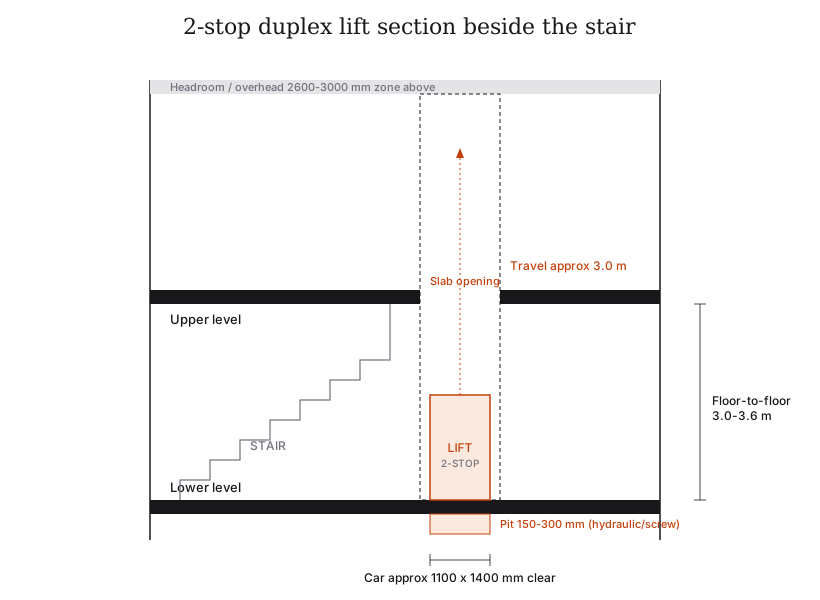
- Shaft / hoistway footprint. A small home car starts around 1219 × 1524 mm (4' × 5') and grows with capacity and door type. If you intend the lift to take a wheelchair plus an attendant — sensible future-proofing — size the car nearer 1100 × 1400 mm clear and the well accordingly.
- Pit. Hydraulic and screw need only ~150–300 mm; traction needs ~300–610 mm, and some modern gearless types want 1200–1500 mm; PVE needs no pit at all. In an apartment you often cannot dig down at all — the floor below is someone else's ceiling — which is precisely why low-pit and pitless types dominate the duplex-apartment case.
- Headroom / overhead. Plan for roughly 2600–3000 mm of overhead depending on model; MRL removes the old "machine room on top" demand by putting the machine in the hoistway. In a duplex the overhead lands inside the upper floor's ceiling zone, so coordinate it with beams and any false ceiling early.
- Lift lobby. For an accessible installation, allow a landing of about 1800 × 1800 mm in front of the doors so a wheelchair can turn — easier to find at the side-by-side placement than in a stair void.
For the full dimensional treatment, go to the home lift space requirements guide; for the well itself, the lift shaft design guide. If you are still at drawing stage, designing a lift into a new house and the lift-ready, future-proof home cover provisioning so you never have to cut a slab.
Cutting the slab and getting permission
This is the step that catches duplex owners out, and it splits cleanly by duplex type.
In a duplex apartment, the slab between your two floors is part of the building's structure, and the openings or shaft you create transfer load into common structure. That means two things. First, a structural engineer must check the slab cut — a lift opening removes a panel of slab and the surrounding beams must carry the redistributed load and any guide-rail bracket reactions. The well wall, where one exists, is typically a 150–200 mm RCC wall left unplastered on its inner face, and it must take guide-rail bracket forces; the exact reaction loads and bracket positions come from the lift supplier's general-arrangement (GA) drawing — never finalise the opening before the vendor's GA is fixed. Second, you almost always need society or builder permission (an NOC) because you are altering common structure and adding mechanical load. Budget time for this; it is the longest-lead item in many duplex projects.
In an independent two-storey unit, the slab is yours, but the structural logic is identical: cut to the vendor's GA, design the surrounding beams and any pit walls (a pit is a waterproof RCC box that must resist lateral earth pressure and buffer-impact forces) to the supplier's reaction schedule. Pit and overhead slabs commonly crack when buffer/impact forces are underestimated — get the reaction schedule in writing. The home lift structural design, lift pit requirements and lift machine room requirements guides carry the engineering detail.
The cheapest duplex lift is the one you provisioned before the slab was cast. The second cheapest is a PVE that needs no slab opening at all. Everything in between is a structural and approvals project — plan it as one.
On the regulatory side: lifts are state-regulated, and roughly ten states (Maharashtra, Gujarat, Karnataka, Kerala, Tamil Nadu, Assam, West Bengal, Delhi, Haryana, Himachal Pradesh) require an installation licence before commissioning, an operation licence / registration, and periodic inspection by the State Electrical or Lift Inspectorate (government inspectors, not private firms). NBC 2016 Part 8 Section 5 and IS 14665 remain the technical baseline everywhere. Most duplexes sit well below the ~15 m fireman's-lift trigger, so a normal 2-stop home lift is fine — but a passenger lift is never a fire escape; it should park at a designated level with doors open on alarm, and occupants use the stair. See lift fire safety planning.
Finish and integration
Because a duplex lift is seen at close range from a living space — not tucked in a service core — finish carries weight.
- Doors. Automatic telescopic/sliding doors ride better and are wheelchair-accessible; manual swing doors are cheaper but block a wheelchair and feel utilitarian in a home. For a duplex, spend on automatic doors.
- Cabin character. A PVE's panoramic glass cylinder can become a feature object in a double-height living volume; a traction or hydraulic car can be finished in timber, mirror or stone to match the joinery. The lift design for luxury residences guide explores high-end cabins.
- Reading as architecture. The lift should belong to the same gesture as the stair — shared material palette, aligned thresholds, lighting that treats the two routes as one core. The lift and staircase integration and designing a staircase in India guides cover this pairing; for the unit itself, duplex house plans shows how the two levels want to connect.
- Accessibility touches. Even in a private duplex, the CPWD/MoHUA benchmarks are worth borrowing — a ≥900 mm clear door, a handrail at 800–1000 mm, audio-plus-visual floor indicators, and a rear mirror to reverse a wheelchair out. They future-proof the home for ageing in place; see accessible home design and senior-friendly lift planning.
Before you sign anything, run the lift specification checklist so nothing — ARD, door type, pit waterproofing, society NOC, state licence — slips through.
References
- IS 14665 (Electric Traction Lifts), BIS — Part 1 outline dimensions (car, well, pit, headroom) and Part 2 installation/operation/maintenance. https://law.resource.org/pub/in/bis/S05/is.14665.1.2000.pdf and https://law.resource.org/pub/in/bis/S05/is.14665.2.1-2.2000.pdf
- IS 15259 — Hydraulic lifts (companion code), by name.
- National Building Code of India 2016, Part 8 (Building Services), Section 5 — Installation of Lifts, Escalators and Moving Walks, BIS. https://www.bis.gov.in/standards/technical-department/national-building-code/ and https://www.bis.gov.in/wp-content/uploads/2022/08/Booklet-Guide-for-Using-NBC-2016.pdf
- RPwD Act 2016 (Rights of Persons with Disabilities) — accessibility standards benchmark. https://ssepd.odisha.gov.in/sites/default/files/2024-01/RPWD%20ACT.pdf and https://depwd.gov.in/en/faqs-4/
- CPWD / MoHUA Harmonised Guidelines and Space Standards for a Barrier-Free Built Environment (2016). https://www.cpwd.gov.in/Publication/Harmonisedguidelinesdreleasedon23rdMarch2016.pdf
- State Lift Acts — e.g. Maharashtra Lifts, Escalators and Moving Walks Act 2017; Karnataka Lifts, Escalators and Passenger Conveyors Act 2015; Delhi Lifts and Escalators Act 2007; Tamil Nadu Lifts Act 1997. Maharashtra licence to operate: https://services.india.gov.in/service/detail/maharashtra-license-to-operate-lift
- Lift regulations overview (99acres): https://www.99acres.com/articles/know-all-about-the-lift-regulations-in-india.html
- Structural requirement for lifts and lift pits (Civilera): https://www.civilera.com/post/structural-requirement-for-lifts-and-lift-pits
- RCC lift well / shaft structural design (SketchUp 3D Construction): https://www.sketchup3dconstruction.com/const/guidelines-for-making-perfect-structural-design-of-a-lift.html
- Lift Vastu guidance: https://www.nobroker.in/blog/lift-vastu/ and https://www.subhavaastu.com/vastu-tips-lift.html
All regulatory figures, dimensions and prices above are indicative and vary by state, vendor and year. Confirm with your local municipal bye-laws, a licensed lift contractor and your structural engineer before you commit.
Export this guide
Related Guides — Deep-dive reading
Lift Integration with Staircase Design (India): The Stair-and-Lift Core Done Well
Putting the lift in the stair void or beside the stair as one vertical-circulation core — void sizes, shared walls and landings, daylight, and landing at the same levels.
Home Lifts & AccessibilityArchitect's Residential Elevator Planning Handbook (India): Shaft, Loads, Code & Coordination
The plan-stage reference for carrying a home lift through the drawing board — shaft, structure, pit, code, licensing and accessibility.
Home Lifts & AccessibilityDesigning a Lift into a New House (India): Getting It Right at the Plan Stage
Where to place the lift, which type to commit to early, what shell to reserve, and how to coordinate architect, structural engineer and vendor before a single column is cast.
Home Lifts & AccessibilityRelated Tools — Try Free
Home Lift Comparison Tool
Compare hydraulic, traction, pneumatic vacuum and screw lifts side by side for your home.
Lift ComparisonHome Lift Cost Calculator
All-in home lift cost by floors, type, capacity and city — equipment, civil, GST and AMC, with a drive-type comparison.
Lift CalculatorAccessibility Compliance Calculator
Check a planned lift against the CPWD and RPwD accessible-lift benchmarks for a score.
Lift Checker