
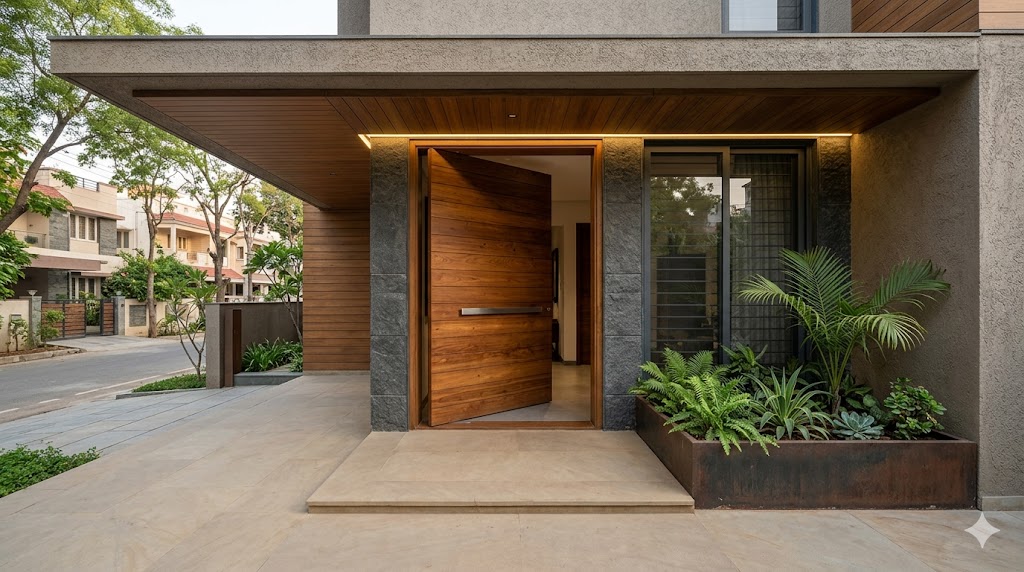
Designing Adaptable & Universal-Design Homes
Accessibility, Aging-in-Place, and the Multi-Stage Family — Code, Anthropometrics, and Plan-Stage Discipline for Indian Residential Architects
Indian residential architecture is built almost exclusively for the able-bodied 35-year-old. The bathrooms are dimensioned for someone who can stand, balance, step over a shower threshold, and reach a tap with full arm extension. The doorways are sized for someone who walks unassisted. The corridors permit one-person passage. The kitchen counters are at one height. Every assumption baked into the standard residential plan presumes a user who is not currently and will never be disabled, elderly, recovering from surgery, pregnant in the third trimester, carrying an infant, or living with anyone who is.
Each of these presumptions is wrong, eventually, for every household. The Indian population over 60 will reach 19% by 2050, up from 10% in 2020 — a National Statistical Office projection (2021) confirmed by the longitudinal LASI study. One in seven Indian households is multi-generational. Two-thirds of homeowners eventually experience temporary mobility limitation through injury or surgery. Roughly 2.2% of the population has a permanent disability registered under the Rights of Persons with Disabilities Act, 2016 — and twice that figure live with one. The standard residential plan fails its users at some point in nearly every project.
Universal design is the design discipline that anticipates this failure at plan stage and prevents it. It is not a specialist discipline reserved for specifically commissioned accessible homes; it is a general residential discipline whose techniques cost very little when designed-in at Stage 2 and cost a great deal — sometimes the entire bathroom or kitchen — when retrofitted at year 15. This guide is the working reference for that discipline.
The regulatory framework, the anthropometric foundations, the room-by-room dimensional schedule, the cost-premium analysis, and the working-drawing deliverables are all here. The treatment is intended for the Indian residential context — apartments and houses, urban and small-town, FSI-constrained and otherwise. It is the design-stage companion to the post-occupancy Home Safety Audit and the Maintenance Checklist tools.
"Designing for people with disabilities is not a special thing — it is just designing well." — Selwyn Goldsmith (1932–2011), British architect, author of Designing for the Disabled (1963), the foundational anglophone text on accessible design
1. The Regulatory Framework — What India Requires
Indian residential architects must work within four overlapping regulatory layers when universal design is in scope. The layers are not always co-extensive, and the architect's first task is to know which layer applies to a given project.
The Statutory Layer
Rights of Persons with Disabilities Act, 2016 (RPwD Act). §40 of the RPwD Act mandates that the appropriate Government, in consultation with the Chief Commissioner for Persons with Disabilities, formulate rules laying down the standards of accessibility for the physical environment, transport, and information & communication. The Act applies to public buildings; its applicability to private residential buildings is indirect — through state building rules, NBC adoption, and lender or insurer requirements.
The Persons with Disabilities (Equal Opportunities, Protection of Rights and Full Participation) Rules. State-level rules implementing the RPwD Act vary; architects must verify the prevailing rules in the project's state.
Accessible India Campaign (Sugamya Bharat Abhiyan). Government of India programme, launched 2015, with measurable accessibility targets for public buildings, transport, and ICT. Indirect influence on the residential market through the cultural normalisation of accessibility.
The Code and Guideline Layer
National Building Code of India, NBC 2016, Part 3 — Development Control Rules & General Building Requirements, Section 13 — Special Requirements for Differently Abled Persons. This is the most directly applicable national-level reference for residential planning, with dimensional requirements for ramps, doorways, bathrooms, and circulation.
CPWD Handbook on Barrier Free and Accessibility (2014, revised editions in continued use). Central Public Works Department reference for the design of accessible facilities — the de-facto Indian design manual.
Harmonised Guidelines and Space Standards for Barrier Free Built Environment for Persons with Disability and Elderly Persons (Ministry of Housing and Urban Affairs, 2016, revised 2021). The most widely-cited current Indian standards document for accessibility in the built environment.
IS 4963:1987 (Reaffirmed 2017) — Recommendations for Building and Facilities for the Physically Handicapped. Bureau of Indian Standards. Older but still referenced.
The International-Reference Layer
For specifications not fully covered by the Indian framework, architects refer to:
- ISO 21542:2011 — Building construction — Accessibility and usability of the built environment. International consensus standard.
- ADA 2010 Standards for Accessible Design. US Department of Justice. Strong on dimensions and tested compliance.
- BS 8300-1:2018, BS 8300-2:2018 — Design of an accessible and inclusive built environment. British Standards Institution.
These are useful supplements where the Indian framework is silent or where the project owner explicitly desires an international-standard outcome.
The Project-Specific Layer
For specific clients with known disabilities, the architect's audit (per the Architect's Scope of Services Stage 1) must capture user-specific dimensional requirements. A wheelchair user's specific chair, an ambulant disabled user's gait pattern, a visually-impaired user's preferred wayfinding strategy — these are project inputs that supersede generic guidelines.
2. The Seven Principles of Universal Design
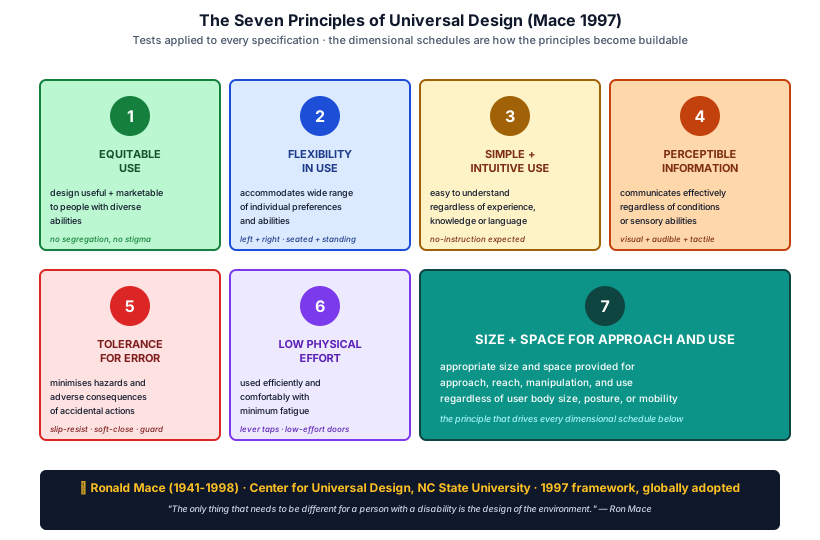
The foundational framework — first articulated by Ronald Mace and the Center for Universal Design at North Carolina State University in 1997 and globally adopted — comprises seven principles. The Indian residential architect should commit them to working memory:
1. Equitable Use — the design is useful and marketable to people with diverse abilities
2. Flexibility in Use — the design accommodates a wide range of individual preferences and abilities
3. Simple and Intuitive Use — the design is easy to understand regardless of user experience, knowledge, language, or concentration
4. Perceptible Information — the design communicates necessary information effectively, regardless of ambient conditions or sensory abilities
5. Tolerance for Error — the design minimises hazards and adverse consequences of accidental actions
6. Low Physical Effort — the design can be used efficiently and comfortably with minimum fatigue
7. Size and Space for Approach and Use — appropriate size and space is provided for approach, reach, manipulation, and use regardless of user's body size, posture, or mobility
These principles operate at every scale — from the front door handle to the floor plan. They are not specifications; they are tests applied to every specification. The dimensional schedules in §4–§9 are how the principles become buildable.
"The only thing that needs to be different for a person with a disability is the design of the environment." — Ronald Mace (1941–1998), founder of the Center for Universal Design, who used a wheelchair throughout his career as an architect
3. Anthropometric Foundations — The Universal Envelope
The dimensional schedules that follow are derived from a small number of anthropometric envelopes. The architect who internalises these envelopes can re-derive the dimensions of any plan element from first principles.
The Wheelchair Envelope
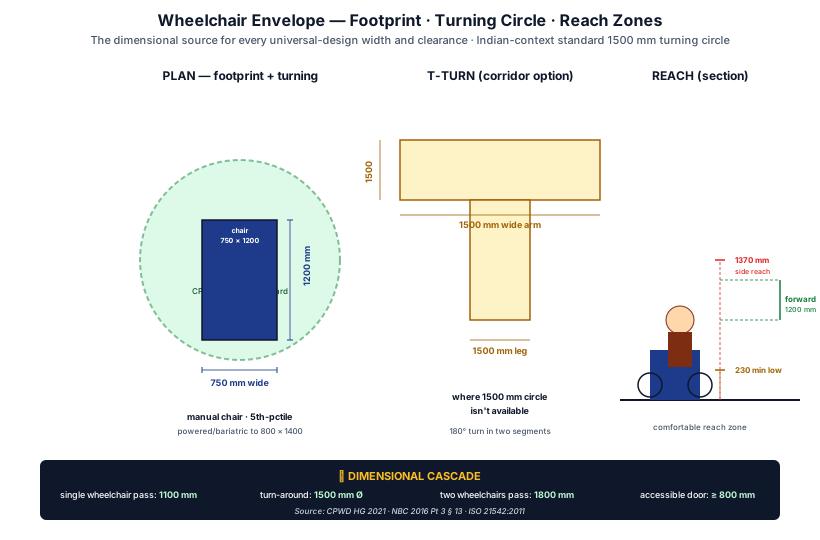
Stationary wheelchair footprint — approximately 650–750 mm wide × 1100–1250 mm long. The 5th percentile is the standard manual wheelchair; powered chairs and bariatric models extend up to 800 × 1400 mm. Indian-context design typically uses 750 × 1200 mm as the working dimension.
Wheelchair turning radius — the 360-degree turning circle requires a clear circle of 1500 mm diameter for manual chairs and 2000 mm for powered chairs. The Indian-context design standard from CPWD HG 2021 is 1500 mm.
Wheelchair T-turn — where a 180-degree turn is required in a corridor without a 1500-mm circle, a T-shaped clear space (1500 mm × 1500 mm with two 900-mm-wide arms) suffices.
Wheelchair reach — forward reach extends to 1200 mm above floor level (AFL); side reach extends to 1370 mm; high reach over an obstruction is reduced. Low reach is constrained to 230 mm AFL minimum (chair frame interferes below this).
The Ambulant-Disabled Envelope
A user with crutches, a walker, or a cane requires more passing space than an unaided walker but less than a wheelchair user. Working dimensions:
- Walker footprint — 600 mm × 700 mm; user occupies an envelope ~750 mm wide
- Crutches passing width — 900 mm minimum, 1000 mm preferred
- Cane user passing width — 800 mm minimum
- Step-up height with mobility limitation — 150 mm maximum (versus 175–200 mm for unimpaired users)
- Reach (standing, ambulant disabled) — 600–1700 mm AFL comfortable; 1900 mm with strain
The Older-Person Envelope
Beyond age 65, the body's dimensional envelope shifts:
- Reach ceiling reduces by ~80 mm per decade after 60
- Stride length reduces by 15–25%
- Balance recovery time increases — implies tolerances on level changes, slip resistance, and grab-bar provision
- Visual contrast threshold increases — implies higher contrast at edge details (stair nosings, door frames, switch plates)
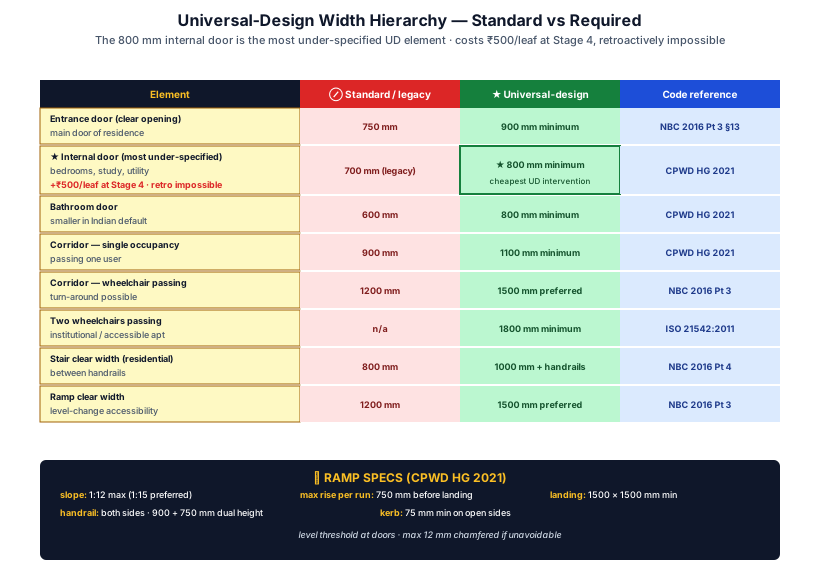
The Universal-Design Width Hierarchy
The dimensional cascade for clear widths in residential plans:
| Element | Standard Spec | Universal-Design Spec | Code Reference |
|---|---|---|---|
| Entrance door clear opening | 750 mm | 900 mm minimum | NBC 2016 Part 3 §13 |
| Internal door clear opening | 700 mm | 800 mm minimum | CPWD HG 2021 |
| Bathroom door clear opening | 600 mm | 800 mm minimum | CPWD HG 2021 |
| Corridor — single occupancy | 900 mm | 1100 mm minimum | CPWD HG 2021 |
| Corridor — wheelchair passing | 1200 mm | 1500 mm preferred | NBC 2016 Part 3 |
| Two wheelchairs passing | n/a | 1800 mm minimum | ISO 21542 |
| Stair clear width (residential) | 800 mm | 1000 mm with handrails | NBC 2016 Part 4 |
| Ramp clear width | 1200 mm | 1500 mm preferred | NBC 2016 Part 3 |
The 800-mm internal door is the single most under-specified universal-design element in Indian residential practice. The 700-mm door is the legacy standard; the 800-mm door costs ~₹500 more per leaf, increases the partition span by 100 mm, and is retroactively impossible without demolishing the partition. Specifying 800 mm at Stage 4 is the cheapest universal-design intervention available.
4. Site Approach and Entrance — The First Threshold
The accessible house begins at the property line. A perfectly accessible interior reached only by a flight of steps is, for a wheelchair user, an inaccessible house. The site-and-approach discipline operates at four levels.
Parking and Drop-off
Accessible parking bay — 3300 mm wide × 5400 mm long, with a 1200-mm transfer aisle on one side (or shared between two bays). Surface must be firm, level (cross-slope < 1:50), and within 30 m of the accessible entrance.
Drop-off zone — at least one 1500-mm-wide shelter-covered drop-off point at the accessible entrance, with kerb-cut to the level approach.
The Accessible Path
From parking or drop-off to the entrance, a continuous accessible path:
- Width — 1200 mm minimum; 1500 mm preferred
- Surface — firm, slip-resistant, glare-free; no loose gravel
- Cross-slope — maximum 1:50 (2%)
- Longitudinal slope — maximum 1:20 (5%); above this becomes a ramp with handrail and landing requirements
- Detectable warning — at any junction with vehicular path, a 600-mm-wide tactile-paving warning strip
The Ramp
Where level changes are unavoidable, a ramp is provided alongside any steps:
| Parameter | Specification |
|---|---|
| Maximum slope | 1:12 (8.33%) per CPWD HG 2021; 1:15 preferred for older users |
| Maximum rise per ramp run | 750 mm before a level landing |
| Landing dimensions | 1500 mm × 1500 mm minimum at top, bottom, and at any direction change |
| Handrail | Both sides; 900 mm and 750 mm AFL (dual height); 300-mm extension beyond ramp ends |
| Edge protection | 75-mm minimum kerb on open sides |
| Surface | Slip-resistant; visual contrast at ramp edges |
The Threshold
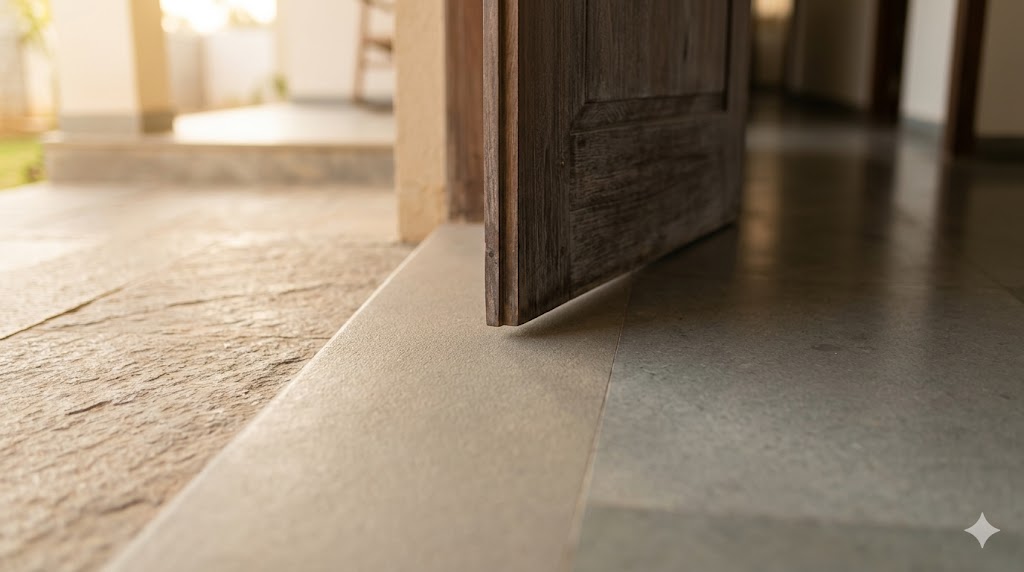
The most common entrance failure is the step — a 25-to-150 mm rise at the front door created by waterproofing detail or sill-frame default. The universal-design specification is a level threshold — flush floor on both sides of the door, with weather protection achieved by overhang and sloped exterior paving rather than a raised lip. Where a threshold is technically unavoidable, it must not exceed 12 mm (chamfered) per CPWD HG 2021.
The threshold detail requires plan-stage coordination with the structural slab level, the waterproofing layer, the floor finish thickness, and the external paving — a Stage-4 working drawing matter that must be solved at Stage 2 in plan to be solvable at all.
5. The Bathroom — The Highest-Stakes Room
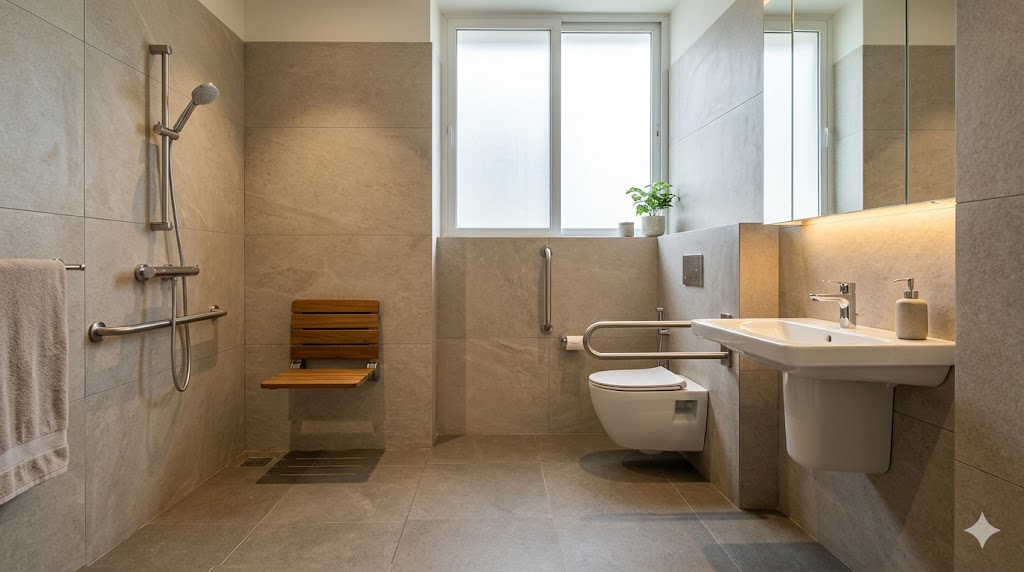
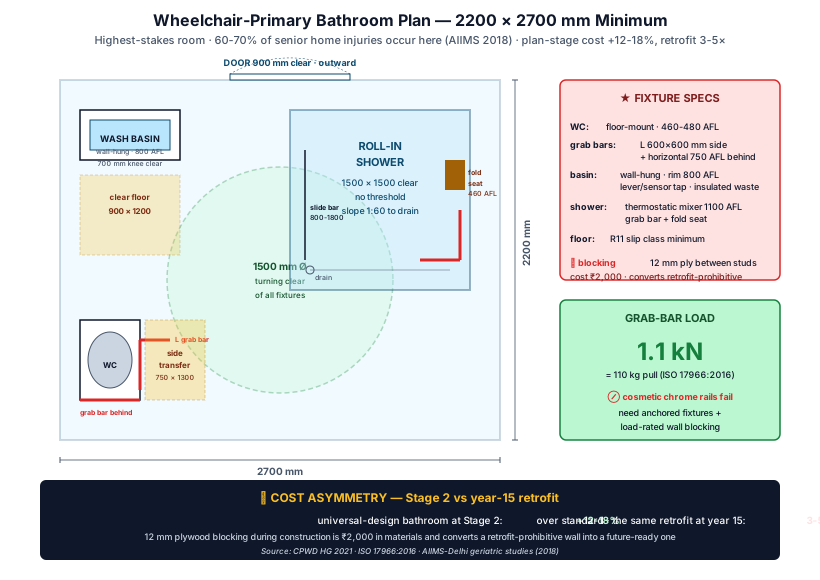
The bathroom is the most consequential room for universal design. It is where falls occur — accounting for 60–70% of home injuries among Indian seniors per AIIMS-Delhi geriatric studies (2018). It is the most-modified room in retrofit work. And it is the room where the cost of plan-stage design versus retrofit is most asymmetric — a universal-design bathroom designed at Stage 2 costs ~12–18% more than a standard one; the same retrofit at year 15 costs three to five times the original bathroom budget.
Minimum Dimensions
Standard accessible bathroom (non-wheelchair-primary use):
- Footprint: 1800 mm × 2400 mm minimum
- Door clear width: 800 mm
- Door swing: outward (preferred) or pocket-sliding
- Walk-in shower: 1200 × 1200 mm clear, no threshold
- WC clear floor: 800 mm × 1300 mm with grab bars on adjacent walls
- Wash basin clear floor: 800 mm × 1100 mm with knee space below
Wheelchair-primary bathroom:
- Footprint: 2200 mm × 2700 mm minimum
- Door clear width: 900 mm
- Wheelchair turning circle: 1500 mm clear of all fixtures
- Roll-in shower: 1500 × 1500 mm clear, no threshold, slope 1:60 to drain
- WC: side transfer space 750 mm × 1300 mm clear
- Wash basin: clear floor 900 × 1200 mm with 700-mm knee clearance below; counter at 800 mm AFL
The Five Fixture Specifications
| Fixture | Universal-Design Specification |
|---|---|
| WC | Floor-mounted (load-rated for grab-bar pull); seat at 460–480 mm AFL; flush actuator on accessible side |
| WC grab bars | One horizontal at 750 mm AFL behind WC; one horizontal+vertical "L" on side wall, 600 mm × 600 mm leg |
| Wash basin | Wall-hung (no pedestal); rim at 800 mm AFL; lever or sensor tap; insulated waste pipe (no skin contact) |
| Shower | Walk-in (no kerb); thermostatic mixer at 1100 mm AFL; hand-shower on slide bar 800–1800 mm range; fixed grab bar; fold-down seat at 460 mm AFL |
| Bathtub (where retained) | Built-in seat; grab bar at rim; lever taps within reach from seated position |
The grab-bar specification is non-trivial. Grab bars must be capable of supporting a 1.1 kN load (110 kg pull) per ISO 17966:2016 — not the cosmetic chrome rails sold in the retail market, but properly anchored fixtures with load-rated wall blocking. The wall blocking must be installed during construction, not as a retrofit; a 12-mm plywood blocking layer between studs on the future grab-bar wall costs ₹2,000 in materials and converts a retrofit-prohibitive wall into a future-ready one.
The Slip-Resistance Specification
Bathroom floors must achieve R10 minimum slip resistance per DIN 51130; R11 preferred for shower zones. The detailed flooring specification is in the Flooring & Finishes Specification guide.
6. The Kitchen — Universal Layout, Variable Heights
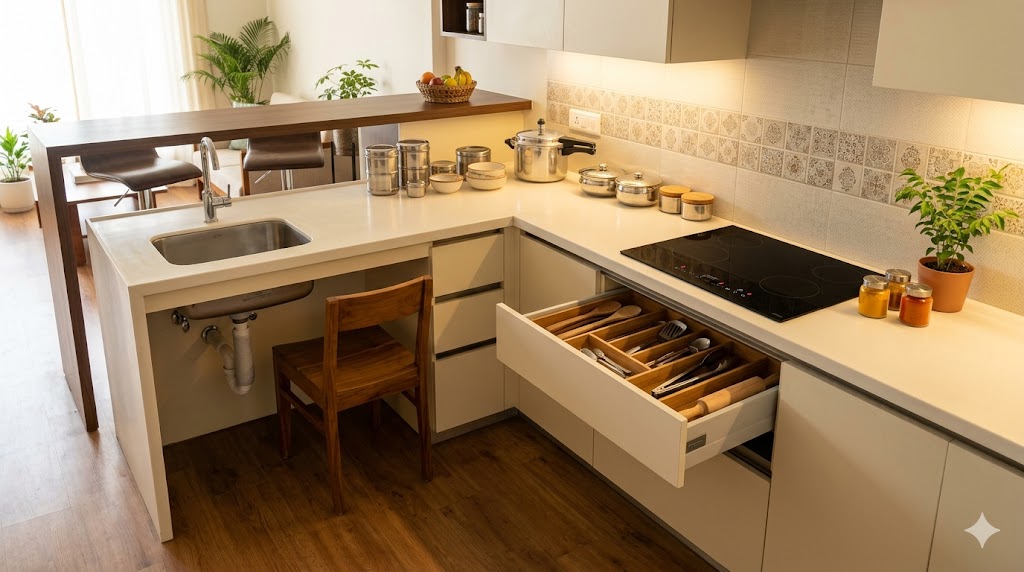
The accessible kitchen is the second most consequential room. The standard 850-mm-AFL counter accommodates the standing 5'6"–6' user; it is too high for a seated wheelchair user and too low for a 6'4" user. The universal-design solution is variable height surfaces and adjustable elements.
The Three-Counter-Height Strategy
The accessible kitchen has three counter zones:
| Zone | Height (AFL) | Use | Universal-Design Note |
|---|---|---|---|
| Standard counter | 850 mm | General prep, cooking | Default for the able-bodied user |
| Low counter (adjustable or fixed-low) | 700–760 mm | Seated prep — wheelchair, stool, or fatigue-impaired user | At least 800 mm of run; knee space 700 mm clear below |
| High counter / breakfast bar | 1050 mm | Standing prep, casual seating | Optional; useful for the very tall user |
The minimum is to provide a single 800-mm-wide section of counter at low height with knee space below, integrated with the prep zone. This is the kitchen equivalent of the bathroom's walk-in shower — a single architectural move that converts the kitchen from inaccessible to accessible.
Reach and Storage
Kitchen storage in the universal-design context follows the reach-zone discipline of the Storage Planning guide, with these adjustments:
- Wall cabinets — bottom at 1200 mm AFL maximum (vs 1450–1500 mm standard); pull-down shelving systems for upper zones
- Base cabinets — full-extension drawers preferred over door-with-shelves; pull-out trays for lower-zone access without bending
- Tall units — pull-out pantry with full-extension at multiple zones; avoid deep static shelves
- Refrigerator — French-door (left + right) preferred over single-door for shorter user accessibility
- Cooktop — induction preferred over gas (no flame, no stooping for ignition); knobs at front (not back) for seated reach
- Sink — single-bowl shallow (150 mm depth max) with insulated waste; lever or sensor tap
MEP Coordination
The accessible kitchen requires coordinated MEP routing to allow the under-counter knee space — drainage routing under the wall cabinets rather than the base, gas line concealment, electrical rerouting. The detailed treatment is in the Residential MEP Coordination guide; the universal-design implication is that the accessible kitchen must be specified at Stage 2 so that the MEP drawings produced at Stage 4 reflect the accessibility coordination.
7. The Bedroom — Mobility Envelope and Transfer Space
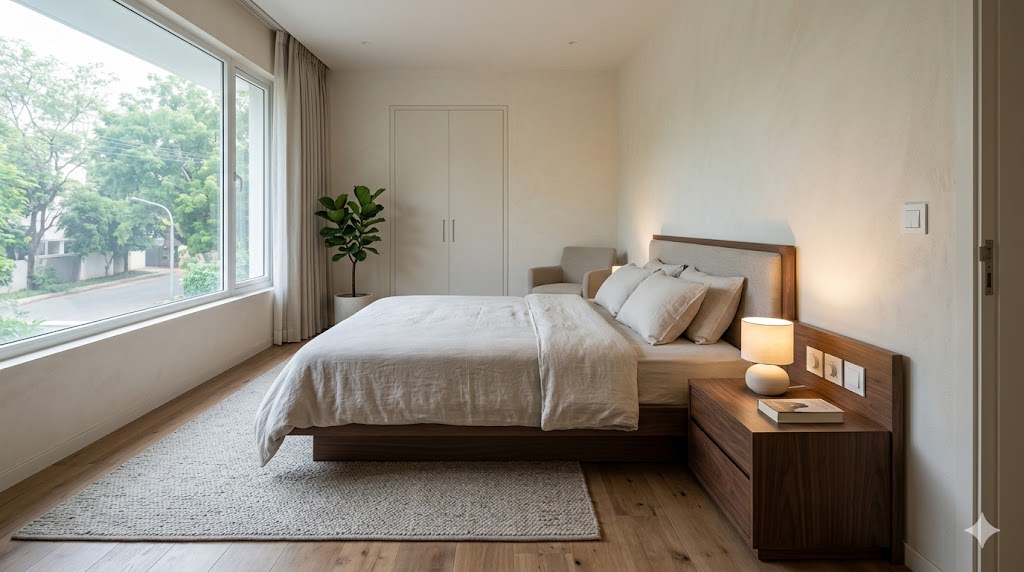
The accessible bedroom is dimensionally driven by the transfer space — the clear floor area required to transfer from wheelchair or walker to the bed.
Bed Approach Clearances
| Approach | Clear Floor | Notes |
|---|---|---|
| Standard side approach | 900 × 1200 mm | One side of bed; sufficient for ambulant users |
| Wheelchair side transfer | 900 × 1500 mm | One long side; adjacent to bedside table |
| Wheelchair both-side transfer | 900 × 1500 mm both sides | For users with bilateral mobility; allows caregiver opposite |
| Hoist / lift access | 1200 × 1500 mm | Mobile or ceiling-track hoist; structural reinforcement required for ceiling track |
For a queen-size bed (1500 × 2000 mm), a wheelchair-accessible bedroom requires a minimum room footprint of 3500 × 3700 mm (with one side and foot transfer) or 4000 × 3700 mm (both-side transfer).
Bedroom Universal-Design Specifications
- Door clear width — 800 mm; pocket or sliding preferred to swing
- Light switch — at door entry, 1100 mm AFL; rocker or paddle (not toggle) for fine-motor-impaired users
- Bedside controls — light, ceiling fan, and power outlet at bedside; reachable from supine position; lighting on dimmer with low-light night setting
- Wardrobe — 800-mm clear in front of doors (1500 mm if wheelchair user); pull-down hanging rod for upper zone access; drawers at active-lower zone
- Window — operable with one hand, lever or crank handle; sill at ≤ 800 mm AFL where the seated user is to view outdoors
- Flooring — slip-resistant; no loose rugs; no thresholds at doorway
- Smoke and CO detector — visual + audible (light + sound) for hearing-impaired users; tested annually
The Convertible Bedroom
A specific adaptable-design move: the convertible ground-floor bedroom. In multi-storey houses, designating one ground-floor room (often the study or guest room) as a future bedroom — sized to accessible-bedroom dimensions, plumbed for a future en-suite, with structural blocking in the future-bathroom wall — converts an aging-in-place crisis from a renovation project to a furniture move. The cost premium at construction is 5–10% of the room cost; the value at year-25 is incalculable.
8. Circulation — Corridors, Stairs, and the Ramp Companion
Universal-design circulation is dimensionally generous and structurally redundant. The principle is that every level change should be accessible by both a stair (efficient for the able-bodied) and a ramp or lift (essential for the mobility-impaired).
Corridor Specifications
- Width — single-direction — 1100 mm minimum, 1200 mm preferred
- Width — two-way / wheelchair passing — 1500 mm minimum, 1800 mm preferred
- Length without passing space — 9 m maximum before a 1500-mm passing point
- Floor finish — continuous, matte, contrast at door thresholds
- Lighting — 100 lux minimum at floor; uniform; no abrupt level changes
- Handrail — recommended on at least one side for corridors > 4 m; mandatory for elderly-occupied homes; height 900 mm AFL with 750-mm second rail for children/short users
Stair Specifications
The universal-design stair does not eliminate stairs — it makes them safer and provides an accessible alternative.
| Parameter | Standard | Universal-Design |
|---|---|---|
| Riser height | 175–200 mm | 150 mm; uniform within ±3 mm |
| Tread depth | 250–280 mm | 300 mm; nosing 25 mm projection |
| Width | 800 mm | 1000 mm with handrails both sides |
| Handrail height | 900 mm | 900 mm + 750 mm dual height |
| Handrail extension | flush at top/bottom | 300 mm extension beyond top and bottom riser |
| Tread surface | smooth tile | slip-resistant; tactile contrast strip at first and last tread |
| Lighting | 50 lux | 150 lux; uniform; no shadow on treads |
| Open risers | permitted | closed risers required (cane and toe safety) |
The Lift Question
In multi-storey homes with adaptability ambitions, architects must consider whether to provide for a future lift even if not installed. A lift shaft provision — a structural opening 1100 × 1400 mm clear, vertically aligned through all floors, currently stacked as closets or storage — converts a future lift retrofit from a structural-demolition project to a casework-removal-and-mechanical-installation project. The cost premium at construction is < 1% of total project cost; the saved retrofit cost is 8–12 lakhs in 2026 currency, and the lift becomes possible at all (which it often otherwise is not, structurally).
For two-storey homes intended for long-term occupancy by the original owners, the lift-shaft provision is the single most cost-effective adaptable-design intervention available.
9. Aging-in-Place — The Five-Stage Lifecycle
The adaptable home is designed across five stages of the aging-in-place lifecycle. Different stages prioritise different design moves; the architect's discipline is to know which stage the family is in now and which it will pass through.
| Stage | Age Band | Primary Concerns | Key Design Moves |
|---|---|---|---|
| Stage 1 — Active independent | 50–65 | Subtle accommodation; future-proof | 800-mm doors, level thresholds, structural blocking, lift-shaft provision |
| Stage 2 — Cautious independent | 65–75 | Handrails, lighting, slip resistance | Handrail installation, brighter lighting, slip-rated floors, grab-bar installation |
| Stage 3 — Assisted independence | 75–85 | Mobility aid use, bathroom safety | Walk-in shower, fold-down seat, kitchen knee space, accessible-bedroom-on-ground move |
| Stage 4 — Care-giver assisted | 85+ | Wheelchair transfer, two-person assistance | Wider doors (already in place), bedroom transfer space, hoist provision |
| Stage 5 — Nursing-care | 85+ with morbidity | Hospital bed, full mobility limitation | Ground-floor bedroom converted to care suite; en-suite accessible bath |
The architect's plan-stage discipline — at Stage 1 of the family's life, when the home is being built — is to design into Stage 4. The Stage 1 family does not need wheelchair-accessible bathrooms; but the structural blocking, the door widths, the threshold details, and the lift-shaft provision must all be Stage-1-installed if Stage-4 conversion is to be possible without architectural demolition.
This is the universal-design discipline most commonly missed in the Indian residential market. The home is designed for the Stage-1 family, sold at Stage-1 condition, occupied through Stages 2–3, and abandoned at Stage 4 because the home cannot accommodate the family's evolving needs. The fix is not money; it is foresight at Stage 2.
10. Multi-Generational Design
The Indian multi-generational home is a universal-design opportunity. Where the home houses three generations — grandparents, parents, children — universal design serves the senior generation now, the parents in 25 years, and the children's eventual family. The cost premium amortises across three generations of occupancy; the alternative is three rounds of renovation.
The Multi-Generational Layout
Architectural moves for multi-generational accessibility:
- Senior suite on ground floor — bedroom + accessible en-suite + sitting area + private circulation route
- Acoustic separation — STC 50+ partitions between the senior suite and the family's primary living spaces (per the Defining Luxury guide's acoustic discipline)
- Independent climate control — separate AHU or split unit for the senior suite; thermostat at accessible reach
- Visual connection without proximity — the senior suite should have line-of-sight to family circulation (drawing room, kitchen) without being on the through-route to bedrooms
- Caregiver provision — adjacent room or alcove for live-in caregiver, with shared bathroom access
The Cultural Adjacency Question
Multi-generational Indian residential plans must also address cultural adjacencies that the abstract universal-design framework does not anticipate — the pooja room location, the kitchen's relationship to the senior generation's dietary practices, the household ritual schedule. These are programmatic inputs to the audit phase (Stage 1 of the COA Scope framework), and they must be reconciled with the universal-design dimensional schedule.
11. The Work-from-Home Zone
Post-2020, the residential brief in India must include a defensible work-from-home zone in nearly every project — not as a desk in the corner of the bedroom but as a designed space with its own acoustic, daylight, and ergonomic specification.
The WFH Zone Specifications
- Footprint — minimum 2.4 × 2.7 m for a single-occupant zone; 3.0 × 3.6 m for a two-occupant household-shared zone
- Acoustic isolation — STC 40+ partition to adjacent rooms; door with weather-seal at jamb and head; soft furnishings to control reverb (RT60 < 0.6 s)
- Daylight — direct or diffused daylight for at least 6 hours daily; depth-to-window-height ratio < 2.5:1
- Artificial lighting — task light at desk (500 lux on work surface) + ambient (200 lux); CRI > 80; tunable-white preferred
- Power and data — 6-outlet duplex above desk + 2 floor outlets; cabled Ethernet socket (do not assume Wi-Fi sufficiency); UPS-circuit provision
- Ergonomic furnishing — adjustable-height desk (600–1200 mm range); seating with lumbar support and adjustability
- Visual privacy — blinds or shading on windows visible from common entrance approach
- HVAC — independent thermostat; air change > 4 ACH
The Adaptable WFH Zone
In smaller homes where a dedicated WFH room is impossible, the adaptable-design move is to specify a convertible alcove — a 1.8 × 2.4 m alcove off a primary room that can host a workstation, with the power, data, and lighting infrastructure provided whether or not the desk is currently installed. This costs ~₹15,000–25,000 in MEP provisions at construction; the retrofit alternative is far higher and disruptive.
The Studio Matrx Storage Calculator and Furniture Size Chart utilities support the WFH zone specification.
12. Cost Premium Analysis
The persistent objection to universal design is cost. The objection is largely false — but it is true at specific points and worth quantifying honestly.
Cost Premium by Intervention (FY 2025-26 reference)
| Intervention | Cost Premium | Retrofit Cost (Year 15) | Recommendation |
|---|---|---|---|
| 800-mm internal doors (vs 700 mm) | ₹500–800 per door | ₹15,000–25,000 per door (partition demolition) | Always specify; trivial cost |
| Level thresholds | ₹2,000–4,000 per door | ₹40,000–80,000 per door (waterproofing rework) | Always specify |
| Lever handles (vs knobs) | ₹150–300 per handle | nominal | Always specify; no real premium |
| Walk-in shower (vs tub) | ₹15,000–25,000 per bathroom | ₹1.5–3 lakh per bathroom | Specify by default in master and one secondary bath |
| Grab-bar wall blocking | ₹2,000 per wall | ₹25,000–50,000 (wall demolition + re-tile) | Always specify in all bathrooms |
| Lift shaft provision | ₹50,000–80,000 (structural) | ₹5–8 lakh (structural retrofit, often impossible) | Specify in all 2+ storey homes for long-term ownership |
| Wheelchair-turning bathrooms | ₹50,000–80,000 (footprint cost) | ₹3–5 lakh per bathroom | Specify for senior suite or where requested |
| Variable-height kitchen counter section | ₹25,000–45,000 | ₹80,000–1.5 lakh | Specify in all primary kitchens |
| Elevated power outlets, low switches | ₹5,000–10,000 (rework wiring) | ₹40,000–80,000 | Always specify |
| Acoustic-grade WFH zone | ₹40,000–80,000 (partition + glazing upgrade) | ₹2–4 lakh | Specify in 2026-onwards residential standard |
The total project-level universal-design premium for a comprehensive specification is approximately 3–6% of total construction cost. The retrofit alternative, summed across the same interventions, is 35–60% of original construction cost — and is often impossible because of structural, layout, or regulatory constraints.
This is the architect's defensible position to the client: universal design is the cheap option if specified now, and the prohibitively expensive option if deferred. The 3–6% premium is the most asymmetric cost-versus-benefit decision in residential architecture.
13. The Working Drawing Outputs
The universal-design discipline produces specific deliverables in the working drawing set (Stage 4 of the COA Scope of Services framework):
1. Universal-design schedule — table listing every room and circulation element against the dimensional checklist (door widths, clear floor, threshold heights, switch heights)
2. Accessible bathroom drawings — 1:25 scale, with grab-bar locations, wall-blocking specification, fixture heights, and clear-floor circles drawn
3. Accessible kitchen drawings — 1:25 scale, showing variable-height counter zone, knee space, drawer configurations
4. Lift-shaft provision drawings — structural drawings showing the future lift shaft, with closet conversion details
5. Threshold details — 1:5 scale section drawings at every external door and shower entry
6. Ramp drawings — gradient, landing, handrail, edge-protection, surface specification
7. Switch and outlet schedule — height for each switch and outlet, with universal-design heights specified
8. Grab-bar location plan — wall-blocking installation drawings during construction
9. Tactile and visual contrast schedule — stair nosings, door frames, threshold-strip contrast specifications
These nine outputs are what convert universal-design intent into universal-design execution. The contractor cannot deliver universal-design accuracy without these drawings; the architect cannot verify post-handover compliance without them.
14. References and Further Reading
Indian Statutory and Regulatory
- Rights of Persons with Disabilities Act, 2016 (RPwD Act). Government of India. §40 — accessibility standards.
- Persons with Disabilities (Equal Opportunities, Protection of Rights and Full Participation) Rules — state-specific implementations.
- National Building Code of India 2016, Part 3 — Development Control Rules and General Building Requirements, Section 13. Bureau of Indian Standards.
- National Building Code of India 2016, Part 4 — Fire and Life Safety. BIS. Egress accessibility requirements.
- Harmonised Guidelines and Space Standards for Barrier Free Built Environment for Persons with Disability and Elderly Persons (2016, revised 2021). Ministry of Housing and Urban Affairs, Government of India.
- Handbook on Barrier Free and Accessibility (2014, in continued use). Central Public Works Department.
- Accessible India Campaign (Sugamya Bharat Abhiyan). Department of Empowerment of Persons with Disabilities, Government of India.
- IS 4963:1987 (Reaffirmed 2017) — Recommendations for Building and Facilities for the Physically Handicapped. Bureau of Indian Standards.
International Reference Standards
- ISO 21542:2011 — Building construction — Accessibility and usability of the built environment. International Organisation for Standardization.
- ISO 17966:2016 — Assistive products for personal hygiene that support users. (Includes grab-bar load specifications.)
- ADA Standards for Accessible Design (2010). US Department of Justice. Definitive English-language dimensional standard.
- BS 8300-1:2018, BS 8300-2:2018 — Design of an accessible and inclusive built environment. British Standards Institution.
- ANSI/ICC A117.1-2017 — Accessible and Usable Buildings and Facilities. International Code Council.
Foundational Texts
- Goldsmith, S. (1963, 3rd ed. 1976). Designing for the Disabled. RIBA Publications. The foundational text of accessible design.
- Mace, R. L., Hardie, G. J., & Place, J. P. (1991). "Accessible environments: Toward universal design." Innovation by Design, North Carolina State University. The seven-principle framework.
- Center for Universal Design (1997). The Principles of Universal Design, Version 2.0. North Carolina State University.
- Story, M. F., Mueller, J. L., & Mace, R. L. (1998). The Universal Design File: Designing for People of All Ages and Abilities. The Center for Universal Design.
- Steinfeld, E., & Maisel, J. L. (2012). Universal Design: Creating Inclusive Environments. Wiley.
- Imrie, R., & Hall, P. (2001). Inclusive Design: Designing and Developing Accessible Environments. Spon Press.
Aging-in-Place and Multi-Generational
- Pirkl, J. J. (1994). Transgenerational Design: Products for an Aging Population. Van Nostrand Reinhold.
- AARP (2010, updated regularly). AARP HomeFit Guide. American Association of Retired Persons. Practical aging-in-place resource, US-based but widely useful.
- WHO (2007). Global Age-Friendly Cities: A Guide. World Health Organization. Includes residential built-environment recommendations.
- National Statistical Office (2021). Elderly in India 2021. Government of India, Ministry of Statistics and Programme Implementation.
- LASI (2020). Longitudinal Ageing Study in India, Wave 1, 2017-18. International Institute for Population Sciences.
Indian Anthropometric Data
- Indian Anthropometric Database (IADB). Defence R&D Organisation, Ministry of Defence, Government of India. 2003–2008 series.
- Chakrabarti, D. (1997). Indian Anthropometric Dimensions for Ergonomic Design Practice. National Institute of Design, Ahmedabad.
Companion Studio Matrx Guides
- The Architect's Scope of Services in India
- Storage Planning as a Design Discipline
- Defining Luxury in Residential Architecture
- Architectural Lighting Design for Indian Homes
- Residential MEP Coordination in India
- Flooring & Finishes Specification
- Passive Design — India Climate Zones
Companion Studio Matrx Tools
- Home Safety Audit — post-occupancy audit for accessibility risk
- Maintenance Checklist — periodic checks for handrails, grab bars, slip resistance
- Storage Calculator — reach-zone-aware storage planning
- Furniture Size Chart — anthropometric reference
- Lighting Planner — accessible-lighting layered schedule
- Pre-Possession Checklist — pre-handover accessibility audit
Author's Note: Universal design is the residential discipline most commonly framed as a specialist add-on and most commonly needed as a general practice. Every architect who has watched a family member become temporarily mobility-impaired — through surgery, pregnancy, injury, or aging — has experienced the failure of standard residential design. The 3–6% premium that universal design imposes at Stage 2 is among the most consequential design decisions a residential architect makes. The architect who routinely specifies 800-mm doors, level thresholds, lever handles, grab-bar wall blocking, and walk-in showers in every project — without waiting to be asked — produces homes that quietly serve their families for fifty years across every life-stage that arrives.
Disclaimer: This article is for informational and educational purposes only. It does not constitute professional architectural, accessibility-consulting, or medical advice. Statutory, code, and dimensional references reflect 2026 Indian practice and the cited international standards but may shift with regulatory amendments. Architects must verify against current statutes, engage qualified accessibility consultants where the project's complexity warrants, and apply professional judgment to each project's specific user requirements. Studio Matrx, its authors, and contributors accept no liability for decisions based on this guide.
Export this guide
Related Guides — Deep-dive reading
How to Plan a Home for Multi-Generational Living
Designing for grandparents, parents and children under one roof — privacy, accessibility and harmony
Home PlanningUniversal Design Doors for Indian Homes: Inclusive Doors That Work for Everyone (2026)
How to design and specify doors that serve children, the elderly, pregnant women, the injured and wheelchair users by default - generous width, lever handles, near-flush thresholds, low-force closing, contrast and good lighting - without your home ever looking medical.
Home Doors & EntrancesThe Accessible Home (India): Step-Free, Mobility-Friendly Design for Every Age
Practical, room-by-room accessibility that quietly works for ageing parents, recovery, pregnancy and kids alike.
Home Lifts & AccessibilityRelated Tools — Try Free
Cross-Ventilation Analyzer
Estimate airflow and air changes per hour (ACH) from room size, window areas, layout, and local wind — with NBC 2016 Part 8 compliance check.
Ventilation CalculatorAcoustic Privacy (STC) Visualizer
Indian healthcare acoustic visualizer — compare wall assemblies and noise sources, see received SPL after STC attenuation, and check FGI 2018 / IS 1950 / NABH speech-privacy compliance with live dual-canvas waveform.
Acoustic ToolBrise-Soleil Visualizer
Interactive horizontal-louvre cut-off angle calculator — sun altitude, louvre depth, and spacing inputs with a live shadow preview. Computes θ = arctan(spacing/depth) for façade shading, ECBC envelope compliance, hospital daylight design, and tropical sun-control detailing.
Sun Shading Tool