
Lift Design for Luxury Residences (India): Panoramic Cabins, Bespoke Finishes and Statement Placement
Treating the home lift as a design statement — panoramic glass and pneumatic cabins, bespoke wood/leather/stone/mirror/light finishes, prestige-scaled cars, double-height foyer placement and smart-home integration.
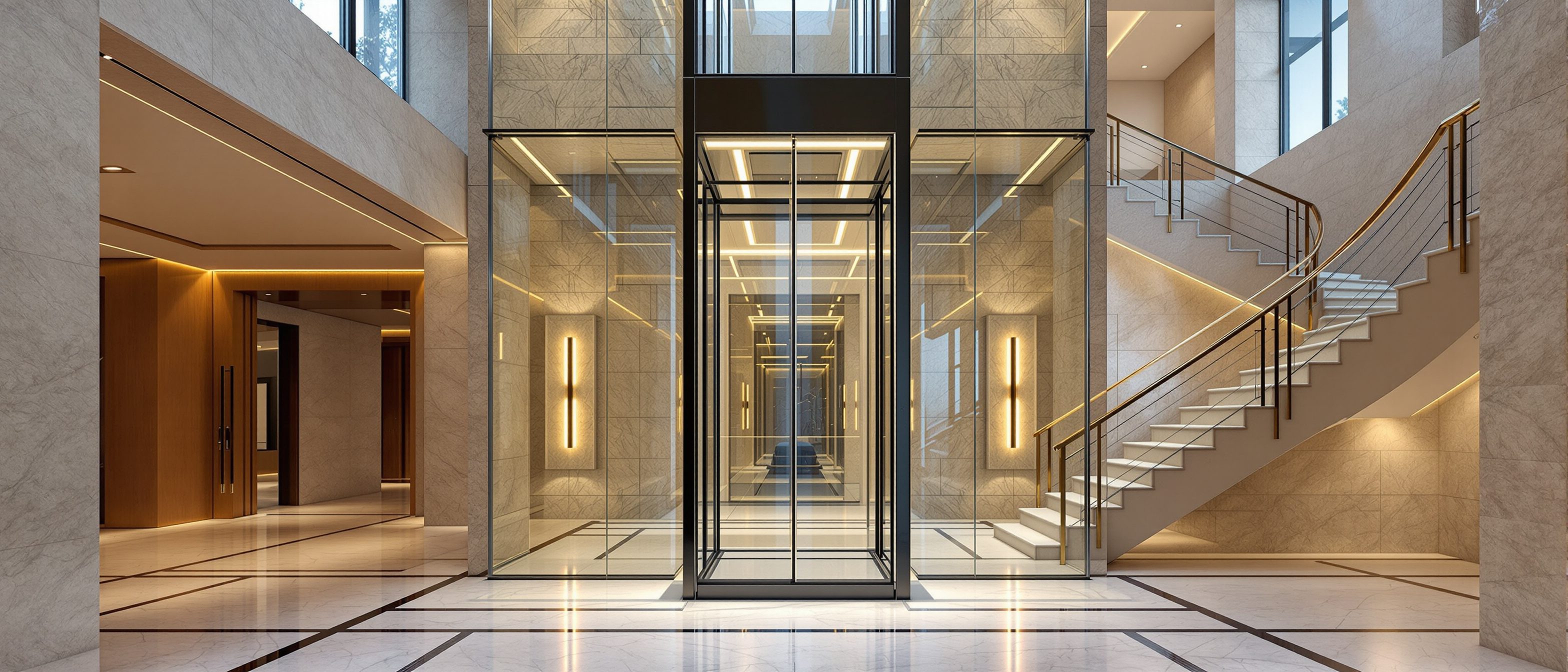
In a luxury home the lift stops being a service item and becomes a piece of architecture. It is the one mechanical object guests ride inside, lit from within, moving slowly through the most ceremonial volume of the house. Done well, a luxury home lift does what a grand staircase once did: it announces arrival, frames a view, and tells you the house was designed with intent.
This guide is about the lift purely as a design statement — panoramic cabins, bespoke finishes, prestige-scaled cars, and where you place all of that in the plan. It is deliberately narrow. For everything underneath the finish — the well, the pit, the structure, the codes — follow the Architect's Residential Elevator Handbook (India), our pillar. For type selection and brands see the Residential Elevator Buyer's Guide, and for the larger design language of a high-end home read Defining Luxury Residential Architecture (India) and Luxury Villa Architecture (India). Here we stay with the lift.
A staircase is the spine of a luxury home. The lift is its jewel — small, precise, and noticed every single time it is used.
What makes a lift "luxury" — and what does not
A luxury lift is not just an ordinary lift with a marble floor stuck in it. Three things separate a statement cabin from a standard one, and only one of them is finish.
- The cabin as an object — transparency (panoramic glass), proportion (a slightly larger car), and material (wood, leather, stone, mirror, light) all designed together.
- The ride — a deliberately calm, slow, near-silent ascent reads as expensive. Speed is a service metric; in a three-storey home, slowness is a luxury.
- The placement — the lift is set where it can be seen and admired, usually in a double-height foyer, not buried in a back-of-house core.
What does NOT make a lift luxurious: ignoring the engineering. A beautiful cabin in an undersized well, with manual doors that snag a gown, or no Automatic Rescue Device so it strands guests during a power cut, is a liability dressed up as a feature. Every finish decision in this guide sits on top of a correctly designed well, pit and structure — see Home Lift Space Requirements, Lift Shaft Design, Lift Pit Requirements and Home Lift Structural Design.
Panoramic and pneumatic cabins — the see-through lift
The single most theatrical move available is the panoramic cabin: glass on two or three sides so the lift becomes a moving lantern in the foyer. Two routes get you there.
Glass-walled traction cabins. A conventional machine-room-less (MRL) traction lift can be specified with structural-glass cabin walls and a glass-faced well, so the car and counterweight are visible as the lift travels. This keeps the larger capacity, smoother long-travel ride and faster speeds of traction, while giving the transparency. It needs a properly designed well and pit like any traction lift.
Pneumatic Vacuum Elevators (PVE). The PVE is the purest panoramic object — a cylindrical, almost entirely transparent cabin that rides on an air-pressure differential inside a clear tube. Its defining luxury advantage is architectural freedom: no pit, no separate shaft, no machine room, and it is self-supporting. That makes it the easiest dramatic lift to drop into an existing villa or a sculptural foyer where you do not want to cast a concrete well. The trade-offs are real and must be designed around: capacity is limited (roughly 2–3 persons), travel is limited, and the cabin draws more power on the way up (it descends under controlled gravity). Nibav is the best-known India-grown PVE brand; Aritco and Elite Elevators also serve this premium segment. For the retrofit mechanics of dropping a PVE into a finished house, see Retrofitting a Lift into an Existing Home.
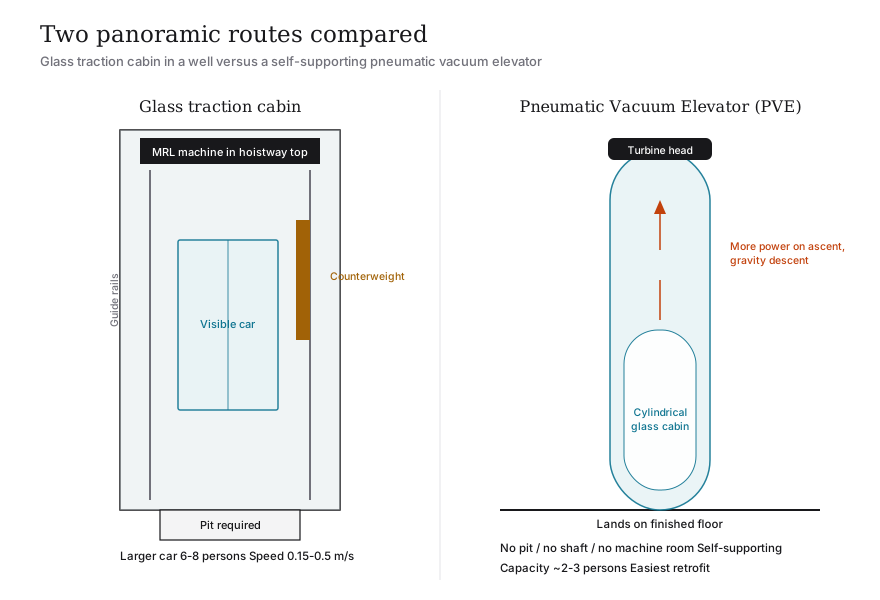
The choice usually comes down to the house. A new-build with a generous double-height void and three or more stops favours a glass traction cabin. A finished villa, a slim sculptural placement, or a two-stop home where you refuse to cut a pit favours a PVE.
Bespoke cabin finishes — the materials palette
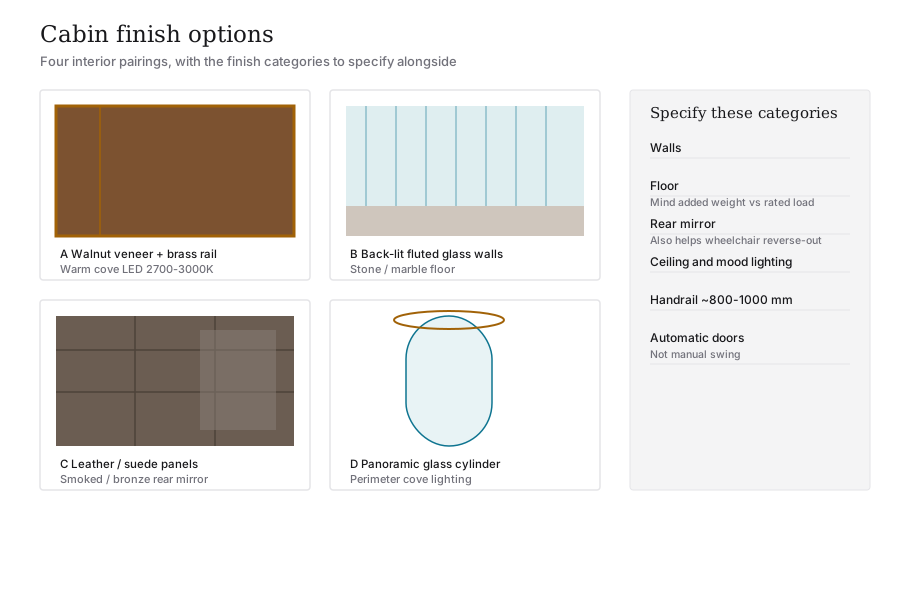
Inside the cabin you are decorating a 1.5 to 2.5 square-metre room that every guest enters. Treat it as the smallest, most intensely detailed room in the house. The premium home-lift makers (Otis, KONE, Schindler, TK Elevator, Johnson Lifts, plus the home specialists above) all offer bespoke finish programmes; below is the working palette.
| Finish element | Luxury options | Design and India-specific notes |
|---|---|---|
| Wall panels | Veneered timber (teak, walnut), back-painted or fluted glass, leather/suede upholstered panels, brushed brass or bronze | Wood and leather warm the cabin; back-lit fluted glass photographs beautifully. Specify scratch- and fingerprint-resistant finishes for daily use. |
| Floor | Natural stone or marble inlay, large-format porcelain, hardwood, brass-edge detailing | Match or deliberately contrast the foyer floor. Stone adds weight; confirm the added cabin load against the supplier's car capacity. |
| Mirror | Full rear-wall mirror, smoked/bronze tint, framed panel | A rear mirror enlarges a small cabin AND lets a wheelchair user reverse out — a luxury touch that doubles as accessibility (see CPWD guidance in Accessible Home Design). |
| Ceiling and lighting | Cove/perimeter LED, dimmable warm-white, pin-spots, mirror or backlit ceiling, statement pendant in a tall cabin | Mood lighting on a scene controller is the cheapest high-impact upgrade. Avoid cold blue-white; warm 2700–3000K reads expensive. |
| Handrail and controls | Solid brass/bronze or leather-wrapped rail, flush touch or hidden capacitive controls, integrated display | A handrail is also a safety/accessibility item — keep it ~800–1000 mm above the floor. |
| Doors | Automatic telescopic glass or stainless doors with flush thresholds | Specify automatic doors, not manual swing — swing doors are not wheelchair-friendly and read as utilitarian. |
Two India-specific cautions. First, weight: stone floors and heavy panels eat into the rated load — agree the finished cabin weight with the vendor so you do not lose a passenger's worth of capacity. Second, heat and dust: a glass cabin in a hot-dry climate gains heat and shows every fingerprint; plan cabin ventilation or light cooling and choose low-maintenance surfaces.
Prestige scale and the slow, silent ride
Two specifications quietly separate a luxury car from a builder's lift, and both run opposite to the usual "smaller and faster is better" instinct.
- A larger car. Where a standard home lift runs at the 2–4 person, ~150–408 kg end of the range, a luxury cabin is specified nearer the upper home band (6–8 persons) so two or three guests, or a wheelchair plus attendant, ride in comfort rather than intimacy. The larger car needs a larger well — coordinate this at design stage via Home Lift Space Requirements, because you cannot retrofit width into a cast shaft.
- A deliberately slow, silent ride. Home lifts run roughly 0.15–0.5 m/s. In a luxury residence you choose the calm end of that band on purpose: a gearless MRL traction drive or a well-tuned hydraulic gives a near-silent, jolt-free glide. Smoothness, not speed, is the prestige signal over two or three storeys.
Insist on the same non-negotiable engineering as any home lift, just hidden behind the finish: an ARD battery backup (essential given Indian power cuts — never let a guest be stranded), door light-curtains, overload sensing, emergency alarm and intercom. These belong in your Lift Specification Checklist.
Statement placement — the lift in a double-height foyer
Placement is where the lift earns its keep as architecture. The luxury move is to set a transparent cabin into a double-height entrance foyer so it reads as a vertical sculpture beside or instead of the staircase — the two together become the spatial event of the entry.
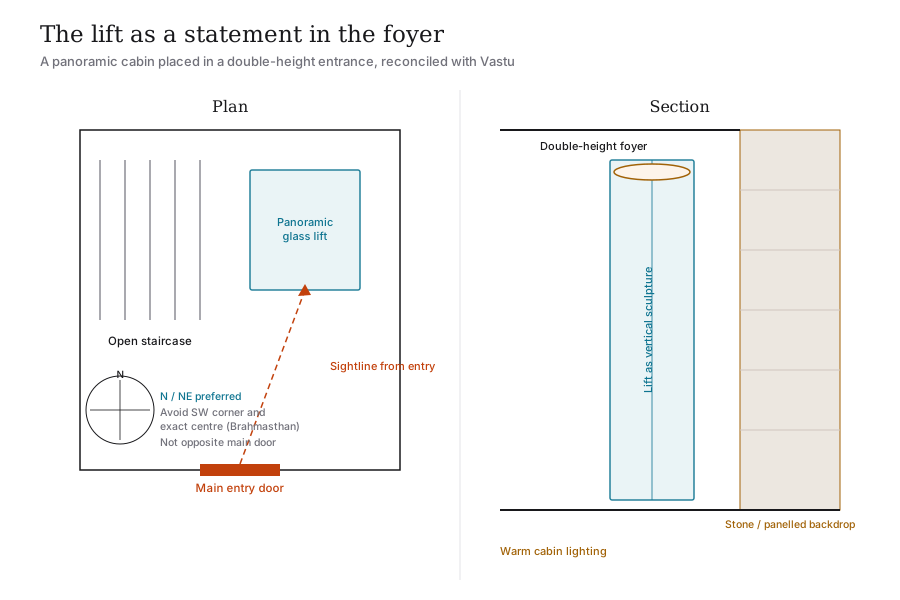
Design rules for statement placement:
- Give it a sightline. Place the cabin where it is seen on entry, ideally lit from within against a stone or panelled backdrop. A panoramic lift hidden in a corridor wastes its biggest asset.
- Pair it with, do not bury it behind, the stair. The lift and staircase as a composed pair is the classic luxury foyer. See Lift–Staircase Integration and our Designing a Staircase (India) guide for the choreography.
- Respect Vastu where the client holds it. Many Indian clients favour NORTH or NORTH-EAST for the lift and avoid the SOUTH-WEST corner and the exact centre (Brahmasthan), and prefer it not directly opposite the main door. Treat this as a cultural preference to reconcile with structure and sightlines — engineering and safety win where they conflict. See Lift Placement and Vastu, Staircase Vastu and Vastu House Plan (India).
- Mind the structure behind the glamour. A glass well still needs walls that carry guide-rail bracket reactions, and a traction cabin still needs a pit; a PVE removes both but limits capacity. Fix the vendor's general-arrangement drawing before you commit the foyer geometry — see Home Lift Structural Design.
In a duplex or villa the same logic scales up: two or three stops, generous space, the lift as the connective gesture between the public ground floor and private upper levels.
Home-automation integration
A luxury lift should behave like the rest of a smart home. Integration is what makes it feel current rather than merely expensive.
- App and voice control — call the lift, see its position, and lock it from a phone or a home-automation panel (KNX, Crestron, Control4 or a vendor app).
- Scene-linked lighting — tie cabin mood-lighting scenes to the home's lighting system so the lift matches "evening" or "guests-arriving" moods.
- Access control and privacy — floor-locking, PIN or RFID call so the lift only serves the private floor for known users; useful in homes that host events.
- Status and safety telemetry — door, overload and ARD status surfaced to the home dashboard, and to a comprehensive AMC where the vendor offers remote monitoring.
Keep one principle: automation is a convenience layer over independent mechanical safety, not a replacement for it. The lift must still operate, level and rescue correctly with the smart home switched off.
Indicative premium cost — and where it goes
Treat all figures as indicative — confirm with a licensed lift contractor and your local bye-laws. A luxury installation sits at the upper end of the home range and above it once bespoke finishes are added. As a frame, traction/gearless home lifts run roughly ₹10–25 lakh and up, screw-driven ₹14–30 lakh, and pneumatic vacuum ₹11–22 lakh; 18% GST applies, and civil work and installation are usually extra. On top of that, panoramic glass, stone and timber cabins, larger cars and automation push the all-in figure well past the base price. We deliberately do not re-derive prices here — for the full type-by-type and floor-by-floor breakdown, GST, civil-work and AMC numbers, use the dedicated Home Lift Cost in India (2026) guide.
Two cost notes specific to luxury:
- Finish and automation are the variable. The lift mechanism has a fairly bounded price; the cabin finish, the glass well and the smart-home integration are where a luxury budget actually moves. Decide the finish brief early so it is quoted, not bolted on.
- Buy a comprehensive AMC. A "bumper-to-bumper" comprehensive contract costs roughly 60–70% more than a non-comprehensive one but caps surprise bills — sensible insurance for an expensive, finish-sensitive cabin you want kept pristine. Read the exclusions (acts of God like pit flooding, vandalism, and sometimes major components) carefully.
A short luxury-lift brief, before you sign
- Choose the cabin type for the house: glass traction cabin for a new double-height void; PVE for a finished villa or a no-pit sculptural placement.
- Fix the finish palette (wall/floor/mirror/ceiling/controls) AND the finished cabin weight with the vendor up front.
- Specify the larger car and the slow, silent ride deliberately — and never drop the ARD, door curtains and alarm.
- Place the cabin on an entry sightline, paired with the stair, reconciled with Vastu where the client holds it.
- Get the vendor's general-arrangement drawing before committing foyer geometry and structure.
- Budget the finish and automation as the real variables; price the base lift from the cost guide; buy a comprehensive AMC.
The lift is the rare element of a luxury home that is engineering, interior design and theatre at once. Get the engineering right first, then let it perform.
References
- IS 14665 — Electric Traction Lifts (BIS, committee ETD 25; Part 1 outline dimensions of car, well, pit, headroom; Parts 2–5 installation, safety, components, inspection). Part 1: https://law.resource.org/pub/in/bis/S05/is.14665.1.2000.pdf ; Part 2: https://law.resource.org/pub/in/bis/S05/is.14665.2.1-2.2000.pdf
- IS 15259 — Hydraulic Lifts (BIS) — companion code, referenced by name.
- National Building Code of India 2016, Part 8 (Building Services), Section 5 — Installation of Lifts, Escalators and Moving Walks (BIS): https://www.bis.gov.in/standards/technical-department/national-building-code/ ; Guide for Using NBC 2016: https://www.bis.gov.in/wp-content/uploads/2022/08/Booklet-Guide-for-Using-NBC-2016.pdf
- RPwD Act 2016 (Rights of Persons with Disabilities) — accessibility benchmark: https://ssepd.odisha.gov.in/sites/default/files/2024-01/RPWD%20ACT.pdf ; DEPwD: https://depwd.gov.in/en/faqs-4/
- CPWD / MoHUA Harmonised Guidelines and Space Standards for a Barrier-Free Built Environment (door width, handrail, rear mirror): https://www.cpwd.gov.in/Publication/Harmonisedguidelinesdreleasedon23rdMarch2016.pdf
- State Lift Acts — Maharashtra Lifts, Escalators and Moving Walks Act 2017; Karnataka Lifts, Escalators and Passenger Conveyors Act 2015; Delhi Lifts and Escalators Act 2007; Tamil Nadu Lifts Act 1997. Overview: https://www.99acres.com/articles/know-all-about-the-lift-regulations-in-india.html ; Maharashtra licence to operate a lift: https://services.india.gov.in/service/detail/maharashtra-license-to-operate-lift
- Structural design of lift wells and pits (background): https://www.civilera.com/post/structural-requirement-for-lifts-and-lift-pits
Export this guide
Related Guides — Deep-dive reading
Home Lift Planning Checklist (India): Everything to Decide Before You Buy
A printable, ten-stage checklist that takes you from the first family conversation to a signed handover.
Home Lifts & AccessibilityLift Specification Checklist (India): The Spec Sheet to Hand Every Home-Lift Vendor
One fillable spec sheet that forces every vendor to quote like-for-like on your shaft, your stops, your safety features.
Home Lifts & AccessibilityArchitect's Residential Elevator Planning Handbook (India): Shaft, Loads, Code & Coordination
The plan-stage reference for carrying a home lift through the drawing board — shaft, structure, pit, code, licensing and accessibility.
Home Lifts & AccessibilityRelated Tools — Try Free
Home Lift Budget Planner
Full line-item budget for a home lift — equipment, finishes, civil, GST, AMC and contingency.
Lift PlannerHome Lift Comparison Tool
Compare hydraulic, traction, pneumatic vacuum and screw lifts side by side for your home.
Lift ComparisonHome Lift Cost Calculator
All-in home lift cost by floors, type, capacity and city — equipment, civil, GST and AMC, with a drive-type comparison.
Lift Calculator