
Home Lift Structural Design Considerations (India): Loads, Shaft and Coordination
The loads a home lift imposes, designing the shaft and pit as RCC elements, framed vs load-bearing implications, and the coordination workflow that ties structural design to the vendor's GA and reaction schedule.
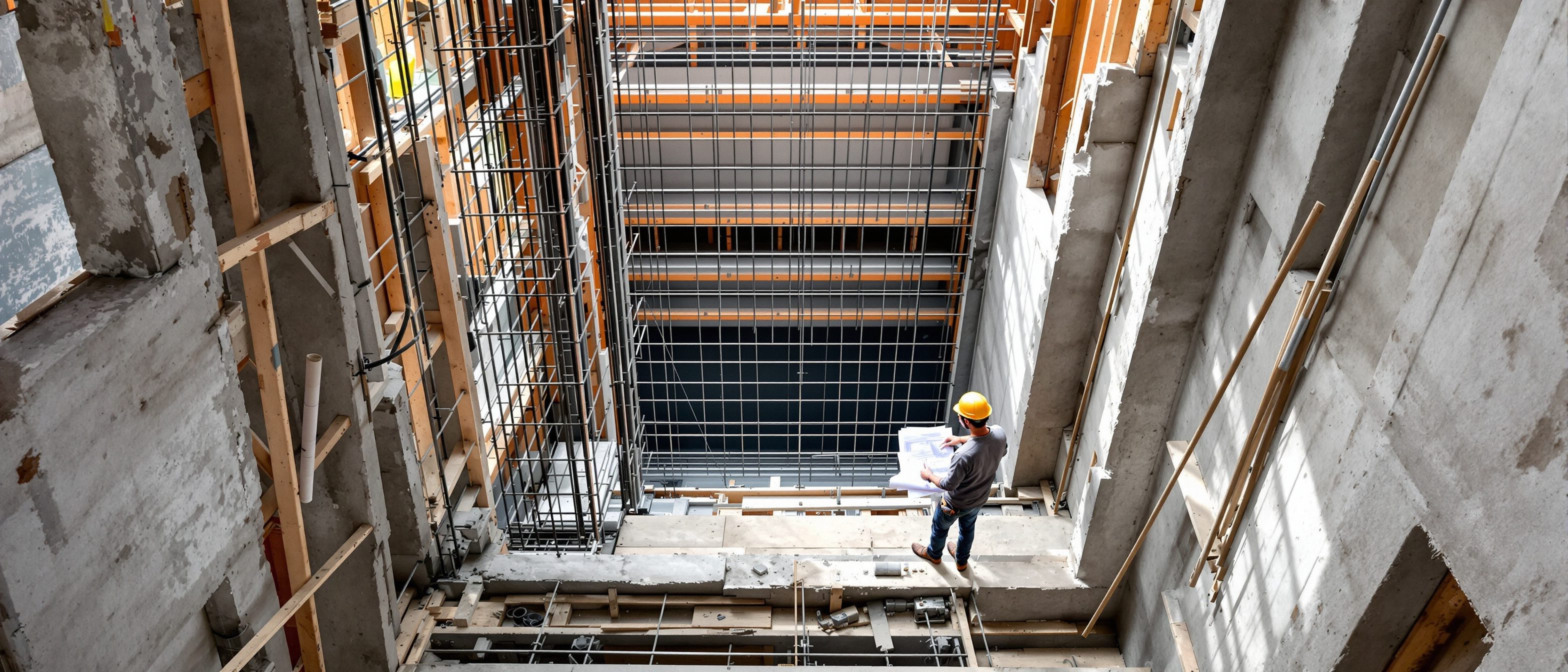
A home lift is not a piece of furniture that the structure merely has to clear. It is a moving machine that hangs, pushes and impacts loads into the building fabric for the next thirty years. A counterweight slams into a buffer in an over-travel event. Guide-rail brackets resist the car trying to tip when the load is off-centre. A hoist beam carries the full weight of car, ropes and counterweight during installation and maintenance. Every one of these forces lands somewhere in your concrete, and if the structural engineer has not designed for it, the pit slab cracks, the shaft wall hairlines, or the bracket fixings loosen.
This guide is the structural deep-dive that sits under the Architect's Residential Elevator Handbook (India) — read the handbook first for the regulatory and planning overview. Here we go narrower: the loads a lift imposes, how to design the shaft as a reinforced-concrete element, the pit slab and lateral earth pressure, what changes between framed and load-bearing construction, and — most importantly — the coordination workflow that ties the structural design to the lift vendor's drawings. For the geometry of the shaft and pit, pair this with Lift Shaft Design Guide (India) and Lift Pit Requirements (India).
The single most important sentence in this guide: the structural engineer designs the shaft, pit and overhead to the lift vendor's General Arrangement drawing and reaction schedule — never the other way round, and never before the GA is fixed.
All figures here are indicative — confirm with your structural engineer, your licensed lift contractor and the vendor's stamped reaction schedule. The numbers in the worked tables are representative placeholders to show the method, not values to design from.
How a lift loads the structure
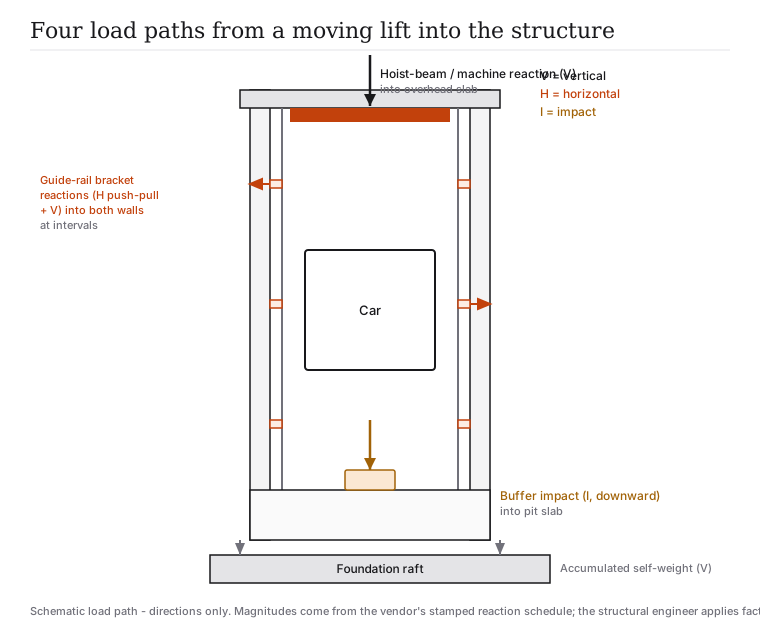
Forget, for a moment, the idea that a lift's only load is "the weight of the car going down to the foundation." The reactions a lift imposes are distributed across at least four distinct interfaces, and they act in different directions.
1. Guide-rail bracket reactions (into the shaft walls). The car and the counterweight each run on a pair of vertical steel guide rails. Those rails are clamped to the shaft walls by brackets at regular intervals up the height of the well. The brackets resist two things at once: a vertical component (rail self-weight, plus the downward drag of the safety gear if it ever grips during an overspeed event) and — the one engineers most often underestimate — a horizontal component. The horizontal force arises whenever the load in the car is eccentric (a person standing in one corner, a wheelchair to one side) or when the safety gear bites. It is reacted as a push-pull couple into the wall through successive brackets. These are typically the most frequent, most distributed loads the shaft sees.
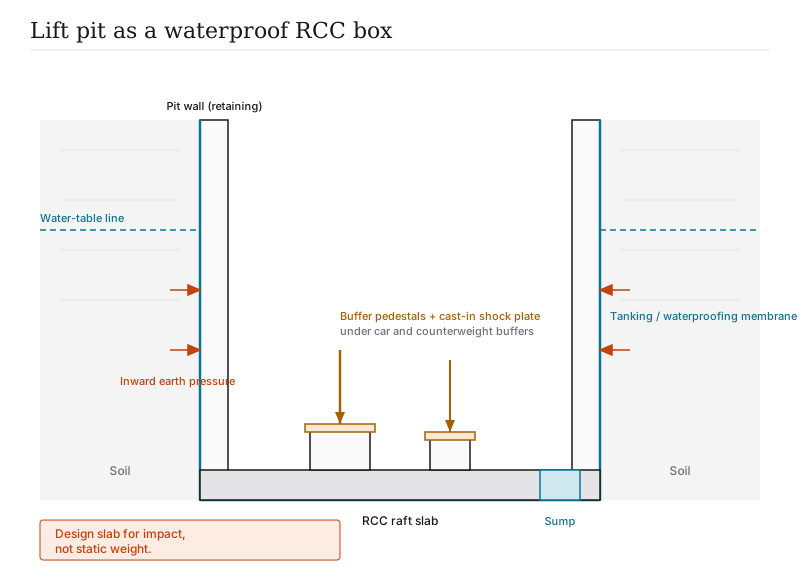
2. Buffer impact (into the pit slab). At the bottom of the well sit the car buffer and the counterweight buffer. In a worst-case over-travel — the car descends past its lowest stop — the buffer arrests the moving mass. The pit slab must absorb this as a short-duration impact load, considerably larger than the static weight resting on it. The supplier specifies the buffer-impact reaction; the slab and, where present, buffer pedestals or steel plates beneath the buffers are designed for it. Underestimating this is the classic cause of a cracked pit slab.
3. Overhead and hoist-beam reactions (into the top slab/beam). Traction and MRL (machine-room-less) lifts hang the car and counterweight from ropes over a sheave at the top of the well. The machine, sheave loads and a hoist beam (used to lift heavy components during install and service) all bear into the overhead slab or a dedicated beam. The supplier gives the hoist-beam capacity as an unfactored value to be designed for. Hydraulic, screw and pneumatic-vacuum (PVE) lifts change this picture — a hydraulic ram transfers much of its load to the pit, a screw lift is largely self-supporting, and a PVE imposes almost nothing on the building because it is self-supporting and needs no shaft. See the Buyer's Guide for how lift type drives every one of these load paths.
4. Self-weight to foundation. The accumulated dead load eventually reaches the foundation — usually modest for a home lift, but it must still be carried by the pit slab/raft and the shaft walls acting as a tube.
A representative reaction schedule (method, not values)
When you ask a vendor for their reaction schedule, you get a table of loads keyed to the General Arrangement drawing — each with a location, a direction, and whether it is a static, dynamic or impact load. Your structural engineer designs each interface to its corresponding line. The table below is a representative format for a small traction/MRL home lift (roughly a 4–6 person, 320–408 kg car). The numbers are illustrative only.
| Load case | Acts on | Direction | Indicative magnitude (verify) | Load type | Designed by |
|---|---|---|---|---|---|
| Guide-rail bracket reaction (car rails) | Shaft wall, each bracket fixing | Horizontal (push-pull) + vertical | ~3–8 kN horizontal per bracket | Live / dynamic | Structural engineer to vendor schedule |
| Guide-rail bracket reaction (counterweight rails) | Shaft wall (counterweight side) | Horizontal + vertical | ~2–6 kN horizontal per bracket | Live / dynamic | Structural engineer |
| Car buffer impact | Pit slab (under car buffer) | Vertical (downward) | ~Car mass plus rated load, dynamically amplified | Impact (short duration) | Structural engineer + buffer pedestal |
| Counterweight buffer impact | Pit slab (under c-wt buffer) | Vertical (downward) | ~Counterweight mass, dynamically amplified | Impact | Structural engineer + pedestal |
| Hoist-beam / machine reaction | Overhead slab or hoist beam | Vertical (downward) | ~Sum of car, c-wt, rope + safety factor | Live (install/service) | Structural engineer |
| Sheave / suspension dead load | Overhead slab | Vertical | Per GA | Dead + live | Structural engineer |
| Lateral earth pressure | Pit walls (below ground) | Horizontal (inward) | Per soil report + water table | Sustained | Structural engineer (geotech input) |
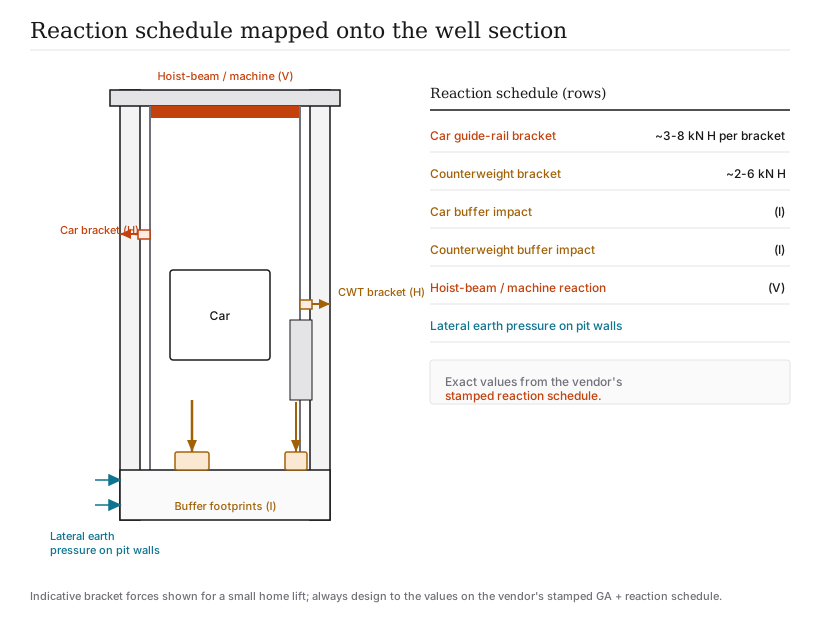
The exact values are the vendor's responsibility and must arrive on a stamped reaction schedule tied to the GA. If a vendor cannot produce one, treat that as a red flag — see the Lift Specification Checklist.
Designing the shaft as an RCC element
In most modern Indian homes the lift well is built as a reinforced-concrete (RCC) tube — four walls acting together as a vertical hollow box that is stiff in both bending and torsion. This is the cleanest structural solution because the shaft then doubles as a shear element that stiffens the whole house against lateral load.
Practical detailing rules from the supplement and standard practice:
- Wall thickness: typically 150–200 mm RCC for a home-lift well. Thinner walls struggle to anchor guide-rail bracket fixings and to resist the horizontal bracket couples.
- Leave the internal face unplastered. Plaster on the inside reduces the running clearances the lift needs and can spall onto the guide shoes and running gear. Cast the internal face true and clean; clearances are measured to the bare concrete.
- Bracket fixing zones: the walls must be designed to take the guide-rail bracket reactions at the vendor-specified intervals — local reinforcement, cast-in plates or proprietary anchors at those levels. Coordinate the bracket spacing with the GA before casting; chasing in fixings afterwards weakens the wall.
- Continuity and openings: landing-door openings interrupt the tube on one face at every floor. The engineer designs the wall as a perforated shear element, adding lintels and trimming bars around each opening.
- Tolerance: the well must be plumb within the lift's tolerance over its full height; an out-of-plumb shaft eats clearance and can foul the car. This is a construction-quality issue as much as a design one.
The shaft walls, the pit slab and the overhead slab together form a continuous load path — the tube transfers bracket couples down into the pit and the overhead reactions into the head. For the dimensional side of all this (internal clear sizes, clearances, opening sizes), use the dedicated Lift Shaft Design Guide; this guide concerns only how the element carries load.
Framed vs load-bearing construction
How the lift well integrates with the house depends heavily on the building's structural system.
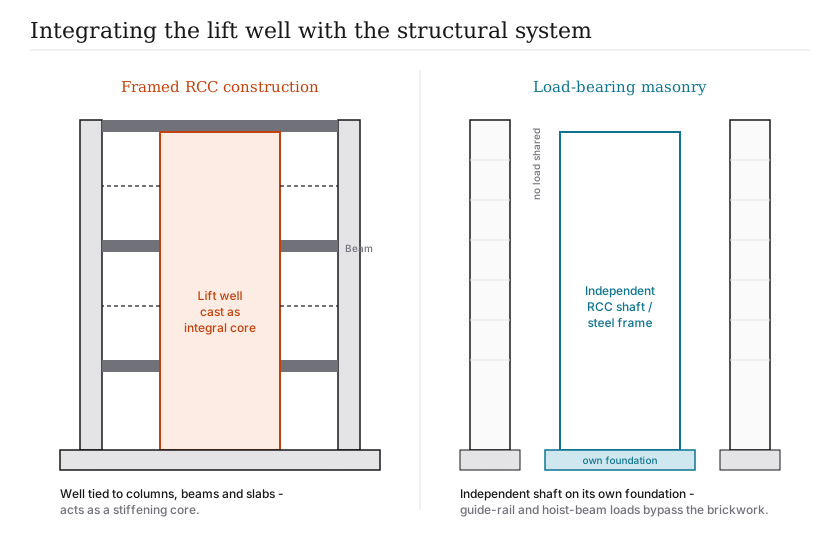
Framed (RCC column-and-beam) construction — the norm for most new Indian homes, duplexes and villas. Here the lift well is usually cast as an RCC core integral with the frame. The shaft tube can be made continuous with the floor slabs and tie-beams, so bracket and buffer reactions are carried by an element that is already part of the lateral system. This is structurally the most forgiving arrangement, and it lets the engineer use the shaft as a stiffening core. See Designing a Lift into a New House and Lift Planning for Villas and Duplex Homes for the planning context.
Load-bearing masonry construction — common in older homes and some low-rise builds. A brick or stone wall is poor at resisting the concentrated, reversing horizontal couples that guide-rail brackets impose, and it is not a reliable element to hang a hoist beam from. The usual answer is to insert an independent RCC shaft (or a steel frame) inside or beside the masonry, founded on its own pad/raft, so the lift loads bypass the masonry entirely. This is also why a retrofit into an existing load-bearing home so often defaults to a self-supporting PVE or a low-impact shaftless option — see Retrofitting a Lift into an Existing Home.
The pit slab, buffers and lateral earth pressure
The pit is, structurally, a waterproof concrete box below the lowest landing. Its depth depends entirely on lift type — roughly 150–300 mm for hydraulic and screw lifts, 300–610 mm for ordinary traction, and 1200–1750 mm for some geared/gearless types; a PVE needs no pit at all. The dimensional requirements are covered in Lift Pit Requirements (India); here we focus on the loads.
Three structural demands act on the pit:
1. Buffer impact (vertical): as in the reaction schedule, the car and counterweight buffers can deliver a large short-duration load to the slab. Design the slab — and provide buffer pedestals or shock plates/inserts cast under the raft where the supplier requires them — for this impact, not just the static weight. The supplement is explicit that pit slabs commonly crack when buffer/impact forces are underestimated.
2. Lateral earth pressure (horizontal): because the pit sits below ground, its walls behave as retaining walls. Design them for active earth pressure from the surrounding soil and, critically, for hydrostatic pressure if the water table is high — much of urban India has a seasonal high water table during the monsoon.
3. Waterproofing as a structural ally: a flooded pit is both a safety hazard and a durability problem (it corrodes the buffer bases and running gear). Make the pit a watertight RCC box — sump, drainage where possible, and tanking. Note that pit flooding ("acts of God") is a common exclusion even in comprehensive AMCs, so the structure must keep water out by design.
For lifts with a separate machine room or hoist beam, the overhead/top-slab design follows the same discipline — design the slab or beam to the supplier's hoist-beam value. Most 2026 home installs are MRL with the machine in the hoistway head; see Lift Machine Room Requirements (India) for when a room is and is not needed.
The coordination workflow
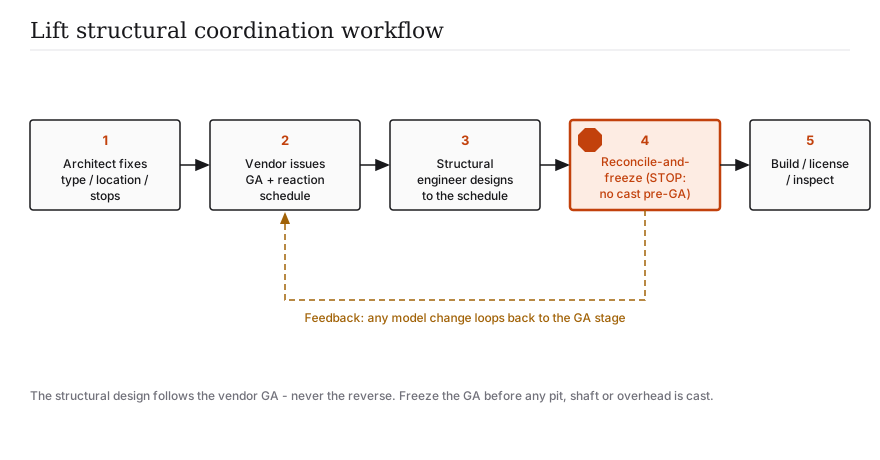
This is where most structural problems on home-lift projects actually originate — not in the calculations, but in the sequence. The lift is a bought-in machine; its loads are defined by the manufacturer, not by the structural engineer's assumptions. So the workflow must be:
1. Architect fixes lift type, location and stops with the client — informed by space, accessibility and (where the client holds it) Vastu preference. See Lift Placement and Vastu and the existing Vastu House Plan guidance; engineering and safety always win where they conflict.
2. Vendor issues the General Arrangement (GA) drawing for the selected model: shaft internal size, pit depth, overhead, door positions, machine location and the reaction schedule (the table above, with the vendor's real numbers and locations).
3. Structural engineer designs the shaft, pit slab and overhead to that GA and reaction schedule — wall thickness and reinforcement, bracket-fixing zones, pit slab and retaining walls, buffer provision, overhead slab/hoist beam.
4. Reconcile and freeze. Any change in lift model, capacity or door type can change the reactions and the GA — so the shaft is only finalised and cast after the GA is fixed. Cross-check against Home Lift Space Requirements and the Lift Specification Checklist.
5. Build, then license and inspect. Lifts are state-regulated in roughly ten Indian states (Maharashtra, Karnataka, Tamil Nadu, Delhi and others); installation/operation licences and periodic inspection by the government lift inspectorate may apply. The handbook covers the regulatory path — verify against local bye-laws.
Never finalise the shaft before the vendor's general-arrangement is fixed. A shaft cast to a guessed size is the single most expensive mistake on a home-lift project — you cannot easily re-pour concrete.
Where this fits in the cluster
This guide is the structural engineering layer. For the rest of the picture, read it alongside the Architect's Residential Elevator Handbook (India) (pillar), the Shaft, Pit and Machine Room geometry guides, the planning context for new houses, retrofits and narrow plots, and the Lift-Ready Future-Proof Home provisioning guide. Stair integration sits in Lift and Staircase Integration, with the broader stair-design context in Designing a Staircase (India).
References
- IS 14665 — Electric Traction Lifts (BIS; Part 1 outline dimensions of car, well, pit, headroom and machine room; Part 4 components including buffers, guide rails/shoes, car frame, counterweight and safety gears). IS 14665 Part 1: https://law.resource.org/pub/in/bis/S05/is.14665.1.2000.pdf — IS 14665 Part 2: https://law.resource.org/pub/in/bis/S05/is.14665.2.1-2.2000.pdf
- IS 15259 — Hydraulic Lifts (companion code for hydraulic installations).
- NBC 2016, Part 8 (Building Services), Section 5 — Installation of Lifts, Escalators and Moving Walks. BIS NBC 2016: https://www.bis.gov.in/standards/technical-department/national-building-code/ — Guide for Using NBC 2016: https://www.bis.gov.in/wp-content/uploads/2022/08/Booklet-Guide-for-Using-NBC-2016.pdf
- RPwD Act 2016 (Rights of Persons with Disabilities) — accessibility standards benchmark: https://ssepd.odisha.gov.in/sites/default/files/2024-01/RPWD%20ACT.pdf
- CPWD / MoHUA Harmonised Guidelines and Space Standards for a Barrier-Free Built Environment: https://www.cpwd.gov.in/Publication/Harmonisedguidelinesdreleasedon23rdMarch2016.pdf
- State Lift Acts — e.g. Maharashtra Lifts, Escalators and Moving Walks Act 2017; Karnataka Lifts, Escalators and Passenger Conveyors Act 2015; Delhi Lifts and Escalators Act 2007; Tamil Nadu Lifts Act 1997. Maharashtra licence to operate a lift (Govt Services Portal): https://services.india.gov.in/service/detail/maharashtra-license-to-operate-lift
- Structural requirement for lifts and lift pits (Civilera): https://www.civilera.com/post/structural-requirement-for-lifts-and-lift-pits
- RCC lift well/shaft structural design guidelines: https://www.sketchup3dconstruction.com/const/guidelines-for-making-perfect-structural-design-of-a-lift.html
- Lift regulations in India (99acres): https://www.99acres.com/articles/know-all-about-the-lift-regulations-in-india.html
All loads, dimensions and regulatory triggers above are indicative — design only to your vendor's stamped reaction schedule and GA, and verify all regulatory requirements with your local municipal bye-laws, a licensed lift contractor and your structural engineer.
Export this guide
Related Guides — Deep-dive reading
Architect's Residential Elevator Planning Handbook (India): Shaft, Loads, Code & Coordination
The plan-stage reference for carrying a home lift through the drawing board — shaft, structure, pit, code, licensing and accessibility.
Home Lifts & AccessibilityLift Shaft Design Guide (India): Hoistway Dimensions, Walls, Ventilation and Tolerances
How to size, build, plumb, ventilate and finish a residential lift hoistway in India — coordinated to the vendor's GA drawing.
Home Lifts & AccessibilityMachine Room Requirements for Home Lifts (India): MRL vs Machine-Room, Space and Services
Why machine-room-less is the 2026 home default — and, when a separate machine room is still used, its size, location, ventilation, access, lighting and the supplier-given hoist-beam load.
Home Lifts & AccessibilityRelated Tools — Try Free
Monsoon-Readiness Checklist
Pre-rain home audit across 9 categories — terrace, drains, waterproofing, electrical, HVAC, pest, vehicles, documents.
Seasonal AuditAccessibility Compliance Calculator
Check a planned lift against the CPWD and RPwD accessible-lift benchmarks for a score.
Lift CheckerHome Lift Comparison Tool
Compare hydraulic, traction, pneumatic vacuum and screw lifts side by side for your home.
Lift Comparison