
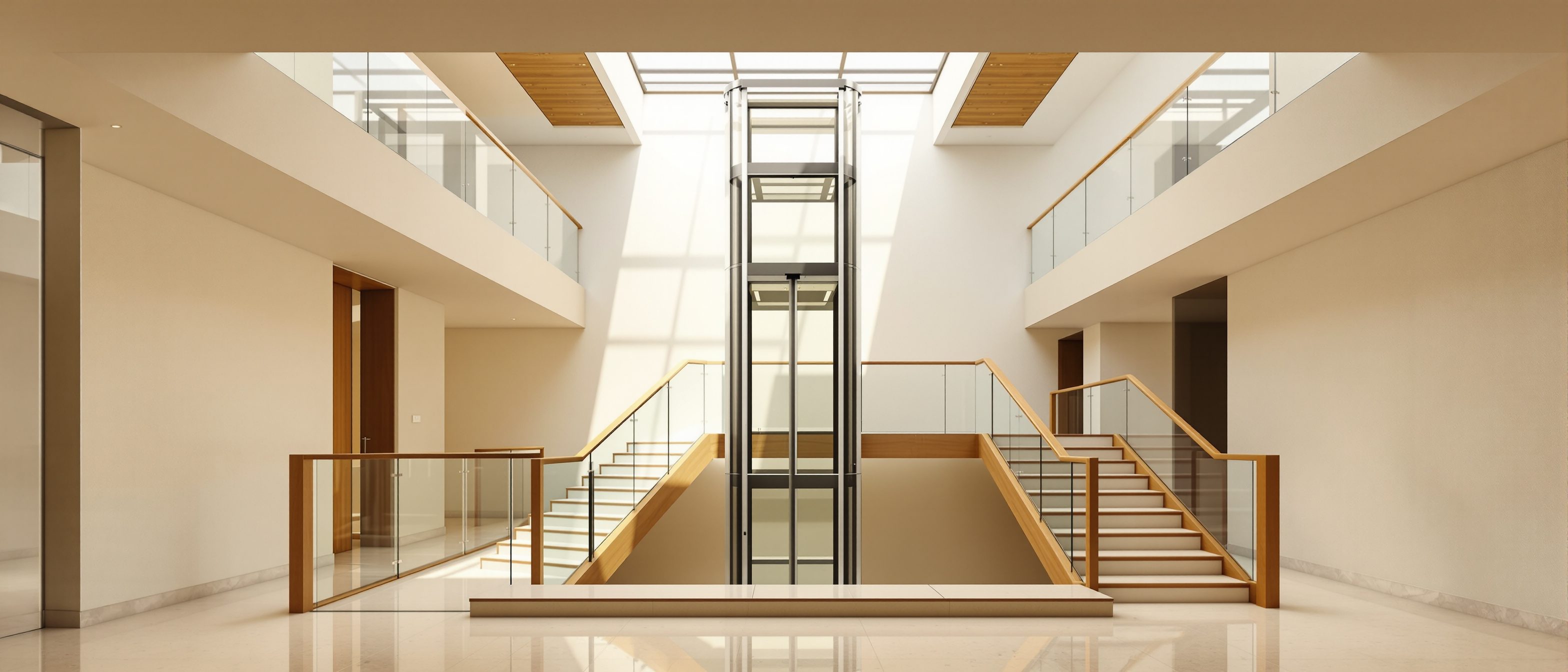
Lift Integration with Staircase Design (India): The Stair-and-Lift Core Done Well
Putting the lift in the stair void or beside the stair as one vertical-circulation core — void sizes, shared walls and landings, daylight, and landing at the same levels.
The stair and the lift are one room, not two
In most Indian homes the staircase and the lift are designed by different hands at different times — the architect lays out the stair early, and the lift gets "fitted in" once a vendor is chosen. The result is the familiar awkward compromise: a lift bolted onto a corner with its own walls, eating an extra 1.5–2 square metres on every floor, landing half a step away from the stair landing, and turning the most public part of the house into a service cupboard.
Done well, the two are a single piece of architecture — a stair-and-lift core. The lift sits inside the stair void or immediately beside it, they share landings and walls, they land at the same levels, and a person stepping off the lift is on the same platform as someone arriving on foot. This guide is about that coordination: the spatial geometry, the structural sharing, the void sizes a lift actually needs, the daylight and sightlines, and the discipline of getting both systems to stop at exactly the same floor levels.
This is one of the deeper architectural spokes under the Architect's Residential Elevator Handbook (India). For the raw clearances we reference throughout, see Home Lift Space Requirements (India); for the box itself, Lift Shaft Design Guide (India); and for the loads, Home Lift Structural Design (India). On the stair side, this guide assumes you have already read Designing a Staircase (India) and, for placement belief, Staircase Vastu.
Treat the stair and the lift as one vertical-circulation room with two devices in it. Every decision — landing size, wall thickness, daylight, where you stop — is shared.
All dimensions and code triggers below are indicative — confirm with your local municipal bye-laws, a licensed lift contractor, and your structural engineer. Lifts are state-regulated in roughly ten states, and the vendor's general-arrangement (GA) drawing always governs the final geometry.
Two ways to integrate: in the void, or beside the stair
There are exactly two honest integration patterns, plus the anti-pattern of leaving them disconnected.
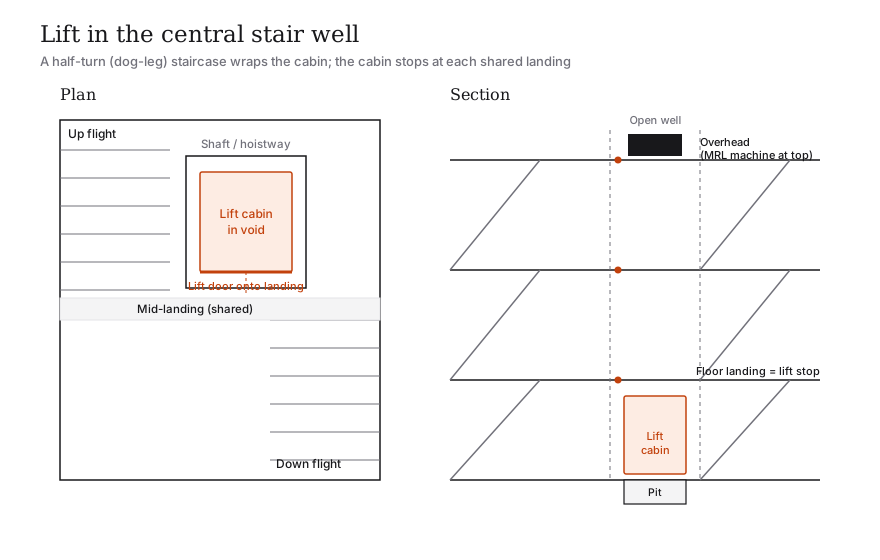
Pattern A — Lift inside the stair void
A dog-leg (half-turn, two flights with a mid-landing) or an open-well stair (flights around a rectangular central void) leaves a vertical hole running the full height of the house. If that hole is big enough, the lift goes inside it. The stair wraps the lift; the lift becomes the visual centre of the stairwell.
This is the most space-efficient pattern because the lift consumes a void that was otherwise empty — you pay almost nothing extra in plan area. It is also the most demanding: the void must be wide enough to take a lift plus the structure around it, the stair flights must clear the shaft, and the two must land together.
In practice, two sub-cases exist:
- A glazed/structural shaft inside the void. A compact MRL traction or screw-driven lift drops into a slim RCC or steel-and-glass shaft set in the open well. Needs a designed pit and the void width to take a real hoistway (see the table below).
- A shaftless PVE in the void. A Pneumatic Vacuum Elevator is self-supporting — no pit, no shaft, no machine room — and its panoramic cylindrical cabin is perfect for an open well. This is by far the easiest lift to drop into an existing stair void on a retrofit, because you are not building a structural box; you are standing a cylinder in the hole. Capacity is limited to roughly 2–3 persons and travel is modest, but for a typical G+1 or G+2 home wrapped by a stair, it is often the cleanest answer. See Retrofitting a Lift into an Existing Home (India).
Pattern B — Lift beside the stair (combined core)
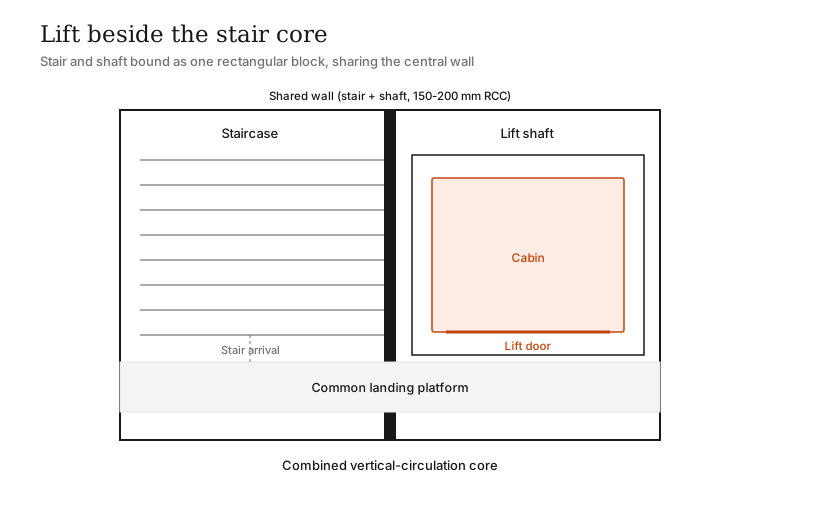
When the stair has no usable void — a straight-flight stair, or a dog-leg with a void too narrow for a lift — the lift sits immediately beside the stair and the two share the wall between them and, ideally, the same landing platform on every floor. This is the combined vertical-circulation core: one rectangular block in plan containing both the stair and the lift, bounded by shared structural walls.
This is the default for new-build, because you design the core as one element from the start. It is slightly less space-efficient than Pattern A (the lift has its own footprint, not a borrowed void) but it is structurally cleaner: the shared wall does double duty as a stair wall and a shaft wall, and the landings naturally align.
The anti-pattern — disconnected
The lift in one corner, the stair in another, landing on different platforms, the user crossing a passage to swap between them. This wastes plan area, breaks the accessibility chain (a wheelchair user steps off the lift and faces a step), and is the most common mistake on Indian residential drawings. If you take nothing else from this guide: the lift landing and the stair landing should be the same platform, or directly adjacent and step-free.
Comparing the integration patterns
| Aspect | A1 — Shaft in stair void | A2 — PVE in stair void | B — Beside-stair core |
|---|---|---|---|
| Best for | Open-well / dog-leg with generous void; new-build or major reno | Retrofit into existing stair void; G+1 to G+2 | New-build; straight or tight-void stairs |
| Lift type | Compact MRL traction / screw | Pneumatic vacuum (shaftless) | Any — MRL traction, hydraulic, screw |
| Extra plan area used | Almost none (uses the void) | None (uses the void) | Lift footprint added to core |
| Pit | Designed RCC pit (or low/pitless type) | None | Designed RCC pit (type-dependent) |
| Structural box | Full shaft inside the void | Self-supporting — no shaft | Full shaft sharing the stair wall |
| Daylight effect | Can keep the well bright if glazed | Panoramic cabin reads as light | Shaft wall can darken stair — glaze it |
| Capacity | 2–8 persons | ~2–3 persons | 2–8 persons |
| Retrofit difficulty | High (cut and build a shaft) | Low (stand a cylinder) | N/A — designed in |
| Typical cost band | Traction ₹10–25 lakh+, screw ₹14–30 lakh | PVE ₹11–22 lakh | As per type chosen |
Cost bands are indicative for 2026, exclude GST (18 percent), civil work and installation. See Home Lift Cost in India (2026) for the full breakdown.
How big must the stair void be to take a lift?
This is the question that decides whether Pattern A is even possible. The void you can see on a plan is the clear inner well of the stair — the hole between the inner stringers of an open well, or between the flights of a dog-leg. To put a lift in it, the void must hold the lift well (hoistway) plus the shaft wall thickness plus construction tolerance, and the stair flights wrapping it must still clear the moving cabin and counterweight.
A small home lift hoistway starts at roughly 1219 × 1524 mm (4' × 5') for a structural shaft, and varies with capacity and door type — automatic sliding doors need more width than a manual swing door. A shaftless PVE is far more forgiving because it has no separate shaft wall and no counterweight: a 2–3 person panoramic cabin fits a much smaller clear void.
The table below gives indicative minimum clear void dimensions (the inner well measured between finished faces) needed to drop a small lift in. Always confirm against your chosen vendor's GA drawing.
| Stair / void scenario | Lift option that fits | Indicative min clear void (W × D) | Notes |
|---|---|---|---|
| Shaftless PVE cabin only | Pneumatic vacuum, ~2 person | ~1050 × 1050 mm round footprint in a ~1200 × 1200 mm well | No pit, no shaft wall; easiest retrofit |
| Shaftless PVE, 3 person | Pneumatic vacuum, ~3 person | ~1300 × 1300 mm well | Larger cylinder; check travel limit |
| Small structural shaft, manual door | Compact MRL traction / screw, 2–3 person | ~1500 × 1700 mm (well + 150–200 mm walls + tolerance) | Add wall thickness to the 1219 × 1524 hoistway |
| Small structural shaft, auto sliding door | Compact MRL traction, 3–4 person | ~1700 × 1900 mm | Auto doors widen the required well |
| Accessible home car in void | MRL, wheelchair + attendant | Car ~1100 × 1400 mm → well ~1600 × 1900 mm + walls | Door clear width ≥ 900 mm; see accessibility guide |
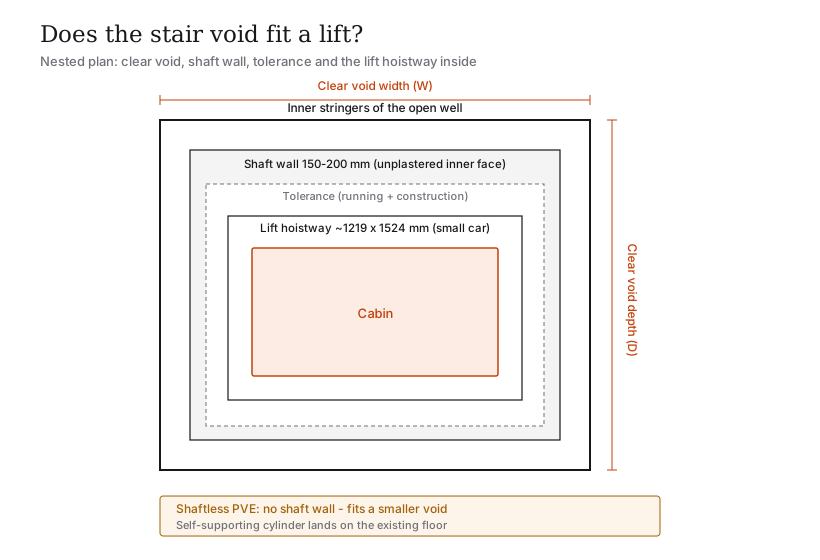
Two cautions on this table. First, the structural shaft wall is part of the cost in space: a 150–200 mm RCC wall on each side eats 300–400 mm of the void width before the cabin even appears — which is precisely why a shaftless PVE wins in tight voids. Leave the internal face of an RCC shaft unplastered; plaster reduces clearances and can spall onto running gear. Second, the wrapping stair flights must clear the moving parts: keep a documented gap between the inner stringer and the shaft, and check the mid-landing does not foul the shaft door swing or sliding zone.
For the full clearance logic — pit, headroom, well, door types — defer to Home Lift Space Requirements (India) and Lift Shaft Design Guide (India). On the tightest urban sites, the void-versus-shaft trade-off is the whole game; see Lift Design for Narrow Plots (India).
Structural coordination: sharing walls, landings and loads
The strength of an integrated core is that one structural element serves both devices — and that is also where coordination bites.
Shared walls
In Pattern B, the wall between the stair and the lift is simultaneously a stair enclosure wall and a shaft wall. A shaft wall is typically a 150–200 mm RCC wall that must also carry guide-rail bracket reactions — both vertical and horizontal forces fed into the wall at intervals up the shaft. The exact bracket loads and locations come from the lift supplier's reaction schedule; you cannot finalise the shared wall's reinforcement until the GA drawing is fixed. A wall designed only as a stair partition will not have been checked for those horizontal bracket forces.
Shared landings
The mid-landing of a dog-leg stair and the lift's landing slab want to be the same slab at the same level. This is the elegant part of integration: one landing platform serves both. But it imposes a constraint — the stair's rise must be set so that the half-landing (Pattern A) or floor landing (Pattern B) lands exactly where the lift door opens. Co-design the stair geometry and the lift stops together, never sequentially.
The pit
The lift pit is effectively a waterproof RCC box below the lowest landing. Depth ranges from 150–300 mm for hydraulic and screw types, up to 1500–1750 mm for some geared/gearless traction; a PVE needs none. When the pit sits beneath or beside the stair's lowest flight, design its walls for lateral earth pressure (it is below ground) and provide buffer-impact capacity in the pit slab — pit and overhead slabs commonly crack when buffer/impact forces are underestimated. Coordinate the pit with the stair's plinth beam and foundation so they do not clash.
Overhead
With MRL the machine sits in the hoistway top — the 2026 norm — so you no longer need a machine room perched over the stair. You still need the overhead clearance (≈2600–3000 mm typical). Where a hoist beam exists, design the overhead slab and beam for the supplier's unfactored hoist-beam live load.
The structural engineer designs the shaft, pit and overhead to the lift vendor's GA drawing and reaction loads. Never cast the shared core before the vendor's general-arrangement is fixed.
For the full load path and detailing, see Home Lift Structural Design (India), Lift Pit Requirements (India) and Lift Machine Room Requirements (India).
Level coordination: landing at the same floors
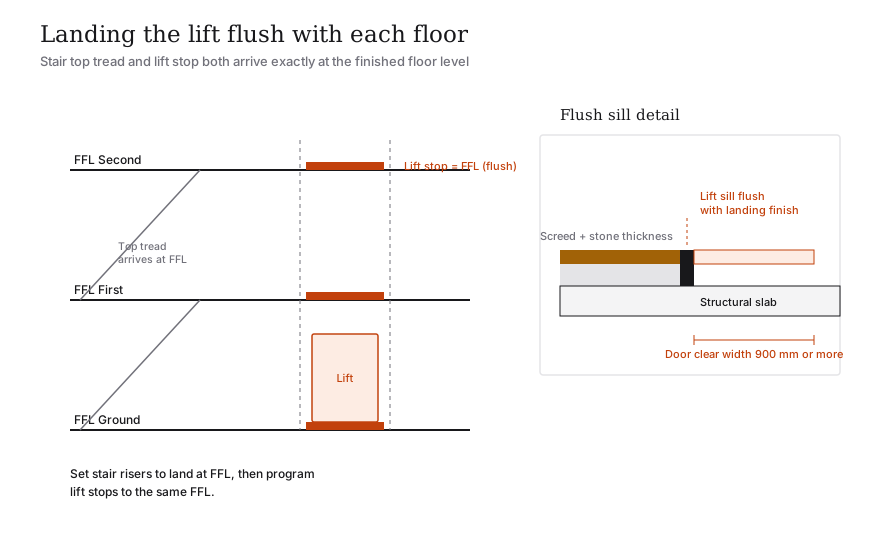
The single discipline that separates a good core from a clumsy one is level coordination — making the lift stop exactly where the stair lands, on every floor, flush.
The stair's geometry is fixed by its riser count and riser height: floor-to-floor height divided into equal risers. The lift, by contrast, can stop at any programmed level. The integration rule is therefore: set the stair first to land cleanly at each finished floor level, then program the lift stops to those same levels. A lift that stops 40 mm proud of or below the landing is a trip hazard and, for a wheelchair, an outright barrier — the whole accessibility case collapses at the threshold.
Three coordination points matter:
- Finished floor levels (FFL), not slab levels. The lift lands on FFL; the stair tread arrives at FFL. Coordinate both to the finished level after flooring, accounting for screed and stone thickness, so the lift sill, the landing and the top tread are coplanar.
- Intermediate / mismatched stops. Split-level or mezzanine homes sometimes have a stair half-landing that is not a lift stop. Decide deliberately whether the lift serves that level; if not, signage and a guarded edge are needed so no one expects a door there. For duplexes specifically, see Lift Planning for Duplex Homes (India).
- Sill and threshold detail. Keep the lift sill flush with the landing finish — a level, gap-controlled threshold. Automatic doors with a closing time of at least 5 seconds and a door clear width of ≥ 900 mm keep the transition step-free for an accessible home.
Daylight, sightlines and the experience of the core
Because an integrated core is usually the most visible interior of an Indian home — you see it from the entry, you climb it daily — its light and sightlines deserve design attention, not just clearance arithmetic.
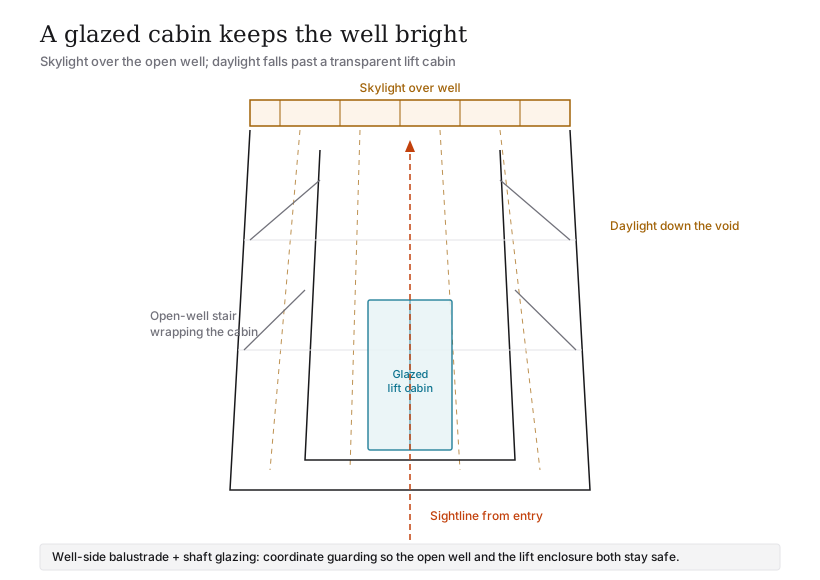
- Borrow the void's daylight. An open well that previously brought light down the centre of the house should not be killed by an opaque shaft. Use a glazed shaft or a panoramic PVE cabin so the lift reads as a transparent object and the daylight survives. A skylight over the void, falling past a glass cabin, is one of the most rewarding moves in the whole house.
- Protect sightlines. Keep the line of sight from the entry up through the well open where you can; a glass lift preserves it, a blockwork shaft severs it. On landings, keep the lift door and the stair arrival visible to each other so a person can choose either without doubling back.
- Handrails and edges. Where the stair wraps a glazed lift, the well-side balustrade and the shaft glazing must both meet guarding requirements; coordinate so you are not stacking two redundant barriers in a 200 mm gap.
Vastu, fire and the placement reconciliation
Many Indian clients hold a Vastu preference: the staircase traditionally in the south-west (a corner meant to stay heavy and grounding), with the lift often kept adjacent to the stair. Lift-vastu writers favour north or north-east for the lift and north or east for the pit, and advise against the exact centre (Brahmasthan), the south-west, and a position directly opposite the main door. These are cultural preferences to reconcile with structural and spatial reality — engineering and safety win where they conflict. When the ideal shared-core location and the favoured direction disagree, present the trade-off honestly and let the client decide. See Staircase Vastu, Lift Placement as per Vastu (India) and Vastu House Plan (India).
On fire, remember that a normal home passenger lift is not an escape route — occupants use the stairs, which is one more reason to keep the stair and lift together: the safe route is right next to the convenient one. On a fire alarm the lift should return to a designated floor and park with doors open. Landing/shaft doors contribute to compartmentation, so fire-rated landing doors matter even in a home. A fireman's lift (min ~8 persons / 544 kg, car ~1100 × 1400 mm, full-height travel on backup power) is generally triggered only above 15 m (some residential rules set 30 m) — most independent homes sit below this, but verify the threshold and any fire NOC locally. And specify an ARD (Automatic Rescue Device) so a power cut during an incident still lets the car reach a floor. More in Lift Fire Safety Planning (India).
A coordination checklist for the integrated core
- Pick the pattern early: lift in the void (A) only if the clear void meets the table above; otherwise beside-stair core (B).
- Lock the vendor GA drawing before designing walls, pit and overhead — the reaction schedule drives the shared wall reinforcement.
- Make the lift landing and stair landing one platform (or directly adjacent and step-free).
- Set the stair to land at each FFL, then program lift stops to the same FFLs; detail a flush sill.
- Design the shared shaft/stair wall (150–200 mm RCC, unplastered inner face) for guide-rail bracket forces.
- Design the pit as a waterproof RCC box for lateral earth pressure and buffer impact; coordinate with the stair plinth.
- Glaze the shaft or use a PVE to keep the well's daylight and sightlines alive.
- Provide automatic doors, ≥ 900 mm clear width, ARD, fire-rated landing doors; confirm state lift licence/registration and any fire NOC.
- For wheelchair use, hold the car ≈ 1100 × 1400 mm and the step-free threshold — see Accessible Home Design (India).
Plan the core into the house from day one and the lift costs you almost nothing in plan area while transforming the experience of the stair. Bolt it on later and you pay in square metres, daylight and a broken accessibility chain. Read the planning spokes alongside this one — Designing a Lift into a New House (India), Lift Planning for Villas (India) and Lift Planning for Senior-Friendly Homes (India) — and keep the home lift-ready and future-proofed even if the lift goes in later.
References
- IS 14665 — Electric Traction Lifts (BIS, committee ETD 25): Part 1 Outline dimensions (car, well/hoistway, pit, headroom); Part 2 Installation, operation and maintenance; Part 3 Safety rules; Part 4 Components; Part 5 Inspection. IS 14665 Part 1: https://law.resource.org/pub/in/bis/S05/is.14665.1.2000.pdf and Part 2: https://law.resource.org/pub/in/bis/S05/is.14665.2.1-2.2000.pdf
- IS 15259 — Hydraulic lifts (companion code for hydraulic installations).
- National Building Code of India 2016, Part 8 (Building Services), Section 5 — Installation of Lifts, Escalators and Moving Walks (BIS): https://www.bis.gov.in/standards/technical-department/national-building-code/ and the BIS Guide for Using NBC 2016: https://www.bis.gov.in/wp-content/uploads/2022/08/Booklet-Guide-for-Using-NBC-2016.pdf
- RPwD Act 2016 (Rights of Persons with Disabilities), Sections 40, 44, 45: https://ssepd.odisha.gov.in/sites/default/files/2024-01/RPWD%20ACT.pdf and DEPwD FAQs: https://depwd.gov.in/en/faqs-4/
- CPWD / MoHUA Harmonised Guidelines and Space Standards for a Barrier-Free Built Environment (2016): https://www.cpwd.gov.in/Publication/Harmonisedguidelinesdreleasedon23rdMarch2016.pdf
- State Lift Acts (lifts are state-regulated in roughly ten states): Maharashtra Lifts, Escalators and Moving Walks Act 2017; Karnataka Lifts, Escalators and Passenger Conveyors Act 2015; Delhi Lifts and Escalators Act 2007; Tamil Nadu Lifts Act 1997. Maharashtra licence to operate a lift: https://services.india.gov.in/service/detail/maharashtra-license-to-operate-lift and an overview of lift regulations in India: https://www.99acres.com/articles/know-all-about-the-lift-regulations-in-india.html
- Structural references: Structural requirement for lifts and lift pits (Civilera): https://www.civilera.com/post/structural-requirement-for-lifts-and-lift-pits and RCC lift well/shaft structural design: https://www.sketchup3dconstruction.com/const/guidelines-for-making-perfect-structural-design-of-a-lift.html
- Vastu (cultural preference, not engineering): Lift vastu (NoBroker): https://www.nobroker.in/blog/lift-vastu/ and Lift vastu (SubhaVaastu): https://www.subhavaastu.com/vastu-tips-lift.html
All dimensions, cost bands and code triggers are indicative for 2026 and vary by state, vendor and year. Confirm with your local municipal bye-laws, a licensed lift contractor and your structural engineer before construction.
Export this guide
Related Guides — Deep-dive reading
Lift and Fire Safety Planning (India): What Home Lifts Must Do When There's a Fire
Why your home lift is never the escape route, how fire recall works, when a fireman's lift is required, and the local fire NOC and bye-law checks every Indian homeowner should make.
Home Lifts & AccessibilityArchitect's Residential Elevator Planning Handbook (India): Shaft, Loads, Code & Coordination
The plan-stage reference for carrying a home lift through the drawing board — shaft, structure, pit, code, licensing and accessibility.
Home Lifts & AccessibilityHome Lift Structural Design Considerations (India): Loads, Shaft and Coordination
The loads a home lift imposes, designing the shaft and pit as RCC elements, framed vs load-bearing implications, and the coordination workflow that ties structural design to the vendor's GA and reaction schedule.
Home Lifts & AccessibilityRelated Tools — Try Free
Accessibility Compliance Calculator
Check a planned lift against the CPWD and RPwD accessible-lift benchmarks for a score.
Lift CheckerCross-Ventilation Analyzer
Estimate airflow and air changes per hour (ACH) from room size, window areas, layout, and local wind — with NBC 2016 Part 8 compliance check.
Ventilation CalculatorLift Headroom Calculator
Required overhead clearance for a home lift, checked against your top-floor height.
Lift Calculator