

Furniture Buying Guide India: How to Buy Well, Online & In-Store (2026)
The practical, do-this-next guide to actually buying furniture in India — where to buy (local carpenter, brand showroom, retail chain, online, pre-owned), the buying process from measuring to delivery, the quality checks that separate a ten-year piece from a two-year one, and the online cautions, warranties and mistakes that cost the most.
Buying furniture in India is oddly stressful for something you do only a few times in your life. You are choosing between a local carpenter who can build anything but shows you nothing finished, a glossy brand showroom with confident salespeople, a retail chain with a sale banner, and an online listing with photos that may or may not match reality — and every one of them sounds right in the moment. The piece then has to fit through your door, survive Indian humidity and the odd termite, and still look good after the return window has closed.
This is the practical how-to-buy guide for the Furniture hub. It is deliberately about the act of buying — where to shop, the order to do things in, what to physically check, and the traps that cost the most — rather than what a piece should cost (that is the furniture cost guide and the furniture cost calculator) or how to lay it out (that is ergonomics and the furniture size chart). Read this before you pay a single advance.
Scope & how to read this. This guide helps you plan, compare and buy well; it is not a fabrication or valuation manual. Every rupee band is indicative — get local quotes and use the furniture cost calculator for your city and spec. Material grades and safety points are named generally (IS plywood and furniture standards, E0/E1/E2 formaldehyde classes); confirm the exact grade, warranty terms and anti-tip fittings against the maker's documents and the relevant IS codes. Where a piece is child-reachable or wall-mountable — tall wardrobes, chests, bunk beds, TV units — anti-tip anchoring and stable design are safety-critical, not optional.
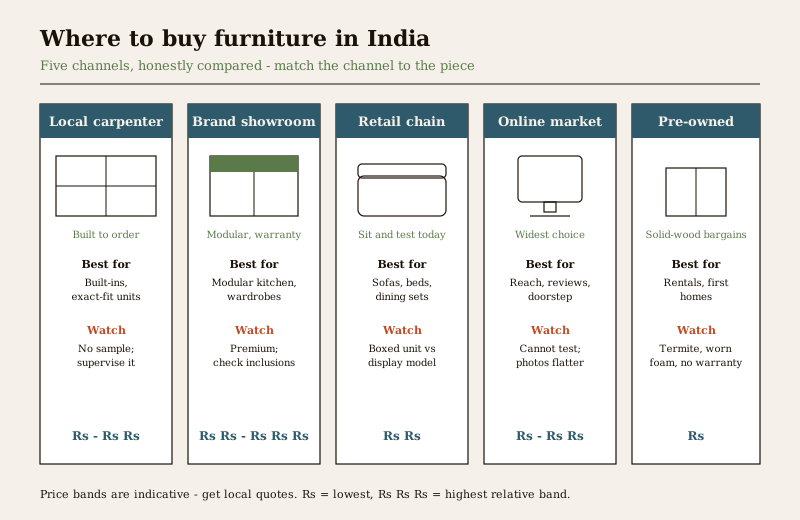
Where to buy — the five routes, honestly compared
Almost every furniture purchase in India runs through one of five channels, and each is genuinely better at some things and worse at others. Match the channel to the piece, not to habit.
| Where to buy | Best for | Watch out for | Price feel |
|---|---|---|---|
| Local carpenter / bespoke workshop | Built-ins, odd sizes, wardrobes, exact-fit units | No finished sample to see; quality rides on your supervision and their skill | Low to medium; material-driven |
| Brand modular showroom | Modular kitchens, wardrobes, warranty-backed systems | Premium over a carpenter for similar boards; upsell on hardware | Medium to high |
| Retail chain / large-format store | Ready sofas, beds, dining sets you can sit on today | Display piece may differ from the boxed one; assembly quality varies | Medium |
| Online marketplace / D2C brand | Convenience, choice, reviews, doorstep delivery | Cannot test; photos flatter; returns and assembly friction | Low to medium |
| Second-hand / pre-owned | Solid-wood bargains, rentals, first homes, sustainability | Termite/borer, worn foam, no warranty, transport cost | Lowest |
A few honest notes on each:
- Local carpenter. Unbeatable for anything that must fit a specific niche — a wardrobe to the ceiling, an under-stair unit, a bed with your exact storage. You are buying labour and boards, so the outcome is only as good as the plywood grade you insist on and the hardware brand you name. Decide carpenter-versus-ready deliberately with custom furniture vs ready-made; for built-ins, see built-in vs modular vs loose.
- Brand modular showroom. Worth the premium when you want a warranty, factory-consistent finish and someone accountable — most valuable for modular kitchens and system wardrobes. Pin down which board grade and hardware brand the quote actually includes.
- Retail chain. The place to physically sit, lie down and open drawers before buying — priceless for a sofa, bed and mattress or dining set. Just confirm the boxed, flat-pack unit matches the floor model.
- Online marketplace / D2C. Superb reach and easy comparison, but you are buying sight-unseen — the whole reason the online-cautions section below exists.
- Second-hand. The smart-money route for solid-wood pieces (which age well) and for rentals and first homes — provided you inspect hard for termite, borer dust and sagging foam, because there is no warranty to fall back on.
The buying process — do it in this order
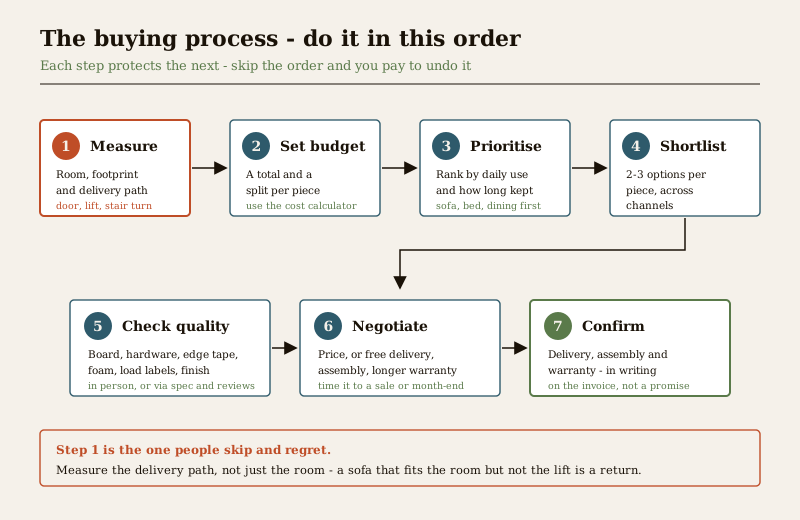
Furniture goes wrong in the wrong order — people fall for a sofa, then discover it will not turn the stair landing. Run the sequence below and each step protects the next.
1. Measure first. The room, the piece's target footprint, and — critically — the delivery path: door widths, lift dimensions, the turn on the stairs. Note them on a plan. The furniture size chart and layout planner turn measurements into a fit-check before you commit.
2. Set a budget band. A total, and a rough split across pieces, using the furniture cost calculator and the cost and budget hub. A budget stops the showroom from setting it for you.
3. Prioritise. Rank pieces by how much they earn their space and how long you will keep them. Sofa, bed and dining anchor daily life and deserve the budget; accents can wait or come pre-owned.
4. Shortlist. Pick two or three options per piece across channels, so you are comparing, not falling in love with the first thing.
5. Check quality. The material-by-material inspection in the next section — done in person where you can, and via reviews and specs where you cannot.
6. Negotiate. Ask for a better price, free delivery, free assembly, or a longer warranty — there is almost always room, especially near a sale or at month-end.
7. Confirm delivery, assembly and warranty in writing. Delivery date, who assembles, what the warranty covers and for how long, and the return window — all on the invoice, not on a promise.
The single highest-return habit is measuring the delivery path, not just the room. A three-seater that fits the living room but not the lift is a return, a re-stocking fee and a wasted week. For tight homes, furniture for small homes and storage solutions for compact apartments show how to buy for fit, not just floor area.
Quality checks — a material-by-material inspection
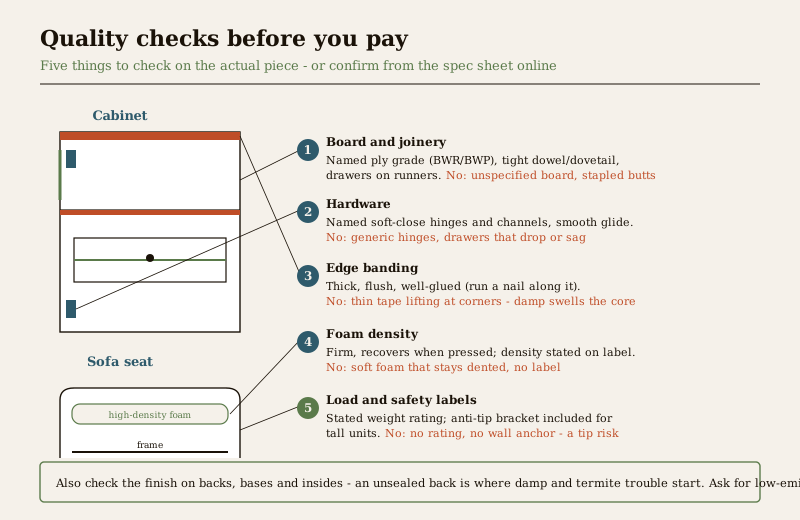
This is the part that separates a piece you keep for a decade from one you replace in two years. You do not need to be a carpenter; you need to check the right six things. Run this on the actual unit — or, online, confirm each from the spec sheet and reviews.
| What to check | Good sign | Warning sign |
|---|---|---|
| Board / joinery | Named plywood grade (BWR/BWP for wet zones), tight dovetail or dowel joints, drawers on runners | "Engineered wood" unspecified, stapled butt joints, drawers that scrape |
| Hardware | Named brand hinges and channels (soft-close), smooth heavy drawer glide | Generic hinges, drawers that drop, doors that sag after a few opens |
| Edge banding | Thick, flush, well-glued edges with no lifting corners | Thin PVC lifting at edges — water and steam get in and swell the board |
| Foam / upholstery | Firm, resilient foam that recovers; density stated on the label | Soft foam that stays dented; no density label; loose, puckered stitching |
| Load & safety labels | Stated weight rating, anti-tip bracket included for tall units | No load rating; tall unit with no wall-anchor fitting |
| Finish | Even PU/laminate/melamine, no bubbles, sealed undersides and backs | Rough or unsealed back and base, visible glue, patchy polish |
How to actually do the checks:
- Board and joinery. Ask which board it is and insist on the grade in writing — plywood grades, engineered wood and MDF vs particle board explain why BWR/BWP plywood belongs in kitchens and bathrooms and MDF does not. For long-life pieces weigh it against solid wood.
- Hardware. Open and close every door and drawer a few times. Soft-close, named-brand hinges and channels are the difference maker and are cheap to specify up front — impossible to retrofit cheaply later.
- Edge banding. Run a fingernail along every edge. Lifting edge tape is the number-one failure in humid Indian homes because moisture wicks in and swells the core.
- Foam density. For sofas and mattresses, press hard and watch it recover; ask for the foam density on the label. The fabric and foam calculator and upholstered furniture go deeper; leather and fabric care tell you what a cover will demand later.
- Load and safety labels. For any tall, child-reachable or wall-mounted unit, confirm a stated load rating and that an anti-tip bracket is included — this is genuine child-safety, covered in furniture safety and regulations. Ask about low-emission boards too (E0/E1 formaldehyde classes) for bedrooms and children's rooms.
- Finish. Check the backs, bases and insides, not just the show face — an unsealed back is where damp and termite trouble start.
Buying for your situation
The same piece is a different buy depending on the home it is going into.
| Situation | Buy this way | Skip |
|---|---|---|
| Rental home | Loose, light, flat-pack, cheap-to-move pieces; keep the boxes | Built-ins, heavy solid wood, anything you cannot carry out |
| Apartment | Delivery-fit checked, right-scaled, multi-functional | Oversized sofas and beds that will not turn the lift or landing |
| Villa / large home | Scale up, invest in quality and solid wood where it shows | Under-scaled pieces that look lost in big rooms |
| First home | Phase it — anchor pieces new, the rest pre-owned or later | Buying everything at once, in a hurry, to "finish" the house |
- Rental homes. Buy loose and portable — flat-pack beds, a modular sofa, standalone storage — and keep the cartons for the next move. Money spent on built-ins walks away with the landlord.
- Apartments. Fit is everything: measure the lift and the landing turn, favour right-scaled and space-saving or multi-functional pieces, and read apartment living for the room-by-room logic.
- Villas and large homes. Scale up so pieces do not float, and put the budget into quality and solid wood where hands and eyes land daily — the luxury interiors hub frames where spending shows.
- First home. Phase it. Buy the sofa, bed and dining anchors well, and let accent chairs, a second wardrobe and the study fill in over months — pre-owned or as budget allows. The homeowner's buying guide walks a full first-home plan.
Buying online — the extra cautions
Online is often the best price and the widest choice, but you are buying blind, so add these guards:
- You cannot test it. Compensate by reading the spec sheet like a hawk — board type, foam density, dimensions, weight, materials — not just the marketing copy.
- Photos flatter. Colour, scale and fabric texture all read differently on a screen. Trust the dimensions over the picture, and lay the footprint out on your floor with tape before ordering.
- Measure twice, order once. Check the product's own dimensions against your room and delivery path; online returns of large furniture are slow and sometimes chargeable.
- Read the reviews properly. Weight the reviews with photos and the ones that mention assembly, sagging or delivery damage — not the star average.
- Assembly is on you (or extra). Flat-pack often arrives as parts; confirm whether assembly is included, or budget for it.
- Know the return and damage policy before you pay. Return window, who pays return freight, and how transit damage is handled — screenshot it. For domestic-versus-import trade-offs online, see imported vs Indian furniture.
Warranty and after-sales — keep the paper
The warranty is only as good as the paperwork you keep, and most furniture warranties are narrower than buyers assume.
- Know what is actually covered. Structural and manufacturing defects usually are; fabric wear, foam softening, sun-fade, humidity swelling and "misuse" usually are not. Read the exclusions, not the headline "10-year warranty".
- Keep the bill and warranty card. No invoice, no claim — file the invoice, warranty card and the online order confirmation together, digitally too.
- Confirm the service path. Who services it, in your city, and how long a claim takes — a warranty with no local service centre is decoration.
- Register if required. Some brands need online registration within a window for the warranty to be valid.
- Log delivery condition. Photograph big pieces at delivery before you sign, so transit damage is not disputed later.
Negotiation and timing
There is almost always room, and timing multiplies it.
- Ask — for price, or for value. If the price will not move, push for free delivery, free assembly, a foam or fabric upgrade, or a longer warranty.
- Buy on the calendar. End-of-season sales, festive sales and financial year-end (March) are when stores clear stock and discounts are real. New-model launches mark down the outgoing range.
- Bundle. A full room or a multi-piece order gives you leverage a single chair does not.
- Advance discipline. With a carpenter or custom order, tie the payment to stages, keep a meaningful balance until final fit-out, and get the spec — board grade, hardware brand, finish — in writing before any advance. See custom vs ready-made and the custom furniture estimator.
The mistakes that cost the most
Almost every furniture regret is one of these:
- Buying before measuring. The room, and the delivery path. The most common and most expensive mistake — a return, a re-stock fee, a wasted week.
- Buying the matching set. A boxed "5-piece set" locks you into one scale and style and rarely fits a real room; buy pieces that each earn their place.
- Chasing the trend. A very of-the-moment sofa or colour dates fast on a piece you keep ten years — anchor pieces neutral, express the trend in cushions and decor. Furniture styles helps you pick what lasts.
- Ignoring the delivery path. Covered above because it bears repeating — measure the door, lift and landing turn.
- Under-speccing to hit a price. Cheap hinges, thin edge tape and unnamed boards fail first; spend where the piece works hardest and save on where it does not.
- Skipping the paperwork. No invoice, no warranty claim; no photos, no damage claim.
How it connects
- Anchor everything to the Furniture hub pillar; price your list with the furniture cost guide and the furniture cost calculator.
- Decide the build route with custom furniture vs ready-made and built-in vs modular vs loose; size it with the furniture size chart and ergonomics guide.
- Buy for the home you have: furniture for small homes, storage solutions for compact apartments and the apartment living hub.
- Check materials against plywood, engineered wood, MDF vs particle board and solid wood; weigh domestic versus imported vs Indian furniture.
- Take safety seriously via furniture safety and regulations and protect the buy with termite and moisture protection.
- Plan the room before you buy with the layout planner and furniture layout designer, and browse real rooms in living-room and bedroom design ideas.
Key takeaways
- Match the channel to the piece — carpenter for exact-fit built-ins, showroom for warranty-backed modular, retail to sit and test, online for reach, pre-owned for solid-wood bargains and rentals.
- Buy in order — measure (room and delivery path), budget, prioritise, shortlist, check quality, negotiate, then confirm delivery and warranty in writing.
- Run the six quality checks — board grade and joinery, named soft-close hardware, thick flush edge banding, stated foam density, load and anti-tip safety labels, and a sealed finish front and back.
- Buy for your situation — loose and portable for rentals, delivery-fit and right-scaled for apartments, scale and quality for villas, phased for a first home.
- Online needs extra guards — you cannot test it, photos flatter, so trust dimensions, read photo reviews, and know the return policy before you pay.
- Keep the paper — invoice, warranty card and delivery photos, and read what the warranty excludes, not just the headline number.
- Avoid the costly mistakes — buying before measuring, boxed matching sets, trend-chasing anchor pieces, and under-speccing to hit a price. All costs are indicative — get local quotes.
References
- IS furniture safety, strength and durability standards, Bureau of Indian Standards — general provisions for furniture strength, stability and anti-tip performance (named generally).
- IS 303 / IS 710 (plywood, including BWR/BWP grades), IS 1734 (plywood test methods), IS 3087 / IS 3097 (particle board), IS 12406 (MDF), IS 1659 (blockboard) — board grade and quality references (named generally).
- Formaldehyde emission classes E0 / E1 / E2 (CARB / EN 13986 context) — low-emission board selection for bedrooms and children's rooms (named generally).
- BIFMA furniture testing and IGBC / CRI GreenPro eco-certification — commercial-grade and low-impact furniture references (named generally).
- Manufacturer / seller documents — invoice, warranty card and terms, board-grade and hardware-brand specification, and delivery condition record.
All prices, material grades and durability notes here are indicative planning aids only; confirm the exact board grade, warranty terms and anti-tip fittings against the maker's documents and the relevant IS codes, get local quotes for cost, and treat anchoring of tall, child-reachable or wall-mounted furniture as safety-critical.
Export this guide
Related Guides — Deep-dive reading
The Complete Guide to Furniture for Indian Homes (2026)
The start-here master guide for furnishing an Indian home — what furniture actually does, the five families of pieces, the decisions in the order you face them (space and needs, loose vs modular vs built-in, materials, size and layout, budget, buy, maintain), an honest read on plywood, humidity and termites, and where every choice hands off to the carpenter, the brand or the fixer.
FurnitureHow to Choose a Wash Basin in India: Mount Type, Size, Tap Holes & Budget (2026 Buyer's Guide)
A buyer's decision guide to picking the right wash basin — matching the mount type to your vanity and space, sizing it to the room, getting the tap-hole config right for your faucet, judging material and durability, checking what's in the box, good/better/best rupee tiers, the IS 2556 vitreous-china mark, and how to spot seconds, hairline cracks and warranty traps.
BathroomsStorage Planning Before Interior Design
Why storage must be planned first — audited, budgeted and given its floor area — before a single layout, colour or sofa is chosen. The homeowner's plan-it-first master guide for Indian homes.
StorageRelated Tools — Try Free
Apartment Furniture Size Chart
Standard furniture dimensions for Indian apartments — sofas, beds, tables, dining, storage.
Reference ChartApartment vs Villa Interior Planning Guide
Compare ceiling height, structural flexibility, lighting, storage, and services between apartments and villas.
Planning GuideWindow Hardware Cost Calculator
Estimate window hardware cost — hinges, handles, locks, rollers and multipoint gears.
Window Calculator