
Storage Planning Before Interior Design
Why storage must be planned first — audited, budgeted and given its floor area — before a single layout, colour or sofa is chosen. The homeowner's plan-it-first master guide for Indian homes.
The most common message I get from homeowners arrives about eighteen months after move-in, and it is always some version of the same sentence: "We've run out of space." A young Bengaluru couple bought a smart 2BHK and spent six lakh on interiors — accent walls, a designer TV unit, a beautiful kitchen island — and now their festival décor lives in suitcases under the bed, the pressure cookers are stacked on the fridge, and there is a permanent pile of "things with nowhere to go" on the spare-room floor. The home looks gorgeous in photographs. It does not work.
This is almost never a small-home problem. It is a sequencing problem. The interiors were designed the way most Indian interiors are: layout first, finishes next, storage squeezed into whatever was left over. A wardrobe got drawn because the bedroom had a wall; a kitchen got modular cabinets because that is what modular kitchens have. Nobody asked the only question that matters — what does this family actually own, and where will all of it live?
Good homes are built the other way round. Storage is audited, budgeted and given its floor area before the first layout is sketched. Everything else — circulation, lighting, the colour of the sofa — wraps around that decision.
Storage is not a finish you add at the end; it is a system you plan at the beginning — and the home that plans it first never overflows.
1. Why storage must come first, not last
When storage is the last decision, three things go wrong, and they go wrong in every type of home — the compact builder flat, the spacious independent house, the joint-family duplex.
The volume gets set by the wall, not by the contents. A 2400 mm wide wardrobe gets drawn because that is the length of the bedroom wall, giving roughly 95 cubic feet of usable space. Whether that matches the family's clothing — and an occasion-heavy household with thirty silk sarees needs far more than a two-shirt-and-jeans professional — is a question nobody asked. The dimension came from the architecture; it should have come from the inventory.
Retrofitting costs 2-3× more and eats floor area. Adding storage after the layout is frozen means surface-mounted cabinets that jut into the room, lofts hacked in above doors, and freestanding almirahs that block windows. A loft built into the original drawings costs a fraction of one added later, and disappears into the architecture instead of fighting it.
The overflow becomes permanent. Possessions are like water — they find the lowest, easiest level. If there is no designed home for the suitcase, the Diwali lights and the spare quilt, they colonise the floor, the bed-top and the balcony. Once that happens, no amount of decluttering fixes it, because the storage simply does not exist.
The alternative is a deliberate sequence: audit, then budget, then allocate floor area, then decide the form of each store, and only then design the room. The professional version of this discipline — volume benchmarks, anthropometrics, material specifications — is laid out for designers and architects in Storage Planning as a Design Discipline. This guide is the homeowner's version: the same logic, made buildable for you.
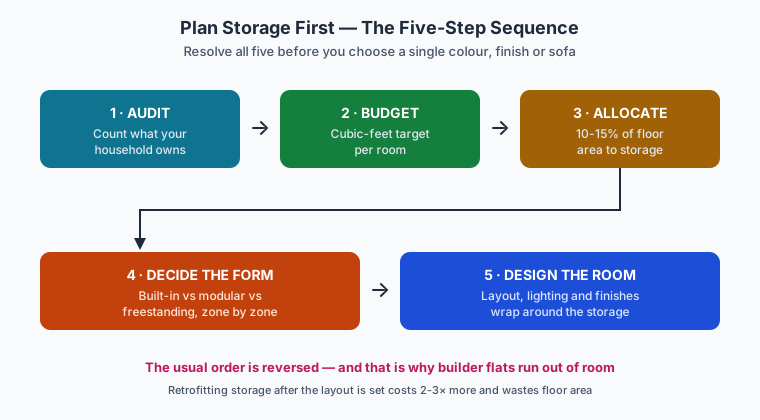
Figure 1: The five-step sequence. Resolve all five before you pick a single colour or sofa. The usual Indian workflow runs this exactly backwards, which is why so many finished homes overflow.
"You can't organise clutter, you can only get rid of it." — Julie Morgenstern, Organizing from the Inside Out
Morgenstern's point cuts to the heart of it: organising is not the answer to a storage shortage — capacity is. And capacity is a planning decision, made before the home is built or renovated, not after.
2. Step one — the household possessions audit
You cannot budget for storage you have never counted. The audit is simply a walk through your current home, room by room, listing what you own — not item by item, but by category and rough volume. It takes an afternoon and it is the single highest-value hour you will spend on your interiors.
For each category, capture three things: roughly how much there is (a wardrobe-worth, a shelf-worth, a trunk-worth), how often you use it (daily, weekly, seasonal, archival), and where it currently lives versus where it should. The frequency answer is what later tells you whether something belongs in easy reach or up in a loft.
Use this checklist as your starting frame, then add anything specific to your household — a parent's medical equipment, a teenager's sports kit, a home business's stock.
| Category | What to count | Typical frequency |
|---|---|---|
| Everyday clothes | shirts, kurtas, work wear, kids' uniforms | Daily |
| Occasion wear | silk sarees, lehengas, sherwanis, suits | Weekly / occasional |
| Bed & bath linen | spare sheets, towels, quilts, blankets | Weekly / seasonal |
| Kitchen — daily | masala dabbas, oils, daily vessels, crockery | Daily |
| Kitchen — bulk | atta, rice, dal sacks, festival cooking gear | Weekly / seasonal |
| Footwear | family shoes, sandals, occasion footwear | Daily + occasional |
| Festival & décor | Diwali lights, idols, garlands, gift stock | Seasonal |
| Seasonal appliances | cooler, room heater, extra fans | Seasonal |
| Documents & archival | papers, certificates, keepsakes, old albums | Archival |
| Luggage | suitcases, duffels, trekking gear | Occasional |
| Cleaning & utility | mop, broom, vacuum, detergents, tool kit | Daily / weekly |
| Hobbies & sport | cricket kit, instruments, craft supplies, books | Weekly |
The surprises in an Indian audit are almost always the same: the sheer volume of occasion goods (no European storage catalogue assumes thirty hung sarees), the bulk groceries a household buys monthly, and the seasonal swing — the woollens-and-quilts pile that is dead weight for eight months and essential for four. Plan for the peak, not the average.
If you would rather not count by hand, the storage calculator walks you through the same categories and returns a rough cubic-feet figure, and the wardrobe storage capacity calculator does the same for clothing specifically. Use them to sanity-check your afternoon's audit.
3. Step two — turn the audit into a storage budget per room
The audit gives you a pile of categories. The budget assigns each category a home and a rough volume, room by room. This is where you discover, on paper and for free, whether your plan has enough storage — long before the carpenter does, for a fee, after move-in.
The table below is a starting allocation for a typical Indian family home. Treat the percentages as the share of each room's floor area that storage should occupy; adjust up for an occasion-heavy or joint family, down for a minimalist couple.
| Room | Typical storage needs | Storage as % of room floor area |
|---|---|---|
| Master bedroom | wardrobe (daily + occasion wear), bedside, box-bed archival | 12-18% |
| Children's / second bedroom | wardrobe, books, toys, sports, study storage | 10-15% |
| Kitchen | base + overhead + tall pantry, bulk grains, vessels | 15-25% (of kitchen) |
| Living / dining | media unit, display, crockery, board games, documents | 6-10% |
| Foyer / entry | shoe cabinet, keys, umbrellas, helmets, courier drop | 4-8% |
| Utility / balcony | washing machine, cleaning gear, tools, seasonal loft | 20-30% (of utility) |
| Common / corridor | linen cupboard, archival store, vacuum, medicines | a dedicated 0.8-1.5 m² |
The two lines people forget are the foyer and the common linen/archival store. A planned entry zone keeps shoes, helmets and the daily clutter of arrival out of the living room — see Entry & Foyer Design for how to design it well. And a single central linen cupboard, 350-400 mm deep shelves, does the work that would otherwise be smeared across every bedroom wardrobe.
Across a whole home, the rule of thumb that well-planned Indian homes converge on is that storage should claim roughly 10-15% of total floor area — more in compact flats where every cubic foot has to work harder, less in large houses with a dedicated store room. If your plan is showing under 8%, you are designing in an overflow problem.
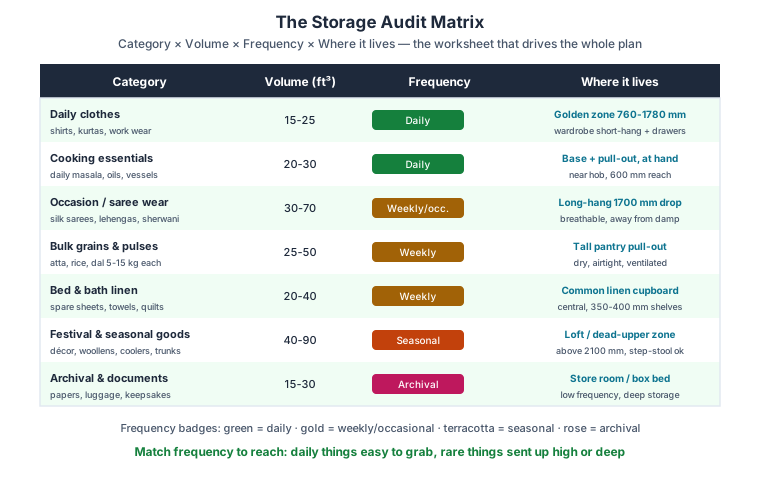
Figure 3: The storage audit matrix — category against volume, frequency and where it lives. Filling this in for your own household is the worksheet that drives every later decision. Daily things get easy reach; rare things go up high or deep.
4. Step three — allocate the floor area, room by room
A budget on paper becomes real only when you draw it into the plan. This is the step where you mark, on each room, the walls and zones that storage will occupy — before the furniture, the false ceiling or the colour scheme exists.
The principle is to give every room a designed storage zone rather than leaving storage to compete with living space later. In the master bedroom, that is the full wardrobe wall. In the kitchen, it is the run of tall units, base and overheads. In the living room, it is a media-and-display wall. In the utility, it is a high loft for seasonal goods plus low cupboards for cleaning gear. And somewhere central — a corridor, a passage — a slim linen-and-archival store.
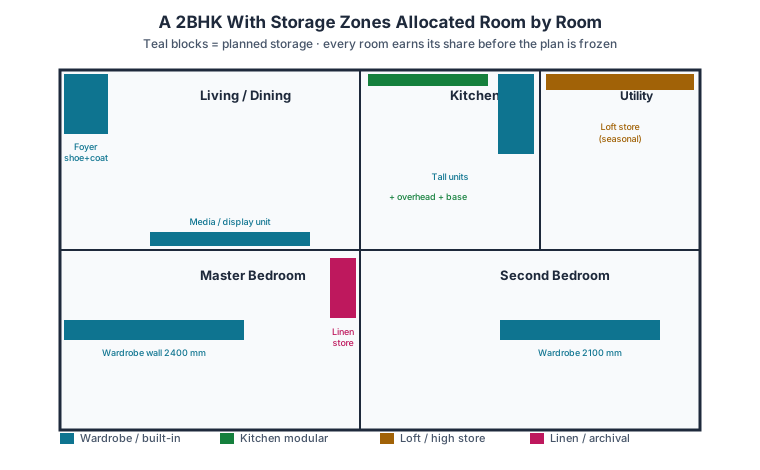
Figure 2: The same 2BHK with storage zones allocated up front, room by room. Every room earns its share before the plan is frozen — so nothing has to be bolted on, and nothing ends up on the floor.
A few allocation rules that consistently pay off in Indian homes:
- Use full-height walls. A wardrobe that stops at 2100 mm wastes the 600-900 mm above it. Carry storage to the ceiling and put seasonal goods in the top zone (reached with a step-stool). That dead-upper space is exactly where Diwali décor and woollens belong.
- Build lofts in, don't bolt them on. A loft drawn into the original carpentry — over the utility, over the foyer, over the bathroom passage — is the cheapest cubic feet in the house. Lofts added later jut out and look it.
- Plan for the monsoon and the damp. External walls, especially in coastal and high-rainfall regions, sweat. Keep archival paper, leather and silk off external-wall-backed cabinets, ventilate wardrobes, and use moisture-resistant (MR or BWR) plywood throughout — see Smart Storage Interiors for the material and detailing reference.
- Respect helper and service patterns. Many Indian homes have daily help; cleaning gear, the broom-and-mop and bulk supplies need an accessible store that does not require opening the family wardrobe.
To test an allocation before committing, sketch it with the layout planner or the furniture layout designer, and measure your real walls with the room measurement tool so the numbers are yours, not generic.
"The total amount of storage required in a house is far greater than people imagine... Make a place... where the family's bulk storage can be kept." — Christopher Alexander, A Pattern Language (Pattern 145, Bulk Storage)
5. Step four — decide built-in, modular or freestanding
For each storage zone you have allocated, you now choose its form. This is a real design decision with cost, lifespan and flexibility trade-offs — not a default. The three options:
- Built-in (site carpentry): custom-made to your walls, floor-to-ceiling, no wasted gaps, integrated with the architecture. Best lifespan, best use of space, least flexible if you move. The right choice for fixed elements — the master wardrobe, the kitchen, lofts, the linen store.
- Modular (factory units): standardised cabinets assembled on site, predictable finish and hardware, faster, easier to service or reconfigure. A strong middle option for kitchens and wardrobes where you want soft-close drawers and pull-outs without bespoke joinery cost.
- Freestanding (loose furniture): almirahs, chests, shoe racks, bookshelves you can move and take with you. Most flexible, least space-efficient (gaps top and sides), useful for rented homes and for storage needs that will change.
| Need | Recommended form | Why |
|---|---|---|
| Master & kids' wardrobes | Built-in or modular | Full-height fit, no wasted gaps, long life |
| Kitchen storage | Modular (or built-in) | Soft-close, pull-outs, serviceable hardware |
| Lofts & seasonal store | Built-in | Cheapest cubic feet, hidden in architecture |
| Living media / display | Built-in or freestanding | Built-in for fit; freestanding if you may move |
| Foyer shoe cabinet | Built-in or modular | Slim, full-height, integrated with entry |
| Rented home / short stay | Freestanding | Takes nothing with the walls; moves with you |
A practical hybrid suits most Indian homeowners: build in the things that are structural and permanent — wardrobes, kitchen, lofts — and keep loose furniture for the things that will change as the family's lifecycle shifts. For the wardrobe specifically, plan the internal layout (long-hang for sarees at a 1700 mm drop, short-hang and drawers in the golden zone, luggage up top) before you finalise the carcass; the wardrobe planning guide for designers and Wardrobe & Closet Planning cover the internal grammar, and Why Wardrobes Become Inefficient explains the common mistakes to design out.
6. Step five — sequence storage into the design process
The last step is about timing — slotting these decisions into the right point in your interior project so they cannot be skipped.
1. At the brief stage, before you appoint anyone: do the audit (§2) and the per-room budget (§3). Bring these to your designer as a requirement, the way you would bring a budget figure.
2. At the layout stage, before finishes are discussed: allocate storage zones into the plan (§4). Insist that storage walls are drawn and dimensioned in the layout, not added later.
3. At the carpentry/spec stage: decide built-in vs modular vs freestanding per zone (§5), and fix the internal layout of each wardrobe and kitchen unit.
4. Only then, the visible design: colours, finishes, lighting, furniture. By now storage is solved and these choices wrap around it cleanly.
This ordering is what separates a home that stays organised from one that overflows. It is also what keeps the cost down — every decision is made on the drawing, where changes are free, rather than on site, where they are expensive.
From here, the rest of this cluster goes deep on each need you have now identified. If your home is compact, Storage Design for Small Apartments shows how to win cubic feet from tight plans. If your audit threw up a lot of festival décor and woollens, Seasonal Storage Solutions is the next read. And whatever your home's size, the broad reference of ready ideas in Smart Storage Ideas for Indian Homes is a useful companion to this plan-it-first master guide.
Sources & further reading
- Christopher Alexander, Sara Ishikawa & Murray Silverstein — A Pattern Language (Oxford University Press, 1977), Pattern 145, Bulk Storage.
- Julie Morgenstern — Organizing from the Inside Out (Henry Holt, 2nd ed.).
- Marie Kondo — The Life-Changing Magic of Tidying Up (Vermilion).
- Bureau of Indian Standards — National Building Code of India 2016, Part 4 (residential space and storage planning provisions).
- Joseph De Chiara & Julius Panero — Human Dimension & Interior Space (Watson-Guptill) — anthropometric reach-zone and clearance standards.
- Bureau of Indian Standards — IS 303 (plywood grades) for moisture-resistant carcass selection in Indian conditions.
This is the master guide to the Studio Matrx storage series. Once you've built your plan here, continue with Storage Design for Small Apartments if space is tight, Family-Based Storage Planning to tune it to who lives in your home, and Seasonal Storage Solutions for the festival-and-monsoon goods that overwhelm so many Indian households.
Export this guide
Related Guides — Deep-dive reading
Storage Planning as a Design Discipline
Why Storage Is a Layout Problem, Not a Cabinetry Problem — Volumes, Anthropometrics, Typologies, and the Indian Family Lifecycle
Room PlanningSmart Storage Interiors — A 2026 Working Reference for Indian Homes
Inventory-driven · Floor-to-ceiling · Hardware-engineered · Zone-mapped
Room PlanningWalk-In Pantry Design
How to design the dedicated larder the Indian kitchen actually needs — for bulk rice and atta, masala stock, monthly rations and festival cooking — with sizing, shelving, ventilation and pest control that survives the monsoon.
StorageRelated Tools — Try Free
Wardrobe Storage Capacity Calculator
India-specific garment math — sarees, lehengas, kurtas, shirts, shoes. Pick a layout (2-door → walk-in), see live fill and saturation gauges.
Capacity CalculatorApartment Interior Planning Checklist
51-item checklist across structural, ceiling, lighting, furniture, storage, electrical, kitchen, bathroom.
ChecklistApartment Furniture Size Chart
Standard furniture dimensions for Indian apartments — sofas, beds, tables, dining, storage.
Reference Chart