
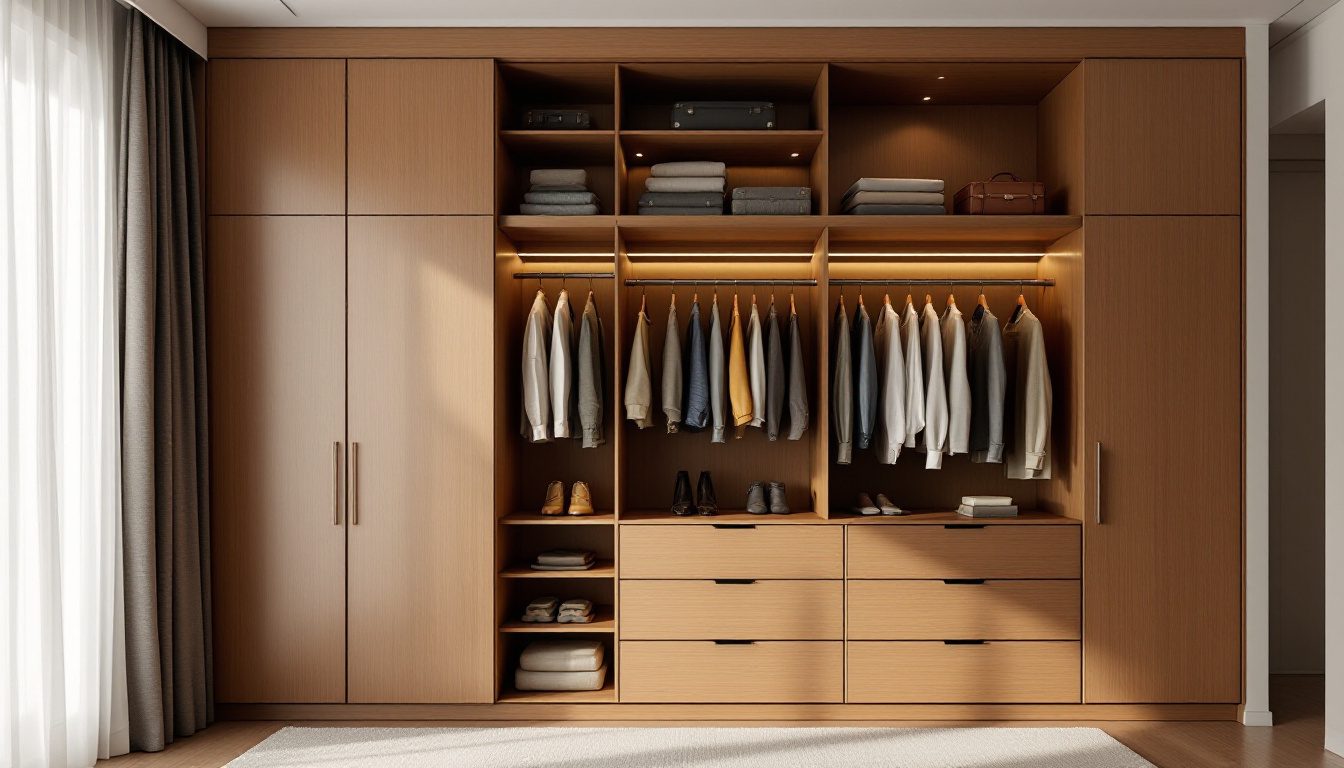
Wardrobe & Closet Planning for Indian Homes
Walk-in vs built-in, the double-rod trick that doubles capacity, internal zoning for sarees to suitcases, sliding vs hinged shutters, and finish costs
Storage is the thing almost everyone forgets to plan, and then misses every single day. The sofa gets chosen with care, the kitchen counter gets debated for weeks, the tile sample board comes home three times — and the wardrobe, where you spend the first ten minutes of every morning, is treated as whatever fits in the gap left over. That is exactly backwards. In an Indian home, where a single family stores sarees, woollens, suitcases, razais, jewellery and three generations of festive wear in the same bedroom, the wardrobe is not an afterthought. It is one of the highest-traffic pieces of architecture you own.
This guide is about planning wardrobes that genuinely hold everything you own — not the everything you imagine, but the real, measured, slightly-too-much everything that lives in your house today. We will cover the first big decision (walk-in versus built-in), the trick that doubles your hanging capacity, the very Indian load a wardrobe has to carry, the dimensions that make modules buildable, and the finishes and rupee bands you will be quoted in 2026.
A poorly planned wardrobe is not just an annoyance. It quietly leaks into the whole house — clothes on chairs, suitcases under beds, bedding stacked on a spare cot — and it shows up again, bluntly, at resale.
The first decision: walk-in or built-in
Almost everyone, given a free wish, asks for a walk-in wardrobe. It reads as luxury, and in the right house it is. But before you commit floor plan to it, understand the trade-off, because it is not subtle.
A walk-in needs space for the clothes and a corridor to stand in between the rods. That corridor is dead circulation — you cannot store anything in it, you only walk through it. A built-in wardrobe, by contrast, shares its standing space with the bedroom. The shutters open into a room you are already standing in. The square footage you would have spent on a private aisle simply does not exist, because the bedroom floor is doing double duty.

When each one actually makes sense
A walk-in earns its keep when two things are true: the bedroom is genuinely large (you can spare a 5 ft by 7 ft or larger pocket without starving the bed and circulation), and the household stores a lot — two adults with full ethnic-wear wardrobes, plus seasonal storage. Below a certain size, a walk-in is just a built-in with a wasted corridor in front of it.
A built-in wins in the vast majority of Indian flats. In a 2BHK or compact 3BHK where every square foot is amortised over a heavy per-sqft purchase price, the built-in is the honest, space-efficient answer.
| Type | Typical footprint | Net storage gained | Circulation you pay for | Best for |
|---|---|---|---|---|
| Built-in, full-height along one wall | 0.6 m deep × wall length; no extra floor | High per sqft — shutter swing shares the bedroom | Almost none (door swing only) | 2BHK / 3BHK flats, most master bedrooms |
| Built-in with sliding shutters | 0.65 m deep × wall length | High; no swing space needed | Zero | Tight bedrooms, narrow rooms |
| Walk-in, single-sided | ~1.5 m × 2.1 m room (about 32 sqft) | Moderate — one wall of storage + aisle | A 0.9 m aisle, all dead | Large master suites |
| Walk-in, double-sided (U or parallel) | ~2.4 m × 2.4 m room (about 62 sqft) | Very high — three walls of storage | A 1.0–1.1 m central aisle | Big homes, two heavy wardrobes |
The honest rule of thumb: a walk-in spends 25–40 percent of its floor area on the aisle. If that area is precious in your plan, a built-in gives you the same hanging and shelving for less floor. Run your room through the Room Programming Worksheet before you decide — it forces you to size storage as a named requirement instead of a leftover.
Allocate the floor space early — the most skipped step
Here is the single most common space-planning mistake in Indian homes: storage is never given square footage on the plan. The architect draws the bed, the side tables, the window, the door swing — and the wardrobe gets whatever wall is left. Sometimes that wall is broken by a window, or shortened by a beam drop, or eaten by the bathroom door swing, and the wardrobe shrinks to a width that was never going to be enough.
Treat the wardrobe like a room, not like furniture. Give it real square footage on the plan from day one, the same way you would a balcony or a study — because reclaiming it later means tearing into a finished home.
A master wardrobe in a modern home is effectively a small dressing room: hanging, shelving, drawers, a mirror, a place to get ready. It deserves to be drawn at full size before the bed position is locked. Practically, that means reserving a continuous run of wall — ideally 2.4 m or more — with no window and no door swing crossing it, at the planning stage. If you are space-budgeting the whole home in rupees and square feet at once, the Cost Calculator helps you see what that wall of storage is worth against everything else competing for the same floor.
The double-rod trick that doubles your hanging
This is the most useful single idea in wardrobe planning, and most people have never been told it. Most of what you hang — shirts, kurtas, folded-over trousers, skirts, t-shirts on hangers — only needs about half-height hanging. A shirt on a hanger drops roughly 1.0 m. A full-height hanging bay is around 2.0 m. So a single rod in a full-height bay wastes the entire lower metre as empty air.
Stack two rods, one above the other, and you have doubled your hanging capacity in the exact same width of wardrobe. The upper rod sits around 1.95–2.0 m off the floor, the lower around 1.0 m, and short garments fit comfortably in both tiers.

You do not double-rod everything. Reserve a smaller section of single, full-height long-hang for the garments that genuinely need it — sarees, lehengas, anarkalis, full-length gowns, sherwanis, robes, and trousers hung from the cuff. The winning layout is mostly double-rod for the bulk, with one generous long-hang bay carved out for formals and ethnic wear.
Build the walk-in to work, not just to look good
If your house and budget do allow a true walk-in, design it for how you will actually use it — not for the photograph. A walk-in that is beautiful but cramped, dark, or damp becomes a daily small irritation. Four things separate a working walk-in from a showroom prop.
Lighting you can see colour by
Wardrobe interiors are caves. Without dedicated light you will carry a navy kurta into the bedroom to check it is not black. Run warm-white LED strips (around 3000–3500K, with a decent colour-rendering index so fabrics read true) along the inside top edge of the shutters and above the long-hang bay. Add a sensor that switches the strip on when shutters open if you want the luxury touch. A mirror in a walk-in wants its own light flanking it, not a single bulb overhead that throws your face into shadow.
Ventilation against damp
India is humid for large stretches of the year, and a sealed wardrobe full of cotton and silk is where mildew is born. Leave a small ventilation gap behind carcasses, do not push the unit dead-flush against a wall that gets wet, and in coastal cities consider louvred shutter panels or discreet vent cutouts. Keep silica-gel packs and, where the family uses them, naphthalene balls in the deep shelves.
Full-height use and a dressing zone
Build to the slab, not to the convenient 7 ft. The space above the comfortable reach line — from about 2.0 m up to the loft at 2.7 m or higher — is exactly where suitcases and off-season razais belong. And give the walk-in a real dressing zone: a bench to sit on while you fasten footwear or lay out a suitcase to pack, and a full-height mirror placed so you can step back from it. Use the Scale and Proportion Calculator to check the aisle is wide enough to dress in comfortably rather than just squeeze through.
The number that prevents regret: measure what you own now
Do not guess at "enough storage." Guessing is how families move into a brand-new home and discover, three weeks in, that there is still nowhere to put the clothes. The fix is almost embarrassingly simple: go and measure what you actually own today.
Walk to your current wardrobe with a tape and write down two numbers. First, the running feet of hanging you are using — measure the rod length your clothes currently occupy, both yours and your partner's, and add a little for growth. Second, the count of shelves and drawers in active use — folded stacks, innerwear, accessories. Those two numbers are your design brief. Any new wardrobe plan that delivers less is a plan you will regret.
The vague worry "will we have enough storage?" becomes a concrete, answerable target the moment you measure the running feet you already use. Design to that number, then add a margin — clothes only ever multiply.
A useful baseline for a couple: most families need somewhere between 14 and 22 running feet of total hanging (long-hang plus double-rod tiers counted separately), 10 to 16 shelf compartments, and 6 to 10 drawers — but your measured numbers override every average. The Room Programming Worksheet has a field for exactly this so the requirement does not evaporate between measuring and building.
The very Indian wardrobe load
A wardrobe designed to a Western template will fail an Indian family, because it does not account for what we store. The Indian wardrobe carries more, in more shapes, than almost any other. Plan for these explicitly, because every one of them is miserable to retrofit.
| What you store | How it needs to be held | What to plan |
|---|---|---|
| Sarees | Rolled flat on shelves, or hung on saree rods; folded on deep shelves | A dedicated saree zone: pull-out saree rods or 0.45 m deep shelves; keep matching blouses and petticoats sectioned nearby |
| Blouses and petticoats | Small folded items, paired to sarees | Shallow drawers or compartmented shelves close to the saree zone |
| Lehengas, anarkalis, gowns | Full-length hanging, often heavy and beaded | Long-hang bay, 2.0 m clear, sturdy rod |
| Sherwanis, suits, formal kurtas | Full-length hanging, breathable | Long-hang bay; avoid crushing; garment covers |
| Everyday shirts, kurtas, trousers | Half-height hanging | Double-rod tiers — the bulk of your hanging |
| Folded woollens, cottons | Flat stacks | Shelf stacks 0.3–0.35 m apart |
| Razais, quilts, blankets, off-season bedding | Bulky, seasonal, light-but-large | Loft / top shelf above 2.0 m; deep 0.6 m shelves |
| Suitcases and trolleys | Large, infrequent | Loft above; size the loft to your biggest bag |
| Jewellery, gold, documents | Secure, lockable | Built-in safe or lockable drawer with a real lock, anchored |
| Accessories, ties, belts, watches | Small, easily lost | Pull-out trays, drawer organisers |
A checklist you can hand to your carpenter
- A long-hang bay of at least 0.9–1.2 m width, 2.0 m clear height, for sarees and formals
- Double-rod tiers across the majority of the hanging width
- A saree zone — pull-out rods or deep folded shelves — sectioned from the blouse and petticoat storage
- A loft above 2.0 m, deep enough for your largest suitcase and the family razais
- A lockable drawer or anchored safe for jewellery and papers
- Drawers at waist height (0.75–1.0 m), where you reach without bending
- Folded-shelf stacks spaced 0.3–0.35 m apart
- Ventilation gaps and a plan for silica gel and anti-pest measures
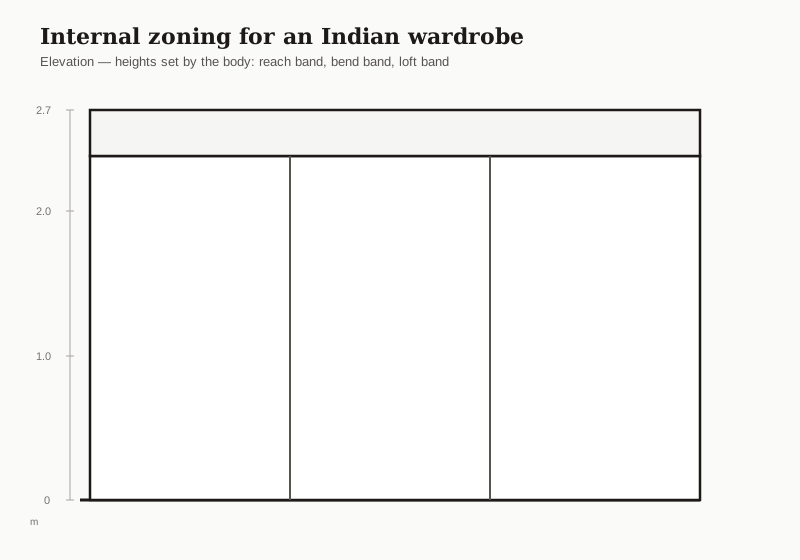
Internal zone heights and sizes
Anthropometry matters here — the reachable band, the bending band, and the loft band are dictated by the human body, and Panero and Zelnik's standard ranges map cleanly onto an Indian wardrobe. The table gives buildable numbers.
| Zone | Height off floor | Depth | Purpose |
|---|---|---|---|
| Loft (above) | 2.0–2.7 m | 0.6 m | Suitcases, razais, off-season bedding |
| Upper double-rod | rod at ~1.95 m | 0.6 m | Half-height shirts, kurtas |
| Long-hang bay | rod at ~2.0 m | 0.6 m | Sarees, lehengas, sherwanis, gowns |
| Lower double-rod | rod at ~1.0 m | 0.6 m | Half-height garments |
| Folded shelves | 0.6–1.6 m (eye-to-reach band) | 0.3–0.45 m | Folded clothes, woollens |
| Drawers | 0.4–1.0 m (waist band) | 0.5 m | Innerwear, accessories, valuables |
| Lockable safe / drawer | 0.6–1.1 m | 0.45 m | Jewellery, documents |
Module sizing, doors, and the dimensions that make it buildable
Wardrobes in India are overwhelmingly built as modular carcasses, and a handful of standard dimensions govern the whole thing. Get these right and the unit is buildable, ventilated, and reachable.
Depth, shutter widths, and the loft
The settled standard wardrobe depth is 600 mm (0.6 m) carcass, which gives roughly 0.55 m of clear interior — enough for a garment on a hanger to sit square-on without crushing against the back. Sliding-shutter units run slightly deeper, around 650 mm, to accommodate the overlapping track. Shutter widths for hinged shutters typically run 450–600 mm each (wider than 600 mm and a single shutter sags and fouls its neighbour). Sliding shutters are usually 900 mm to 1.2 m wide panels on a track. Above the main carcass sits the loft — a separate 0.45–0.6 m tall compartment from the main top (around 2.1 m) up to the slab.
Doors: hinged versus sliding
The shutter decision is really a decision about clearance. Hinged shutters need swing space in front of the wardrobe — and in a tight Indian bedroom that swing arc fouls the bed. Sliding shutters need zero swing clearance, which is precisely why they have become the default in compact flats. The trade-off is that with sliders you can only ever see half the wardrobe at once.

| Door type | Swing clearance needed | Visibility | Best for | Note |
|---|---|---|---|---|
| Hinged shutters | 450–600 mm in front | Whole wardrobe at a glance | Walk-ins, wide built-ins, rooms with floor to spare | Hinge toward the corner; let it park flat |
| Sliding shutters | None | Half at a time | Tight bedrooms, narrow rooms | Slightly deeper carcass; track needs cleaning |
| Mirror shutters | As per hinged or sliding base | — | Saves a separate mirror; visually enlarges room | Mirror on a sliding shutter is the space-saver favourite |
| Open / curtained (walk-in) | None | Full | Inside a walk-in only | Cheapest; dust and damp are the cost |
A mirror shutter is the quiet two-for-one: it gives you a full-height dressing mirror without spending wall or floor on a separate one, and it bounces light around a small bedroom. On a sliding unit it is the single most popular configuration sold in Indian metros today.
Finishes and the 2026 rupee bands
The carcass is almost always 18 mm BWP (boiling-water-proof) plywood graded to IS 710, or BWR plywood to IS 303 for drier interior work — this is the structural choice and worth not skimping on, because the carcass is what carries the load of a wardrobe stuffed with sarees and razais for twenty years. The finish is a separate decision, applied to the shutters and visible faces, and it is where the cost spread really lives.
| Finish | Look and feel | Durability | 2026 cost band (per sqft of shutter, finished) | Notes |
|---|---|---|---|---|
| Laminate | Matte or gloss, huge range | Very good; scratch-resistant | INR 90–180 | The workhorse; best value; easy to repair a panel |
| Acrylic | High-gloss, mirror-like, vivid | Good; shows fingerprints and fine scratches | INR 250–450 | Premium glossy look; pricey to replace |
| Membrane (PVC foil) | Seamless, can be moulded, soft-touch | Moderate; can peel at edges in heat | INR 150–280 | Good for shaker / grooved profiles |
| PU (polyurethane) paint | Smooth, deep, any colour, site-finished | Excellent but site quality varies | INR 350–600 | Richest finish; needs a skilled applicator |
For a complete built-in wardrobe — carcass plus shutters plus internal fittings, hardware and finish — Indian metros in 2026 are quoting broadly INR 1,400–2,800 per square foot of wardrobe elevation (front face), with laminate at the lower end and acrylic or PU pushing the top. A walk-in costs more per useful garment stored, because you are also finishing the floor and walls of a room you mostly walk through. Plug your real wall length and finish into the Cost Calculator before you sign anything — the spread between a laminate built-in and a PU walk-in is large enough to fund a whole second bedroom's worth of furniture.
Moisture, pests, and ventilation — the maintenance you design in
Three quiet failures shorten a wardrobe's life in India, and all three are designed-in, not maintained-in. Moisture: keep silica-gel sachets in shelves, do not seal carcasses airtight, and keep the back off a damp external wall. Pests: the silverfish and moth that eat into silk and wool are deterred by naphthalene balls or modern anti-pest sachets in the deep shelves and saree zone. Ventilation: a small gap behind each carcass and the occasional opening of shutters keeps air moving — a wardrobe that never breathes grows mildew. None of this is expensive, and all of it is miserable to fix later.
Bring it to life with Studio Matrx
Tell Studio Matrx what you actually own — your measured running feet of hanging, your saree count, the suitcases and razais, the jewellery you need locked away — and get a wardrobe layout sized to your room and your real life: the right balance of double-rod and long-hang, a saree zone, a loft, lockables, and a finish costed to your budget. Plan the storage first, and the whole home stays calmer for it.
References
- Bureau of Indian Standards. IS 710: Marine Plywood / Boiling Water Proof Plywood — Specification. BIS, New Delhi.
- Bureau of Indian Standards. IS 303: Plywood for General Purposes — Specification. BIS, New Delhi.
- Bureau of Indian Standards. IS 12823: Wood Products — Prelaminated Particle Boards — Specification. BIS, New Delhi.
- National Building Code of India 2016 (NBC 2016), Bureau of Indian Standards — Part 4 and provisions on residential spatial requirements and ventilation.
- Central Public Works Department (CPWD). CPWD Specifications (woodwork, joinery and modular furniture sections). Government of India.
- Panero, Julius, and Martin Zelnik. Human Dimension and Interior Space: A Source Book of Design Reference Standards. Whitney Library of Design — anthropometric ranges for storage, hanging and reach.
- Neufert, Ernst. Architects' Data. Wiley-Blackwell — standard wardrobe depths, hanging clearances and module dimensions.
- Hirsch, William J. Jr. Designing Your Perfect House: Lessons from an Architect. Dalsimer Press. (A general inspiration for this series' approach to planning wardrobes that hold everything.)
Export this guide
Related Guides — Deep-dive reading
Storage Planning Before Interior Design
Why storage must be planned first — audited, budgeted and given its floor area — before a single layout, colour or sofa is chosen. The homeowner's plan-it-first master guide for Indian homes.
StorageWhy Scale Matters: Keeping Rooms Comfortable for Humans
How sizing furniture, art and lighting to the human body — not the showroom — keeps small Indian flats from feeling crushed and large halls from feeling empty.
Design PrinciplesSpace-Efficient Homes — A 2026 Working Reference for Compact Indian Apartments
Five spatial multipliers · Floor plan tricks · Dual-purpose furniture
Room PlanningRelated Tools — Try Free
Wardrobe Storage Capacity Calculator
India-specific garment math — sarees, lehengas, kurtas, shirts, shoes. Pick a layout (2-door → walk-in), see live fill and saturation gauges.
Capacity CalculatorCross-Ventilation Analyzer
Estimate airflow and air changes per hour (ACH) from room size, window areas, layout, and local wind — with NBC 2016 Part 8 compliance check.
Ventilation CalculatorApartment Furniture Size Chart
Standard furniture dimensions for Indian apartments — sofas, beds, tables, dining, storage.
Reference Chart