
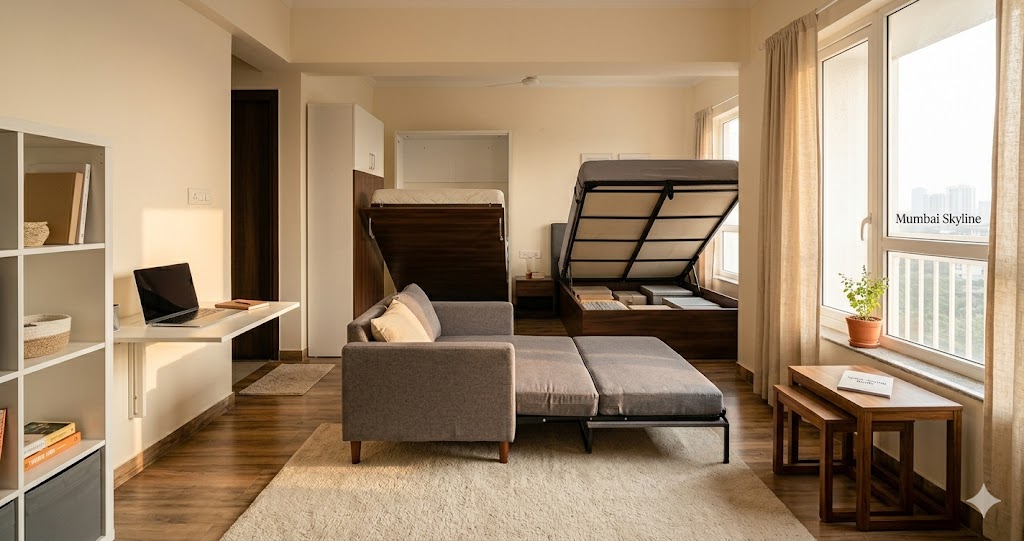
Space-Saving Furniture — The 12-Category Piece-by-Piece Indian Reference (2026)
Sofa-cum-beds · Murphy beds · Transformer dining · Modular wardrobes · IS 8888 · Indian brand+price tables
Space-saving furniture in 2026 India is no longer a budget compromise — it is an engineered category of pieces that compress two or three functions into a single footprint, recover floor area measured in actual square feet, and pay back their premium within a year of occupancy in metro apartments where carpet area costs ₹18,000–₹45,000 per sqft. A 1 BHK in Andheri West, a builder floor in Lajpat Nagar, a 2 BHK in Whitefield, a studio in Koramangala — these are the canvases. The pieces themselves are the answer.
This guide is a furniture-piece-first reference. It is not about how to organise a wardrobe or layer a bedroom; it is about which specific furniture categories — sofa-cum-beds, wall beds, transformer dining tables, hydraulic storage beds, modular wardrobes, loft beds and eight more — actually free up floor area, what they cost in 2026 rupees, which India brands sell them, and where each one quietly fails.
"In a 550-sqft Mumbai apartment, the difference between a conventional sofa-plus-bed-plus-dining setup and six well-chosen multifunctional pieces is roughly 95 sqft of usable floor — about the size of an extra bedroom."
For the layout-and-storage angle that wraps around the pieces themselves, read smart-storage-interiors, space-efficient-homes and compact-urban-home-planning-india; for the rental-specific furniture rules see apartment-interior-planning-india.
This guide refreshes every 12 months. Last verified: May 2026 · Next verify: May 2027.
What Space-Saving Furniture Actually Means in 2026 India
Space-saving furniture is the category of residential furniture pieces engineered so that one footprint serves two or more functions, or so that the piece collapses, folds, stacks, nests, lifts or transforms to free floor area when the secondary function is not in use. The defining metric is sqft recovered per piece — not aesthetic compactness, not "minimalist look", not even small overall dimensions. A 6-seater dining table that folds to a 14-inch console against a wall is space-saving; a beautiful 4-seater that stays at 4 seats is just small.
In 2026 India the category has split cleanly into three tiers. Mass-market multifunctional pieces from Wakefit, Pepperfry, Urban Ladder, Wooden Street, IKEA India and Saraf Furniture price between ₹15,000 and ₹1.5 lakh per piece. Engineered-mechanism imports — Hettich Tavolone, Hafele lift systems, Spaceman India wall beds, Resource India console-to-dining transformers — price between ₹60,000 and ₹6 lakh per piece. Custom carpentry against a brief sits across both bands depending on hardware spec.
Five things space-saving furniture is NOT:
1. Small furniture. A 3-seater sofa narrower than usual is not space-saving; a 3-seater sofa that opens into a queen bed is.
2. Built-in joinery. Built-in wardrobes, loft storage and platform beds with drawers are built-ins, covered under smart-storage-interiors. Space-saving furniture is movable, replaceable and largely tenant-friendly.
3. Modular kitchen cabinetry. The kitchen is its own discipline — see modular-kitchen-india and the ai-modular-kitchen-planner.
4. Folding chairs you bring out for guests. These are temporary auxiliaries, not the primary daily piece.
5. "Minimalist" decor. Visually spare interiors with conventional furniture do not recover sqft; they just appear to. The piece must mechanically compress or convert.
The line between this guide and smart-storage-interiors is the line between what you buy and where you put it. Both matter. This guide is the catalogue.
Why Space-Saving Furniture Matters Now
Three structural pressures in 2026 India are driving the category from a niche import segment to mainstream homeowner spend.
Apartment carpet areas have compressed. Knight Frank India's H2 2025 Affordable Housing report puts the average new 2 BHK in Mumbai MMR at 612 sqft carpet (down from 720 sqft in 2018), Bengaluru at 832 sqft, and Pune at 778 sqft. New 1 BHK units in Mumbai now average 384 sqft. Studio apartments under 350 sqft, almost unheard of in 2018, made up 14% of new Mumbai launches in 2025 (Anarock Q4 2025). Smaller carpet area at unchanged ₹/sqft means the only way to fit a complete life is multifunctional furniture.
Rental tenure has shortened. Magicbricks renter survey 2025 puts the average urban Indian rental tenure at 23 months, down from 31 months in 2019. Tenants who move every two years cannot invest in built-in joinery. They invest in movable space-saving furniture they can take with them — sofa-cum-beds, modular wardrobes, ottoman storage, wall-mounted folding desks that come off the wall with four screws.
Work-from-home is permanent for ~30% of the urban workforce. NASSCOM 2025 hybrid-work survey reports that 28% of metro IT/IT-services workers are fully remote and another 41% are hybrid 2-3 days/week. Every one of these households needs a desk in a home that was not designed with one. Wall-mounted folding desks, drop-leaf dining tables doubling as workstations, and bench seating with laptop storage have become non-negotiable.
The market response is visible in the catalogues. Pepperfry's "space-saving" category in 2026 lists 4,200 SKUs (up from 1,800 in 2022). Wakefit launched its hydraulic-lift bed range in 2023 and now sells ~18,000 units/month. IKEA India's KALLAX, NORDEN, NORBERG and PAX lines together account for ~22% of the chain's furniture revenue in India (IKEA India FY25 disclosure). Spaceman India and Resource India — the two engineered-transformer importers — together cleared ~3,500 wall-bed installs in 2025, doubling year-on-year.
A category that was ₹2,000 crore in 2020 is, on Anarock's 2025 estimate, a ₹14,000 crore segment in 2026, growing 28% CAGR.
The Twelve Defining Categories of Space-Saving Furniture
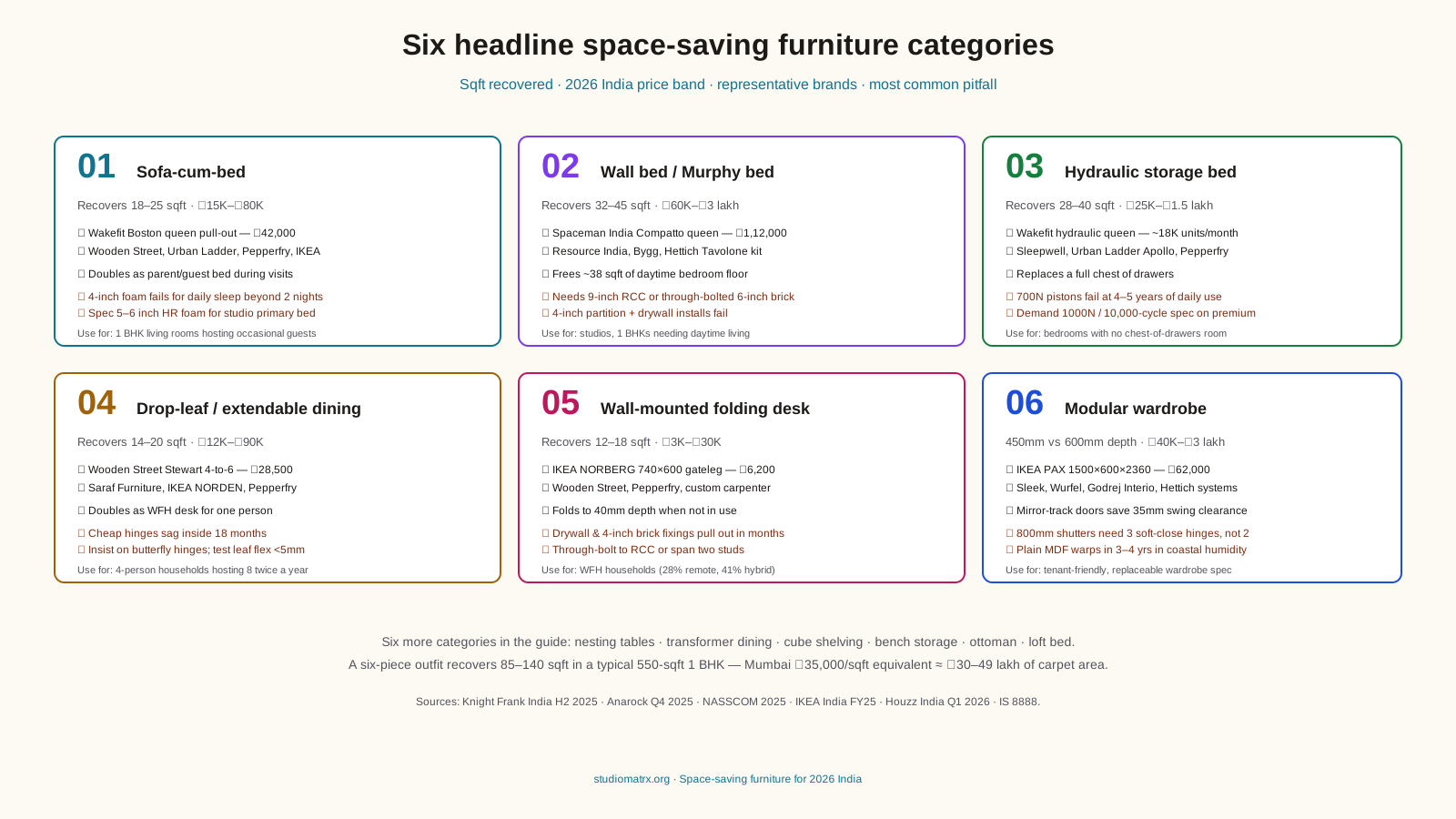
The twelve categories below cover roughly 95% of what an Indian homeowner or tenant will actually shortlist. Each row gives the dimensional saving (sqft recovered vs the conventional single-function equivalent), the 2026 India price band, and a representative pitfall.
| # | Category | Sqft recovered | India price band (2026) | Top brands | Common pitfall |
|---|---|---|---|---|---|
| 1 | Sofa-cum-bed | 18-25 sqft | ₹15K-₹80K | Wakefit, Wooden Street, Pepperfry, Urban Ladder, IKEA India | Mattress thickness 4-5 inches — uncomfortable for daily sleep beyond 2 nights |
| 2 | Wall bed / Murphy bed | 32-45 sqft | ₹60K-₹3 lakh | Spaceman India, Resource India, Bygg India, Hettich Tavolone | Wall must be 9-inch RCC or proper stud frame; 4-inch brick partition fails |
| 3 | Nesting / stacking tables | 6-12 sqft | ₹3K-₹25K | Pepperfry, FabIndia, Urban Ladder | Buying decorative nesting that does not actually stack flush — wasted depth |
| 4 | Drop-leaf / extendable dining | 14-20 sqft | ₹12K-₹90K | Wooden Street, Saraf Furniture, IKEA NORDEN, Pepperfry | Hinges sag within 18 months on cheap units; insist on butterfly hinges |
| 5 | Transformer dining (console-to-12-seater) | 35-50 sqft | ₹2-₹6 lakh | Resource India (Goliath Console), Spaceman Italy, Ozzio India | Mechanism needs 50mm floor clearance; high-pile carpet jams it |
| 6 | Modular shelving / cube storage | 8-15 sqft | ₹4K-₹40K | IKEA KALLAX, Pepperfry Hyderabad-Lakkad, Wooden Street | Treating it as decor rather than load-bearing storage — 25 kg per cube max |
| 7 | Storage beds with hydraulic lift | 28-40 sqft | ₹25K-₹1.5 lakh | Wakefit hydraulic, Sleepwell, Urban Ladder, Pepperfry | Hydraulic pistons fail at 4-5 years; replacement is ₹2K-₹4K per pair |
| 8 | Wall-mounted folding desks | 12-18 sqft | ₹3K-₹30K | IKEA NORBERG, Wooden Street, custom carpenter, Pepperfry | Tightening into drywall — must hit a stud or use through-bolt to RCC |
| 9 | Bench seating with storage | 10-16 sqft | ₹8K-₹60K | Pepperfry, Wooden Street, custom local | Lid-on-piano-hinge designs pinch fingers — gas-strut soft-close is safer |
| 10 | Ottoman storage | 4-8 sqft | ₹4K-₹25K | Pepperfry, Urban Ladder, FabIndia | Upholstery degrades fast in coastal humidity — choose synthetic over linen |
| 11 | Modular wardrobes | Variable (depth 450mm vs 600mm built-in) | ₹40K-₹3 lakh | Sleek Modular, Wurfel, Godrej Interio, IKEA PAX, Hettich systems | Underspecifying hinge count — 800mm shutter needs 3, not 2, soft-close hinges |
| 12 | Loft / mezzanine beds | 45-65 sqft | ₹1.5-₹5 lakh | Resource India, Spaceman India, custom welded steel | Ceiling height under 3.0m kills headroom; below 2.8m it is unsafe |
Aggregate finding: a thoughtfully chosen set of 6 pieces (one per major life function — sleeping, sitting, eating, storing, working, dressing) recovers between 85 and 140 sqft of floor area in a typical 550-sqft 1 BHK. At Mumbai's ₹35,000/sqft new-launch median (Knight Frank H2 2025), that is the rupee equivalent of ₹30 lakh to ₹49 lakh of carpet area — for a furniture spend of ₹1.8 to ₹2.5 lakh.
Reference dimensional standard: IS 8888 (Indian Standard: Specification for furniture — beds, dining tables, study desks, wardrobes) specifies minimum useful dimensions; the multifunctional pieces below should be evaluated against IS 8888 minimums in their deployed state, not their folded state.
A Worked Example: 550-sqft 1 BHK in Andheri West, Mumbai
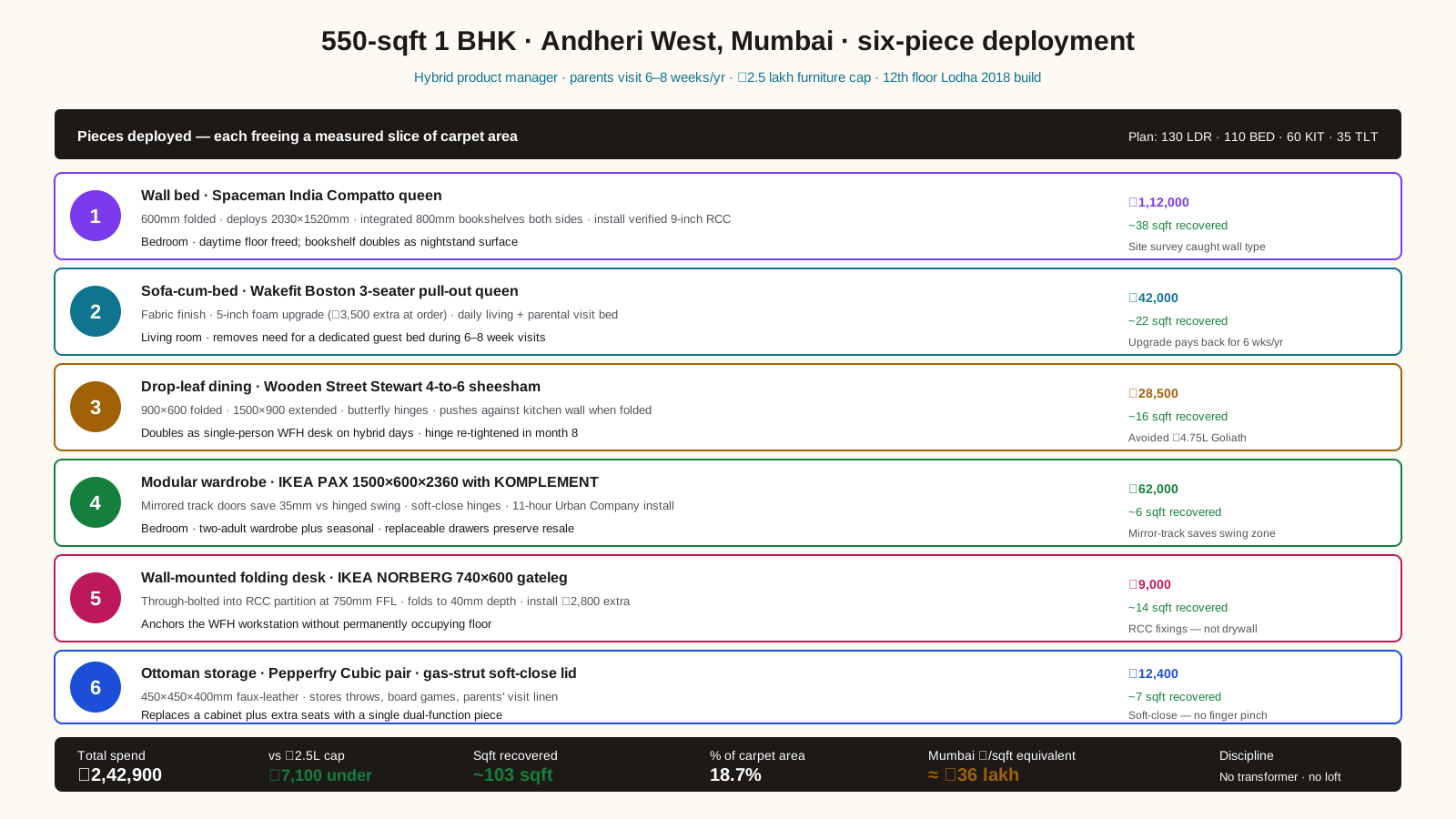
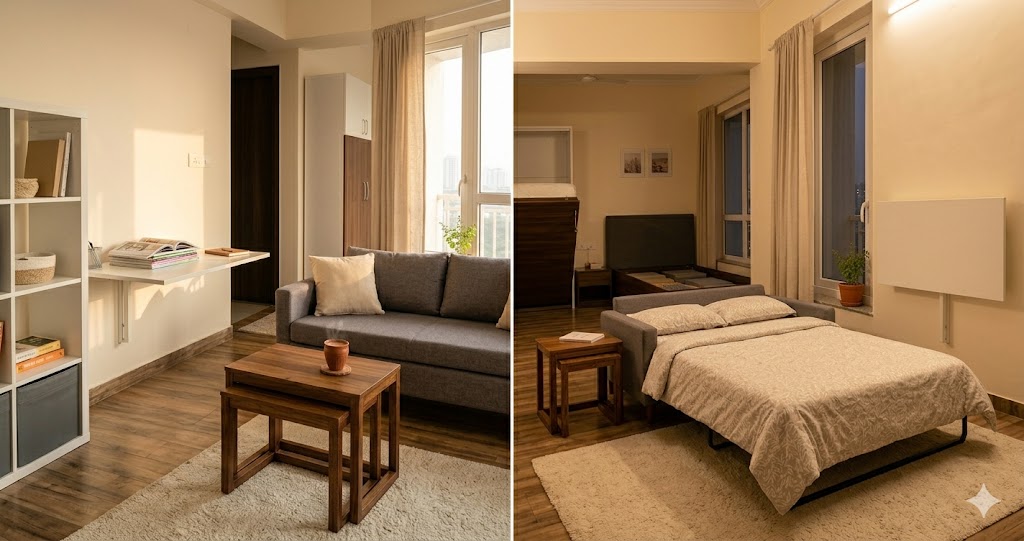
The client is a 32-year-old product manager working hybrid (3 days WFH), partner travels weekly for work, parents visit from Pune for 6-8 weeks a year. The flat: 1 BHK, 550 sqft carpet, RERA-recorded, 12th floor of a 2018 Lodha-built tower off Lokhandwala. Floor plan: 130-sqft living-dining, 110-sqft bedroom, 60-sqft kitchen, 35-sqft toilet, the rest in passages and a 22-sqft balcony.
Brief. Sleep two daily plus host two parents for extended periods. Dine four. Work full-time from home 3 days/week. Store full wardrobe for two adults plus seasonal/parents' luggage. Total furniture budget cap: ₹2.5 lakh.
The six pieces, deployed:
1. Wall bed in the bedroom — Spaceman India "Compatto" queen, 600mm depth folded, deploys to a 2030mm × 1520mm queen bed. Price: ₹1,12,000 installed (includes the integrated 800mm bookshelf on either side). Sqft recovered when folded: ~38 sqft of the bedroom becomes usable daytime floor.
2. Sofa-cum-bed in the living room — Wakefit "Boston" 3-seater with pull-out queen, fabric finish, 5-inch foam mattress. Price: ₹42,000. Sqft recovered vs separate sofa + guest bed: ~22 sqft. Doubles as the parents' bed during visits.
3. Drop-leaf dining table — Wooden Street "Stewart" 4-seater extendable, sheesham wood, 900mm × 600mm folded, 1500mm × 900mm extended. Price: ₹28,500. Sqft recovered vs a fixed 6-seater dining: ~16 sqft. Pushes against the kitchen wall when folded; doubles as a work desk for 1 person on WFH days.
4. Modular wardrobe — IKEA PAX 1500mm × 600mm × 2360mm with KOMPLEMENT internal organisers, soft-close hinges, mirrored doors on track runners (saves 35mm vs hinged doors swinging into the room). Price: ₹62,000 including all internals. Sqft recovered vs a 600mm-deep built-in: ~6 sqft (the mirror-track door saves the swing clearance).
5. Wall-mounted folding desk — IKEA NORBERG 740mm × 600mm wall-mounted gateleg, mounted to the RCC partition between living and bedroom at 750mm finished floor level. Price: ₹6,200 plus ₹2,800 install (through-bolted to RCC). Sqft recovered vs a standalone 1200mm desk: ~14 sqft. Folds flat to 40mm depth when not in use.
6. Ottoman storage — Pepperfry "Cubic" pair, 450mm × 450mm × 400mm, faux-leather, gas-strut soft-close lid. Price: ₹12,400 the pair. Stores throws, board games, the parents' visit linen. Sqft recovered vs a separate cabinet + extra seats: ~7 sqft.
Total spend: ₹2,42,900 — ₹7,100 under the ₹2.5 lakh cap.
Total sqft recovered vs conventional single-function equivalents: ~103 sqft.
Effective recovered area as % of carpet area: 18.7%.
Mumbai ₹/sqft equivalent value of recovered area (at ₹35,000/sqft): ~₹36 lakh.
What was deliberately avoided: a transformer dining table (overkill for a 4-person household), a loft bed (the 2.8m floor-to-slab ceiling is right at the safety margin), modular cube shelving (would have crowded the limited wall area already taken by the wall bed and folding desk). Discipline in not buying every category is as important as buying the right six.
Lessons from the install:
- The wall bed install required core-cutting the bedroom wall to verify it was 9-inch RCC, not 4-inch brick. The Spaceman site survey caught this before purchase.
- The IKEA PAX assembly took 11 hours by a 2-person Urban Company team; budget half a day per wardrobe of this size, not the IKEA-quoted 4 hours.
- The Wakefit sofa-cum-bed mattress was 4-inch foam, comfortable for ~3 nights of parental visits but not for permanent guest accommodation. A 5-inch upgrade at order time costs ₹3,500 more and is worth it.
- The drop-leaf table's hinges loosened in month 8; one tightening with a hex key restored function. Cheap drop-leaves do not have this self-service path.
For households repeating this exercise, the Studio Matrx furniture planner can verify clearance and circulation before purchase — useful when stacking multiple multifunctional pieces in the same room.
Space-Saving Furniture vs Adjacent Categories
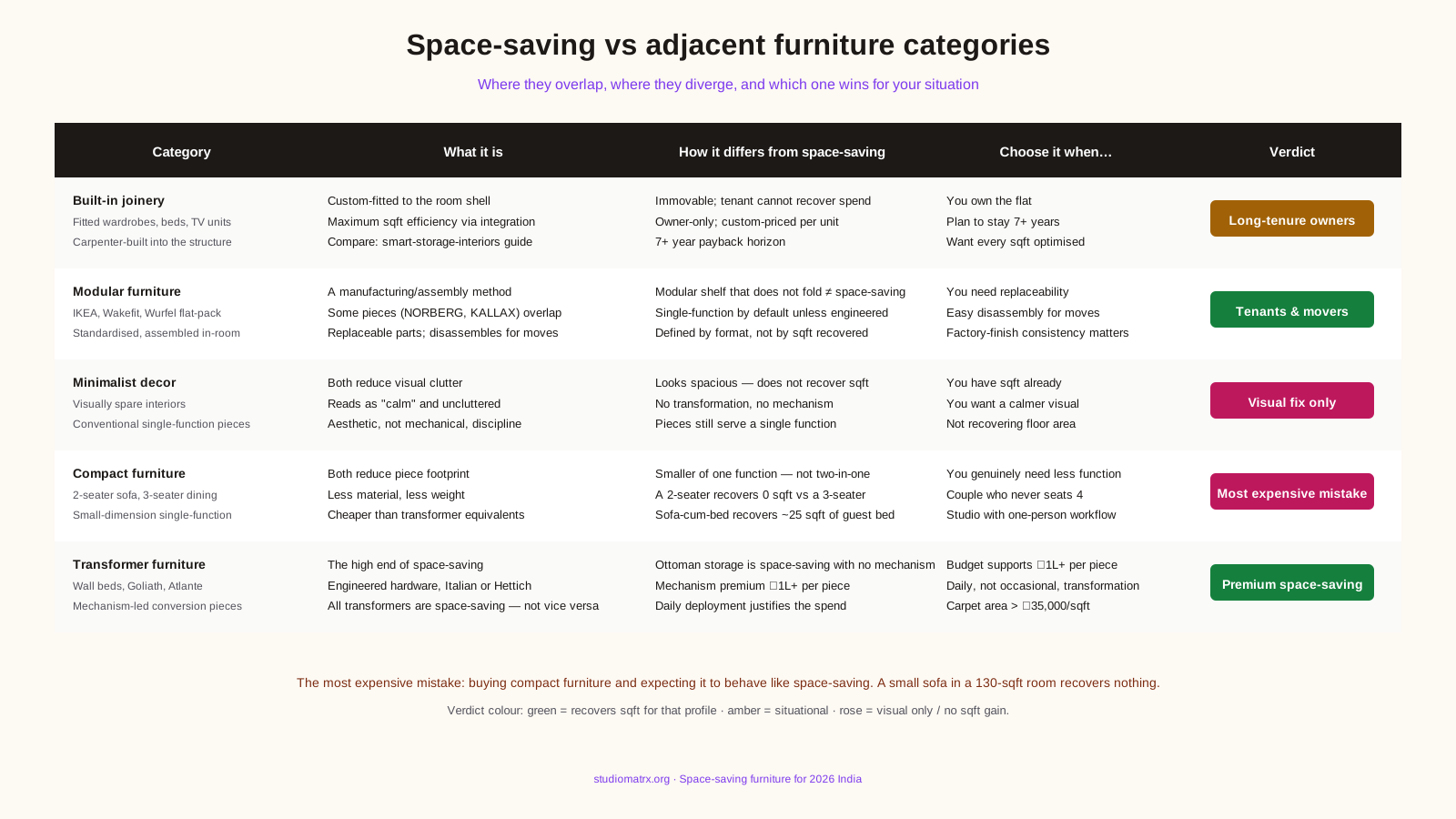
Space-saving furniture is often confused with — and sometimes substituted poorly for — four adjacent categories. The distinctions matter because they drive different vendor lists, different price bands, and different installation considerations.
| Category | What it is | Where it overlaps | Where it differs | When to choose it instead |
|---|---|---|---|---|
| Built-in joinery / fitted furniture | Carpenter-built wardrobes, beds, TV units fixed to the structure | Both recover floor area through dual-function design | Built-ins are immovable, custom-priced, owner-only (tenants cannot recover the spend) | When you own the flat, plan to stay 7+ years, and want maximum sqft efficiency |
| Modular furniture | Standardised flat-pack pieces (IKEA, Wakefit, Wurfel) that assemble in-room | Many space-saving pieces (IKEA NORBERG, KALLAX) are modular | Modular is about manufacturing/assembly method; space-saving is about function. A modular bookshelf that does not fold is not space-saving | When you need replaceability, easy disassembly for moves, factory-finish quality |
| Minimalist decor | Visually spare interiors with conventional furniture | Both reduce visual clutter | Minimalism appears spacious but uses single-function pieces; sqft is not recovered | When you have enough sqft already and only want a calmer visual |
| Compact furniture | Small-dimension pieces (2-seater sofas, 3-seater dining) | Both reduce piece footprint | Compact is smaller of one function; space-saving is two functions in one footprint | When you genuinely need less function (e.g., a couple who never seats 4) |
| Convertible / transformer furniture | Mechanically transforming pieces (wall beds, console-to-dining tables) | Transformer furniture is the high end of space-saving | All transformers are space-saving; not all space-saving is a transformer (e.g., ottoman storage has no mechanism) | When budget supports ₹1 lakh+ per piece and the transformation is daily |
The most expensive mistake is buying compact furniture and treating it as space-saving. A small 2-seater sofa in a 130-sqft living room recovers no sqft against a 3-seater; it just gives you a smaller sofa. A 3-seater sofa-cum-bed in the same spot recovers the entire ~25 sqft of a folded guest bed.
Materials, Finishes and Brand Landscape
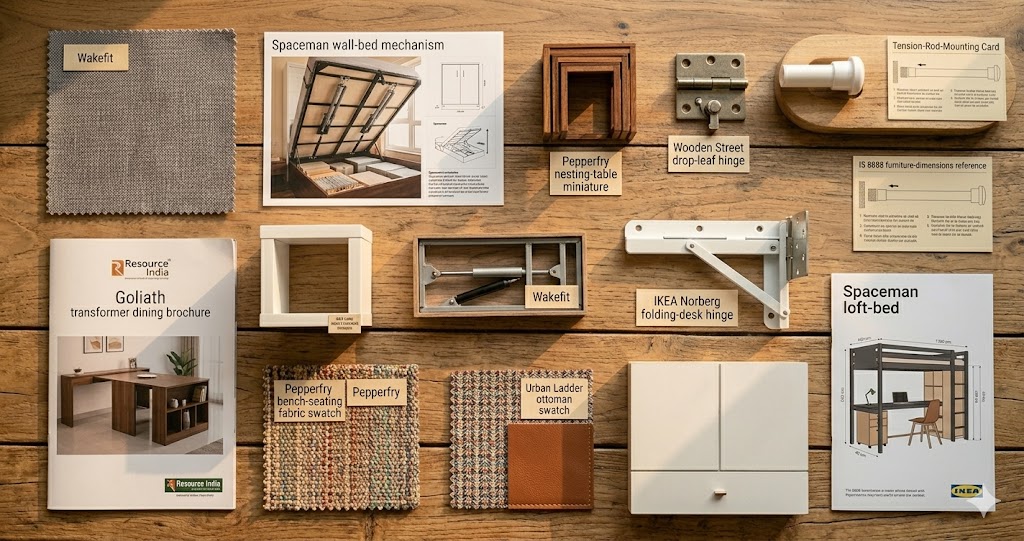
The brand landscape splits into five clean cohorts. Choosing within the right cohort matters more than chasing the cheapest piece across cohorts, because mechanism quality (hinges, hydraulics, slides, locking pins) is what fails first on space-saving furniture — not the surface finish.
| Brand | Cohort | Strength | Weakness | Representative SKU + 2026 ₹ |
|---|---|---|---|---|
| Wakefit | Mass D2C | Hydraulic-lift beds, sofa-cum-beds at ₹15K-₹50K | Limited transformer mechanisms; no wall beds | Boston sofa-cum-bed queen: ₹42,000 |
| Wooden Street | Mass omnichannel | Wood-finish drop-leaf and extendable pieces | Hinge longevity varies by SKU; QC inconsistent | Stewart extendable 4-to-6 seater: ₹28,500 |
| Pepperfry | Marketplace | Widest SKU catalogue (4,200+); strong on cube storage, nesting tables, ottomans | Marketplace QC variance; check seller ratings | Cubic storage ottoman pair: ₹12,400 |
| Urban Ladder | Mass premium | Better-finished sofa-cum-beds and storage beds | Limited transformer range; pricier than Wakefit for similar function | Apollo storage bed queen: ₹68,000 |
| IKEA India | Modular flat-pack | KALLAX, PAX, NORBERG, NORDEN — engineered modularity | Install requires skilled assembler; not all SKUs available in all cities | PAX 1500×600×2360 with internals: ₹62,000 |
| FabIndia | Crafted heritage | Solid-wood nesting tables, low storage benches | No mechanism-based pieces; premium ₹/sqft | Sheesham nesting table set of 3: ₹14,800 |
| Spaceman India | Specialist import | Wall beds, loft beds, transformer systems from Italy | Premium pricing; site survey mandatory | Compatto queen wall bed with side bookshelves: ₹1,12,000 |
| Resource India | Specialist import | Goliath Console transformer (3 to 12 seats), Atlante lift bed | Top-end pricing; lead times 6-10 weeks | Goliath Console 1.0m to 3.0m: ₹4,75,000 |
| Bygg India | Mid specialist | Wall beds and Murphy beds at mid-spec hardware | Smaller dealer network outside metros | Bygg queen wall bed: ₹78,000 |
| Hettich India | Hardware supplier | Tavolone wall bed mechanism, lift hardware for custom carpenters | Sold as hardware, not finished pieces | Tavolone queen mechanism kit: ₹38,000 |
| Hafele India | Hardware supplier | Hydraulic lift mechanisms, soft-close hinges, drawer slides for custom carpenters | Hardware-only; needs carpenter integration | Hydraulic bed lift pair: ₹6,200 |
| Sleek Modular (Asian Paints) | Modular wardrobe | Wardrobe systems with finished-shutter range | Lead time 4-6 weeks; install quality dealer-dependent | 1800mm 3-shutter wardrobe: ₹85,000 |
| Wurfel | Modular wardrobe premium | German-spec hardware (Blum, Hettich), better finish | 25-40% premium over Sleek | 1800mm 3-shutter wardrobe: ₹1,18,000 |
| Godrej Interio | Heritage modular | Steel storage beds, Slimline wardrobes, factory finish | Less design-forward; limited transformer options | Slimline 3-door wardrobe: ₹56,000 |
| Saraf Furniture | Solid wood mass | Sheesham drop-leaf dining and benches | All wood, no mechanisms; bulkier than panel-board equivalents | Sheesham 6-seater extendable: ₹54,000 |
Material rules of thumb for 2026 India:
- Engineered wood (MDF/HDHMR) with melamine or laminate finish is the price/durability sweet spot for indoor multifunctional furniture in non-coastal cities. Avoid plain MDF for coastal Mumbai, Chennai, Kochi humidity — moisture warps it within 3-4 years.
- HDF-core boiling-water-resistant (BWR) ply is mandatory for kitchen-adjacent dining and bench pieces.
- Sheesham (Indian rosewood) is the solid-wood option that holds drop-leaf hinges best over 10 years; mango wood and acacia are 30-40% cheaper but loosen sooner.
- Steel-frame wall beds and loft beds outperform engineered-wood frames structurally but transmit vibration; insist on rubber bushings at floor and wall anchors.
- Hardware spec — Hettich, Hafele, Blum — adds ₹4K-₹8K per piece over generic Chinese hardware but tripled service life is the documented payback (Hafele India 2024 dealer reliability report).
Eight Pitfalls Common in 2026 India
1. Buying a wall bed without verifying the wall. Spaceman India and Bygg both require minimum 9-inch RCC, 6-inch brick with through-bolts, or properly framed stud partitions. A 4-inch lightweight brick partition will not take 60kg-plus dead load + dynamic deployment force. The mitigation: site survey first, payment after. Reputable vendors do not skip this.
2. Underspecifying hydraulic-bed pistons. Most ₹25K-₹35K hydraulic beds ship with 700N pistons rated for ~5,000 cycles. At daily use that is ~13 years; at twice-daily (couple making bed in morning + lifting at night for storage access) it halves. Demand 1000N pistons rated for 10,000 cycles for premium units. Replacement piston pairs are ₹2,000-₹4,000 from Hettich/Hafele dealers when failure happens.
3. Choosing a sofa-cum-bed with a thin mattress for a daily-use bed. A 4-inch foam mattress is comfortable for ~2-3 guest nights, not daily sleep. If the sofa-cum-bed is the primary bed (studio apartment, hostel-style PG), spec a 5-6 inch HR foam or pocket-spring mattress — this typically adds ₹6K-₹12K to the order.
4. Ignoring the deployed clearance. A wall bed needs 2100mm clear floor in front when deployed. A drop-leaf table needs 850mm circulation around all extended sides. Buying for the folded footprint and forgetting the deployed one is the single most common space-saving regret. The Studio Matrx furniture planner lets you sketch the deployed-and-folded footprint of each piece against your real floor plan.
5. Treating modular cube storage as decor. IKEA KALLAX is rated for 25 kg per cube. Loading 40 kg of books in a single cube cracks the MDF base. Distribute weight; use the lower cubes for heavy items.
6. Buying drop-leaf and extendable dining tables without testing the mechanism in showroom. Sagging hinges are the #1 dining furniture complaint in 2026 (Houzz India Q1 2026 sentiment data). Test the extended position by leaning hard on the leaf edge in showroom; reject anything that flexes more than 5mm.
7. Wall-mounting folding desks into drywall or 4-inch brick. A 600mm × 740mm desk loaded with a laptop and elbow weight pulls 25-35 kg on the wall fixings. Drywall mounts will pull out in 6-18 months. Either through-bolt to RCC, hit a stud, or use a proper rear back-plate spanning two studs.
8. Buying a transformer dining table for a 4-person household. The Goliath Console and similar (₹4-6 lakh) make sense for households that genuinely seat 10-14 four-plus times a year. For a household that hosts 8 twice a year, a ₹28K drop-leaf does the same job with 95% of the function at 6% of the price. Match the mechanism premium to actual frequency of full deployment.
India-Specific Considerations
NBC 2016 and IS code references. The National Building Code 2016 (Part 4, Furniture and Fittings, and Part 3, Habitable Spaces) does not regulate furniture choice directly but does set minimum room and circulation dimensions that space-saving furniture must respect even when deployed. Habitable rooms require a minimum 9.5 sqm floor area; circulation paths a minimum 750mm width. A wall bed that, when deployed, blocks the only egress door violates NBC.
IS 8888 is the Indian Standard for residential furniture dimensions — minimum bed lengths (1900mm single, 2000mm queen), table heights (700-760mm), wardrobe depths (500-600mm), seat heights (400-450mm). When evaluating multifunctional pieces, check the deployed state against IS 8888 minimums; the folded state is irrelevant for usability.
IS 4838 (Decorative laminate sheets) and IS 12823 (Pre-laminated particle boards) are the surface-material standards. Reputable Indian brands (Sleek, Wurfel, Godrej, IKEA India) comply by default; cheap marketplace sellers often do not. Ask for the IS conformity certificate on any spend above ₹30,000.
DPDP Act 2023. Several "smart" space-saving pieces (motorised wall beds, app-controlled lift beds) collect usage telemetry. Under the Digital Personal Data Protection Act 2023, the brand must disclose data collection and provide opt-out; insist on a written privacy disclosure before installing app-paired furniture.
Vastu compatibility. Wall beds raise common Vastu concerns about sleeping head-direction (south or east preferred). Spaceman and Bygg both offer left-deploy and right-deploy options to accommodate; specify at order. The vastu-for-bedroom guide covers the head-direction logic. Sofa-cum-beds in living rooms are Vastu-neutral as long as the deployed sleeping direction is not directly north-head.
Society / RWA rules. Most metropolitan apartment associations require approval for wall-mounting heavy fixtures into structural walls — wall beds, loft beds, large wall-mounted desks all qualify. Lodha, Hiranandani and Prestige societies typically have a 7-day notice requirement and may demand a structural engineer's NOC for wall beds. Check before ordering.
Climate zone differences. Coastal cities (Mumbai, Chennai, Kochi, Goa) — humidity 75-90% — demand BWR ply / marine-grade engineered wood, stainless steel hardware not chrome-plated. Hot-dry cities (Delhi NCR, Jaipur, Ahmedabad) — large humidity swings 25-80% — cause solid-wood joints to expand/contract; oversized tenons and slotted screw holes matter. Cold-cloudy (Shimla, Gangtok) — condensation at wall-bed fold creates mould; ventilation gaps mandatory.
Regional vendor differences. IKEA is established in Hyderabad, Mumbai (Navi Mumbai), Bengaluru, Delhi NCR (Noida + Gurugram), and Pune (2025). Outside these metros, IKEA delivery exists but install support is patchy. Pepperfry's Studio network and Urban Ladder's experience centres cover 30+ cities. Spaceman India and Resource India install primarily in the top 8 metros; tier-2 city installs typically require sending a team and add ₹15K-₹35K to the bill.
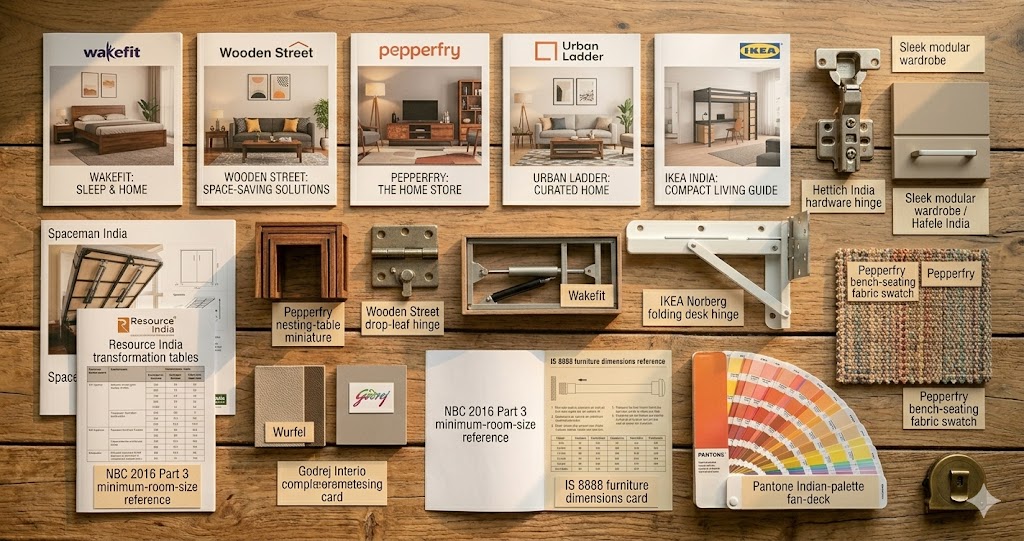
The Budget Bands for 2026 India
A six-piece space-saving outfit covering the major life functions (sleeping, sitting, eating, working, storing, dressing) falls into four predictable bands in 2026 India.
| Tier | Total budget (6 pieces) | What you get | Vendors | Where to compromise |
|---|---|---|---|---|
| Entry | ₹65K-₹1.1L | Wakefit sofa-cum-bed, Pepperfry storage bed (manual lift), IKEA NORDEN drop-leaf, Godrej Slimline wardrobe, IKEA NORBERG folding desk, Pepperfry ottoman | Wakefit, Pepperfry, IKEA, Godrej | No wall bed, no transformer table; manual lifts instead of hydraulic |
| Mid | ₹1.5L-₹2.5L | Wakefit hydraulic-lift bed, Urban Ladder sofa-cum-bed, Wooden Street extendable dining, IKEA PAX wardrobe, Wooden Street folding desk, Pepperfry ottoman pair — worked example above | Wakefit, Urban Ladder, Wooden Street, IKEA, Pepperfry | Skip the transformer dining; use a quality drop-leaf instead |
| Premium | ₹3.5L-₹5.5L | Spaceman India wall bed, Urban Ladder premium sofa-cum-bed, Goliath Console transformer dining, Wurfel modular wardrobe, custom carpenter wall-desk in walnut veneer, FabIndia ottoman | Spaceman, Urban Ladder, Resource India, Wurfel, FabIndia | This tier requires real engineering — site survey mandatory |
| Super-premium | ₹7L-₹14L | Spaceman India wall bed with integrated lighting + bookshelves + desk, Minotti or Cassina sofa-cum-bed, Goliath Console with veneer top + USB integration, Boffi or Poliform wardrobe with internal lighting, custom Italian-import folding workstation, leather ottoman pair from Hermès Home | Spaceman, Minotti, Cassina, Boffi, Poliform, Hermès Home | Reserved for clients where ₹/sqft of the flat exceeds ₹50,000 — typical Mumbai Pali Hill, Delhi Lutyens, Bengaluru CBD penthouses |
Cross-reference the spend against budget-luxury-interiors and compact-luxury-apartment for context on where furniture spend sits within total interior spend.
When Space-Saving Furniture Is NOT the Right Fit
Honest counter-cases. There are households and floor plans where reaching for space-saving furniture is the wrong call.
Large floor plates (1500+ sqft per BHK). A 4 BHK villa in Whitefield with 2,400 sqft carpet does not need a sofa-cum-bed; it has a dedicated guest room. The mechanism premium buys nothing. Conventional single-function furniture is more comfortable, lasts longer, and looks better.
Long-tenure ownership (15+ years). If you intend to live in the flat for 15+ years and have the budget, built-in joinery outperforms movable space-saving furniture on sqft efficiency, finish quality and integration. See smart-storage-interiors. Space-saving furniture is the right choice when movability matters; built-ins are right when integration matters.
Heavy hosting households. A joint family hosting 12-16 people for meals 50+ times a year needs a real 12-seater dining, not a Goliath transformer that has been deployed-folded 600 times in 2 years. Mechanism fatigue is real. Buy a fixed table.
Daily-use convertible sleep beyond 18 months. A sofa-cum-bed slept on every night for 18+ months will degrade — both the mattress and the convertible mechanism. If two people share a studio long-term, invest in a wall bed (proper queen mattress, deployed-folded once a day) rather than a sofa-cum-bed.
Elderly or mobility-impaired users. Folding-mechanism furniture requires manipulation that arthritis, post-surgical recovery or mobility aids may make unsafe. A wall bed deployment, a hydraulic-lift bed, a transformer dining mechanism — all assume two hands and full mobility. Plan for conventional pieces or motorised assists in such households.
Heritage or rented flats with restoration covenants. Many heritage Mumbai (Bandra, Colaba), Chennai (Mylapore), Delhi (Civil Lines) properties have rental covenants prohibiting wall-mounted heavy fixtures. Wall beds and loft beds are off the table; you are working with movable pieces only.
The 5-Year Trajectory: 2030 Outlook
Three shifts are visible in supplier roadmaps and demographic data that point to where space-saving furniture goes by 2030.
Motorised and app-controlled mechanisms become standard, then expected. In 2026 motorised wall beds (a touch deploys the bed rather than a manual pull) are a ₹30K-₹50K premium over manual. By 2030, manual mechanisms persist only in the entry tier; mid-tier shifts to motorised default. Hettich's 2025 roadmap and Hafele's India 2026 product pipeline both confirm motorisation as the spec direction. App control, voice-assistant integration ("Alexa, deploy bedroom bed") becomes the upper-mid feature.
Indian manufacturing replaces imports at the engineered-mechanism tier. Goliath Console and Compatto are imported into India today, sold at 2.5-3x European retail because of duty + freight + dealer margin. PLI-scheme furniture manufacturing in Andhra Pradesh and Tamil Nadu, and Indian licensing deals with Italian originators, should bring engineered transformers into the ₹1.5-₹3 lakh band by 2028-2029 — half of today's price. Expect 3-4 Indian-manufacturer entrants in this tier by 2030.
The "studio apartment as default young-urban product" pushes catalogue depth. Anarock's 2025 outlook projects studios at 20-25% of new metro launches by 2030 (up from 14% in 2025). Brands that currently carry 8-12 space-saving SKUs (Wakefit, Urban Ladder) will likely carry 40-60 by 2030, including studio-specific configurations (combined wall-bed + desk + wardrobe single-furniture-system). Expect the "studio kit" — a pre-engineered set of 4-5 pieces designed to outfit a 300-400 sqft studio — to become a category in itself by 2028.
A secondary shift: as climate awareness deepens (see sustainable-interiors-india), expect material certifications (FSC, GREENGUARD, IS conformance) to become tablestakes for purchases above ₹50K. Brands that publish lifecycle and material disclosure data will command the premium tiers.
Frequently Asked Questions
Q: What is the single best space-saving piece to buy first if I have only ₹50,000?
A: A hydraulic-lift storage bed from Wakefit or Sleepwell (₹30-45K), which recovers ~32 sqft of bedroom storage that would otherwise need a chest of drawers, plus a Wakefit or Pepperfry sofa-cum-bed in the living room (₹20-30K). These two pieces together transform a 1 BHK more than any other ₹50K combination.
Q: Are wall beds safe? I have seen videos of them falling.
A: Properly installed wall beds from Spaceman India, Bygg, Resource India or those built around Hettich Tavolone mechanisms are extremely safe — the mechanism uses counterbalanced springs or pistons that hold the bed in either position. The failure videos are typically of cheap unverified imports installed into 4-inch brick walls without through-bolts. Insist on a proper site survey, 9-inch RCC or correctly bolted alternative, and a vendor with a 5-year mechanism warranty.
Q: Can I install a wall bed in a rented apartment?
A: Technically yes, but most rental agreements require the tenant to restore the wall to original condition on exit. Patching a 9-inch RCC wall after a 12-bolt removal costs ₹8-15K. Many rental landlords will refuse permission outright. Better tenant choices: sofa-cum-bed, hydraulic storage bed, modular wardrobe — all movable.
Q: How long does a hydraulic-lift bed mechanism last?
A: 4-7 years typical service life for the pistons at daily use; replacement pistons cost ₹2K-₹4K per pair from Hettich/Hafele dealers. The frame and structure last 12-18 years. Servicing one piston pair every 5 years is realistic; do not let a sagging piston damage the lift geometry — replace at first sign.
Q: What is the difference between Spaceman India and Resource India?
A: Spaceman India primarily distributes Italian-engineered wall beds, loft beds and integrated wall systems — price band ₹70K-₹4L per system. Resource India distributes the Goliath Console and Atlante series — transformer dining tables and lift beds, price band ₹2L-₹6L. The two are complementary; Spaceman for the bedroom transformation, Resource India for the dining transformation.
Q: Is IKEA PAX really worth the price vs a local carpenter?
A: Depends on tenure and quality demands. IKEA PAX with KOMPLEMENT internals at ₹60-80K for a 1500mm wardrobe is comparable in cost to a mid-tier local carpenter built-in (₹50-70K for the same size). IKEA wins on consistent finish, soft-close hardware, replaceable parts (you can swap a drawer in 5 years), and disassembly for moves. Carpenter built-ins win on perfect fit to wall niches and on-site customisation. For rentals or 5-year ownership, IKEA. For 10+ year ownership in your own flat with awkward wall niches, carpenter.
Q: Are sofa-cum-beds comfortable enough to sleep on every night?
A: Most are not. A 4-inch foam mattress designed for guest use degrades within 8-12 months of daily sleep. If you are using the sofa-cum-bed as a primary daily bed (studio apartment, single-room PG), spec a 5-6 inch HR foam or pocket-spring mattress at order time (₹6K-₹12K upgrade), or accept that you will replace the mattress every 18-24 months.
Q: Will a wall bed work with a king-size mattress?
A: Yes, but the cabinet depth increases from 600mm (queen) to ~700mm (king), and the wall mechanism rating jumps. King wall beds from Spaceman start ~₹1.4L and require 9-inch RCC mandatorily. The deployed floor clearance also extends to ~2200mm from the wall. King wall beds make sense in 13ft+ bedroom widths; in a typical 11ft bedroom, the queen is the better fit.
Q: Can I retrofit a transformer dining mechanism (like Goliath) into an existing table?
A: Not realistically. The Goliath Console is a fully engineered system — the leg/foot mechanism, the leaf-extension geometry, the base ballast, all designed together. Aftermarket retrofit kits do not exist at consumer scale. If you want this function, buy the engineered piece; do not try to modify a conventional table.
Q: How do I plan space-saving furniture for a flat I have not yet possessed?
A: Get the RERA-recorded carpet area and the architect's floor plan from the developer. Use the Studio Matrx furniture planner or ai-room-planner to sketch the deployed and folded footprint of each piece against the real plan. Confirm wall types (RCC vs brick vs partition) with the developer before ordering wall beds. Plan for delivery 2-3 weeks after possession, not the day of — installation on move-in day is chaotic and mistakes are expensive.
References
1. Knight Frank India. Affordable & Mid-Income Housing Report — H2 2025. Mumbai, 2026.
2. Anarock Property Consultants. Indian Residential Market Q4 2025 Outlook. Bengaluru, 2026.
3. Magicbricks. Renter Sentiment Survey — Urban India 2025. Noida, 2025.
4. NASSCOM. Hybrid Work in Indian IT/ITES — 2025 Annual Survey. Bengaluru, 2025.
5. Bureau of Indian Standards. IS 8888: Indian Standard Specification for Furniture — Beds, Dining Tables, Study Desks, Wardrobes. New Delhi, BIS.
6. Bureau of Indian Standards. IS 4838: Decorative Thermosetting Synthetic Resin-bonded Laminated Sheets. New Delhi, BIS.
7. Bureau of Indian Standards. IS 12823: Pre-laminated Particle Boards from Wood and Other Lignocellulosic Materials. New Delhi, BIS.
8. Bureau of Indian Standards / Government of India. National Building Code of India 2016 — Part 3 Development Control and Part 4 Furniture and Fittings. New Delhi, BIS.
9. Government of India. Digital Personal Data Protection Act 2023. Gazette of India, 2023.
10. IKEA India. FY25 Annual Disclosure — India Operations. Hyderabad, 2025.
11. Hafele India. Dealer Reliability and Service-Life Report. Mumbai, 2024.
12. Houzz India. India Home Renovation Sentiment — Q1 2026. Bengaluru, 2026.
13. IBEF (India Brand Equity Foundation). Indian Furniture Industry Report 2025. New Delhi, IBEF.
14. JLL India. Real Estate Outlook H2 2025 — Residential Sector. Mumbai, 2026.
15. CBRE India. India Residential Market Monitor — December 2025. Gurugram, 2026.
Related Guides
- smart-storage-interiors — the whole-room storage strategy that complements furniture-piece choices
- space-efficient-homes — floor-plan-level efficiency, the architectural counterpart
- compact-urban-home-planning-india — small-flat planning frameworks
- apartment-interior-planning-india — apartment-specific interior planning
- compact-luxury-apartment — when small + premium converges
- smart-home-design-india — for the automation overlay on motorised mechanisms
Export this guide
Related Guides — Deep-dive reading
Space-Efficient Homes — A 2026 Working Reference for Compact Indian Apartments
Five spatial multipliers · Floor plan tricks · Dual-purpose furniture
Room PlanningPremium Apartment Interiors — The ₹15-40 Lakh Tier for Indian 3 BHKs (2026)
Above budget-luxury · Below super-luxury · Materials, brands, contractor-tier reality
Design StylesStudio Apartment Design — The 1RK 250-450 sqft Indian Cornerstone (2026)
1RK studio · 5 zones in 350 sqft · Bed-as-sofa · Co-living adjacent · Mumbai BKC ₹35K rent
Design StylesRelated Tools — Try Free
Cross-Ventilation Analyzer
Estimate airflow and air changes per hour (ACH) from room size, window areas, layout, and local wind — with NBC 2016 Part 8 compliance check.
Ventilation CalculatorApartment vs Villa Interior Planning Guide
Compare ceiling height, structural flexibility, lighting, storage, and services between apartments and villas.
Planning GuideApartment Furniture Size Chart
Standard furniture dimensions for Indian apartments — sofas, beds, tables, dining, storage.
Reference Chart