
Fabric Upholstery Care in India: Cleaning Codes, Stains & Protection (2026)
How to keep a fabric sofa or chair clean, fresh and long-lasting in Indian homes — reading the W/S/WS/X cleaning code before you touch it, weekly routine care, fabric-by-fabric notes, a stain-removal quick guide (turmeric and curry included), monsoon musty-smell defence, and when to protect, re-cover or reupholster instead.
A fabric sofa is the most-used, most-abused piece of furniture in an Indian home — it takes the evening chai, the spilled sambar, the kids, the pet, the visiting relatives, the fan-blown dust and, for four months a year, the monsoon damp. Cared for well, a good fabric sofa stays fresh and comfortable for ten to fifteen years. Cared for badly — or "cleaned" with the wrong thing in a panic after a spill — the fabric fades, pills, smells, and needs re-covering long before the frame is tired.
The single most valuable habit in this whole guide is boring: read the cleaning code on the label before you put anything wet on the fabric. Most upholstery-care disasters in Indian homes are not the stain — they are the well-meant scrub with water on a fabric that says "S" (solvent only), which leaves a permanent ring worse than the original mark. This guide is about that literacy, plus the routine care, stain rescue, protection and monsoon defence that keep a fabric sofa going. It sits inside the complete guide to furniture and its care companion, the furniture maintenance guide.
Scope & how to read this. This is homeowner routine care and stain first-aid, not a substitute for a professional. Every product note and cost band is indicative — always test any cleaner on a hidden patch first, and follow the manufacturer's own care label, which overrides anything here. Deep stains, delicate fabrics (silk, some velvets), pet accidents that soak the foam, or musty smells that will not lift are professional upholstery-cleaning jobs — a wrong DIY move can set a stain or shrink and ring the fabric permanently. If the fabric itself is worn out rather than dirty, the answer is reupholstery, not more cleaning.
Read the code first: W / S / WS / X
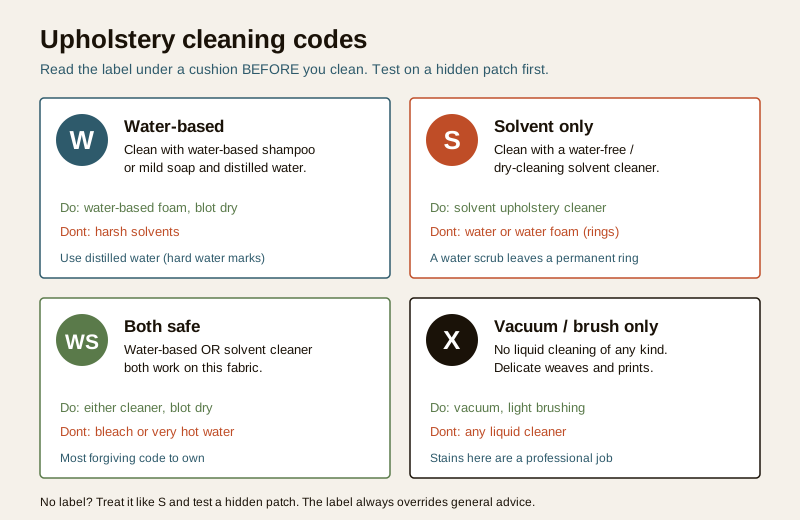
Almost every manufactured sofa, and most fabric sold by the metre, carries an upholstery cleaning code — usually a single letter on a label under a seat cushion or stitched into the frame. It tells you the ONE thing you must know before cleaning: what kind of cleaner the fabric can tolerate. Ignore it and you risk a permanent water ring, shrinkage, or dye bleed. This is the core literacy of fabric care.
| Code | What it means | Clean with | Never |
|---|---|---|---|
| W | Water-based cleaning safe | Distilled-water upholstery shampoo, water-based foam, mild soap solution | Harsh solvents |
| S | Solvent only — no water | Dry-cleaning solvent / water-free upholstery cleaner | Plain water or water-based foam (leaves rings) |
| WS | Both safe | Either water-based OR solvent cleaner | Bleach / very hot water |
| X | Vacuum / brush only | Vacuuming and light brushing; no liquid cleaning of any kind | Any liquid — call a professional for stains |
A few honest notes on reading it:
- No label? Treat an unknown fabric conservatively — assume it is closer to "S" and test any cleaner on a hidden patch (under a back cushion or the base) before touching a visible area. If you have the invoice or brand, check their care sheet.
- "X" is not "do nothing" — it means clean only by vacuuming and brushing; delicate weaves, some viscose blends and printed fabrics fall here, and a stain on them is genuinely a professional job.
- Distilled water matters — India's hard tap water leaves mineral marks of its own on "W" and "WS" fabrics. Use distilled or filtered water for cleaning, and blot dry.
- Test first, always — even on a "W" or "WS" fabric, a hidden-patch test for colour-fastness and shrinkage takes two minutes and saves the sofa. The upholstered furniture guide explains how the fabric, foam and frame go together, which is why a wet clean on the wrong fabric can wick into the foam and smell.
Routine care — the weekly and monthly habits
Fabric upholstery lives or dies on routine, not rescue. The dust and grit that settle into a sofa every day are abrasive: they cut the fibres from the inside every time someone sits down, which is what actually wears a fabric out. Regular light care beats occasional deep cleaning every time.
Weekly
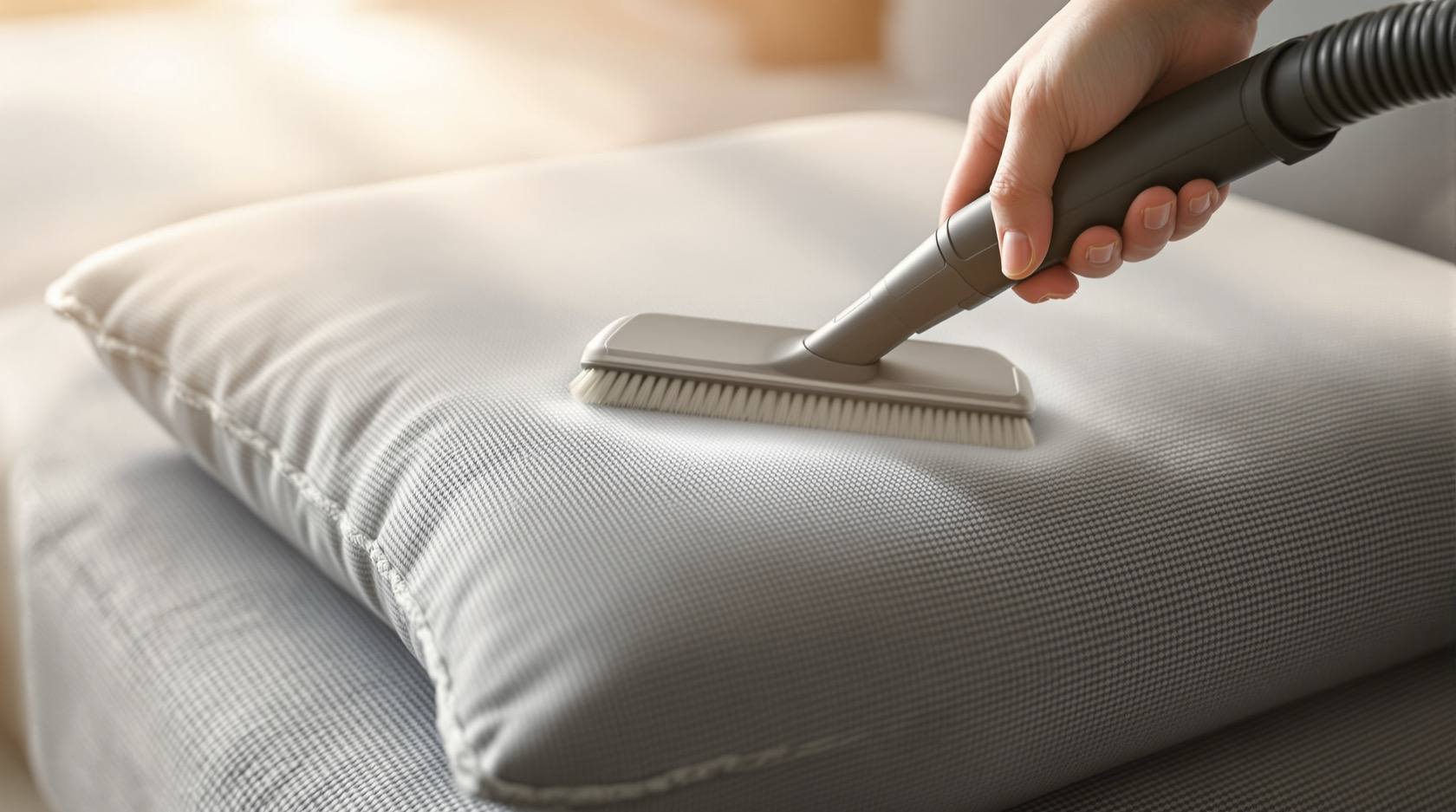
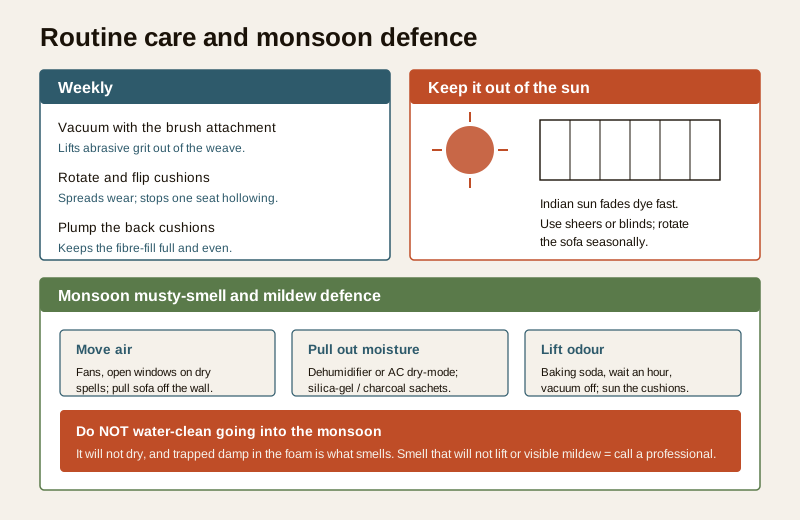
- Vacuum with the upholstery (brush) attachment, not the bare nozzle — the soft brush lifts grit out of the weave without stretching it. Do the seat, back, arms and, crucially, the crevices where crumbs and dust collect.
- Rotate and flip reversible seat cushions, and swap end cushions with middle ones, so wear and sag spread evenly instead of hollowing out the favourite seat.
- Plump and karate-chop the back cushions to redistribute the fibre-fill and keep them full.
Monthly / seasonal
- Move the sofa off the wall and vacuum behind and under it — the biggest dust and pet-hair reservoir in the room.
- Keep it out of direct sun. Indian sunlight is brutal on textile dye; a sofa parked in an unshaded window will fade unevenly within a couple of years. Use sheers or blinds, or rotate the sofa's orientation seasonally.
- Air it out. On a dry, breezy day, open the windows and let air move through the room — this is your first line against the musty smell dealt with below.
Fabric-by-fabric notes
Different upholstery fabrics behave differently — "care" for a cotton weave is not the same as for velvet. Know what you have.
| Fabric | Character | Care notes |
|---|---|---|
| Cotton | Breathable, natural, common | Usually "W" or "WS"; can shrink and wrinkle if over-wetted; blends resist better than pure cotton |
| Linen | Cool, textured, upscale | Creases and stains easily; often best professionally cleaned; blot spills instantly |
| Polyester / poly-blend | Durable, budget-friendly, common | Resilient and fade-resistant; usually "W" or "WS"; the everyday India default |
| Microfibre | Tight synthetic weave, family-friendly | Easy-clean; many are "W"; brush the nap back up after it dries |
| Chenille | Soft, plush pile | Sheds and flattens; vacuum gently; avoid over-wetting the pile |
| Velvet | Rich pile, directional nap | Vacuum with the nap; blot, never rub (rubbing crushes the pile); often "S" or professional-only; brush the pile back up |
Two rules cut across all of them. On any napped or pile fabric (velvet, chenille, microfibre), always work with the direction of the nap and brush it back up as it dries — rubbing against the pile crushes and marks it. And blot, never rub, any fabric: rubbing drives the stain deeper and frays the fibres. For the fuller picture of how upholstery is built and specified, see the upholstered furniture guide; if you are choosing new fabric, the fabric-and-foam calculator helps you size and budget it.
Stain removal — blot first, then match the cleaner
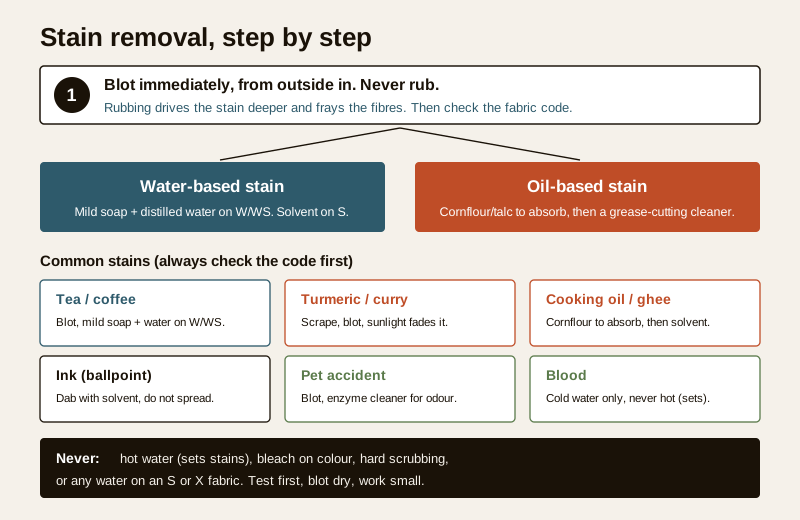
Speed and the right first move win most stains. The universal opening is the same for everything: blot up the excess immediately with a clean cloth, working from the outside of the spill inwards, and never rub. Then match the cleaner to the stain type AND the fabric's code — a water-based stain on an "S" fabric still needs solvent, not water.
| Stain | Type | First move (check code first) |
|---|---|---|
| Tea / coffee | Water-based | Blot; dab with mild soap + distilled water on "W/WS"; solvent on "S" |
| Curry / turmeric | Oily + strong dye | Scrape off solids; blot; the yellow is stubborn — mild detergent then a gentle dab, and sunlight helps fade turmeric; deep marks are professional |
| Cooking oil / ghee | Oil-based | Sprinkle cornflour/talc to absorb, brush off; then solvent or a grease-cutting upholstery cleaner |
| Ink (ballpoint) | Solvent-based | Dab (do not spread) with a solvent cleaner; blot onto a cloth beneath; professional for large marks |
| Pet accident (urine) | Water + odour | Blot dry, then an enzyme cleaner to break down odour; if it soaked the foam, call a professional |
| Blood | Protein | Cold water only (heat sets it) on "W/WS"; blot; never hot water |
| Wine / juice | Water-based dye | Blot; mild soap + distilled water; act fast before it sets |
The one everyone in India meets is turmeric — the bright yellow curry stain. It is both oily and a powerful natural dye, so it is genuinely hard: scrape and blot first, use a mild detergent solution (code permitting), avoid scrubbing, and remember that sunlight naturally bleaches turmeric over days, so a treated-but-faint mark on a "W/WS" fabric will often keep fading if the cushion is aired in indirect sun. What NOT to do: no hot water (sets many stains), no bleach on coloured fabric, no vigorous scrubbing, and no water on an "S" or "X" fabric.
Deep cleaning — DIY vs professional
Beyond spot-cleaning, a sofa needs an occasional deep clean — but choose the method by the fabric code, not convenience.
- DIY upholstery shampoo / foam suits "W" and "WS" fabrics. Use a low-moisture foam, work in sections, do not soak, and let it dry fully with fans and open windows — trapped moisture in the foam is what causes the musty smell. Vacuum the dried residue.
- Steam cleaning is powerful but is not safe on every fabric — the heat and moisture can shrink cotton/linen, crush velvet pile, and over-wet foam that then smells. Only steam fabrics rated for it, and never an "S" or "X" fabric.
- Professional cleaning is the right call for "S" and "X" fabrics, delicate weaves, whole-sofa refreshes, set-in stains, and post-monsoon deodorising. Indicative cost for a professional sofa clean runs in relative bands by seater count and city — get two or three local quotes rather than a headline price. Log it so it happens on time with the furniture maintenance scheduler.
Protecting the fabric
The cheapest care is the care that stops dirt reaching the fabric at all.
- Fabric protector spray (a Scotchgard-type finish) makes fabric water- and stain-resistant so spills bead up and blot off before soaking in. Apply on clean, dry "W/WS" fabric, test first, and re-apply after deep cleans. Ask for it as a factory finish when buying, or DIY on suitable fabrics.
- Removable, washable covers are the most practical protection for Indian family homes — machine-wash them on rotation, and they take the daily hit instead of the sofa. Many modern sofas offer zip-off covers; loose throws and fitted covers do the same on older ones.
- Arm caps and head-rest covers protect the two spots that wear and grease first — the arms and where heads rest — and are cheap to replace.
- A house rule of no shoes and no oily snacks on the sofa does more than any spray. Keep a microfibre cloth nearby so spills get blotted in the first ten seconds.
India problems — dust, monsoon musty smell, mites and pet hair
Indian conditions throw specific challenges at fabric upholstery. Handle them deliberately.
- Dust. Fan- and window-borne dust is relentless and abrasive; the weekly brush-vacuum above is the main defence, plus keeping windows screened.
- Humidity, musty smell and mildew (monsoon). The big one. In the monsoon, foam and fabric hold damp and start to smell; unchecked, mildew spots appear. Defence: improve airflow (fans, open windows on dry spells, pull the sofa off the wall), run a dehumidifier or AC dry-mode in closed rooms, tuck silica-gel or activated-charcoal sachets behind cushions, sprinkle baking soda, leave it an hour and vacuum it off to lift odour, and sun the loose cushions on a dry day. Never deep-clean with water going into the monsoon — it will not dry. A smell that will not lift, or visible mildew, is a professional job.
- Dust mites and allergens. Upholstery harbours dust mites, a real trigger for asthma and allergies in humid India — regular hot-wash of removable covers, thorough vacuuming (ideally a HEPA vacuum), and airing all reduce the load. This is part of a healthier interior overall; see the healthy homes hub for the wider indoor-air picture.
- Pet hair. Vacuum with the brush tool, use a rubber pet-hair brush or a slightly damp rubber glove to gather hair off the weave, and washable covers to contain it.
When to re-cover or reupholster instead
Cleaning fixes dirt; it cannot fix worn-out fabric. Know when you have crossed from a care problem to a replacement one:
- The fabric is thin, pilled, faded or torn rather than just dirty.
- The foam has gone flat or lumpy and cushions no longer recover — a comfort and support issue cleaning cannot touch.
- Stains or smells are set into the foam, not the surface.
- You simply want a new look on a frame that is still sound.
If the frame is solid — which good hardwood and ply frames usually are — re-covering is far better value than buying new, and often cheaper than years of professional cleaning on a dying fabric. Read upholstery replacement for how re-covering works, what it costs in bands, and how to judge the frame; the wider furniture repair and restoration guide covers frame and spring fixes.
How it connects
- This is the fabric chapter of furniture care — start at the complete guide to furniture pillar and the furniture maintenance guide, and see the leather counterpart in leather furniture care.
- Understand what you are caring for in the upholstered furniture guide; when fabric is worn out, move to upholstery replacement.
- Size and budget new fabric and foam with the fabric-and-foam calculator, and keep cleaning and protection on schedule with the furniture maintenance scheduler.
- Cut allergens and monsoon damp as part of the wider healthy homes hub.
Key takeaways
- Read the cleaning code first — W (water), S (solvent only), WS (both), X (vacuum/brush only) — and test on a hidden patch before cleaning anything; the wrong cleaner ruins fabric faster than the stain.
- Routine beats rescue: weekly brush-vacuum, rotate and plump cushions, keep the sofa out of direct sun.
- Know your fabric — velvet and chenille need with-the-nap care and no rubbing; cotton and linen over-wet and shrink; polyester and microfibre are the forgiving defaults.
- Blot, never rub, and match the cleaner to the stain type AND the code — turmeric/curry is the classic Indian stain: scrape, blot, mild detergent, and let sunlight fade the rest.
- Monsoon is the real enemy — airflow, dehumidifying, silica/charcoal sachets, baking soda and sunning cushions beat musty smell and mildew; do not water-clean into the monsoon.
- Protect with a fabric-protector finish, washable covers and arm caps; when the fabric or foam is worn out, reupholster rather than clean.
References
- Manufacturer care labels and the standard upholstery cleaning codes (W / S / WS / X) — the governing instruction for any given fabric; always follow the label over general advice.
- The IS furniture standards (furniture strength, durability and safety; named generally) — context for how upholstered furniture is built and expected to perform.
- Indian Green Building Council (IGBC) / GreenPro and low-VOC guidance — context for healthier fabrics, foams and finishes indoors.
- Professional upholstery cleaners and manufacturers' service sheets — for deep cleaning, delicate fabrics, set-in stains and post-monsoon deodorising; get local quotes.
All fabric, cleaner, stain and cost notes here are indicative homeowner guidance only; always follow the manufacturer's care label, test any cleaner on a hidden patch first, and use a professional upholstery cleaner for delicate fabrics, set-in stains, mildew or anything the label rates "S" or "X".
Export this guide
Related Guides — Deep-dive reading
Furniture Maintenance Guide: Keep Every Piece Lasting in India (2026)
The start-here routing guide to keeping furniture in good condition through Indian heat, humidity, monsoon, dust, hard water and termites — the one enemy and one habit for each material, a routine schedule you can actually follow, and where upkeep hands off to a professional.
FurnitureHow to Clean Bathroom Tiles (India): Shine, Hard-Water Film & Soap Scum
A practical, India-first routine for cleaning bathroom tiles and keeping them glossy — the daily squeegee habit, weekly wash, monthly deep clean, and the safe cleaner for each tile type, including the golden rule that natural stone must never meet acid.
BathroomsCurtain Cleaning & Care: Wash, Steam or Dry-Clean? (India 2026)
How to clean every curtain fabric — cotton and poly in the machine, linen with care, velvet and silk at the dry-cleaner, sheers gently — without shrinking or fading, plus a dust schedule built for Indian homes.
Window TreatmentsRelated Tools — Try Free
Cross-Ventilation Analyzer
Estimate airflow and air changes per hour (ACH) from room size, window areas, layout, and local wind — with NBC 2016 Part 8 compliance check.
Ventilation CalculatorCurtain Fabric Comparison
Compare curtain fabrics side by side — drape, opacity, care, durability and cost — and get a quick recommendation.
Comparison ToolWindow Cleaning Cost Calculator
Estimate professional window cleaning cost per visit and per year by access and frequency.
Window Calculator