
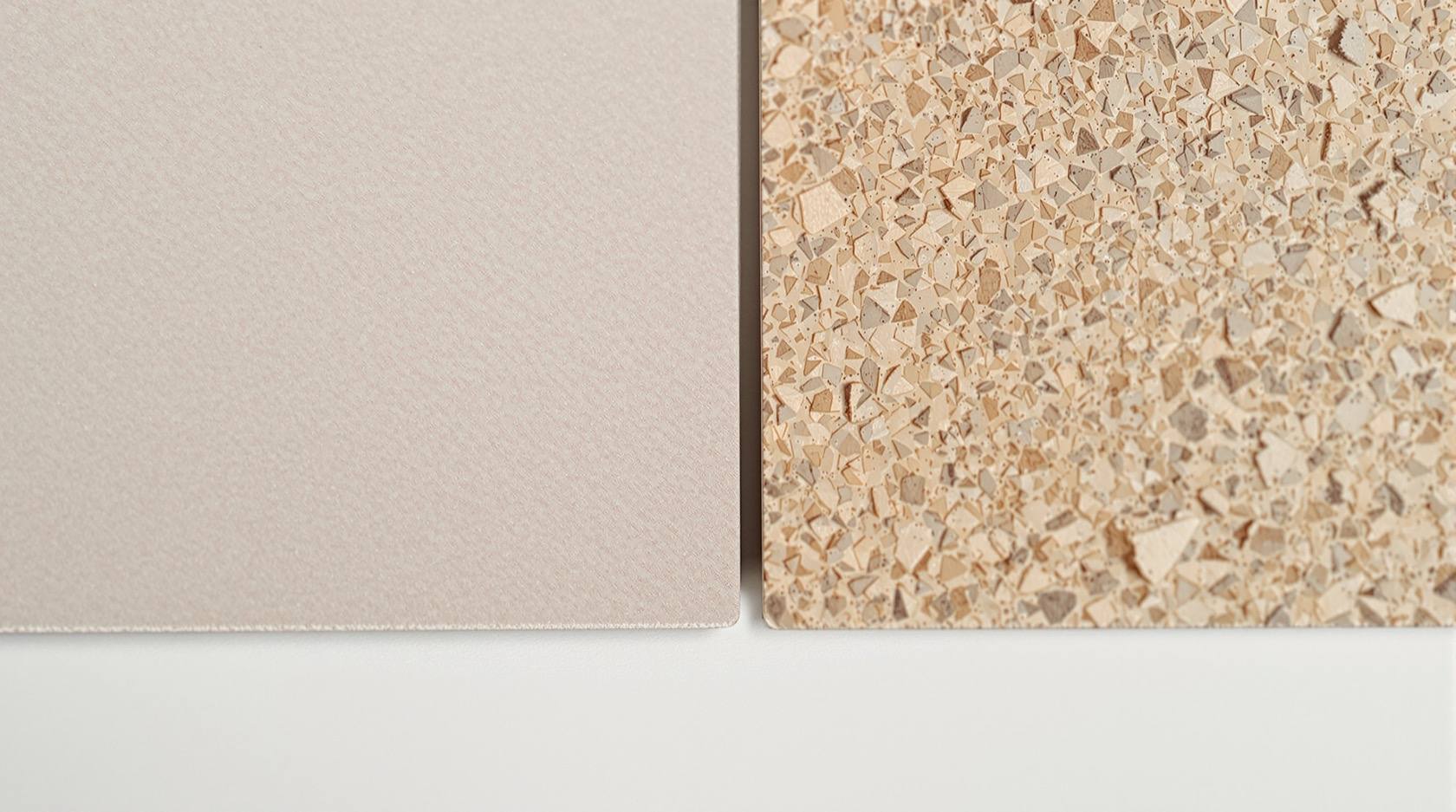
MDF vs Particle Board Furniture in India: Which Is Better? (2026)
A plain-spoken head-to-head between the two cheapest engineered boards — MDF and particle board — plus their denser cousins HDF and HDHMR: how each is made, how they hold a screw, take an edge and survive Indian humidity, what they cost, where each belongs, and the line at which you should stop saving and buy plywood instead.
Walk into any budget furniture showroom or open a flat-pack carton, and the board inside is almost certainly one of two things: MDF or particle board. They are the two cheapest engineered wood panels made, they look nearly identical once wrapped in laminate, and shops use the names loosely — so buyers end up paying particle-board money for one thing and MDF money for another without ever knowing which is in the carcass. This guide settles the difference in the terms that actually matter to a homeowner: how each holds a screw, how it takes an edge, how it behaves the day water gets to it, what it emits, what it costs, and how long it lasts.
It also brings in the two denser cousins that keep getting sold as "upgrades" — HDF and HDHMR (High Density High Moisture Resistance) — because the honest answer to "MDF or particle board?" is often "neither, go one grade up." For the wider family of boards and where these sit, start with our engineered wood furniture guide and the furniture pillar.
Scope & how to read this. Every density, cost band and behaviour note here is typical and indicative, meant to help you choose, budget and brief a carpenter or brand — not a lab spec. Confirm the actual grade and standard on the invoice: particle board to IS 3087 / IS 3097, MDF to IS 12406, and ask specifically for a moisture-resistant (MR) or HDHMR grade for anything near water. Formaldehyde emission (the E0 / E1 / E2 classes) is an indoor-air-quality and child-health matter — insist on E1 or better in writing. None of these boards is a structural or long-life wet-area material; where that is the job, the answer is plywood, and we say so plainly below.
First, what each board actually is
All three are "reconstituted wood" — timber waste broken down and glued back into flat sheets — but the size of the pieces is the whole story.
- Particle board (chipboard). Wood chips, shavings and sawdust bonded with resin (usually urea-formaldehyde) and hot-pressed. The particles are coarse and you can often see them at a cut edge. Made to IS 3087 / IS 3097. It is the cheapest, lightest board and the default core of most flat-pack and budget modular furniture.
- MDF (medium-density fibreboard). Timber broken all the way down to individual fibres, mixed with resin and pressed into a dense, uniform, grain-free panel. Made to IS 12406. The fine, homogeneous core is why MDF machines so cleanly — it routs, carves and profiles without splintering, which is exactly what a painted or membrane shutter needs.
- HDF / HDHMR (high-density boards). The same fibre process pressed to a higher density. HDF is denser and stronger than MDF; HDHMR is a high-density board specifically engineered for moisture resistance, and in India it has become the popular middle ground between MDF and plywood for kitchens and wardrobes. It holds screws better and swells less than plain MDF or particle board — at a higher price.
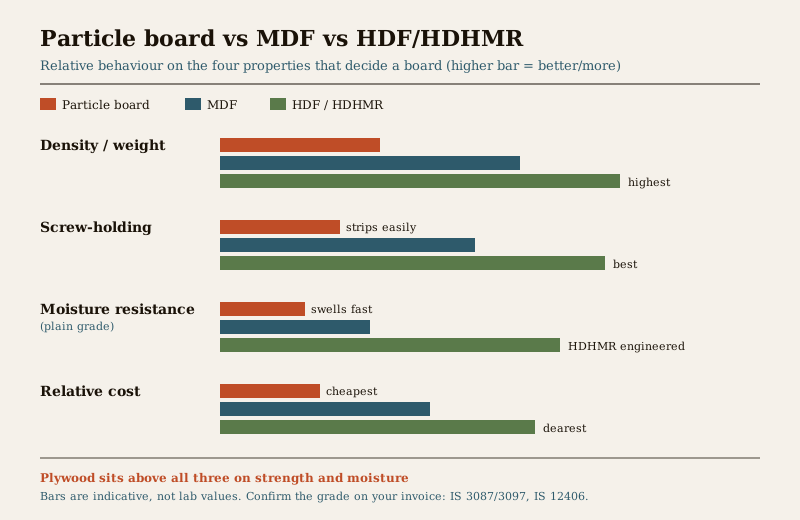
The quick mental model: particle board = chips, MDF = fibres, HDF/HDHMR = fibres pressed harder. Density rises left to right, and with it goes screw-holding, edge quality, moisture resistance, weight and cost.
The head-to-head that matters
Density and weight
Particle board is the lightest and least dense — good for keeping a flat-pack carton shippable, bad for everything structural. MDF is noticeably denser and heavier; a full MDF wardrobe shutter has real heft, which is why large MDF doors can sag on cheap hinges over time. HDF and HDHMR are denser still. Weight is not a virtue in itself, but here it tracks strength: the denser the board, the more it resists crushing, screw pull-out and edge damage.
Screw-holding — the joint that fails first
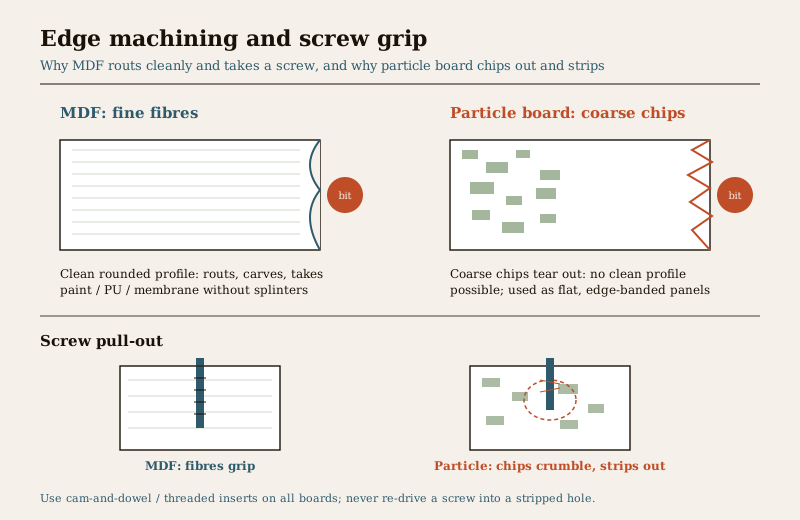
This is where cheap board furniture dies. A screw driven into particle board bites only the loose chips around it; load it, open and shut it a few thousand times, and the chips crumble and the screw strips out — the classic "wobbly wardrobe hinge" and the drawer that drops. MDF holds a screw better because the fibre core is uniform, but it still weakens badly if you drive a screw straight into a cut edge (end-grain equivalent), which can split or lose grip. HDF and HDHMR hold best of the three. The practical rule across all of them: use the right inserts and connectors (cam-and-dowel, threaded inserts, mini-fix), never over-tighten, and never rely on a screw re-driven into the same stripped hole. For carcasses that must carry real, repeated load — heavy wardrobes, tall bookcases, kitchen base units full of vessels — this single weakness is why we push you toward plywood.
Edge machining — MDF's home turf
Run a router along an MDF edge and you get a clean, dense profile that takes paint, PU or a membrane wrap beautifully — no visible grain, no voids. That is why nearly every membrane shutter, painted panel, moulded profile and CNC-carved jaali in Indian homes is MDF. Do the same on particle board and the coarse chips tear and chip out, leaving a ragged edge that must be banded and can never be routed into a profile. So particle board is almost always used as a flat panel, edge-banded on the four sides and faced with laminate — never shaped. If your design has curves, grooves, profiled shutters or a paint/PU finish, that is an MDF (or HDF) decision, not a particle-board one. Compare the finish routes in our laminate finishes guide and the PU vs laminate cost comparison.
Moisture and swelling — the big Indian problem
Here is the honest, uncomfortable truth for Indian homes: standard MDF and standard particle board both fail badly when they get wet. They drink water at any exposed or unsealed edge, swell irreversibly, lose all strength and never recover their shape — the swollen, crumbling kitchen shutter bottom and the wardrobe base that puffed up after one monsoon leak are both this. Between the two, plain particle board is usually the first to go because its coarse structure wicks water fast. In a country of high coastal humidity, monsoon damp, floor-mopping and the occasional silent plumbing leak, this matters enormously.
The mitigations, in order of seriousness:
- Get a moisture-resistant grade. Both boards come in MR versions (often marketed with a green tint). HDHMR is the properly moisture-engineered high-density option and the sensible choice for kitchens, vanities and wardrobes in damp cities.
- Seal every edge and cut-out — full edge-banding, sealed hinge borings and sink/tap cut-outs. Water finds the one unsealed millimetre.
- Keep board off the floor — legs, skirting gaps and stone/quartz around wet zones.
- For anything that will regularly meet water — under-sink units, bathroom vanities, utility-area storage — do not use plain MDF or particle board at all. Use HDHMR at minimum, and honestly, marine/BWP plywood is the safer long-life answer.
Formaldehyde and indoor air
Because these boards are held together with urea-formaldehyde resins, they can off-gas formaldehyde — an indoor-air-quality and health concern, especially in closed, air-conditioned Indian bedrooms and in homes with children or anyone with respiratory sensitivity. Boards are graded by emission class — E2 (highest, avoid), E1 (the sensible minimum), E0 (lowest). Insist on E1 or better in writing, look for CRI GreenPro / IGBC-type eco-certification where available, and let new board furniture air out before heavy use. Higher-density boards and better resins generally emit less; the cheapest unbranded chipboard is where the worst emitters hide.
Cost — the reason anyone chooses these
Cost is the whole appeal, and the ranking is consistent: particle board is cheapest, MDF sits above it, HDF/HDHMR above that, and plywood is dearest. The gaps are meaningful at scale — a full modular kitchen or a wall of wardrobes in particle board can be a fraction of the plywood price. But cost per sheet is the wrong number; cost per year of useful life is the right one, and on that measure the cheapest board is rarely the cheapest choice. Put your real numbers into the furniture cost calculator and price a bespoke piece with the custom furniture estimator before you decide.
The comparison at a glance
| Property | Particle board (IS 3087/3097) | MDF (IS 12406) | HDF / HDHMR |
|---|---|---|---|
| Made of | Coarse wood chips + resin | Fine wood fibres + resin | Fibres pressed to high density |
| Density / weight | Lowest, lightest | Medium, heavy | Highest, heaviest |
| Screw-holding | Weakest (strips easily) | Moderate | Best of the three |
| Edge machining | Chips out — flat panels only | Routs cleanly — profiles, carving | Routs cleanly, tougher edge |
| Smoothness for paint/PU | Poor | Excellent (paint/membrane's home) | Excellent |
| Moisture (plain grade) | Poorest — swells fast | Poor — swells | Better; HDHMR is moisture-engineered |
| Relative cost | Cheapest | Low-medium | Medium |
| Typical use | Flat-pack, budget modular carcass | Painted/membrane shutters, profiles | Kitchens, wardrobes, near-damp zones |
When to use each — and when to avoid it
| Board | Use it for | Avoid it for |
|---|---|---|
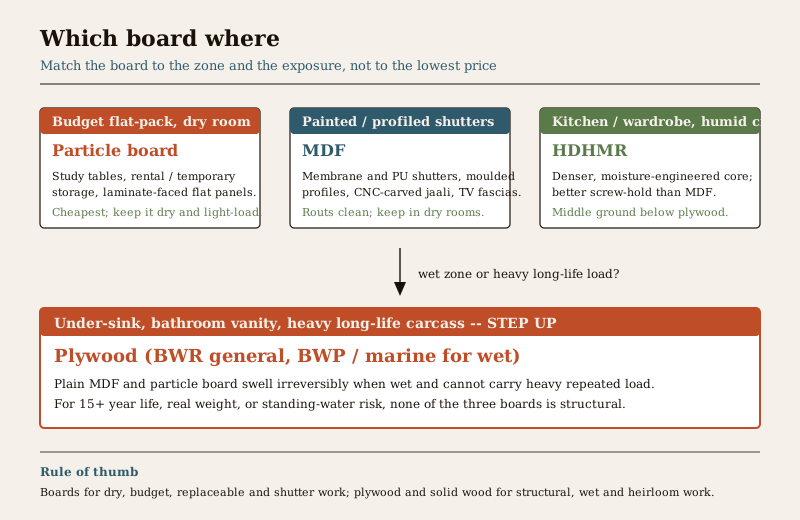
| Particle board | Low-cost flat-pack, study tables, temporary or rental furniture, light dry-area storage, laminate-faced flat panels | Anything load-bearing, hinged doors used daily, any wet or humid zone, profiled/painted shutters |
| MDF | Membrane and painted shutters, moulded/CNC-carved panels, decorative profiles, TV-unit fascias, wall panelling in dry rooms | Structural carcasses, heavy shelving, kitchens/bathrooms in plain grade, edge-screwed joints |
| HDF / HDHMR | Kitchen and wardrobe shutters and carcasses in humid cities, mild-damp zones, where you want better screw-hold than MDF without full plywood cost | True wet zones with standing water risk (still prefer BWP ply), long-life heavy-load carcasses |
| (Step up to) Plywood | Wet-area carcasses, heavy long-life wardrobes and kitchen base units, anything that must last 15+ years or carry real weight | Nothing here — it is the honest upgrade; see the plywood guides |
Lifespan, repairability and the upgrade line
Treated well and kept dry, laminate-faced MDF and particle board furniture will serve a bedroom or study for several years — perfectly reasonable for rentals, a first home, a child's room that will change anyway, or any piece you expect to replace. HDHMR stretches that meaningfully in damp conditions. But none of them is truly repairable: a swollen edge cannot be un-swollen, a stripped screw hole in chipboard rarely holds again, and a water-damaged panel is replaced, not mended. Solid wood and, to a lesser extent, plywood forgive; these boards do not.
So the upgrade line is really about exposure and expectation. Spend up to plywood — ideally BWR for general carcasses and BWP/marine for wet zones — the moment the piece must (a) carry heavy, repeated load, (b) live near water or in a very humid coastal city, or (c) last well over a decade. That is the clean handoff: engineered boards for dry, budget, replaceable and decorative-shutter work; plywood and solid wood for structural, wet and heirloom work. The complete plywood grades guide and the marine ply vs HDHMR vs MDF comparison draw that line in full.
How it connects
- This guide is one material chapter of the complete guide to furniture in India; read it alongside the broader engineered wood furniture guide.
- When these boards are not enough, step up via plywood furniture and solid wood furniture, and settle the wet-zone choice with marine ply vs HDHMR vs MDF and the complete plywood grades guide.
- For the surface over the board, see best laminate finishes for Indian homes and the PU finish vs laminate cost comparison.
- Browse the wider materials hub for how every furniture material behaves.
- Budget before you commit: the furniture cost calculator for ready pieces and the custom furniture estimator for bespoke; learn how carcasses actually go together in the furniture construction & detailing course.
Key takeaways
- Particle board = coarse chips, MDF = fine fibres, HDF/HDHMR = fibres pressed harder — density, screw-holding, edge quality, moisture resistance and cost all rise in that order.
- MDF owns finishes and profiles — it routs and carves cleanly for painted, membrane and moulded shutters; particle board chips out and is used only as flat, laminate-faced panels.
- Screw-holding is the weak joint — particle board strips easily, MDF is moderate, HDHMR is best; use proper inserts and never edge-screw cheap board.
- Moisture is the big Indian failure mode — plain MDF and particle board both swell irreversibly when wet; insist on MR/HDHMR grades near damp, seal every edge, and keep board off the floor.
- Formaldehyde matters — insist on E1 or better in writing, prefer eco-certified boards, and air out new pieces.
- Cost per year, not per sheet — particle board is cheapest, MDF low-medium, HDHMR medium; for heavy-load, long-life or wet-area work, step up to plywood — none of these boards is structural.
- Every figure here is indicative — confirm the grade against IS 3087/3097 (particle), IS 12406 (MDF), ask for E1 emission class, and get local quotes.
References
- IS 3087 / IS 3097 — particle boards of wood and other lignocellulosic materials (specification and test methods); named generally.
- IS 12406 — medium density fibreboard (MDF) for general purposes; named generally.
- IS 303 / IS 710 / IS 1734 — plywood grades (MR/BWR/BWP), marine plywood and plywood test methods, for the upgrade comparison; named generally.
- Formaldehyde emission classes E0 / E1 / E2 (CARB / EN 13986 context) — indoor-air-quality grading for wood-based panels; named generally.
- CRI GreenPro / IGBC (Indian Green Building Council) — eco-certification for low-emission, sustainable boards; named generally.
- Board manufacturer technical data sheets and your invoice/grade markings — the actual density, MR grade and emission class of the specific board supplied.
All densities, behaviour notes and cost bands here are indicative planning aids only; confirm the exact grade and standard on your invoice (IS 3087/3097, IS 12406), insist on an E1-or-better emission class in writing, use moisture-resistant grades or plywood near water, and get local quotes for cost.
Export this guide
Related Guides — Deep-dive reading
The Complete Guide to Furniture for Indian Homes (2026)
The start-here master guide for furnishing an Indian home — what furniture actually does, the five families of pieces, the decisions in the order you face them (space and needs, loose vs modular vs built-in, materials, size and layout, budget, buy, maintain), an honest read on plywood, humidity and termites, and where every choice hands off to the carpenter, the brand or the fixer.
FurnitureBathroom Vanity India: Floor-Standing vs Wall-Hung Units, Materials & Cost
The complete India-first guide to bathroom vanity units — floor-standing versus wall-hung (floating), the carcass materials that actually survive Indian bathroom humidity, counter tops and basin fixing, sizes, heights and honest ₹ costs.
BathroomsThe Design Decisions With the Biggest Cost Consequences
A cost-leverage map of Indian home interiors — the handful of decisions that swing your total budget the most, so you spend your attention where a single choice has an outsized rupee impact.
Cost & MoneyRelated Tools — Try Free
Material Comparison Sheet
India's interior material cheatsheet — plywood, finishes, hardware, countertops, paints, waterproofing.
Reference GuideModular Kitchen Budget Calculator
Live breakdown by running feet, countertop area, material tier and city — with wastage, design fee, GST.
Kitchen CalculatorDoor Cost Calculator
Estimate the all-in cost of a door — leaf, frame, hardware, fitting and GST — by type, material and size.
Door Calculator