

Imported vs Indian Furniture: Quality, Cost & What to Buy (2026)
An honest, non-nationalist comparison for Indian homes — what imported furniture really is, why it costs more, whether it is actually better made, how European-built pieces cope with Indian humidity, and where local wins on service, fit and footprint.
Walk into any furniture showroom in a metro and you will meet the same quiet pitch: the imported piece is the "premium" one, the Indian-made piece is the "budget" one. It is a tidy story that sells at a markup — and it is often wrong. Some imports are genuinely superb; plenty are mass-produced flat-pack that a good local carpenter would out-build for less. And a piece engineered for a dry European flat can quietly come apart in a Chennai monsoon. This guide cuts through the showroom framing so you can decide on the actual trade-offs — cost, build quality, climate fit, service and delivery — not on the flag on the label.
This is a buying-decision guide within the Studio Matrx Furniture hub. It pairs closely with the furniture buying guide, the custom vs ready-made comparison and the furniture cost guide — read those alongside this one.
Scope & how to read this. Every rupee figure here is an indicative band to help you compare and budget, not a quote — imports especially swing wildly with brand, exchange rate and duty, so get live quotes and check the landed cost. We help you weigh the choice; we do not endorse any brand or country of origin. For strength, safety and formaldehyde limits, look for pieces tested to the IS furniture standards and low-emission (E0 / E1) boards — the label's origin tells you nothing about that on its own.
First, what "imported" actually means
"Imported" is not one thing. It spans three very different tiers, and the showroom rarely tells you which one you are looking at.
- Mass-produced RTA / flat-pack (usually China or South-East Asia). Ready-to-assemble particle-board and MDF units — the bulk of "imported" volume. Efficient, consistent, cheap to make; quality ranges from decent to disposable. This is what most affordable imports actually are.
- European / Italian premium. Design-led pieces from Italy, Germany, Scandinavia and similar — strong engineering, refined finishes, distinctive design, and a price to match. This is the tier the "imports are better" story is really about.
- Brand-name and designer. Global marques and named designers where you pay substantially for the label, the design language and the guarantee — quality is usually high, but so is the premium over the make cost.
Lumping all three together as "imported = better" is the core mistake. A budget Chinese flat-pack and a hand-finished Italian cabinet share a customs form and nothing else.
And what "Indian-made" spans
Indian-made furniture is an equally wide spectrum — from a one-man workshop to an automated factory.
- Local carpenter / bespoke workshop. Built on site or in a small workshop, often in solid teak or sheesham, fitted exactly to your room. Quality tracks the carpenter's skill — the best rival anything imported; the weakest need supervision. This is the heart of bespoke furniture and custom work.
- Indian brands (retail). Homegrown labels offering ready-made ranges with warranties, delivery and service networks — a middle path between carpenter and import.
- Factory modular. Panel-based, machine-cut, laminate-finished production — the same manufacturing logic as imported flat-pack, but made and serviced locally.
The honest headline: quality lives on both sides of the border. The question is never "imported or Indian" in the abstract — it is "which specific piece, for what job, at what landed cost, with what service behind it."
Cost: why imports carry a structural premium
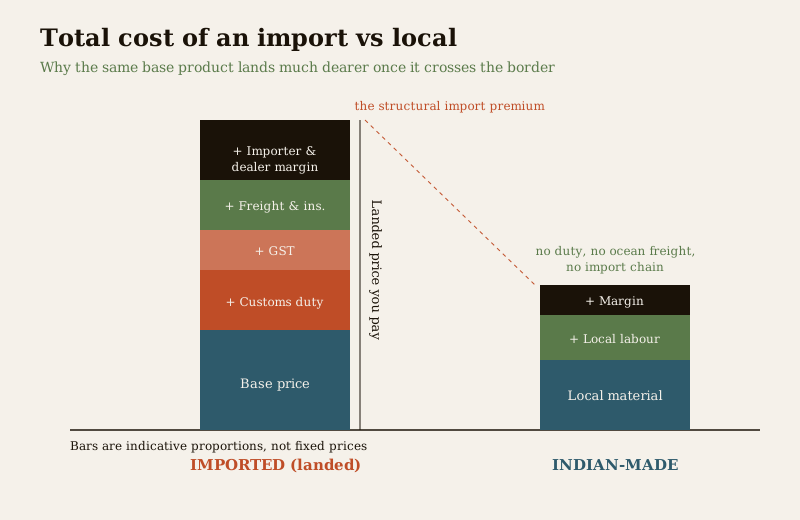
Set design aside for a moment and just follow the money. An imported piece has to clear several cost gates before it reaches your living room that a locally made piece never faces.
- Import duty + GST. Furniture attracts customs duty on the landed value, and GST on top — a stack that can add a large slice to the base cost before anyone has made a rupee of margin.
- Ocean / air freight and insurance. Bulky, low-density goods are expensive to ship; a wardrobe is mostly air, and you pay to move that air across an ocean.
- Importer + dealer margin. The import chain — importer, distributor, showroom — each takes a cut on an already-inflated landed cost, and margins compound multiplicatively, not additively.
- Exchange-rate exposure. A weaker rupee raises the base cost of every import overnight, independent of the product.
By contrast, Indian-made furniture is built on local labour, which remains comparatively affordable, and local timber and boards, which skip the freight and duty stack entirely. That is precisely why a custom carpenter or Indian brand is so often competitive — sometimes for a solid-wood piece against an imported particle-board one. Model your own numbers with the furniture cost calculator, and see the full band tables in the furniture cost guide.
Quality: the myth and the reality
Here is the part the showroom will not volunteer: imported does not mean better made. Country of origin is not a quality certificate.
- A lot of affordable imported furniture is RTA particle-board and MDF joined with cam-locks and dowels — perfectly fine for light, dry use, but no stronger than the same construction made in an Indian factory, and often weaker than solid Indian carpentry.
- Solid-wood Indian joinery — mortise-and-tenon teak, dovetailed drawers from a skilled workshop — can comfortably outlast an imported flat-pack unit that arrives in a box.
- The things that actually decide durability are material, joinery, hardware and finish — not the flag. A good hinge, a proper tenon and a moisture-rated board matter far more than where they were assembled.
- Look past the label to the evidence: board grade (BWR/BWP plywood to the IS plywood standards, MR-grade at minimum), emission class (E0/E1 for indoor air), tested strength to the IS furniture standards, and honest hardware brands.
Premium European pieces do often earn their reputation — tighter engineering, better edge-banding, superior finishes. But that is a property of that tier, not of "imported" as a category. Judge the piece in front of you against the checklist in the furniture buying guide, not against its passport.
The climate-fit argument — the one most people miss
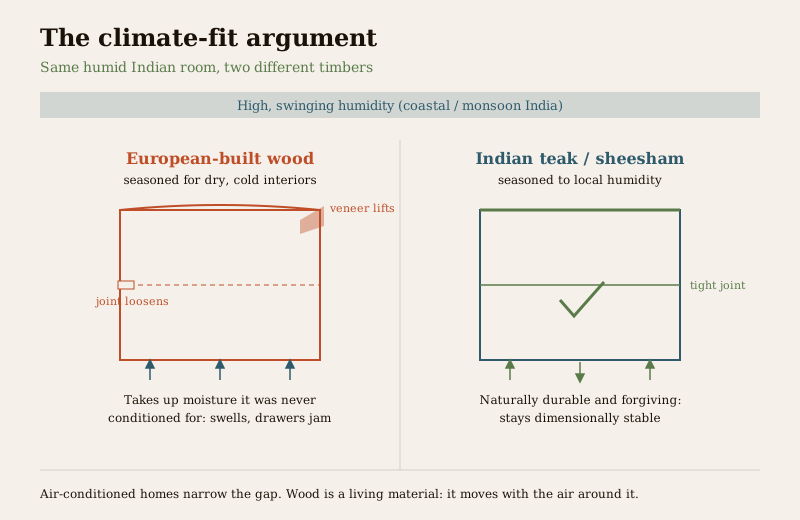
This is the argument that rarely makes it into a showroom, and it is one of the strongest in favour of local. Wood is a living material: it takes up and gives off moisture with the air around it, swelling and shrinking as it does.
- A piece designed and seasoned for a dry, cold European interior is acclimatised to low humidity. Bring it into coastal or monsoon India — high, swinging humidity for months — and the timber can swell, joints can loosen, veneers and edge-banding can lift, and drawers can jam. It was never conditioned for this air.
- Indian-made furniture is built in the climate it will live in. The timber is seasoned to local humidity, and traditional choices like teak and sheesham are naturally durable and dimensionally forgiving in heat and damp — which is exactly why they have furnished Indian homes for generations.
- Humidity is also the front line for termite and moisture damage. Local makers detail for it as a matter of course; an import may not. The termite and moisture protection guide covers what to insist on either way.
None of this says imports fail in India — well-made, properly finished pieces cope fine, and air-conditioned homes narrow the gap. But "built for a different climate" is a real risk to weigh, not showroom folklore.
Service, spares and warranty — the quiet dealbreaker
If one factor flips more real-world buying decisions than any other, it is this — and it almost never appears on the price tag.
| Concern | Imported furniture | Indian-made furniture |
|---|---|---|
| Repairs | Hard to find someone who knows the system; parts may be proprietary | Local carpenter or brand service can fix most things |
| Spare parts | Often must be ordered from abroad; long waits or unavailable | Hardware locally stocked and swappable |
| Warranty support | Honoured only if the importer stays in business and stocks parts | Direct maker/brand accountability, in your language and time zone |
| Modifications later | Re-cutting a factory-finished import is risky | Carpenter can alter, extend or refinish |
A jammed drawer runner or a failed hinge on an imported unit can mean weeks of waiting for a part from overseas — or a piece you simply cannot repair. On a locally made piece, the same fix is a phone call and a stocked part. Over a ten-year life, repairability is durability, and this is where local quietly wins for most households. The furniture repair and restoration guide shows just how much easier local pieces are to keep going.
Delivery and lead times
- Imports carry long, sometimes unpredictable lead times — ocean freight, customs clearance and inland transport stack up, and a delay at the port is out of your hands.
- Indian brands and factory modular typically deliver in a predictable window from stock or short production runs.
- Custom carpentry has a build time, but it is a known, local one you can track and chase — and there is no customs surprise.
If you are furnishing to a move-in date, the import lead time is a real planning risk to price in, not a footnote.
When imported is worth it — and when Indian wins
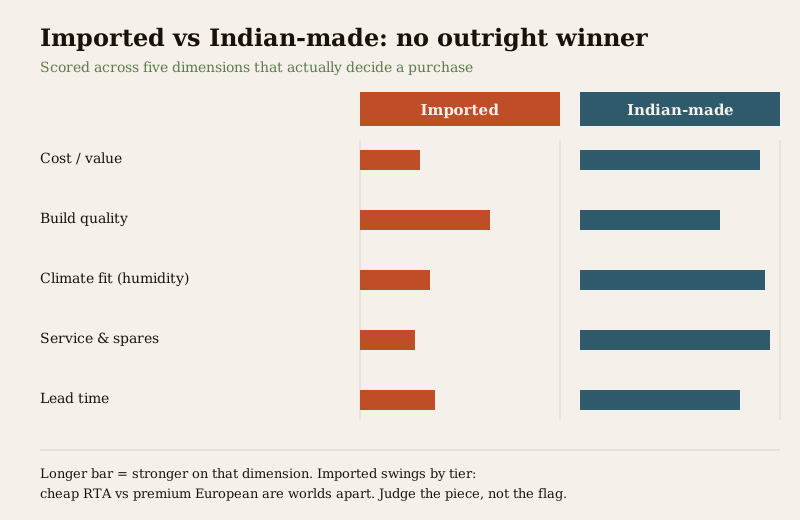
Neither side wins across the board. Match the choice to the job.
| Choose IMPORTED when... | Choose INDIAN-MADE when... |
|---|---|
| You want a specific design, brand or engineering that has no local equivalent | Value for money is the priority — local skips duty and freight |
| The premium European/designer tier's finish quality genuinely matters to you | You need an exact fit for a real room — bespoke beats a standard box |
| It is a statement or heirloom piece and cost is secondary | Long-term service, spares and easy repair matter to you |
| Your home is climate-controlled, softening the humidity risk | You live in high-humidity or coastal India and want acclimatised timber |
| You accept longer lead times and harder-to-source repairs | You want a lower footprint — local sourcing cuts transport emissions |
The sustainability angle deserves a line of its own: locally made furniture from responsibly sourced Indian timber generally carries a lower transport footprint than a piece shipped across an ocean — and supporting local artisans and the "Make in India" workshop economy keeps traditional joinery skills alive. That is a genuine, non-sentimental point in local's favour, alongside the cost and service ones.
How it connects
- Start at the complete furniture guide (the pillar), then use the furniture buying guide to inspect any specific piece — imported or not — on its real merits.
- Weigh the build routes in custom vs ready-made and understand what solid timber actually buys you in solid wood furniture and bespoke furniture explained.
- Put real numbers on the comparison with the furniture cost guide and the furniture cost calculator.
- Factor in the footprint with the sustainable furniture guide.
Key takeaways
- "Imported" is three different things — cheap mass RTA, premium European, and brand-name — so "imported = better" is a showroom myth, not a fact.
- Imports carry a structural cost premium: duty, GST, freight and stacked dealer margin. Local labour and timber make Indian-made — even custom solid wood — genuinely competitive.
- Quality lives on both sides. Judge material, joinery, hardware and finish, and look for the IS furniture standards and E0/E1 boards — not the country on the label.
- Climate fit is real. Furniture seasoned for dry Europe can struggle in Indian humidity; Indian-made teak and sheesham are acclimatised and forgiving.
- Service and spares are the quiet dealbreaker — imports can be near-impossible to repair or get parts for; local pieces are fixable with a phone call. Over a decade, repairability is durability.
- Imported wins for a specific design/brand or top-tier finish you cannot get locally, in a climate-controlled home. Indian wins on value, exact fit, service, humidity performance and a lower footprint.
References
- The IS furniture standards — furniture strength, stability and durability testing (named generally; look for tested compliance regardless of origin).
- IS 303 / IS 710 — plywood grades (MR / BWR / BWP) and IS 1734 plywood tests; IS 3087/3097 particle board; IS 12406 MDF; IS 1659 blockboard (board quality; named generally).
- Formaldehyde emission classes E0 / E1 / E2 (CARB / EN 13986 context) — indoor-air-quality guidance for engineered-wood furniture (named generally).
- CRI GreenPro / IGBC (Indian Green Building Council) — eco-certification context for lower-footprint furniture choices.
- Central Board of Indirect Taxes and Customs — customs duty and GST apply to imported furniture; confirm current rates and landed cost with your importer or a customs agent.
All rupee bands, duty and quality notes here are indicative planning aids only; import duty, GST and exchange rates change, so confirm the landed cost with live quotes, judge any piece by its material, joinery and tested standards rather than its country of origin, and buy from makers who can service and repair what they sell.
Export this guide
Related Guides — Deep-dive reading
The Complete Guide to Furniture for Indian Homes (2026)
The start-here master guide for furnishing an Indian home — what furniture actually does, the five families of pieces, the decisions in the order you face them (space and needs, loose vs modular vs built-in, materials, size and layout, budget, buy, maintain), an honest read on plywood, humidity and termites, and where every choice hands off to the carpenter, the brand or the fixer.
FurnitureImported vs Indian Doors: Worth the Premium? India 2026
A balanced guide to imported doors and hardware versus Make-in-India — price premium, quality reality, spare-parts risk and when each wins.
Home Doors & EntrancesThe Design Decisions With the Biggest Cost Consequences
A cost-leverage map of Indian home interiors — the handful of decisions that swing your total budget the most, so you spend your attention where a single choice has an outsized rupee impact.
Cost & MoneyRelated Tools — Try Free
Cross-Ventilation Analyzer
Estimate airflow and air changes per hour (ACH) from room size, window areas, layout, and local wind — with NBC 2016 Part 8 compliance check.
Ventilation CalculatorMaterial Decision Framework (M-Score)
Score 30+ Indian construction materials across cost, durability, climate fit, maintenance, and sustainability.
MaterialsBefore vs After — Cost Reality Check
Compare what you expected to pay vs what you actually paid, category by category.
Reality Check