
Plywood Furniture in India: Grades, Brands, Cost & How to Choose (2026)
The practical buyer's guide to the workhorse material of Indian carpentry and modular — why plywood is the default for good furniture, how MR, BWR and marine grades map to your rooms, which thickness goes where, how to read an ISI mark and dodge fakes, and how it pairs with laminate and veneer.
Walk into any Indian carpenter's shop or modular factory and one material dominates the racks: plywood. It is the quiet workhorse behind most good furniture in the country — the carcass of your wardrobe, the box of your kitchen, the frame under your bed, the shell of your TV unit. When someone says a piece is "made in ply," they usually mean it is built to last, and that reputation is earned. Plywood is stronger, holds screws better and shrugs off humidity far more reliably than the cheaper engineered boards it is often confused with.
But "plywood" is not one thing. It is a family of grades, cores and thicknesses, and the gap between a genuine boiling-water-proof sheet and a light, hollow, mis-stamped fake sold at the same price is enormous. This guide is the furniture buyer's tour of that family: what to choose, where each grade belongs, and how not to get cheated. It sits under the complete guide to furniture and pairs with the other material guides — solid wood, engineered wood and MDF vs particle board. For the deep grade science and the marine-versus-alternatives argument, we cross-link rather than repeat: the complete guide to plywood grades and marine ply vs HDHMR vs MDF.
Scope & how to read this. This is a furniture-focused buyer's guide, not a fabrication manual. Grades are named against the Indian Standards generally — IS 303 for MR and BWR plywood, IS 710 for BWP marine grade, IS 1734 for the test methods — but confirm exact specs and licences against BIS. Every rupee figure is an indicative band per square foot to help you compare quotes, never a fixed price: get local quotes and use the furniture cost calculator and custom furniture estimator. The cutting, joinery and edge-banding are the carpenter's craft — this guide helps you specify and vet, not do their job. Treat formaldehyde emission (aim for E1 or lower) and child anti-tip safety as non-negotiable whatever the board.
Why plywood is the default for good furniture
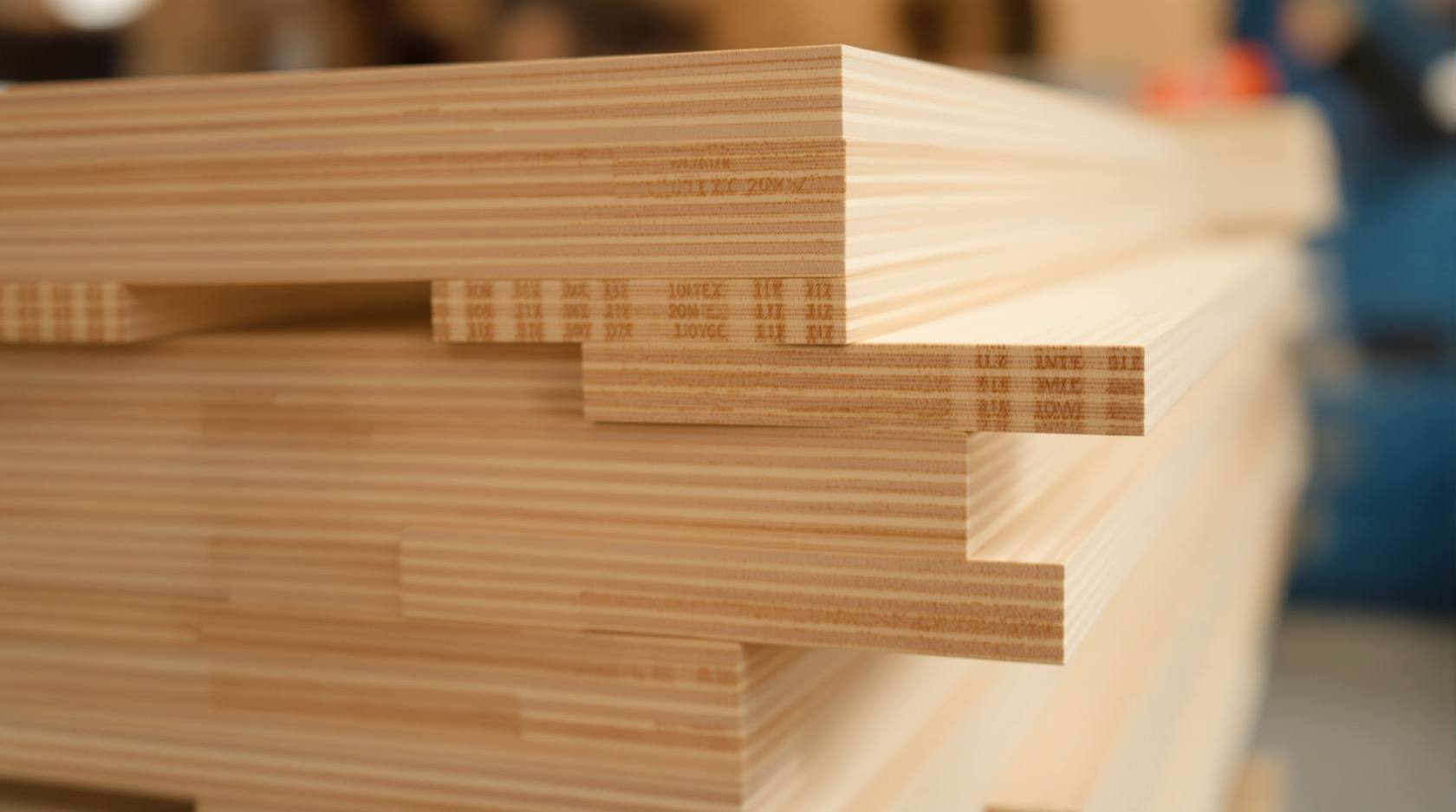
Plywood earns its place because of how it is made. Thin sheets of wood veneer are glued in layers with the grain of each ply turned at right angles to the next, always in an odd number, around a central core. That simple cross-lamination is the whole trick, and it gives plywood four properties that loose boards cannot match.
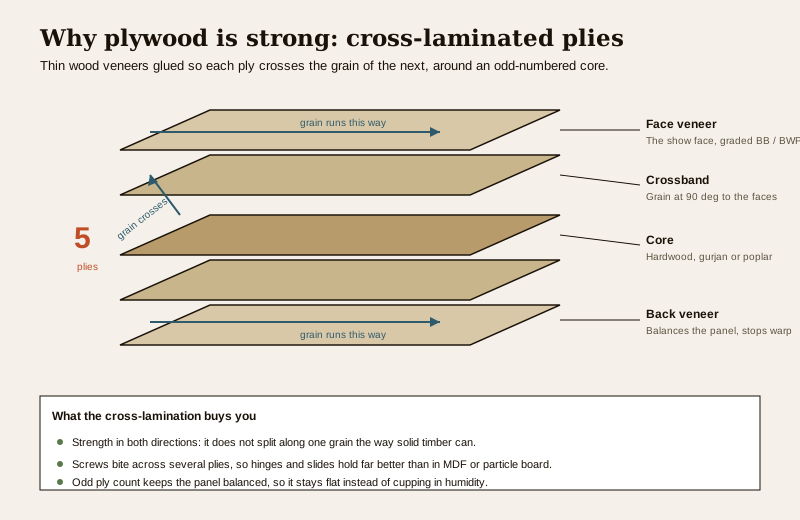
- Strength in both directions. Solid timber is strong along its grain and splits across it. Because plywood alternates the grain, it resists bending and cracking whichever way you load it — a wardrobe shelf spanning three feet does not sag or split.
- Screw-holding power. This is the one that matters most for furniture. Hinges, drawer slides, handles and wall brackets all rely on screws that bite and hold. Screws in plywood grip across several plies; in particle board or MDF they pull out of a crumbly core far sooner. A kitchen shutter opened ten times a day for fifteen years needs the hinge to stay put.
- Moisture resistance. With the right grade and glue, plywood tolerates the humidity, monsoon damp and occasional splash that define most Indian homes without swelling into a ruined lump the way particle board does.
- Durability and repairability. A good ply carcass outlives its laminate, can be re-surfaced, and takes a knock without disintegrating. It is the reason carpenters and homeowners keep coming back to it.
For the fuller material comparison — where ply beats MDF and HDHMR and where it does not — see marine ply vs HDHMR vs MDF and engineered wood furniture.
Grades: MR, BWR and BWP marine — and where each belongs
The single most important plywood decision is the grade, because the grade is really a statement about which glue holds the plies together and therefore how much moisture the board survives. Get this right and everything else is detail.
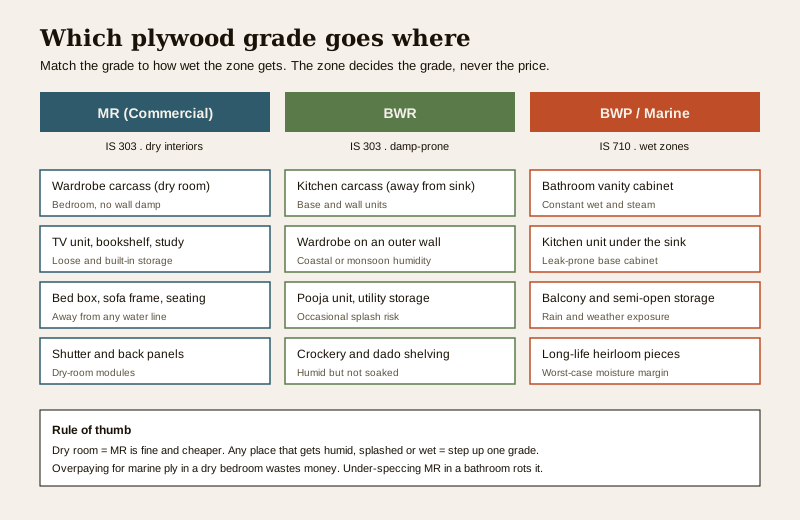
- MR — Moisture Resistant (IS 303, commercial grade). Bonded with urea-formaldehyde resin. It tolerates humid air, not water. This is the everyday interior grade for dry zones. Despite the name, MR is not waterproof — a leak or a splash will eventually delaminate it.
- BWR — Boiling Water Resistant (IS 303). Bonded with a phenolic resin that survives humidity and occasional water contact. The sensible middle grade for damp-prone zones and coastal or heavy-monsoon homes.
- BWP / Marine (IS 710). Boiling Water Proof, made to the stricter marine standard with fully phenolic bonding and better core timber. This is the grade for genuinely wet zones and worst-case moisture margin.
The trap homeowners fall into runs both ways. Buying marine ply for a dry bedroom wardrobe wastes real money; using MR under a kitchen sink or in a bathroom vanity rots it within a few years. Match the grade to the wetness of the zone, not to the size of your ego or your budget.
| Grade | Standard | Best for | Avoid for |
|---|---|---|---|
| MR (commercial) | IS 303 | Dry wardrobes, TV units, beds, bookshelves, seating frames, shutters in dry rooms | Kitchen sink units, bathrooms, balconies |
| BWR | IS 303 | Kitchen carcasses away from the sink, wardrobes on outer/damp walls, pooja and utility storage, coastal homes | Constant standing water |
| BWP / Marine | IS 710 | Bathroom vanities, under-sink kitchen units, semi-open and balcony storage, heirloom pieces | Nothing, except the cost sting in a dry room |
A practical rule for a typical apartment: MR for bedroom and living carcasses, BWR as the default for the kitchen body, and BWP only where water actually sits — under the sink and in the bathroom vanity. For the deeper science on resins, cyclic tests and grade certification, read the complete guide to plywood grades.
Thickness: which millimetre goes where
Grade decides moisture; thickness decides strength and how flat a panel stays. Indian plywood comes in standard thicknesses, and matching them to the furniture part keeps cost sane without inviting sag.
| Thickness | Typical use | Why |
|---|---|---|
| 6 mm | Wardrobe and cabinet back panels, drawer bottoms | Only closes the box; carries no real load |
| 9-12 mm | Shutters, light shelves, drawer sides, sliding shutters | Stiff enough for doors without adding needless weight |
| 18-19 mm | Carcass sides, tops, bottoms, main load-bearing shelves | The structural workhorse; holds screws and spans without sagging |
| 25 mm | Long unsupported shelves, heavy tabletops, worktop substrates | Extra depth to resist sag over a wide span |
The most common cost mistake is over-thickening the back or under-thickening the shelf. A 6 mm back is fine; an 18 mm carcass is standard; a wide bookshelf shelf that will hold a row of heavy books wants 25 mm or a mid-support, or it bows within a year. When you brief a carpenter, specifying thickness by part is how you control both cost and quality.
Core types and calibrated boards
Below the grade sits the core — the inner plies that make up most of the thickness. Core quality is where a lot of hidden cheating happens.
- Hardwood core. The best and most common quality core, using dense hardwood species. Heavy, strong, excellent screw-hold. Genuine "100 percent hardwood" ply is what you want for furniture that carries load.
- Gurjan / Keruing core. Gurjan is a prized dense hardwood, and imported gurjan-faced ply is marketed as premium. Real gurjan is excellent; the label is also heavily faked, so treat "gurjan" claims with the same suspicion as any premium tag and verify by weight and edge.
- Poplar core. Lighter, softer, cheaper. Fine for lightweight, non-structural or export-style furniture, but it holds screws less well and dents more easily. Acceptable for a light shutter, weak for a loaded carcass.
- Calibrated plywood. Ply that is sanded to a precise, uniform thickness so that laminate and machine-cut joinery sit flat. Modular kitchens and factory furniture want calibrated boards; a bowed, uneven sheet ruins a laminate finish.
You will also hear about HDHMR (high-density high-moisture-resistance board) and MDF pitched as plywood alternatives. They are engineered boards, not plywood, with different strengths — smoother for paint and routing, weaker at screw-hold and edge-swelling. Do not let a salesperson blur the line; the honest comparison lives in marine ply vs HDHMR vs MDF and MDF vs particle board furniture.
How to read an ISI mark and dodge fakes
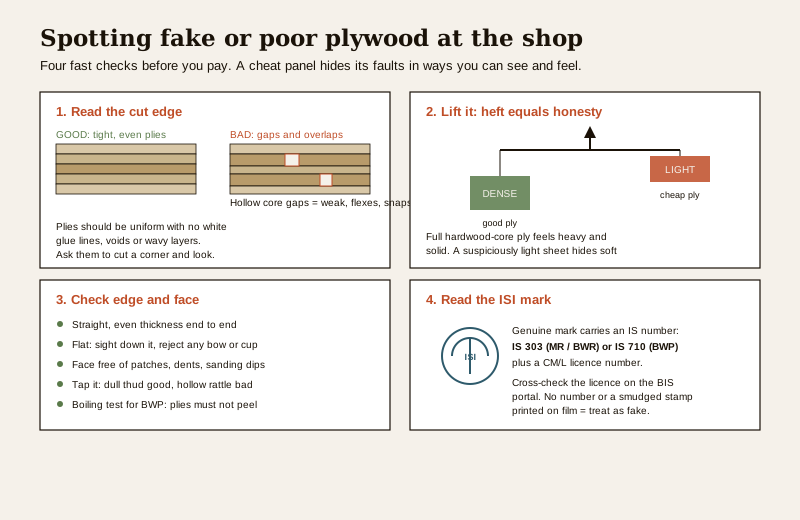
This is where money is lost. The plywood market is notorious for mis-graded, hollow-cored and falsely stamped sheets sold at genuine-grade prices. You do not need to be an expert to catch most of it — five checks at the shop weed out the worst.
| Check | What good looks like | Red flag |
|---|---|---|
| Cut edge | Tight, even, uniform plies; no white glue voids | Gaps, overlaps or hollow pockets between plies |
| Weight | Heavy and dense for its size (full hardwood core) | Suspiciously light — soft or gappy core |
| Flatness | Dead flat when you sight down the sheet | Visible bow or cup; will never sit true |
| Sound | Dull, solid thud when tapped | Hollow rattle signals voids |
| ISI mark | Clear ISI monogram with the IS number (303 or 710) and a CM/L licence number | No number, smudged, or printed on film |
Two things worth insisting on. First, ask them to cut a corner and look at the fresh edge — good ply shows clean, uniform, void-free layers, while a cheat sheet reveals gaps and patched core. Second, for anything sold as BWP / marine, the real test is the boiling test: a genuine IS 710 board can be boiled for hours and its plies will not separate, whereas a fake delaminates. A reputable dealer will let you take a sample for this; refusal is itself a red flag. Always cross-check the CM/L licence number on the BIS portal — the ISI mark means nothing if the licence behind it does not exist.
Grade vs price — the honest reality
Plywood is priced per square foot, and the bands below are indicative for 2026 to help you sanity-check quotes, not fixed prices. Costs vary by brand, core, region and market swings, so always get local quotes.
| Grade / type | Relative price band | Reality check |
|---|---|---|
| MR commercial | Lowest | Fine for dry zones; the value default |
| BWR | Medium | Worth the step up for kitchens and humid homes |
| BWP / marine (IS 710) | Highest | Pay it only where water sits, not everywhere |
| Premium gurjan-faced | Top of the range | Genuine article is excellent; verify before paying the premium |
The honest takeaway: grade should follow the room, not the wallet. A whole-house upgrade to marine ply is usually money misspent — put the premium grade where it earns its keep (kitchen, bathroom, balcony) and use MR where the air is dry. That single discipline saves more than any brand-shopping.
Plywood plus finish: laminate and veneer
Plywood is the structure, not the show surface. Bare ply is almost never the final face; it is clad. The two mainstream choices are laminate and veneer, and the choice changes the look, the cost and the upkeep — not the grade you need underneath.
- Laminate is a printed, wear-resistant sheet pressed onto the ply. Tough, wipe-clean, huge range of colours and textures, forgiving in Indian kitchens and kids' rooms. The go-to for most modular work. See best laminate finishes for Indian homes and estimate sheets with the laminate sheet calculator.
- Veneer is a thin slice of real wood glued on and then polished, giving a natural timber grain. More luxurious, more delicate, needs periodic care — best on statement pieces rather than hard-use surfaces.
Whichever you pick, the ply grade underneath is still chosen by the room, and the edge-banding matters: unsealed ply edges soak up moisture, so insist on proper edge-banding on every exposed edge, especially in the kitchen and bath.
How it connects
- Start at the complete guide to furniture, then compare materials across solid wood, engineered wood and MDF vs particle board.
- Go deep on the grade science in the complete guide to plywood grades and settle the board debate with marine ply vs HDHMR vs MDF.
- Choose the show surface with best laminate finishes for Indian homes and the materials hub.
- Apply it: plan a kitchen with the modular kitchen hub, and budget with the custom furniture estimator and laminate sheet calculator.
- Learning the craft? The furniture construction and detailing course covers how these boards are actually joined.
Key takeaways
- Plywood is the default for good furniture because cross-lamination gives it strength in both directions, superior screw-hold, moisture resistance and durability — the traits a carcass, hinge and slide depend on.
- Choose the grade by the room's wetness: MR (IS 303) for dry zones, BWR for humid and coastal homes, BWP marine (IS 710) only where water sits. Marine ply everywhere wastes money; MR in a bathroom rots.
- Match thickness to the part — 6 mm backs, 12 mm shutters, 18 mm carcasses, 25 mm for long shelves and worktops.
- Insist on a full hardwood or genuine gurjan core and calibrated boards for laminate work; verify claims by weight and edge, not by the label.
- Catch fakes with five checks — cut edge, weight, flatness, tap-sound and a genuine ISI mark — and cross-check the CM/L licence on the BIS portal; boil-test anything sold as marine.
- Plywood is the structure; laminate or veneer is the finish — pick the finish for look and upkeep, and edge-band every exposed edge.
- Every rupee band here is indicative — get local quotes, confirm grades against IS codes, and aim for E1 or lower formaldehyde emission.
References
- IS 303 — specification for plywood for general purposes, covering MR and BWR grades (named generally).
- IS 710 — specification for marine plywood, the BWP boiling-water-proof grade (named generally).
- IS 1734 — methods of test for plywood (delamination, boiling and related tests; named generally).
- BIS / ISI certification scheme and CM/L licence verification — the authority for genuine grade marking.
- Formaldehyde emission classes E0 / E1 / E2 (EN 13986 / CARB context) — named generally for indoor-air-quality guidance.
- Local plywood dealers and carpenters, and manufacturer specification sheets — for current per-square-foot pricing and core disclosure.
All grades, thicknesses, core notes and cost bands here are indicative planning aids only; confirm the governing values against the relevant IS codes and BIS certification, get local quotes for price, verify any ISI mark and licence before you buy, and treat formaldehyde emission and child anti-tip safety as non-negotiable.
Export this guide
Related Guides — Deep-dive reading
The Complete Guide to Furniture for Indian Homes (2026)
The start-here master guide for furnishing an Indian home — what furniture actually does, the five families of pieces, the decisions in the order you face them (space and needs, loose vs modular vs built-in, materials, size and layout, budget, buy, maintain), an honest read on plywood, humidity and termites, and where every choice hands off to the carpenter, the brand or the fixer.
FurnitureHow to Choose Bathroom Furniture in India: The Buyer's Guide to Vanities, Mirror Cabinets & Storage
A buyer's decision guide to bathroom furniture in India — the one check that matters most (moisture-proof material), wall-hung versus floor, soft-close hardware, counter tops, ready-made versus custom, good/better/best ₹ tiers, warranty, and how to spot MDF sold as ply.
BathroomsHow to Choose a Wash Basin in India: Mount Type, Size, Tap Holes & Budget (2026 Buyer's Guide)
A buyer's decision guide to picking the right wash basin — matching the mount type to your vanity and space, sizing it to the room, getting the tap-hole config right for your faucet, judging material and durability, checking what's in the box, good/better/best rupee tiers, the IS 2556 vitreous-china mark, and how to spot seconds, hairline cracks and warranty traps.
BathroomsRelated Tools — Try Free
Apartment Interior Planning Checklist
51-item checklist across structural, ceiling, lighting, furniture, storage, electrical, kitchen, bathroom.
ChecklistBefore vs After — Cost Reality Check
Compare what you expected to pay vs what you actually paid, category by category.
Reality CheckFull-Room BOQ — Living, Bedroom, Kitchen, Bath
Room-wise BOQ across living, bedrooms, kitchen, utility, and bathrooms with line-item pricing.
Full-Room BOQ