
Upholstered Furniture in India: Foam, Fabric, Frames & Care (2026)
The anatomy-and-buying guide to sofas, beds, dining chairs, ottomans and recliners — the four layers that decide comfort and lifespan (frame, suspension, foam and fabric), how to read foam density, which covers survive Indian heat, kids and pets, and the quality checks that tell a ten-year piece from a two-year one.
A sofa is the one piece of furniture your household touches every single day, and the one most people buy almost blind — judging it by the fabric they can see and the fifteen seconds they sit on it in a showroom. Yet the fabric is the least of it. What decides whether your sofa is still comfortable and square in ten years, or sagging and creaking in two, is everything you cannot see: the frame under the foam, the springs under the cushion, and the grade of the foam itself. Upholstered furniture is really four materials stacked into one object, and cost, comfort and lifespan are set independently by each layer.
This guide teaches you to read those four layers — frame, suspension, foam and cover — so you can tell a piece built to last from one dressed to sell, and brief a maker or shortlist a brand with confidence. It covers sofas above all, but the same anatomy runs through upholstered beds and headboards, dining and accent chairs, ottomans, benches and recliners. It sits alongside the material siblings on solid wood furniture and cane and rattan furniture, and under the complete guide to furniture in India.
Scope & how to read this. Every foam grade, rub count, dimension and cost band here is typical and indicative, meant to help you plan, budget and brief a maker or shop — not a spec sheet. Actual density, fill and fabric vary by brand and batch; ask for the numbers in writing and sit on the actual piece. Foam density and fabric durability standards are named generally (the IS furniture and foam standards, the Martindale and rub-count test idea, BIFMA-type strength testing) without fabricated clause numbers or firm prices. Costs are relative bands — always get local quotes. Where a claim matters to your household — child-safe recliner mechanisms, flame behaviour, foam off-gassing (VOC) in a closed Indian bedroom — treat the maker's and the standard's word as the authority, not this page.
Upholstery is four materials in one
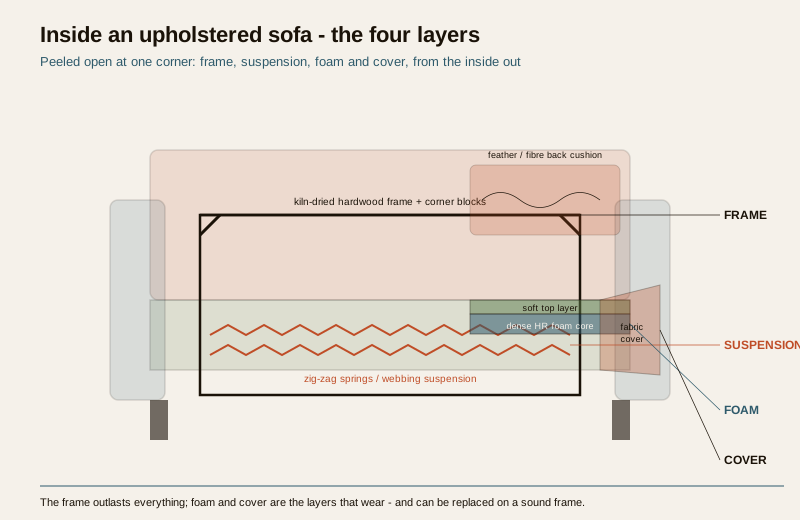
Peel a sofa apart and you find a stack, each layer doing one job. Understand the stack and the whole buying decision falls into place.
| Layer | What it is | What it decides | Lasts |
|---|---|---|---|
| Frame | The hidden skeleton — hardwood, ply or metal | Structural life, whether it stays square | 10-25 yrs if good |
| Suspension | Webbing or springs spanning the frame | Bounce, support, how the seat "gives" | 8-20 yrs |
| Foam & fill | PU / HR foam, memory foam, feather, fibre | Comfort and how long it holds shape | 2-12 yrs |
| Cover | The fabric or leather you see and touch | Look, feel, cleanability, wear | 5-15 yrs, re-coverable |
The important insight: these age at different rates. A good frame outlives three sets of foam; a cover wears out while the frame is barely middle-aged. That is why reupholstery is a real option on a well-framed piece and a waste of money on a badly-framed one — a theme we return to at the end.
The frame — the thing that actually lasts
The frame is the piece. Everything else is replaceable; a broken or warped frame is the end. In roughly descending order of quality:
- Kiln-dried solid hardwood (seasoned sheesham, sal, teak, or imported beech/ash) — the gold standard. "Kiln-dried" matters as much as "hardwood": timber that is not properly seasoned keeps drying in service, then twists, cracks and lets joints loosen. In Indian humidity swings this is the difference between a frame that stays square and one that develops a wobble and a squeak.
- Engineered ply frame (thick BWR/BWP marine-grade plywood, per the plywood grades system) — excellent and often better than low-grade solid wood because good ply does not warp or split. A quality plywood frame is nothing to apologise for. Avoid frames of thin particle board or MDF, which crumble at screw points and cannot take a sofa's flexing loads — see MDF vs particle board.
- Metal frame — common in recliners, sofa-cum-beds and contemporary designs; strong, slim, but can be noisy and, if under-gauged, can flex. Covered in metal furniture.
What separates a good frame from a cheap one is the joinery, not the timber alone. Look for corner blocks glued and screwed (not stapled) into every corner, dowelled or mortise-and-tenon joints rather than nails, and glue that reinforces every joint. Push down hard on an arm and a corner: a good frame does not creak, rack or shift. That five-second test tells you more than the price tag.
The suspension — how the seat springs
Between the frame and the foam is the suspension system that spans the open seat and gives it support and bounce. This is the layer buyers never ask about and it makes or breaks long-term comfort.
| Suspension | How it works | Feel | Longevity |
|---|---|---|---|
| Elastic / rubber webbing | Woven or parallel stretch straps | Softer, more "give" | Good; straps can loosen over years |
| Zig-zag (sinuous / no-sag) springs | S-shaped steel wires front to back | Firm, even, supportive | Very good; the mainstream default |
| Pocket / coil springs | Individually pocketed coils, like a mattress | Plushest, most responsive | Excellent; heaviest and dearest |
| Solid ply deck + foam only | A plywood platform, no springs | Firm, flat, no bounce | Fine for firm/minimal designs |
For most homes, zig-zag springs or good webbing over a hardwood frame is the sweet spot. Pocket springs are a genuine luxury upgrade; a bare ply deck with only foam is acceptable in deliberately firm modern sofas but feels hard and dead if the foam above it is thin. Ask which system a sofa uses — a shop that cannot tell you is a warning in itself.
The foam and fill — where cheap furniture quietly dies
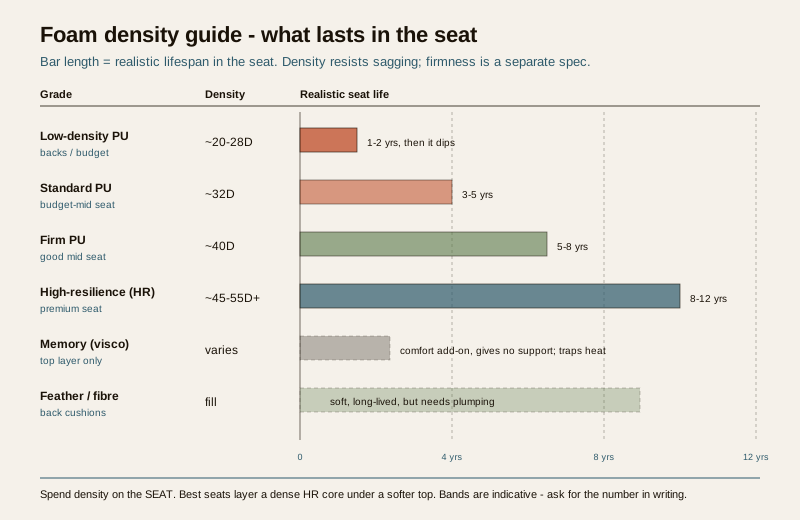
This is where budget sofas are hollowed out to hit a price, and where you must be most alert. Foam is graded by density — the weight of a cubic block, written as "D" (for example 32D means 32 kg per cubic metre). Density is not the same as firmness: density tracks how much material is packed in and therefore how long the foam resists sagging, while firmness (hardness) is a separate spec. A dense foam can be soft; a light foam can feel firm for a month and then collapse.
Cheap sofas use low-density PU foam (below ~28-30D) in the seat. It feels fine in the showroom and for a few months, then compresses permanently — the sag, dip and "bottoming out" that make a two-year-old sofa feel a decade old. Paying for density in the seat is the single highest-value upgrade in the whole piece.
| Foam / fill | Typical density | Best for | Feel | Realistic life in the seat |
|---|---|---|---|---|
| Low-density PU | ~20-28D | Backs, budget builds | Soft, quick to sag | 1-2 yrs before it dips |
| Standard PU | ~32D | Budget-to-mid seats | Medium, decent | 3-5 yrs |
| Firm PU | ~40D | Good mid-range seats | Firm, supportive | 5-8 yrs |
| High-resilience (HR) foam | ~45-55D+ | Premium seats | Springy, recovers fast | 8-12 yrs |
| Memory (visco) foam | Varies | A comfort top layer only | Slow, moulding, warm | Add-on, not support |
| Feather / down + fibre | n/a (fill) | Back cushions, plush look | Soft, needs plumping | Long, but goes flat between plumps |
A few honest rules for India:
- Seat vs back should differ. A well-built seat uses a firmer, denser foam (40D or HR) for support; the back can be softer PU, or feather-and-fibre for a relaxed lean. A sofa that uses the same soft foam everywhere sags where you sit.
- Layered is better than single-block. The best seats stack a dense HR core (support) under a softer top layer (comfort), sometimes with a thin memory-foam or fibre wrap. One uniform block is either too hard or too quick to sag.
- Memory foam is a topping, not a base. It moulds and relieves pressure but gives no support and traps heat — a real drawback in a warm, humid Indian living room. Never let it be the whole cushion.
- Foam off-gasses. New foam releases a chemical smell (VOCs) for days to weeks; air the piece well, especially in a closed bedroom, and prefer makers who name a lower-emission or CertiPUR-type foam if indoor-air-quality matters to you.
For a first cut at how much foam and fabric a given piece needs — useful when you commission a custom sofa or re-cover an old one — the fabric and foam calculator turns dimensions into indicative material quantities.
The cover — choosing a fabric for India
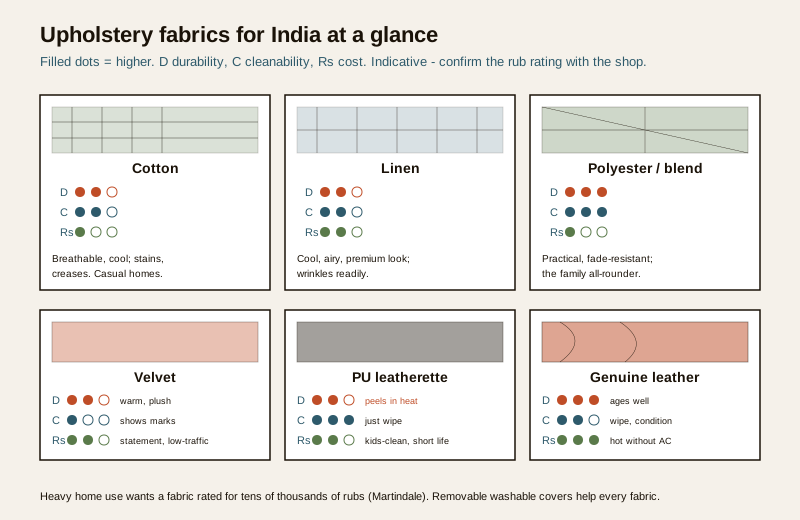
The cover is the layer you live with by hand and eye, and the one most abused by Indian realities: heat, humidity, dust, spilled chai, kids and pets. Fabric durability is measured generally by a rub test (the Martindale or double-rub count) — the number of back-and-forth rubs a fabric survives before it wears through. As a rough guide, heavy domestic use wants a fabric rated for tens of thousands of rubs; ask the shop where a fabric sits on that scale rather than trusting the look.
| Cover | Durability | Cleanability | Best for | Feel & climate note |
|---|---|---|---|---|
| Cotton | Medium | Fair; stains, may shrink | Casual, breathable homes | Soft, cool, breathable; creases |
| Linen | Medium | Fair; stains, wrinkles | Relaxed premium look | Cool and airy; wrinkles readily |
| Polyester / poly-blend | High | Good; wipes, resists fade | Everyday family sofas | Warmer to sit on; very practical |
| Chenille | Medium-high | Fair-good | Soft, cosy family rooms | Plush and warm; can flatten |
| Velvet | Medium | Poor-fair; needs care | Statement, low-traffic | Luxurious; shows marks, warm |
| PU leatherette | Medium | Excellent; just wipe | Kids, pets, easy-clean | Peels and cracks in a few years in heat |
| PVC rexine | Low-medium | Excellent; wipe | Budget wipe-clean | Stiff, hot, sticky in humidity |
| Genuine leather | Very high | Good; wipe, condition | Long-term, premium | Ages beautifully; hot without AC, costly |
Reading the table for Indian homes:
- Best all-round family pick: a good polyester or poly-blend weave — practical, fade-resistant, forgiving, and increasingly available with a factory stain-guard. Chenille is a soft, cosy cousin.
- Kids and pets: wipe-clean surfaces win, but be clear-eyed. PU leatherette looks like leather and cleans beautifully, but in Indian heat and humidity it peels, cracks and flakes within a few years — treat it as a medium-term cover, not a lifetime one. Performance/stain-resistant woven fabrics often serve a pet household better than cheap faux leather.
- Comfort in heat: cotton, linen and cloth weaves breathe and stay cooler to sit on; leather and vinyl get hot and sticky without air-conditioning. In a non-AC home, breathable cloth is a comfort decision, not just a look.
- Genuine leather is the durability and ageing champion and the priciest; it rewards a home that will keep the sofa a decade and can condition it, and it sits hot in a warm room without a fan or AC.
Removable covers, stains and everyday care
Two features quietly decide how well a sofa lives with a real household:
- Removable, washable covers. A sofa whose seat and back covers zip off and machine-wash (or dry-clean) is transformed for a home with children or pets — a spill becomes a wash, not a stain for life. Check that zips are hidden and sturdy and that covers are cut to go back on cleanly. Even where full covers are not removable, loose scatter cushions with washable covers help.
- Factory stain treatment. Many mid and upper fabrics come with a fluorocarbon or nano stain-guard that makes liquids bead and wipe off. It is worth having, but it is not armour — blot spills immediately, never rub, and reapply the treatment every few years as it wears.
Beyond that, the everyday basics: vacuum crumbs and dust weekly so grit does not abrade the weave; rotate and plump loose cushions so they wear and settle evenly; keep the sofa out of direct sunlight, which fades every fabric and hardens leather; and deal with a spill in the first minute. Deeper cleaning, spot-treatment recipes and fabric-by-fabric maintenance are a subject of their own and get a dedicated care guide rather than a rushed paragraph here.
Quality checks before you buy
You can judge most of a piece in the showroom in two minutes:
- Rock the frame. Grip an arm and the opposite corner and push. A quality frame stays dead solid and silent; creak, flex or racking means weak joinery.
- Sit, then sit again in an hour. Feel for even support and no "bottoming out" to a hard base. If you can, ask to press hard into the seat and watch it spring back — dense foam recovers fast, cheap foam stays dented.
- Ask the four numbers. Frame material (and "is it kiln-dried?"), suspension type, seat foam density, and the fabric's rub rating. A confident, specific answer signals a serious maker; a vague one signals a piece dressed to sell.
- Check the tailoring. Straight, even seams; patterns matched across cushions; tight, wrinkle-free upholstery at the corners; zips that run smoothly. Sloppy sewing usually rides on sloppy build.
- Look underneath. Lift a corner or peek beneath: you want to see webbing or springs and a proper dust cover, not a stapled cardboard base.
- Confirm the warranty split. Good makers warrant the frame far longer (often a decade or more) than the foam and fabric — a sign they know which layer lasts.
Reupholster or replace?
Because the layers age at different rates, an old sofa is often worth saving. The rule is simple: if the frame is sound, reupholster; if the frame is gone, replace. A well-framed piece whose fabric has worn or whose foam has sagged can be re-covered and re-foamed for a fraction of a new sofa of the same build quality, and you keep a frame you already know is good and a size that already fits your room. It stops making sense when the frame creaks or has cracked joints, when the piece was cheaply built to begin with (re-covering a particle-board frame throws good money after bad), or when the cost of new fabric and foam approaches the price of an equivalent new piece. This is a decision worth a proper walk-through, which a dedicated care-and-restoration guide gives it; here, just know the option exists and hinges entirely on the frame.
What drives the cost
Understanding the price band means knowing which layer you are paying for:
- Frame — kiln-dried hardwood and real joinery cost more than a stapled ply-and-block frame, and buy the most years.
- Suspension — pocket springs cost more than zig-zag springs, which cost more than plain webbing or a bare deck.
- Foam — HR and 40D seat foam cost markedly more than low-density PU; this is the upgrade most worth paying for.
- Cover — genuine leather and performance fabrics sit at the top; plain polyester and rexine at the bottom, with the fabric quantity (a large sectional eats metres) multiplying the effect.
- Make — bespoke build, removable covers, matched patterns and tailored detailing all add labour.
For an indicative figure on a piece or a room of upholstery, the furniture cost calculator and the fabric and foam calculator give planning bands to sanity-check against local quotes — and the furniture size chart helps you get the dimensions right before you commit. Whether to buy off the shelf or commission the exact piece is weighed in custom furniture vs ready-made.
How it connects
- Sits under the complete guide to furniture in India and beside the material siblings solid wood furniture, plywood furniture, metal furniture and cane and rattan furniture.
- Read alongside the residential furniture guide for planning a whole home, and custom furniture vs ready-made for whether to commission a sofa to your exact size.
- For the frame materials, cross to the materials hub, plywood grades and MDF vs particle board.
- Budget and size it with the fabric and foam calculator, the furniture cost calculator and the furniture size chart.
- For the look in the room, browse living room design ideas.
Key takeaways
- Upholstered furniture is four materials in one — frame, suspension, foam and cover — and each sets cost, comfort and lifespan independently.
- The frame is the thing that lasts: kiln-dried hardwood or quality marine ply with glued-and-screwed corner blocks; avoid particle-board frames, and rock-test every piece.
- Foam density decides longevity — pay for a dense 40D or HR foam in the seat; low-density foam feels fine for months, then sags permanently.
- Density is not firmness, and seat and back should use different foam — firm and dense below, softer above or a feather-fibre back.
- Match the cover to your home — polyester/blends for practical family use, cloth weaves for cooler comfort in non-AC homes, leather for long-term ageing; know that PU leatherette peels and cracks in Indian heat within a few years.
- Removable washable covers and factory stain-guard transform life with kids and pets — and air new foam out to let VOCs dissipate.
- A sound frame is worth reupholstering; a cheap or broken frame is not — the frame is the whole calculation.
- All grades, rub counts and cost bands are indicative — ask for the numbers in writing, sit on the actual piece, and get local quotes.
References
- The IS furniture standards — strength, stability, durability and safety requirements for seating and domestic furniture (named generally, no clause numbers).
- IS / general standards for flexible polyurethane foam — density grading and hardness of PU and HR foams used in seating (named generally).
- Martindale / double-rub abrasion testing — the general basis for upholstery fabric durability (rub-count) ratings.
- BIFMA-type furniture testing — strength, stability and durability protocols referenced generally for build quality.
- Plywood and engineered-board standards — IS 303 / IS 710 (plywood grades), IS 3087 / IS 3097 (particle board), IS 12406 (MDF), and E0 / E1 / E2 formaldehyde-emission classes for indoor-air-quality context (named generally).
- Manufacturer specifications and warranties — the authoritative source for a given piece's frame material, suspension, foam density and fabric rating; confirm in writing before buying.
All foam grades, rub counts, fabric notes, dimensions and cost bands here are indicative planning aids only; confirm the actual specification and warranty with the manufacturer in writing, sit on the piece before buying, air new foam to dissipate VOCs, and get local quotes for cost.
Export this guide
Related Guides — Deep-dive reading
The Complete Guide to Furniture for Indian Homes (2026)
The start-here master guide for furnishing an Indian home — what furniture actually does, the five families of pieces, the decisions in the order you face them (space and needs, loose vs modular vs built-in, materials, size and layout, budget, buy, maintain), an honest read on plywood, humidity and termites, and where every choice hands off to the carpenter, the brand or the fixer.
FurnitureImported vs Indian Furniture: Quality, Cost & What to Buy (2026)
An honest, non-nationalist comparison for Indian homes — what imported furniture really is, why it costs more, whether it is actually better made, how European-built pieces cope with Indian humidity, and where local wins on service, fit and footprint.
FurnitureSofa Buying & Sizing Guide for Indian Homes (2026)
How to pick the right sofa type and seat count, size it to your living room with the two-thirds wall rule, get the seat depth and height comfortable, and — the part everyone forgets — make sure it actually fits through your door, lift and stairwell.
FurnitureRelated Tools — Try Free
Apartment Furniture Size Chart
Standard furniture dimensions for Indian apartments — sofas, beds, tables, dining, storage.
Reference ChartCurtain Fabric Comparison
Compare curtain fabrics side by side — drape, opacity, care, durability and cost — and get a quick recommendation.
Comparison ToolDoor Material Comparison Tool
Compare 2–4 door materials on cost, durability, maintenance, security and moisture resistance.
Comparison Tool