
Built-in vs Modular vs Loose Furniture in India: Which to Choose (2026)
The decision guide to the three ways you can furnish an Indian home — site carpentry, factory modular and freestanding loose pieces — compared on cost, flexibility, finish, timeline, space and resale, with a clear pick for renters and for owners.
Almost every furniture decision in an Indian home is really one question asked over and over: do you build it, order it, or buy it? Build it, and a carpenter makes it on site, fixed to your wall. Order it, and a brand delivers factory-made modules that bolt together. Buy it, and you carry home a finished, freestanding product. These three supply models — built-in, modular and loose — behave very differently on cost, on the day you move house, on how a corner gets filled, and on what the piece is worth in five years. Choosing well, room by room, is the single biggest lever you have over both your budget and how the home actually lives.
This guide sits under the complete guide to furniture in India and is the "which model" decision layer. It does not teach you how to build a wardrobe or lay a kitchen — the deeper custom vs ready-made furniture and wardrobe planning guides do that. Here we simply help you pick the right model for each room, budget it in bands, and avoid the three classic regrets: built-in you cannot take when you move, modular that leaves gaps at odd walls, and loose furniture that eats the floor.
Scope & how to read this. All rupee figures are indicative bands to help you plan and brief a vendor — never firm quotes; get local estimates, because timber, laminate and labour rates swing hard by city and season. This guide helps you choose, budget and buy; the actual joinery, module engineering and installation belong to your carpenter or the modular manufacturer, and anything safety-critical — anti-tip anchoring of tall units, child-safe soft-close, and low-formaldehyde (E0/E1) boards for indoor air quality — should be specified and confirmed with the maker, not improvised.
The three models at a glance
Before the trade-offs, fix the definitions — because "modular" in particular gets used loosely by salespeople.
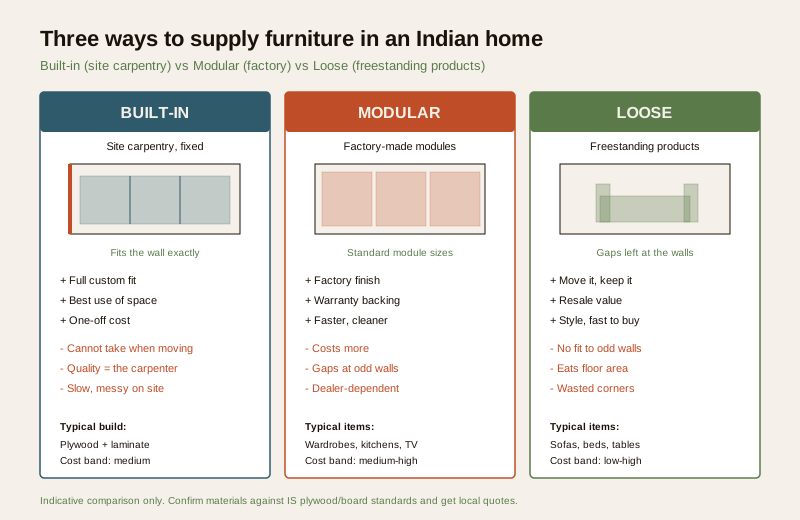
- Built-in (site carpentry). A carpenter fabricates the piece at your site and fixes it to the wall or floor — wardrobes, lofts, TV panelling, pooja units, study tables. Usually plywood carcass with a laminate or veneer finish, cut to your exact wall. It is bespoke by nature and does not leave the house when you do.
- Modular (factory). A brand or workshop manufactures standard-size modules off site (base units, wall units, wardrobe shutters) and assembles them at your home. This is the world of modular kitchens and branded wardrobe systems — factory finish, hardware warranty, faster fit, but priced per module and dependent on the dealer network.
- Loose (freestanding). Finished products you buy and place — sofas, beds, dining tables, chairs, sideboards. Maximum flexibility and resale, zero fit to your walls, and they occupy floor area rather than disappearing into it.
Most real Indian homes are a blend of all three, and that is the correct answer far more often than any single model. The skill is knowing which room leans which way.
Cost: what each model really costs
There is no honest single price — everything depends on material grade, finish, city and the maker. But the relative bands are stable enough to plan with. Read the table as "for the same job, roughly how the three compare," not as a quotation.
| Model | Relative cost | What drives it up | What keeps it down |
|---|---|---|---|
| Built-in carpentry | Low to medium | Veneer/acrylic finish, imported hardware, tall lofts | Basic laminate on commercial ply, simple shutters |
| Modular (factory) | Medium to high | Branded hardware, membrane/acrylic shutters, accessories | Base laminate finish, fewer internal accessories |
| Loose (freestanding) | Very low to very high | Solid wood, designer brands, upholstery | Engineered-wood flat-pack, local product lines |
A few honest points. Carpentry often undercuts branded modular for the same storage volume, because you are paying a local labour rate rather than a factory-plus-showroom margin — but the finish and consistency ride entirely on the carpenter. Modular's premium buys finish, hardware warranty and speed, not necessarily more storage. Loose furniture spans the widest band of all: a flat-pack engineered-wood bed and a solid-teak one are both "loose," and cost an order of magnitude apart. To turn any of this into numbers for your rooms, run the furniture cost calculator; for a site-made piece specifically, the custom furniture estimator breaks down board, finish and labour. Also see the wardrobe cost guide for a worked storage example.
Flexibility and portability: the renting question
This is where the models genuinely diverge, and it maps almost perfectly onto do you own or rent.
| Model | If you move house | If you renovate | Long-term |
|---|---|---|---|
| Built-in | Stays behind — you lose it | Often demolished | Best if you will not move for years |
| Modular | Can sometimes be dismantled and refitted | Modules can be re-used | A reasonable middle ground |
| Loose | Comes with you, intact | Just re-arrange | Best for anyone who moves |
Built-in furniture is effectively part of the flat. In a rented home it is money you leave for your landlord, and few landlords adjust rent for it — so renters should keep built-in to an absolute minimum. Modular systems sit in the middle: a good modular wardrobe can be unbolted and refitted in a new home, though panels rarely survive more than one or two moves cleanly. Loose furniture is the portable option by definition — you paid for a product, and the product is yours to carry, sell or re-style. If your life involves job moves or you are in a flat you may leave within a few years, weight the whole home toward loose and light modular. The apartment living hub has more on furnishing a home you do not own.
Finish, warranty and quality control
Who guarantees the piece is as different as who makes it.
- Built-in quality is the carpenter. A skilled one delivers flawless, tight joinery cut to your millimetre; a weak one delivers wavy shutters, misaligned hinges and edge-banding that peels in the monsoon. There is rarely a written warranty — your protection is choosing the person well and specifying the board and hardware. Insist on the right plywood grade: BWR/BWP for anything near water per the IS plywood standards (IS 303 / IS 710), covered in the plywood grades guide and the marine ply vs HDHMR vs MDF comparison.
- Modular is factory-finished and usually carries a written warranty on the carcass and, separately, on the hardware (hinges, channels, soft-close). Panels are edge-banded by machine, so finish is consistent. The catch is that you are tied to the dealer for service and spares.
- Loose carries the manufacturer's product warranty and you can inspect the actual finished item before it enters your home — no site surprises. Quality ranges from disposable flat-pack to heirloom solid wood.
Across all three, ask about formaldehyde emission class (aim for E0/E1 low-emission boards) for bedrooms and children's rooms — it is an indoor-air-quality point worth taking seriously, and reputable makers can tell you the class of their board.
Timeline: how fast you get furnished
| Model | Typical lead time | Site disruption |
|---|---|---|
| Built-in carpentry | Slow (weeks on site) | High — dust, noise, workers in the home |
| Modular (factory) | Medium (manufactured, then quick fit) | Low — a clean day or two of assembly |
| Loose (freestanding) | Fast (buy off the floor or short order) | None — it is delivered and placed |
If you need a home habitable quickly — a rental you have just taken, a room for arriving family — loose furniture wins outright, and modular is the fastest of the fitted options. Built-in is the slowest and the messiest: it means weeks of a carpenter, sawdust and daily supervision. That supervision cost is real and often under-counted.
Space efficiency: filling awkward walls
Indian flats are full of odd corners, niches, beam drops and non-square rooms. This is where built-in earns its keep.
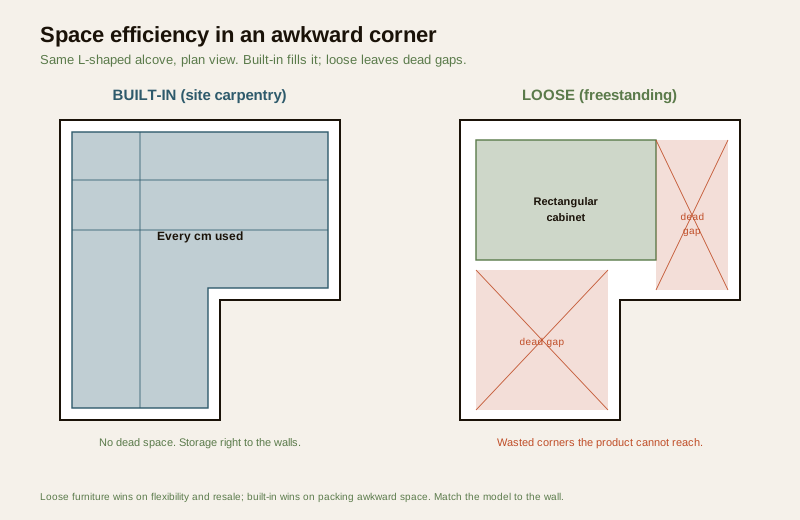
A site-made unit is cut to the exact wall — it runs floor to ceiling, wraps a corner, ducks under a beam and steals every usable centimetre. A modular system does this well on straight, standard runs but leaves filler panels or gaps where the wall misbehaves. A loose cabinet is a rectangle in a room that is rarely a clean rectangle, so it leaves dead space behind and beside it. For small homes where every litre of storage counts, built-in and modular beat loose on pure efficiency — see space-saving furniture and smart storage interiors, and plan the volumes with the storage hub. The flip side: loose furniture keeps the floor flexible, which matters more than storage in living and dining rooms.
Resale and long-term value
- Built-in has effectively zero resale — it cannot leave the wall, so its value is entirely the use you get while you live there.
- Modular holds a little value if it can be dismantled, but used modular sells at a steep discount.
- Loose furniture has a real second-hand market — solid-wood pieces especially hold value, and branded loose furniture resells readily. A good loose piece is closer to an asset than an expense.
If you think in terms of what survives a move or a sale, loose furniture is the only model that gives money back.
The decision, in one flow
Put the four factors together and a simple sequence falls out: settle own vs rent first, then the wall shape, then let budget fine-tune.
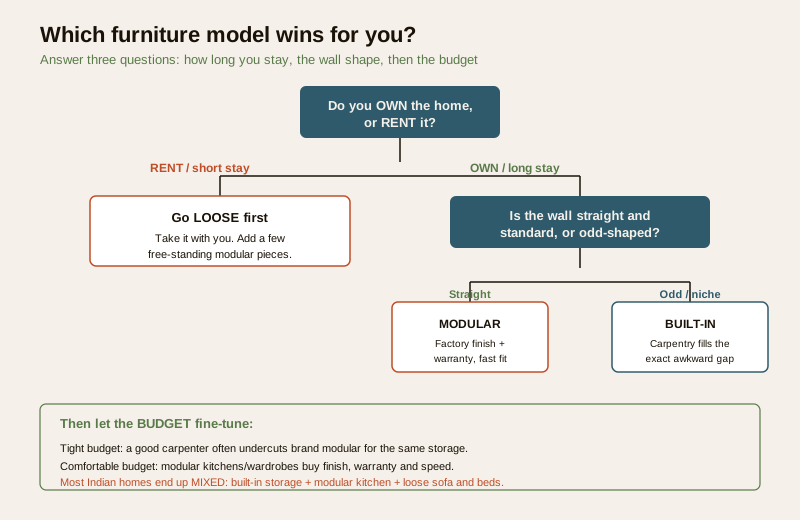
| If you are... | And the wall is... | Lean toward | Because |
|---|---|---|---|
| Renting / short stay | Any | Loose (+ light modular) | You take it with you; nothing lost to the landlord |
| Owning long-term | Straight, standard | Modular | Factory finish, warranty, fast clean fit |
| Owning long-term | Odd, niche, floor-to-ceiling | Built-in | Carpentry packs the exact awkward space |
| Tight budget, owning | Any storage | Built-in carpentry | Often undercuts brand modular for the same volume |
| Want speed above all | Any | Loose | Delivered and used the same week |
| Want an asset that resells | Any | Loose (solid wood) | The only model with a real second-hand value |
When each model wins, room by room
| Room / piece | Usually best | Why |
|---|---|---|
| Kitchen | Modular | Factory finish survives heat/moisture; warranty on hardware; see the modular kitchen hub |
| Bedroom wardrobe | Built-in or modular | Floor-to-ceiling fit and volume matter most; wardrobe planning |
| Sofa / seating | Loose | Comfort, style and resale; must be re-arrangeable |
| Beds | Loose or built-in | Loose for flexibility; built-in with storage in tiny rooms |
| Dining table & chairs | Loose | Freestanding by nature; flexes with guests |
| TV / media unit | Built-in or modular | Cable management and wall-fit; modern TV unit ideas |
| Study / pooja / niche | Built-in | Cut to an exact odd corner |
| Occasional & accent pieces | Loose | Cheap to change as taste evolves |
The pattern most Indian homes settle into: modular kitchen, built-in or modular wardrobes, and loose everything you sit on or gather around. That blend is not a compromise — it is each model doing the job it is best at. For a fuller room-by-room treatment see the residential furniture guide and the room-by-room hub.
Renters vs owners: the clean cut
If you remember one thing, remember this split.
- Renters and short-stayers: go loose-first. Buy a sofa, bed, dining set and a couple of freestanding or light modular storage units you can carry to the next home. Resist any built-in you cannot take. Your furniture should be a set of products you own, not fixtures you gift the landlord.
- Owners settling in: invest in built-in and modular where fit and storage pay off — the wardrobes, the kitchen, the niche units — and keep the sofas, beds and dining loose so the home can be re-styled without demolition. For truly bespoke, character pieces, read bespoke furniture explained.
How it connects
- Start at the complete guide to furniture in India, then dig into the build-vs-buy detail in custom vs ready-made furniture and bespoke furniture explained.
- For fitted storage, combine this with wardrobe planning, the storage hub and space-saving furniture; browse looks in wardrobe design ideas.
- For the kitchen, go to the modular kitchen hub; furnishing a home you do not own is covered in apartment living.
- Get the material right with the plywood grades guide before you sign off any carpentry.
- Budget it: the furniture cost calculator for the whole home and the custom furniture estimator for a specific site-made piece; sanity-check sizes with the furniture size chart.
Key takeaways
- The three models — built-in, modular, loose — differ most on cost, portability, fit and resale; choose per room, not for the whole home.
- Built-in packs awkward walls best and often costs least for storage, but stays behind when you move and rides entirely on the carpenter.
- Modular buys factory finish, warranty and speed on standard runs, at a higher price and tied to the dealer.
- Loose is the flexible, resellable, fast option — but eats floor area and cannot fit odd corners.
- Renters go loose-first; owners invest in built-in/modular for wardrobes and kitchens, and keep seating and dining loose.
- The default Indian blend — modular kitchen, fitted wardrobes, loose living and dining — is usually the right answer.
- Every cost here is an indicative band — get local quotes, insist on the right plywood grade and low-emission (E0/E1) boards, and confirm safety details with the maker.
References
- IS 303 / IS 710 — plywood grades and boiling-water-resistant / marine plywood specifications (named generally).
- IS 1734 — methods of test for plywood; IS 1659 (blockboard), IS 3087 / IS 3097 (particle board), IS 12406 (medium-density fibreboard), named generally for board selection.
- The IS furniture strength and durability standards (IS 4838-type) for structural safety of finished furniture, named generally.
- Formaldehyde emission classes E0 / E1 / E2 (CARB / EN 13986 context) — indoor-air-quality guidance for engineered boards, named generally.
- IGBC / Indian Green Building Council and CRI GreenPro eco-certification, and BIFMA commercial furniture testing, named generally for buyers seeking certified low-emission or contract-grade pieces.
All costs, cost bands and material notes here are indicative planning aids only; confirm current prices with local vendor quotes, verify board grades and hardware against the relevant IS plywood and furniture standards, choose low-emission (E0/E1) boards for bedrooms and children's rooms, and have your carpenter or modular manufacturer specify and certify any safety-critical fabrication and anti-tip anchoring.
Export this guide
Related Guides — Deep-dive reading
The Complete Guide to Furniture for Indian Homes (2026)
The start-here master guide for furnishing an Indian home — what furniture actually does, the five families of pieces, the decisions in the order you face them (space and needs, loose vs modular vs built-in, materials, size and layout, budget, buy, maintain), an honest read on plywood, humidity and termites, and where every choice hands off to the carpenter, the brand or the fixer.
FurnitureThe Design Decisions With the Biggest Cost Consequences
A cost-leverage map of Indian home interiors — the handful of decisions that swing your total budget the most, so you spend your attention where a single choice has an outsized rupee impact.
Cost & MoneyCustom vs Ready-Made Doors: Buyer's Guide India 2026
Factory ready-made, made-to-order from a brand, or carpenter-built on site — costs, lead times, fit and warranty compared for Indian homes.
Home Doors & EntrancesRelated Tools — Try Free
Apartment Furniture Size Chart
Standard furniture dimensions for Indian apartments — sofas, beds, tables, dining, storage.
Reference ChartApartment Interior Planning Checklist
51-item checklist across structural, ceiling, lighting, furniture, storage, electrical, kitchen, bathroom.
ChecklistApartment vs Villa Interior Planning Guide
Compare ceiling height, structural flexibility, lighting, storage, and services between apartments and villas.
Planning Guide