
Furniture Safety, Standards & Warranties in India (2026)
The homeowner's literacy guide to furniture safety — the child tip-over risk that quietly kills toddlers, stability and load limits, fire and upholstery, the Indian standards and BIS marks behind a safe piece, elderly and accessibility safety, and how to read a warranty before you sign it.
Most furniture buying is about looks, size and price. Safety only comes up after something goes wrong — a bookshelf that leans, a chair leg that splits under a heavier guest, a glass top that shatters, a wardrobe that tips onto a child who climbed it. None of that is bad luck. It is the predictable result of a piece that was never chosen, placed or anchored with safety in mind. This guide is the missing literacy layer for the Furniture hub: it treats safety as the through-line, names the Indian standards and marks behind a well-made piece, and gives you a method to make YOUR home safe rather than a list of products to buy.
This is a homeowner literacy guide, and it links out rather than repeats. Read it alongside the complete guide to furniture in India — the pillar — and the buying guides at furniture buying guide and a homeowner's guide to buying furniture, where safety becomes one line on the checklist.
Scope & how to read this. Everything here is indicative literacy to help you assess, place and maintain furniture safely — not a spec sheet and not legal advice. Standard names, marks and grades are given generally; confirm the exact test, class or warranty term with the maker and the current IS documents. The anti-tip / child tip-over point, fire point and glass point are safety-critical — treat them seriously, do not "eyeball" them, and when a load rating or a structural failure is in question, defer to the manufacturer and a qualified professional.
Child safety — the one that actually kills
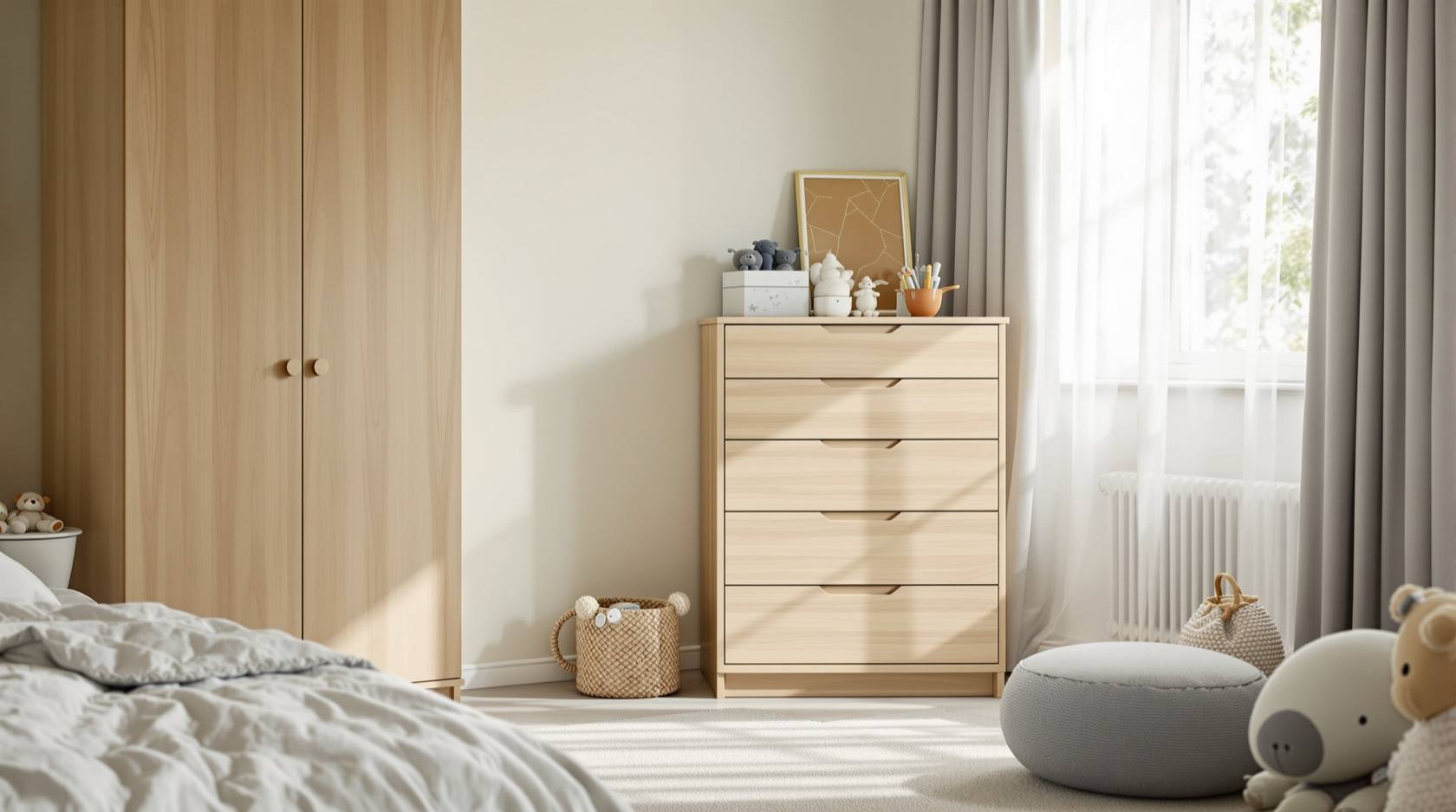
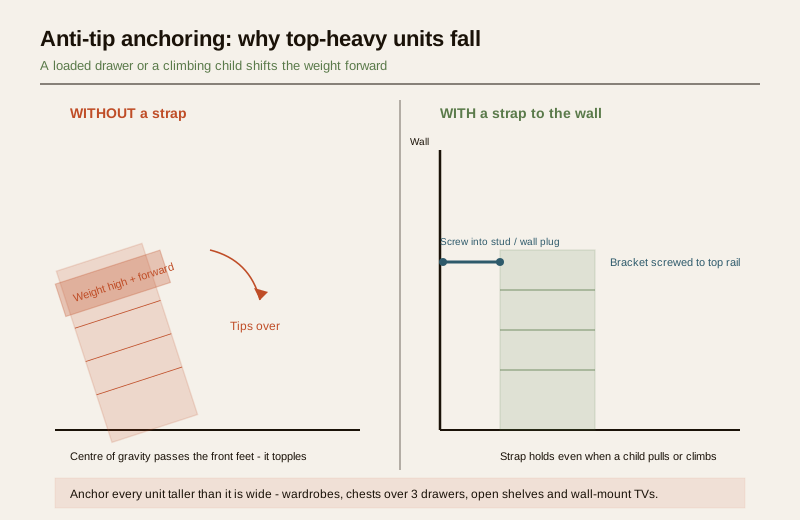
The single most serious, most under-known furniture hazard in an Indian home is the tip-over. Tall, top-heavy units — a chest of drawers, a wardrobe, an open bookshelf, a TV on a slim console — go over when a toddler opens the lower drawers as a ladder and climbs, or pulls on an open door. The unit's centre of gravity crosses the front feet and it comes down, often with the TV, onto a child who cannot get clear. These falls are silent, fast and disproportionately fatal to under-fives. It is the hazard people never plan for and the easiest to eliminate.
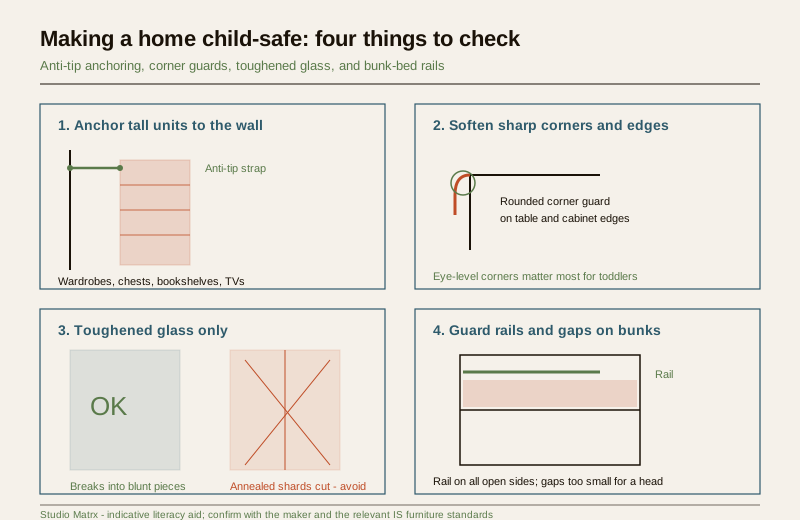
- Anchor everything taller than it is wide. Wardrobes, chests with three or more drawers, open shelving and wall-mount TVs get an anti-tip strap or bracket screwed from the top rail into a wall plug or stud. This is the highest-value five-minute job in the whole house. Do not rely on weight alone — a loaded drawer plus a climbing child beats it.
- Sharp corners and edges. At a toddler's eye and forehead height, glass and stone table corners, cabinet edges and open drawer runners are the common injury. Choose rounded profiles where you can; fit corner guards on the pieces you already own.
- Glass — toughened only. Any glass a child can walk into or pull down — table tops, shelf fronts, cabinet doors — must be toughened (tempered) safety glass, which crumbles into blunt granules instead of long shards. This is important enough to have its own guide: read glass furniture in India before buying anything with a glass element.
- Pinch points and toy-box lids. Folding tables, recliners and drop-front units have finger-trap points; toy boxes need lid supports or safety hinges that hold at any position so a lid cannot slam on a hand or neck.
- Bunk beds. Guard rails on all open sides of the top bunk, a fixed ladder, and gaps between rails, frame and mattress small enough that a child's head cannot pass or wedge. Bunks are not for under-sixes on the top.
- Small parts. Loose knobs, castor caps and decorative studs on children's furniture are choking hazards — check they are fixed, not press-fit.
Stability and load ratings
Beyond tipping, furniture fails when it is loaded past what it was built for. Every seat, bed and shelf has a working limit, even when the maker does not print it.
| Piece | What to check | Why it matters |
|---|---|---|
| Chairs & stools | Joint tightness, leg splay, a stated weight limit | A racked or under-built joint splits under a heavier or leaning user |
| Beds | Slat spacing and support legs, a centre rail on queen/king | Sagging and mid-span collapse trace to too few slats or a missing centre leg |
| Shelves & bookcases | Shelf thickness vs span, fixings into the wall | Long thin engineered-wood shelves bow and pull fixings out under books |
| Wall units & TV consoles | Bracket rating vs actual TV weight | A cheap bracket rated below the screen is a slow-motion failure |
| Wardrobes | Hanging-rail and hinge load, back-panel fixing | Overloaded rails bend; a stapled back panel racks the whole box |
Two habits cover most of this. First, respect the rating — if a maker states a weight limit, it is a real number, not marketing. Second, treat wobble as a warning: a chair that rocks, a bed that creaks at one corner, a shelf that dips is telling you a joint or fixing is going. For bed spans and slat support, cross-check dimensions in bed and mattress sizes in India; for how frame material drives strength, see upholstered furniture and the pillar's material section.
Fire safety
Upholstered furniture is the fire risk people forget, because the danger is not the frame but the foam and fabric. Cheap polyurethane foam ignites fast and gives off dense smoke; a sofa or mattress near an open flame, a heater, an electrical point or a kitchen is a hazard.
- Ask whether the foam and cover meet a flammability / fire-retardant standard — better makers use treated foam and fabric or naming a flammability class. Take the claim generally, but ask the question; a maker who cannot answer is a signal.
- Keep upholstery away from heat sources — heaters, diyas and candles, exposed wiring, and direct kitchen flame. Distance is free safety.
- Do not overload power strips behind or under a sofa or bed; the commonest home fire is electrical, and soft furnishings turn a spark into a blaze.
- Mattresses and children's upholstered items deserve the most attention here, because they are slept on.
Fire-retardant treatment and healthy indoor air pull in opposite directions sometimes, so balance them against low-emission choices — the sustainable furniture guide and the healthy homes hub cover the foam, formaldehyde and VOC side.
The Indian standards behind a safe piece
Furniture safety is not left to chance — there is a body of Indian Standards for it, and knowing the names lets you ask the right question without pretending to be an inspector.
| What it governs | What to look for (generally) |
|---|---|
| Furniture strength, stability, durability & safety | The IS furniture standards (strength/stability/safety series) that test seating, tables, storage and beds |
| Plywood grade | BWR / BWP (marine) / MR grades per IS 303 / IS 710; IS 1734 for the tests |
| Particle board / MDF / blockboard | IS 3087 / IS 3097 (particle board), IS 12406 (MDF), IS 1659 (blockboard) |
| Formaldehyde emission | E0 / E1 / E2 emission classes — lower is better for indoor air |
| The mark to look for | The BIS / ISI mark on boards and certified furniture; GreenPro / IGBC for eco-certified |
| Commercial & office furniture | BIFMA testing for contract-grade seating and desks; RPwD-compliant heights for public seating |
Three practical takeaways. First, the ISI / BIS mark on the board (ply, MDF, particle board) is your best single proxy for a piece that will not warp, delaminate or off-gas badly — insist on it, and read plywood furniture and MDF vs particle board for what the grades mean. Second, for anything going into an office or a rented commercial space, ask for BIFMA-tested contract furniture — it is built and warranted for heavier daily use. Third, do not accept fabricated clause numbers from a salesperson as proof of anything; the honest signal is a genuine mark and a maker who can name the standard, not a quoted sub-clause.
Elderly and accessibility safety
An ageing household changes what "safe furniture" means, and it is worth planning before a fall forces it.
- Chairs with arms and a firm, higher seat let an older person rise without straining; low, soft, armless seats are a trap.
- Bed height matters — a bed you sit onto with feet flat on the floor and stand up from is safer than a very low platform or a very tall one.
- Stable, non-tipping pieces near where someone rises or turns — a side table that will not skate away when leaned on, a chair that will not slide.
- Grab support and clear paths — avoid low coffee tables, trailing rugs and furniture edges in the walking line; trip hazards, not dramatic failures, cause most elderly injuries.
- Public, rental and commercial seating should follow RPwD Act 2016 and the Harmonised Guidelines for accessible heights and clearances.
The full seat-height, depth and reach logic lives in the furniture ergonomics guide — safety and ergonomics are the same subject read for two different bodies.
Warranties — reading them before you sign
A warranty is a safety and value document, and most buyers never read it until a claim is refused. The key idea is that different parts of the same piece carry very different cover.
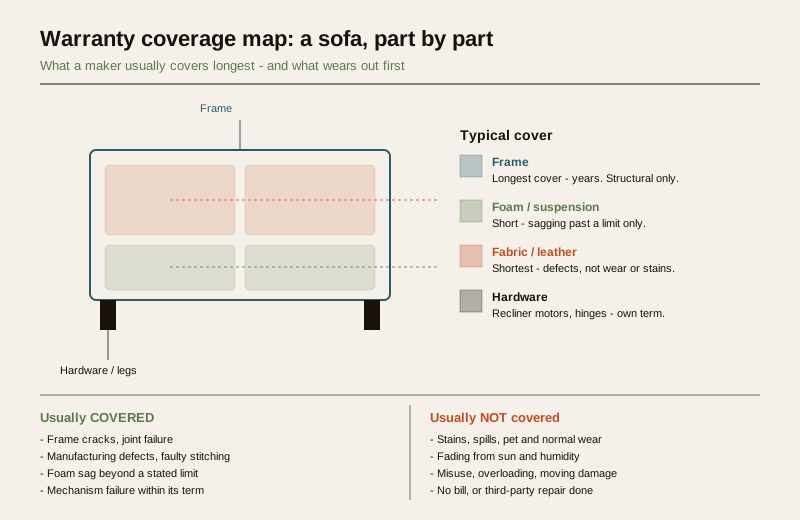
| Component | Typically covered | Typically NOT covered |
|---|---|---|
| Frame | Structural cracks, joint failure — the longest term | Cosmetic marks, damage from moving or overloading |
| Foam / suspension | Sagging beyond a stated limit — a shorter term | Normal softening and body impressions with use |
| Fabric / leather | Manufacturing defects, faulty stitching — the shortest term | Stains, spills, fading from sun and humidity, pet damage |
| Hardware / mechanism | Recliner motors, hinges, runners — their own term | Wear from misuse; damage from unauthorised repair |
How to keep a warranty alive:
- Keep the bill and warranty card — no proof of purchase, no claim. Photograph them so a lost slip cannot end your cover; the furniture maintenance scheduler is a handy place to log purchase dates and warranty end dates alongside care reminders.
- Use the maker's service channel — a third-party repair, or moving a heavy piece badly, usually voids cover.
- Register the product if the brand asks, and note the start date and term per component — frame, foam, fabric and mechanism can each expire on different days.
- Read the exclusions first — humidity, sunlight, stains and "normal wear" are the common get-outs, and they are exactly what Indian conditions inflict.
Second-hand safety checks
A pre-owned piece can be excellent value, but you inherit its wear and none of its warranty — so inspect for safety, not just looks.
- Rack test. Push diagonally on chairs, tables and beds; a wobble means loose or failed joints.
- Tip and load. Check tall units for a solid back panel and the ability to be re-anchored; test that drawers and doors cannot pull the piece forward.
- Glass and mirrors. Look for a toughened-glass mark; reject chipped or cracked glass outright.
- Upholstery. Smell for damp and mould, press for even foam, check for pest signs — termites and borers travel in second-hand wood, so cross-check termite and moisture protection practices before bringing old timber home.
- Mechanisms and hardware. Cycle every recliner, hinge and runner; failed mechanisms are the expensive, unwarranted repairs.
A room-by-room safety checklist
Walk your home with this once. It mixes child and elderly checks because the same room serves both.
| Room | Child safety | Elderly / stability safety |
|---|---|---|
| Living | Anchor TV unit & shelves; corner guards on table; toughened glass tops | Firm armchair to rise from; clear walking line; no skating side tables |
| Bedroom | Anchor wardrobe & chest; safe toy-box lids; bunk rails | Bed at sit-and-rise height; stable bedside table; night path clear |
| Kids' room | All tall units strapped; rounded edges; no small loose parts | (n/a) |
| Kitchen / dining | Chairs that will not tip; keep upholstery from flame | Chairs with arms; stable stools; non-slip |
| Study / office | Cable and pinch-point management; stable desk | Supportive task chair; footrest; BIFMA seating if heavy use |
| Balcony / outdoor | Weighted, tip-resistant pieces; no climb-to-railing furniture | Stable, dry, non-slip seating |
How it connects
- Start at the complete guide to furniture in India, then let safety become one line on your furniture buying guide and homeowner's guide to buying furniture checklists.
- Read glass furniture in India before any glass piece, and bed and mattress sizes for slat support and safe bed height.
- Use the furniture ergonomics guide for seat and bed heights that keep older users safe, and the healthy homes hub plus sustainable furniture for the foam, formaldehyde and fire-versus-emission balance.
- Understand the boards behind a safe piece via plywood furniture and MDF vs particle board; understand frames via upholstered furniture.
- Log purchase dates and warranty end dates in the furniture maintenance scheduler so a claim is never lost to a missing bill.
Key takeaways
- The tip-over is the deadliest, most-ignored furniture hazard — anchor every unit taller than it is wide, especially in kids' rooms; it is a five-minute, life-saving job.
- Handle the other child risks seriously: sharp corners, toughened-glass-only, pinch points, safe toy-box lids and bunk rails, and no small loose parts.
- Respect load ratings and treat wobble as a warning — chairs, beds and shelves all have limits, stated or not.
- Fire risk lives in the foam and fabric — ask about fire-retardant treatment and keep upholstery away from heat and overloaded power points.
- Learn the IS furniture standards and the BIS / ISI mark as literacy — insist on a marked board, ask for BIFMA on commercial pieces, and never accept invented clause numbers as proof.
- Furniture is an elderly-safety and accessibility question too — stable armchairs, right bed height, clear paths, and RPwD-compliant heights in public settings.
- Read a warranty part by part — frame, foam, fabric and hardware carry different terms — keep the bill, use the maker's service, and check second-hand pieces for safety before value.
References
- The IS furniture standards (furniture strength, stability, durability and safety series), Bureau of Indian Standards — named generally; confirm the current documents and tests with the maker.
- IS 303 / IS 710 (plywood grades, incl. BWR/BWP/MR), IS 1734 (plywood tests), IS 3087 / IS 3097 (particle board), IS 12406 (MDF), IS 1659 (blockboard) — board standards behind furniture, named generally.
- BIS / ISI certification mark and E0 / E1 / E2 formaldehyde emission classes — the marks and classes to look for on boards and furniture.
- BIFMA furniture testing (commercial / contract furniture) and GreenPro / IGBC eco-certification — named generally.
- RPwD Act 2016 and the Harmonised Guidelines for Accessibility — accessible seating heights and clearances for public and commercial settings.
- Manufacturer product manuals, anti-tip anchoring instructions and warranty documents — the authoritative source for each specific piece's ratings and cover.
All safety notes, standard names, marks and warranty descriptions here are indicative literacy aids only; confirm the exact ratings, standards, flammability class and warranty terms with the manufacturer and the current IS documents, follow the maker's anti-tip anchoring instructions, and consult a qualified professional where a structural or load-bearing failure is in question.
Export this guide
Related Guides — Deep-dive reading
The Complete Guide to Furniture for Indian Homes (2026)
The start-here master guide for furnishing an Indian home — what furniture actually does, the five families of pieces, the decisions in the order you face them (space and needs, loose vs modular vs built-in, materials, size and layout, budget, buy, maintain), an honest read on plywood, humidity and termites, and where every choice hands off to the carpenter, the brand or the fixer.
FurnitureSecurity for People Living Alone in India (2026): Calm, Practical Habits When There Is No Second Person to Notice
Living alone is an ordinary and growing part of Indian life - the student in a new city, the working single, the elder whose children are abroad, the person after a separation. It does not call for fear. It calls for a few deliberate habits, because there is no second person in the home to notice trouble, raise the alarm, or catch an accident. This is calm self-reliance, layer by layer.
SecurityBathroom Fire Safety India: NBC 2016 Part 4, Fire-Rated Materials & Electrical Ignition
The bathroom is rarely thought of as a fire risk, yet it hides several: a leaky geyser element, an over-run exhaust-fan motor, cheap flammable PVC panels overhead, and aerosol cans stored beside a heat source. This is an honest, practical reference to fire and life safety in the Indian bathroom — the NBC 2016 Part 4 context that actually applies to homes, the real ignition sources, self-extinguishing false-ceiling and PVC materials, earth-leakage protection as fire prevention, escape considerations, and the carbon-monoxide danger of gas geysers.
BathroomsRelated Tools — Try Free
Apartment Furniture Size Chart
Standard furniture dimensions for Indian apartments — sofas, beds, tables, dining, storage.
Reference ChartInterior Contract Clause Checklist
16 sections and 98 checkboxes covering scope, BOQ, milestones, penalties, warranty, and disputes.
Contract ChecklistChild & Elder Home-Safety Audit
Room-by-room safety audit for households with children or seniors — 10 categories, 70+ checkpoints tagged by audience.
Safety Audit