
Engineered Wood Furniture in India: Ply, MDF, Particle & HDF (2026)
The umbrella guide to the man-made boards behind almost all modern Indian furniture — what engineered wood is and why it beats solid wood for modular work, the family from plywood to WPC, how each behaves in Indian humidity, the finish that goes on top, formaldehyde and cost — and how not to get particle board sold to you as ply.
Walk into any modern Indian home and open a wardrobe, a kitchen cabinet or a TV unit, and you are almost certainly looking at engineered wood — not a plank sawn from a tree, but a big flat board built from wood that has been peeled, chipped or ground down and glued back into a sheet. It is the quiet material behind the entire modular furniture boom. Solid teak and sheesham still have their place, but the wardrobe carcass, the cabinet shutter and the study table in most homes are engineered boards wearing a laminate or veneer skin.
This is the umbrella, start-here guide to that whole category. It explains what engineered wood is and why it took over, walks the family — plywood, MDF, HDF/HDHMR, particle board, blockboard and WPC — with a one-line job for each, shows how each behaves in Indian humidity, covers the finish that goes on top, formaldehyde and indoor air, and cost versus solid wood. This is a routing guide: it frames the choices and hands you to the deeper sibling guides rather than repeating them. Read it first, then go deep on the board your project actually uses.
Scope & how to read this. Every grade, thickness and cost band here is indicative and typical, to help you plan, budget and brief a carpenter or modular vendor — not a firm quote. Confirm board grades against the relevant IS codes (IS 303 / IS 710 plywood, IS 3087 / IS 3097 particle board, IS 12406 MDF, IS 1659 blockboard) and the IS mark on the actual sheet, and get local quotes for price. Studio Matrx helps you select, budget and buy well; the fabrication, joinery and hardware are the carpenter's or manufacturer's craft. Where a choice touches indoor air quality (formaldehyde) we flag it seriously — treat that as a health line, not a preference.
What "engineered wood" means — and why it took over
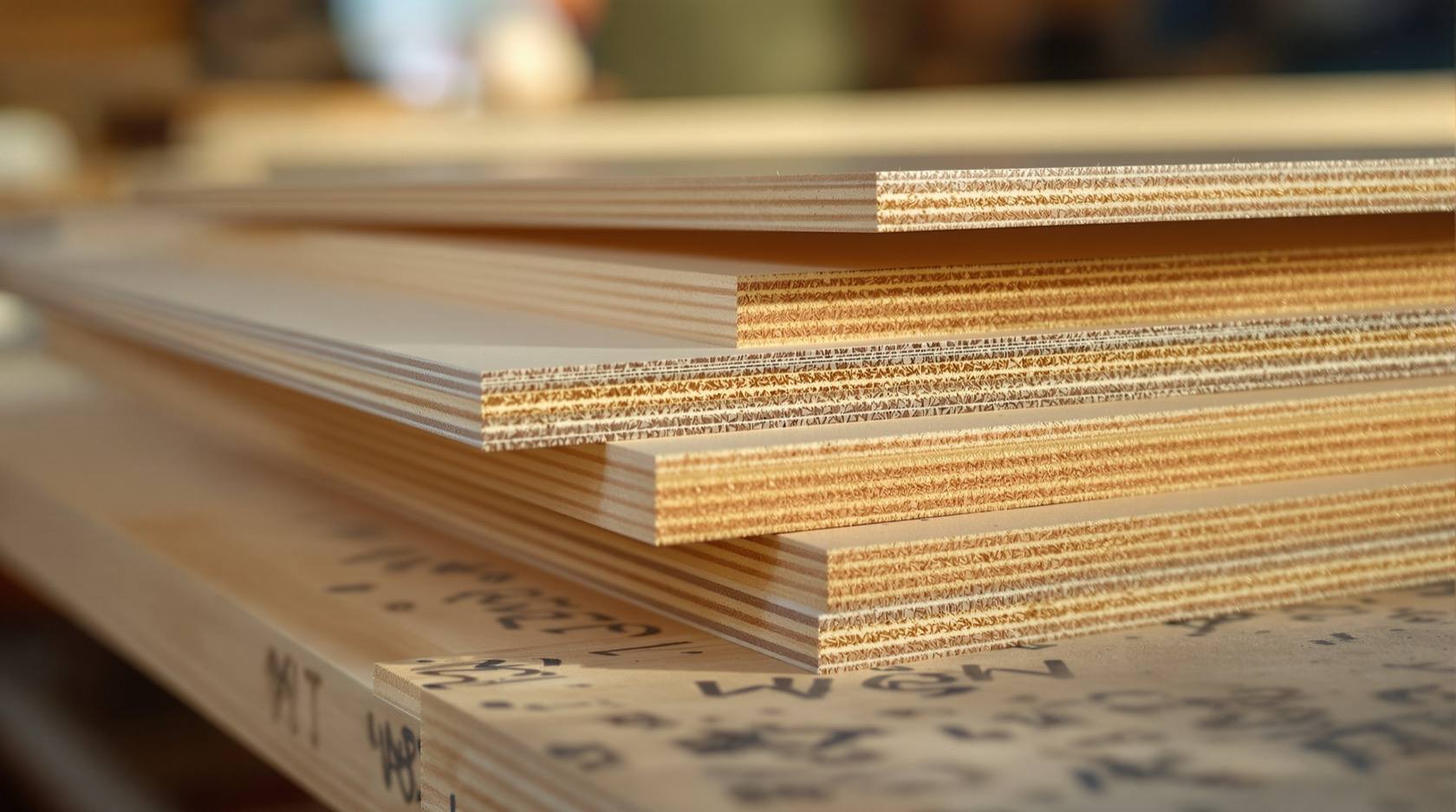
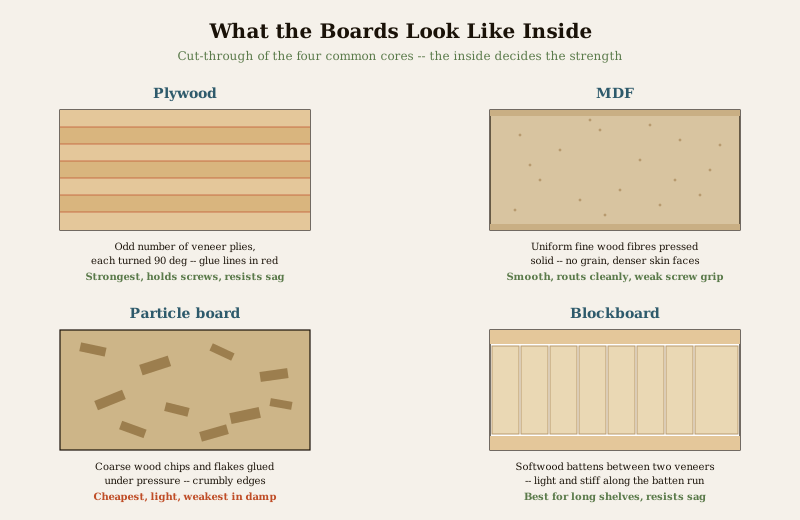
Engineered wood is any board made by breaking wood down and re-assembling it with adhesive under heat and pressure. Depending on how finely the wood is broken — thin veneers, coarse chips or fine fibres — you get plywood, particle board or MDF. The point is not to imitate solid wood but to beat it at the jobs furniture needs:
- It stays flat and stable. A solid plank moves with the seasons — it cups, warps and splits as humidity swings, which in coastal or monsoon India is brutal. An engineered board, with its grain crossed or randomised, barely moves. For a wardrobe shutter or a 6-foot shelf, flat-and-stable beats beautiful-but-alive.
- It comes in big sheets. A standard board is roughly 8 feet by 4 feet, so a full wardrobe side or a kitchen shutter is one clean piece with no joints. Solid wood that wide would be a glued-up, expensive, movement-prone panel.
- It is cheaper and more predictable. It uses fast-growing and plantation wood and even wood waste, so it costs a fraction of seasoned hardwood and every sheet performs the same — no hidden knots or weak grain.
- It takes any finish cleanly. A flat, uniform face is the perfect base for laminate, veneer, acrylic, membrane or PU — which is exactly what modular manufacturing needs.
The trade-off is honesty about limits: engineered boards depend entirely on their glue and their skin. Wet the wrong grade, or leave a raw edge exposed in a bathroom, and it swells and delaminates in a way solid wood never does. Matching the right board and grade to the right job is the whole game — and the reason the engineered wood vs solid wood comparison matters before you commit.
The family, one line each
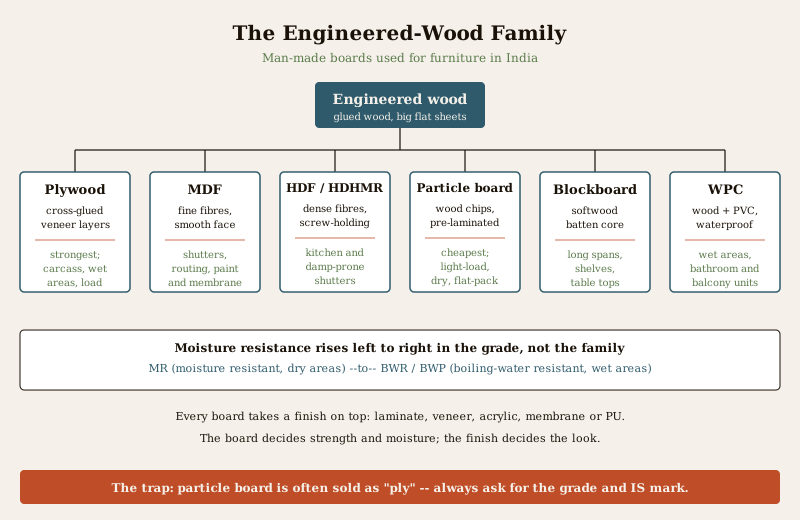
Six boards do almost all the work in Indian furniture. Name the board first and its job, strength and price fall into place.
| Board | Made from | One-line job |
|---|---|---|
| Plywood | Thin veneers cross-glued in odd layers | The strong all-rounder — carcass, load and wet areas |
| MDF | Fine wood fibres pressed into a smooth board | Flat painted or membrane shutters, routed and moulded fronts |
| HDF / HDHMR | Denser, high-pressure fibre board | Kitchen and damp-prone shutters where MDF is too soft |
| Particle board | Coarse wood chips glued under pressure | Cheapest — light-load, dry, flat-pack and filler work |
| Blockboard | Softwood battens between two veneers | Long shelves and table tops that must not sag |
| WPC | Wood fibre blended with PVC | Waterproof — bathroom vanities, balcony and utility units |
A quick way to hold it in your head: plywood is layers, MDF and HDF are fibres, particle board is chips, blockboard is battens, and WPC is plastic-and-wood. Strength and screw-holding follow the structure — layered and battened boards hold screws and carry load best, chip boards worst, with fibre boards in between. The deep dives live in the plywood furniture guide and the MDF vs particle board comparison; this table is the map, those are the territory.
How each behaves in Indian humidity — the grade matters more than the family
This is the part that trips up Indian buyers. Moisture behaviour is set less by which board you pick and more by its grade — and the grade is a separate spec you must ask for by name. Two plywood sheets can look identical and behave completely differently: one shrugs off a monsoon leak, the other swells and peels.
| Grade | What it means | Where it belongs |
|---|---|---|
| MR (moisture resistant) | Also called commercial grade; resists humidity, not standing water | Bedrooms, wardrobes, living-room units — dry interiors |
| BWR (boiling water resistant) | Better glue; survives damp and occasional wetting | Kitchens, near windows, humid coastal homes |
| BWP (boiling water proof) / marine | Best glue; withstands prolonged water | Under sinks, wet areas, exteriors, extreme humidity |
For plywood, MR sits under IS 303 and BWR/BWP under IS 710 — and a genuine sheet carries the IS mark stamped on the edge, which you should physically check rather than take on trust. Particle board and ordinary MDF are essentially dry-area materials: standard grades drink water and swell, so they belong in bedrooms and dry storage, never under a sink. Where you need a fibre board in a damp spot, step up to HDHMR (a high-density, high-moisture-resistant board) or, for genuinely wet zones, to WPC, which does not rot or swell because it is part plastic. In a coastal or high-rainfall city the rule tightens: default to BWR anywhere near the kitchen or an external wall, and keep raw board edges sealed and banded, because water always attacks the edge first.
The finish that goes on top — the board is only half the piece
An engineered board is almost never left bare. It carries a finish layer that gives the piece its colour, texture and everyday protection — and the finish is a separate decision from the board, priced and chosen on its own. The common finishes:
- Laminate. A tough printed sheet pressed onto the board — the workhorse skin for wardrobes and kitchens, huge range, forgiving and repairable. The laminate finishes guide covers the types and where each earns its place.
- Veneer. A thin slice of real wood bonded on and then polished — the natural-grain look, warmer and more premium than laminate, but needing more care.
- Acrylic. A high-gloss mirror-like front, popular on kitchen and wardrobe shutters; the acrylic vs laminate comparison is worth reading before you pay the premium.
- Membrane (PVC foil). A single moulded skin vacuum-pressed over a routed MDF shutter — seamless, good for grooved and profiled doors.
- PU (polyurethane). A sprayed, painted-and-lacquered finish for solid colours and a furniture-grade smoothness; the PU vs laminate cost comparison shows where the extra spend lands.
The board decides strength and moisture; the finish decides the look and much of the touch-and-feel. A common, sensible pairing is a plywood carcass with a laminate skin for the body of a wardrobe, and an MDF or HDHMR shutter with membrane, acrylic or PU for the visible doors — strength where it is loaded, a flawless flat face where it is seen.
Formaldehyde and indoor air — the health line
Engineered boards are held together with glue, and many adhesives release formaldehyde, a gas that off-gasses from the board into your rooms — more so when the furniture is new, warm and enclosed. It is an irritant and a recognised health concern, which is why boards are rated by emission class:
| Class | Emission level | What to do with it |
|---|---|---|
| E0 / E1 | Very low to low | Target this for bedrooms, children's rooms and closed storage |
| E2 | Higher | Acceptable only in well-ventilated, non-sleeping areas at best |
Ask your vendor for the emission class the way you ask for the grade, and prefer E1 or E0 for anything in a bedroom, a nursery or a shut wardrobe where clothes and air sit for days. Boards carrying CRI GreenPro or IGBC (Indian Green Building Council) eco-labels have verified low emissions and are worth the small premium in sleeping spaces. Two practical habits help everywhere: let new engineered-wood furniture air out before heavy use, and keep raw cut edges banded and sealed, since exposed edges off-gas and absorb moisture fastest. This is the one place in the whole decision where "cheapest board" is a false economy — indoor air is not worth a few hundred rupees.
Cost and lifespan versus solid wood
Set against seasoned hardwood, engineered wood is the value and stability play; solid wood is the heirloom-and-repair play. Indicative only — get local quotes:
| Material | Relative cost | Typical life in a home | Best at |
|---|---|---|---|
| Particle board | Lowest | Shortest; poor in damp | Cheap dry, light-load, flat-pack pieces |
| MDF | Low to medium | Moderate; smooth painted fronts | Shutters, routed and moulded faces |
| HDHMR / HDF | Medium | Good, better in damp than MDF | Kitchen and moisture-prone shutters |
| Plywood | Medium to high | Long with a good grade and sealed edges | Carcass, load-bearing and wet-area work |
| Blockboard | Medium | Long; stiff over spans | Long shelves, table and bench tops |
| Solid wood | Highest | Longest; sandable and repairable | Heirloom pieces, exposed frames, legs |
The honest summary: a good-grade plywood piece with sealed edges can last as long as a solid-wood one at a lower price and with far less warping — but a cheap particle-board piece in the wrong place is bought twice. Spend where the piece is loaded, wet or slept beside; economise on dry, light-use fillers. Put your project's numbers through the custom furniture estimator and, for skins, the laminate sheet calculator to turn boards and finishes into an indicative figure.
Which board for which part
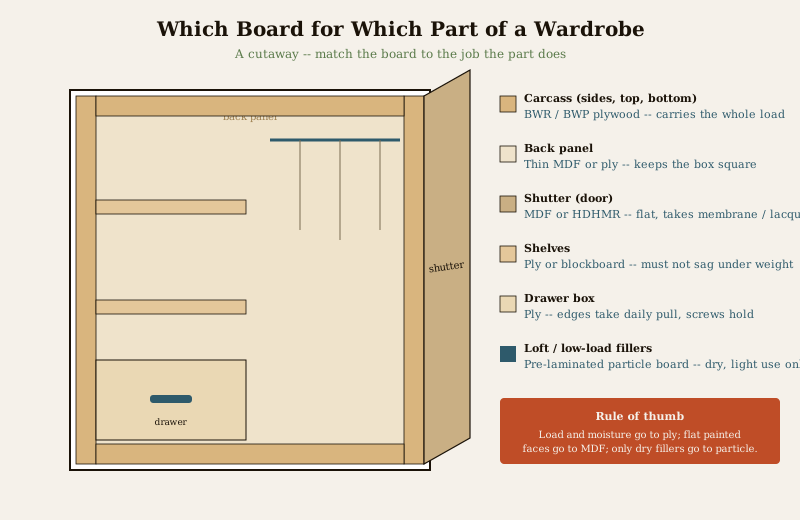
The single most useful skill is matching the board to the part, not buying one board for the whole piece. A well-made wardrobe or kitchen mixes boards deliberately.
| Furniture part | Recommended board | Why |
|---|---|---|
| Wardrobe / cabinet carcass | BWR/BWP plywood | Carries the load and hardware; must not sag or swell |
| Kitchen carcass (under counter) | BWP plywood or WPC | Constant damp and spills; must be near-waterproof |
| Shutters / doors (visible) | MDF or HDHMR | Flat, stable, takes membrane, acrylic or PU cleanly |
| Long shelves, table tops | Blockboard or thick ply | Stiff over a span so it does not bow under weight |
| Drawer boxes | Plywood | Edges take daily pull; needs to hold screws |
| Back panels | Thin MDF or ply | Keeps the box square; carries little load |
| Loft / low-load dry fillers | Pre-laminated particle board | Cheapest where use is light and the area stays dry |
For a full kitchen, the same logic scales up in the modular kitchen hub, where carcass, shutter and finish are chosen part by part.
How not to get cheated
The commonest trick in the Indian furniture market is selling particle board or cheap MDF as "ply." The words "ply" and "wood" get used loosely, and once a piece is laminated you cannot see the core. Protect yourself:
- Ask for the core by name and see it. Insist on the exact board — "BWR plywood," not "good ply" — and ask to see a raw edge before lamination: layered plies, fine solid fibre or loose chips are unmistakable once you know what each looks like inside.
- Check the IS mark and grade on the sheet. A genuine graded sheet is stamped (IS 303 / IS 710 for plywood, IS 12406 for MDF, IS 3087 for particle board). No stamp, no trust.
- Get the grade in writing. Put the board type, grade and finish on the quote and the invoice, so "MR sold as BWR" is a documented breach, not a he-said dispute.
- Weigh and tap. Plywood and blockboard feel dense and sound solid; particle board is lighter and duller — a rough field test, not a substitute for the stamp.
- Mind the price gap. A quote far below the going rate for "ply" almost always means a cheaper core underneath. Cross-check against the complete guide to plywood grades and the marine ply vs HDHMR vs MDF comparison so you know what fair looks like.
How it connects
- Start with the complete guide to furniture in India for the whole picture, then this guide for materials.
- Go deep on the board your project uses: plywood furniture, MDF vs particle board, and how it all stacks up against solid wood furniture in the engineered wood vs solid wood comparison.
- Nail the grades with the complete guide to plywood grades and marine ply vs HDHMR vs MDF.
- Choose the skin on top: best laminate finishes, acrylic vs laminate and PU vs laminate cost.
- For seating and soft pieces, engineered wood hides inside the frame — see upholstered furniture; browse the materials hub and the modular kitchen hub for where these boards go to work.
- Budget it with the custom furniture estimator and the laminate sheet calculator.
Key takeaways
- Engineered wood is the default for modern Indian furniture because it is flat, stable, big-sheeted, cheaper and predictable — it beats solid wood at modular carcass and shutter work.
- Know the family: plywood (layers, strongest), MDF and HDF (fibres, smooth faces), particle board (chips, cheapest), blockboard (battens, best over spans), WPC (plastic-and-wood, waterproof).
- Grade beats family for moisture — ask for MR (dry), BWR (damp) or BWP/marine (wet) by name, per IS 303 / IS 710, and check the IS mark on the sheet.
- The finish is a separate choice — laminate, veneer, acrylic, membrane or PU sits on top; board decides strength and moisture, finish decides the look.
- Formaldehyde is a health line — prefer E1 or E0 (and GreenPro/IGBC labels) for bedrooms and closed storage, and air out new furniture.
- Match the board to the part — plywood for carcass and load, MDF/HDHMR for shutters, blockboard for long shelves, particle board only for dry light fillers.
- Do not get cheated — insist on seeing the raw core, get the grade in writing, and treat a too-cheap "ply" quote as a warning.
References
- IS 303 — plywood for general purposes, including MR-grade (moisture-resistant) plywood (named generally).
- IS 710 — marine / BWP plywood; boiling-water-proof grade for wet and exterior use (named generally).
- IS 1734 — methods of test for plywood (named generally).
- IS 3087 / IS 3097 — particle board specification and test methods (named generally).
- IS 12406 — medium-density fibreboard (MDF) for general purposes (named generally).
- IS 1659 — blockboard specification (named generally).
- Formaldehyde emission classes E0 / E1 / E2 (CARB / EN 13986 context) — indoor-air emission grading for wood-based panels (named generally).
- CRI GreenPro and IGBC (Indian Green Building Council) — eco-labels for low-emission, sustainable boards (named generally).
- The IS furniture strength and durability standards — general furniture safety and performance (named generally).
All grades, thicknesses, emission classes and cost bands here are indicative planning aids only; confirm the governing values against the relevant IS codes and the IS mark on the actual board, get local quotes for cost, prefer low-emission (E1/E0) boards for sleeping and closed-storage spaces, and rely on your carpenter or modular manufacturer for fabrication, joinery and hardware.
Export this guide
Related Guides — Deep-dive reading
The Complete Guide to Furniture for Indian Homes (2026)
The start-here master guide for furnishing an Indian home — what furniture actually does, the five families of pieces, the decisions in the order you face them (space and needs, loose vs modular vs built-in, materials, size and layout, budget, buy, maintain), an honest read on plywood, humidity and termites, and where every choice hands off to the carpenter, the brand or the fixer.
FurnitureHow to Choose Bathroom Furniture in India: The Buyer's Guide to Vanities, Mirror Cabinets & Storage
A buyer's decision guide to bathroom furniture in India — the one check that matters most (moisture-proof material), wall-hung versus floor, soft-close hardware, counter tops, ready-made versus custom, good/better/best ₹ tiers, warranty, and how to spot MDF sold as ply.
BathroomsThe Design Decisions With the Biggest Cost Consequences
A cost-leverage map of Indian home interiors — the handful of decisions that swing your total budget the most, so you spend your attention where a single choice has an outsized rupee impact.
Cost & MoneyRelated Tools — Try Free
Cross-Ventilation Analyzer
Estimate airflow and air changes per hour (ACH) from room size, window areas, layout, and local wind — with NBC 2016 Part 8 compliance check.
Ventilation CalculatorMaterial Comparison Sheet
India's interior material cheatsheet — plywood, finishes, hardware, countertops, paints, waterproofing.
Reference GuideDoor Material Comparison Tool
Compare 2–4 door materials on cost, durability, maintenance, security and moisture resistance.
Comparison Tool