
How to Choose a Wash Basin in India: Mount Type, Size, Tap Holes & Budget (2026 Buyer's Guide)
A buyer's decision guide to picking the right wash basin — matching the mount type to your vanity and space, sizing it to the room, getting the tap-hole config right for your faucet, judging material and durability, checking what's in the box, good/better/best rupee tiers, the IS 2556 vitreous-china mark, and how to spot seconds, hairline cracks and warranty traps.
Buying a wash basin looks like a five-minute decision and turns into a five-year regret more often than any other fitting in the bathroom. The showroom shows you a wall of pretty bowls; nobody tells you that the one you liked needs a tap you did not buy, a counter you did not plan, or a trap that is sold separately. This guide is the buyer's checklist — how to actually choose a wash basin in India, match it to your space and faucet, read the budget honestly, and walk out with the right box.
This is the decision guide. For the deep technical breakdown of every basin type, sizes and standards, read the bathroom wash basin guide for India; this page sits under the bathroom shopping guide for India and links across to specific formats where you need them. Get the six decisions below right and the rest is styling.
A wash basin is bought as one object but installed as a system — bowl, tap, waste, trap, and the counter or wall behind it. Choose the system, not the bowl.
The six decisions that actually pick your basin
Everything a showroom throws at you reduces to six questions. Answer them in order and the shortlist writes itself.
1. Mount type — how it fixes to the room (wall-hung, countertop, under-counter, half-pedestal or full pedestal).
2. Size — bowl footprint versus the room and the traffic it takes.
3. Tap-hole configuration — must match the faucet you are buying.
4. Material and durability — how it survives Indian hard water and daily knocks.
5. What's in the box — waste, bottle trap, brackets, fixings included or extra.
6. Quality, certification and warranty — the IS mark, spotting seconds, and the paper that backs it.
1. Mount type — match it to your vanity and space
The mount type is the decision that touches everything else — your plumbing rough-in, your counter, your tap and your floor space. Pick this before you fall for a shape.
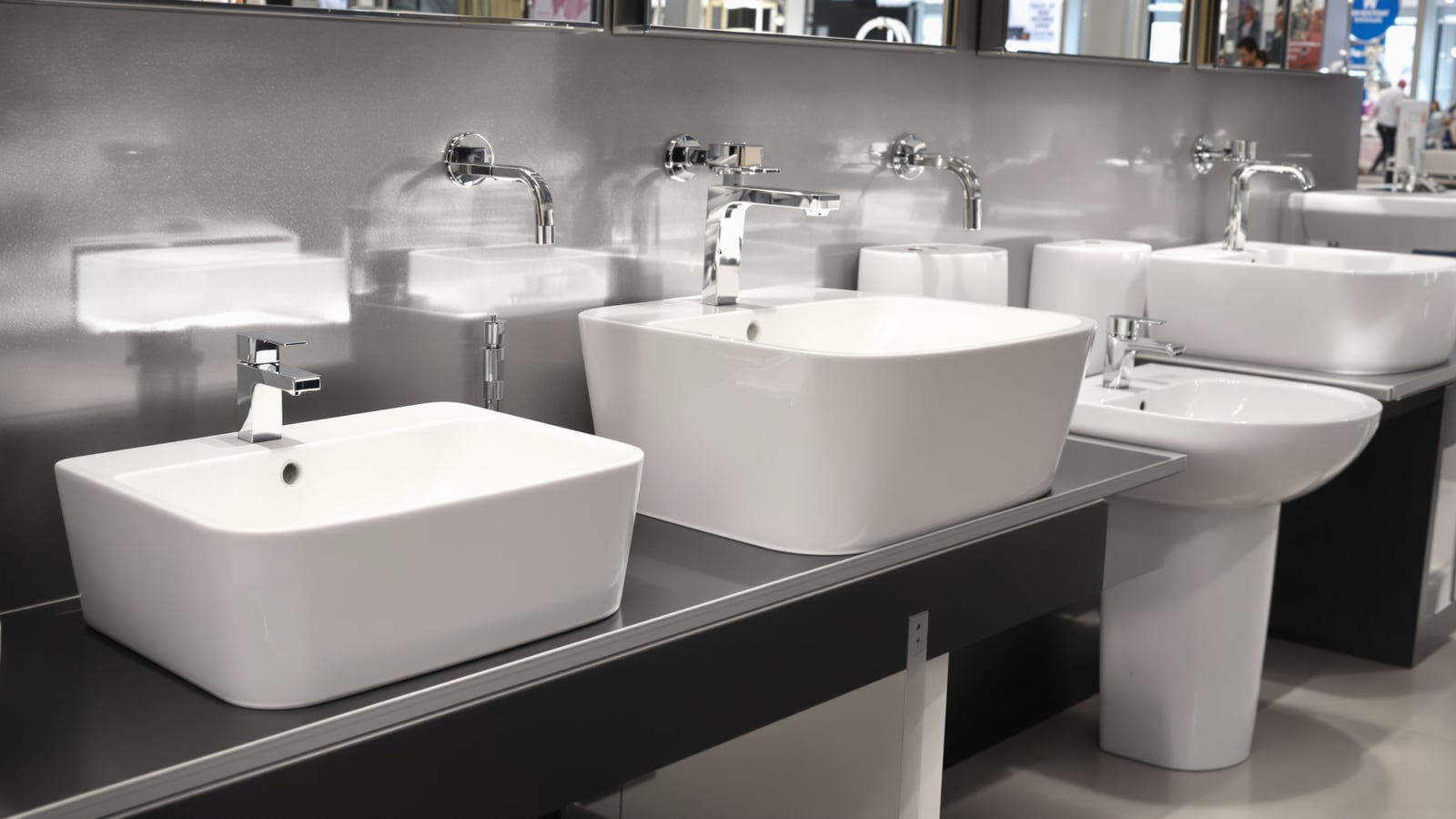
- Wall-hung basin. Bolts straight to the wall on concealed brackets, no vanity, no pedestal. The lightest visual footprint and the easiest floor to mop — ideal for small and narrow bathrooms. Needs a solid wall or a backing plate and the waste pipe roughed in at the right height. See wall-hung basins for India.
- Countertop / table-top basin. The bowl sits fully on top of a vanity or slab as a feature piece. Beautiful, but it raises your working height by 120–150 mm, so the counter must be built lower and the tap must be tall or wall-mounted. Detail in countertop basins for India.
- Under-counter basin. Sunk beneath the slab for a clean, minimal, easy-wipe top — the calm choice for a busy family bathroom with a vanity. See under-counter basins for India.
- Pedestal / half-pedestal basin. The classic column that hides the trap and pipes with no vanity needed. Budget-friendly and tidy, but the pedestal fixes the height and eats a little floor. See pedestal basins for India.
The single most common basin mistake in India is buying a countertop bowl for a standard 800 mm counter. The bowl then lands the rim near 950 mm — shoulder-high. If you love the look, plan the lower counter first.
2. Size — bowl versus bathroom versus traffic
A basin that is right in the showroom can be wrong on your wall. Measure the run of wall or counter you have, then leave clearance.
- Compact / cloakroom basins (~350–450 mm wide) suit a powder room or a tight ensuite where you only rinse hands.
- Standard family basins (~500–600 mm) are the everyday default — big enough to wash a face and fill a bucket-mug without soaking the counter.
- Wide or double basins (650 mm+ or twin bowls) belong in a master or shared bathroom where two people get ready at once.
- Leave ≥200 mm clearance either side of the basin centreline to a wall, and check the bowl depth: a shallow art bowl splashes, a deeper bowl (110 mm+ internal) keeps water in.
3. Tap-hole configuration — the mistake that stalls the plumber
This is where buyers get caught. A basin comes pre-drilled (or not) for a specific faucet, and it must match the tap you buy. Decide the faucet and basin together.
| Tap-hole config | What it means | Pairs with |
|---|---|---|
| Single tap hole | One central hole | A single-lever monobloc basin mixer |
| No tap hole | Bowl is blank | A wall-mounted spout or a deck tap on the counter behind |
| Three tap holes | Two + central spout, ~200 mm apart | A traditional 3-hole/widespread mixer |
| Two tap holes | Separate hot & cold | Twin pillar taps |
Most modern Indian basins are sold single tap hole or no tap hole. Buy a wall-mounted or concealed faucet and you want a no-hole basin; buy a deck mixer and you want a single hole. Getting this wrong means either a drilled hole nobody can plug or a tap that will not fit. Also confirm the basin has an overflow slot (most do) so a left-open tap does not flood the floor, and that the outlet is a standard 32 mm / 40 mm waste.
4. Material and durability — built for hard water
Nearly all mainstream Indian basins are vitreous china (glazed ceramic) and for good reason: cheapest to buy and replace, most stain-tolerant against hard water, and available in every shape. Reserve the others for feature use.
- Vitreous china / ceramic (IS 2556). The honest default. Films with hard water but wipes clean; glaze resists stain. Chips if you drop a heavy bottle on the rim.
- Natural stone. Premium and tactile, but etches with acid, rings with hard water, and needs sealing. Best in a low-use guest basin.
- Engineered stone / terrazzo / solid surface. More stain-resistant and consistent; mid-to-premium price.
- Tempered glass. Jewel-like but shows every water spot — a daily-wipe basin in a hard-water city.
- Stainless steel / brass / copper (art). Durable or artisan, but water-spots and needs polishing.
5. What's in the box — the "sold separately" trap
The price tag on the bowl is rarely the price you pay. Before you agree a number, get the salesperson to confirm, in writing, what is included:
- Waste / pop-up — included or extra? A slotted waste is needed if the basin has an overflow.
- Bottle trap — the P-shaped chrome trap under the basin is very often sold separately (₹800–3,500). A cheap plastic trap under a ₹15,000 bowl is a false economy and a smell risk; see plumbing traps for India.
- Brackets / fixing set — wall-hung basins need the right concealed bracket rated for the weight.
- Faucet — almost never included; budget it as a separate line.
- Installation — showroom price usually excludes fitting and plumbing labour.
6. Quality, IS mark, seconds and warranty
Sanitaryware is a big second-quality and mis-sold market in India. Protect yourself with three checks.
The IS 2556 mark. Genuine vitreous-china sanitaryware carries the BIS IS 2556 standard. Look for the standard number and the maker's stamp on the underside. It is your baseline assurance of glaze quality, dimensions and vitrification.
Spot the seconds. Factory "seconds" and B-grade stock are pushed hard at discounts. Before you pay, inspect the actual piece you are taking (not the display):
- Run a fingertip and eye along the rim and bowl for hairline cracks and glaze crazing — tap the rim gently; a healthy vitreous bowl rings, a cracked one gives a dull thud.
- Sight down the rim for warping — it should sit flat; a rocking basin was fired off-true.
- Check the glaze for pinholes, specks, dimples or colour variation, especially inside the bowl.
- Confirm the tap-hole and outlet are cleanly drilled and the overflow is clear.
- Reject anything marked "second", "B-grade" or sold with "no exchange" for a full-price piece.
Warranty. Reputable brands warrant sanitaryware against manufacturing defects (glaze, structural) for years, and chrome faucet finishes separately. Keep the invoice with the model number — a warranty is worthless without it. Ask what the warranty actually covers (defect vs. wear) and who services it locally.
Good, better, best — 2026 rupee tiers
Ball-park 2026 retail for the basin alone, before tap, waste, trap and labour. Brand, material and finish move these a lot; use them to set expectations, not as quotes.
| Tier | Typical basin | Price band (basin only) | Buy it when |
|---|---|---|---|
| Good | Standard vitreous-china wall-hung / pedestal / drop-in, plain white, IS 2556 | ₹1,200–3,500 | Rentals, utility, guest and budget builds |
| Better | Branded designer ceramic — under-counter, single-hole countertop, matte or shaped | ₹4,000–12,000 | Main family bathrooms wanting looks + durability |
| Best | Premium art / stone / terrazzo / glass, imported or designer ranges | ₹13,000–40,000+ | Master baths, powder rooms, feature vanities |
Add the tap (₹2,000–15,000), waste + bottle trap (₹800–3,500), any counter cut-out, and plumbing labour, and a complete basin installation commonly lands in the ₹5,000–45,000 band. Brands you will see as neutral examples across these tiers — Jaquar, Hindware, Cera, Kohler, Parryware, Roca — are illustrations, not endorsements; buy to the IS 2556 standard, the tap-hole match and the size maths above, not the showroom lighting.
Questions to ask before you pay
- Is this piece first quality to IS 2556, or a second? Show me the mark.
- Which tap-hole configuration is it, and does it match the faucet I'm buying?
- Are the waste and bottle trap included, or priced separately?
- What does the warranty cover, for how long, and who services it in my city?
- Is installation included, and will the plumber verify the rough-in height first?
Coordinate the final pick with your bathroom vanity and the overall scheme, and let the bathroom shopping guide for India sequence the rest of the fittings so nothing arrives that does not match. Studio Matrx's rule holds across every fitting: choose the system, verify the box, keep the paper.
References
- IS 2556: Vitreous Sanitary Appliances (Vitreous China) (BIS) — the specification family covering wash basins, dimensions, glaze quality and vitrification.
- National Building Code of India (NBC) 2016, Part 9 (Plumbing Services) — sanitary appliance fixing, water supply and drainage practice for wash basins.
- IS 1172: Code of Basic Requirements for Water Supply, Drainage and Sanitation (BIS) — appliance provision and plumbing basics.
- IS 774 / IS 2963 — flushing cisterns and copper-alloy sanitary fittings (waste, trap and fitting references).
- Bureau of Indian Standards (BIS) — ISI mark and standard-verification guidance for sanitaryware buyers.
- CPWD Specifications — government workmanship benchmarks for sanitaryware fixing and vanity work.
Export this guide
Related Guides — Deep-dive reading
Bathroom Wash Basin India: Types, Sizes, Height, Materials & Cost (2026)
The complete India-first guide to choosing a bathroom wash basin — wall-hung, countertop, under-counter, pedestal and semi-recessed mounting; ceramic, stone, solid-surface and glass materials under IS 2556; ergonomic heights, tap-hole options, waste and bottle-trap fittings, rupee costs and how to match a basin to your bathroom.
BathroomsHow to Choose a Toilet in India: A Buyer's Guide to WCs, Traps, Flush & Budget (2026)
The make-or-break trap and rough-in check, floor-mounted vs wall-hung, one-piece vs two-piece, flush type and water use, seat and rimless upgrades, good/better/best rupee tiers, what's actually in the box, and how to spot a fake before you pay.
BathroomsHow to Choose a Bathroom Faucet in India: A Buyer's Guide to Cartridges, Brass & Fakes (2026)
A buyer's decision guide to CP fittings — the ceramic-disc cartridge that decides life in hard water, the brass-vs-zinc weight test, finish durability, warranty, honest good/better/best rupee tiers, and how to spot the huge fake-faucet problem in the Indian market.
BathroomsRelated Tools — Try Free
False Ceiling Cost Estimator
Live ₹/sqft across 8 ceiling types — POP, gypsum, designer, metal, PVC, wooden — with cove and spot lighting for 20 Indian cities.
Cost CalculatorBathroom Drainage Pipe Calculator
Recommended drain and waste pipe sizes, slopes and stack size for a bathroom's fixtures — indicative IS 1172 / NBC plumbing practice.
Bathroom CalculatorBathroom Vanity Size Calculator
Recommended vanity width, counter depth and height, how many basins fit, and indicative counter cost — fit to your wall run.
Bathroom Planner