
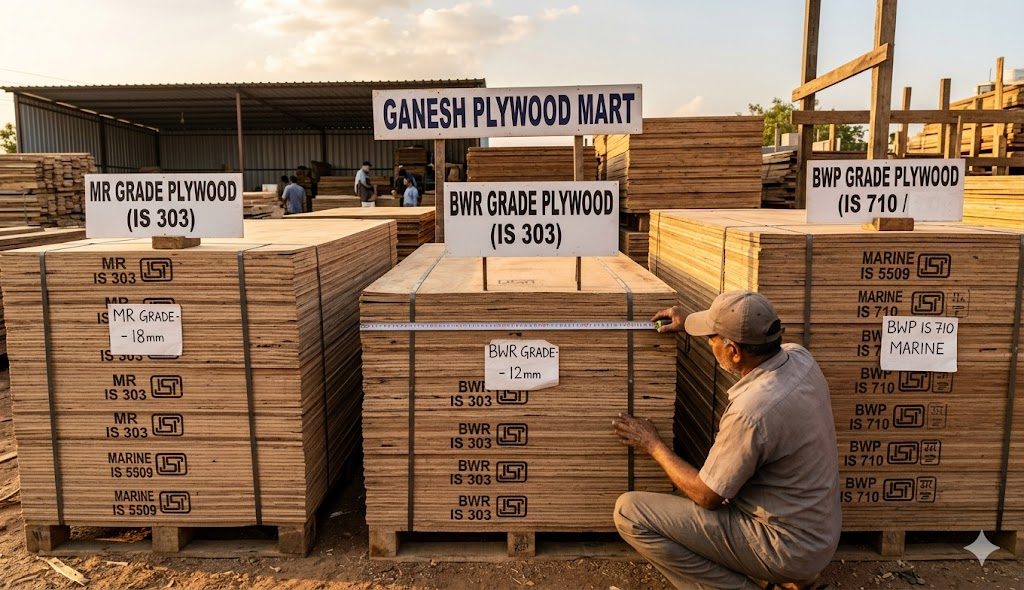
Complete Guide to Plywood Grades in India
MR, BWR, BWP, FR — the IS-code ladder, the right grade per zone, and how to verify it on site
Most Indian interior failure traces back to one decision taken five minutes before the carcase order is placed: which plywood. Two sheets that look identical from the outside — same wood grain, same edge banding, same supplier — can have radically different lifespans. One survives twenty years under a sink. The other swells and crumbles in eighteen months. The difference is invisible to the eye, lives in the glue line, and is governed by a small set of Bureau of Indian Standards specifications that almost no homeowner has heard of.
This guide is the complete reference for plywood grades in India: the IS-code ladder from MR through BWP and FR, the right grade for every zone of an Indian home, real 2026 rupees-per-square-foot rates, the cost-versus-life arithmetic that makes the wrong grade the most expensive choice, the brand landscape, and the field tests that prove what your supplier actually delivered. It is the pillar of the Studio Matrx materials series, and it links to nine deep-dive companions on marine ply, laminates, flooring, hardware, IS codes and moisture-prone homes.
The single idea underneath all of it is brutal and simple: the right grade is decided by the zone, not the budget. Substituting MR where BWP is specified saves about ₹650 on a sheet and costs about ₹55,000 in rework five years later. The grade ladder is the cheapest insurance you can buy in any Indian interior.
The plywood grade ladder
Indian plywood is graded by the BIS — Bureau of Indian Standards — into a small number of clearly defined grades, each with its own IS specification. Four grades cover almost every interior decision a homeowner ever makes, with two more (concrete shuttering and preservative-treated) appearing only in specialist construction work.
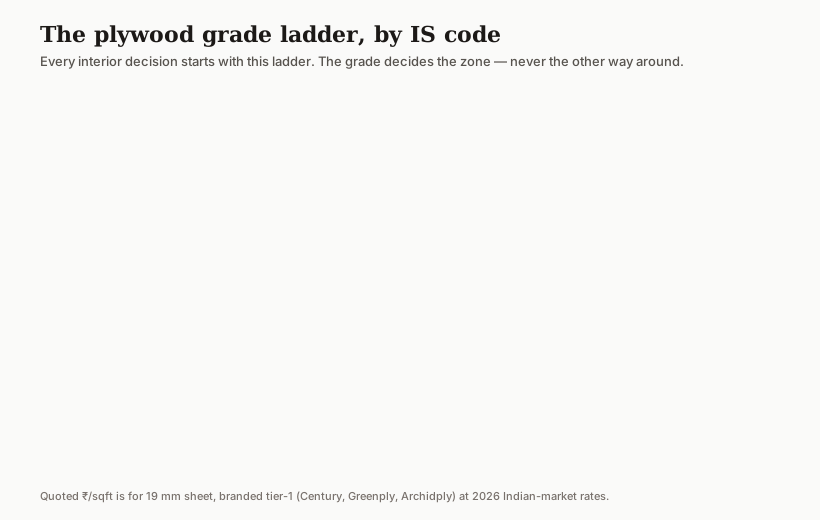
| Grade | IS code | Resin | Resists | Typical 2026 ₹/sqft (19 mm, tier-1) | Life in correct zone |
|---|---|---|---|---|---|
| MR | IS 303 Type II | Urea-formaldehyde (UF) | Conditioned humidity, occasional damp air | ₹45–65 | 8–12 years |
| BWR | IS 303 Type I | Phenol-formaldehyde (PF) | Humid air, occasional splash | ₹65–95 | 12–18 years |
| BWP / Marine | IS 710 | PF on hardwood plies | Repeated boiling-water exposure | ₹95–150 | 15–25 years |
| FR | IS 5509 | BWR/BWP base + FR chemical | Class-1 spread of flame | ₹110–180 | matches base grade |
The price step between MR and BWP is about a 2× increase — the lifespan increase in a wet zone is closer to 10×. That is the trade no homeowner regrets making and many regret missing.
Anatomy of a plywood sheet
To understand why two grades cost so differently, you have to look at what is actually inside a sheet. A 19 mm plywood is not one slab of wood. It is a sandwich of eleven to thirteen thin hardwood veneers, alternating their grain at 90° between layers, bonded together with a thermoset resin under heat and pressure. The wood does some of the work. The glue does most of it.
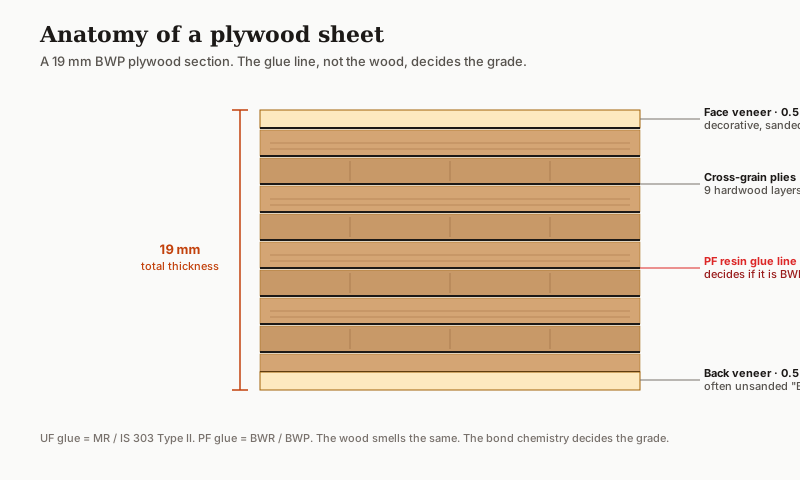
The glue line is where the grade lives. Urea-formaldehyde (UF) resin is cheap, dries clear and bonds well — but it is hydrolytically unstable, meaning prolonged exposure to water gradually breaks down the polymer chain. UF-bonded ply (MR / IS 303 Type II) is fine in a dry, conditioned bedroom and a disaster under a sink. Phenol-formaldehyde (PF) resin is more expensive, darker in colour, and chemically resistant to hydrolysis — which is why every grade above MR uses it. The hardwood veneers used in BWP (IS 710) are also denser and less prone to swelling than the mixed timber used in MR.
The thickness numbers you see in the market — 4 mm, 6 mm, 9 mm, 12 mm, 15 mm, 18 mm, 19 mm, 25 mm — refer to total sheet thickness and are an indicator of the number of plies. A 19 mm BWP typically uses 11 or 13 plies. Anything labelled as "21-ply" or similar is a brand description; what matters technically is the IS-code grade and the thickness.
Pick the grade by the zone
Most plywood failures in Indian homes are not about cheap brands. They are about the right grade in the wrong place. The matrix below shows the right IS-grade for each common zone of an Indian flat or house. Use this when you walk through the carcase order with your contractor.
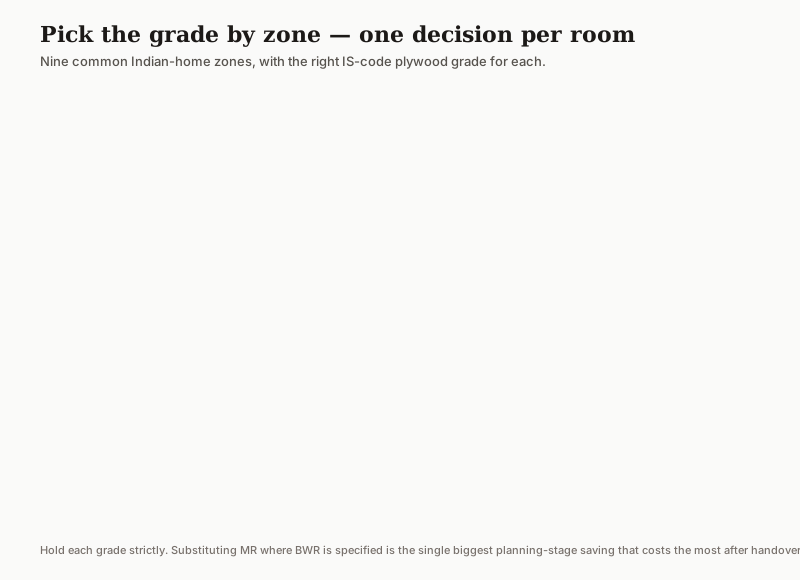
The compressed version, by zone:
| Zone | Recommended grade | Why |
|---|---|---|
| Living, dining, bedroom carcases | MR (IS 303 Type II) | Conditioned, dry, no water contact |
| Wardrobe (dry city) | MR | Move to BWR in coastal or high-humidity cities |
| Kitchen carcase (overhead, tall units) | BWR (IS 303 Type I) | Constant humidity from cooking, no direct water |
| Pooja zone | BWR | Diya heat, oil splash, incense humidity |
| Sink-base cabinet | BWP (IS 710) | Direct, repeated water exposure |
| Bathroom vanity | BWP | Constant high humidity, splash |
| Utility / washing area | BWP | Repeated splash, occasional flooding |
| Exterior balcony / terrace storage | BWP | Sun, rain, monsoon cycles |
| High-rise (above 15 m) | FR (IS 5509) base BWR/BWP | NBC Part 4 fire-safety requirements |
The rule of thumb is harsh and simple: wet zone always BWP; everything else BWR is the safe default. MR is correct only where the air is conditioned, the relative humidity is moderate, and water exposure is impossible.
The IS-code decision tree
The IS codes are the language of plywood quality in India, and the only language your vendor's quote should be in. Read this as a decision tree from the zone you are specifying to the code your BOQ should cite.
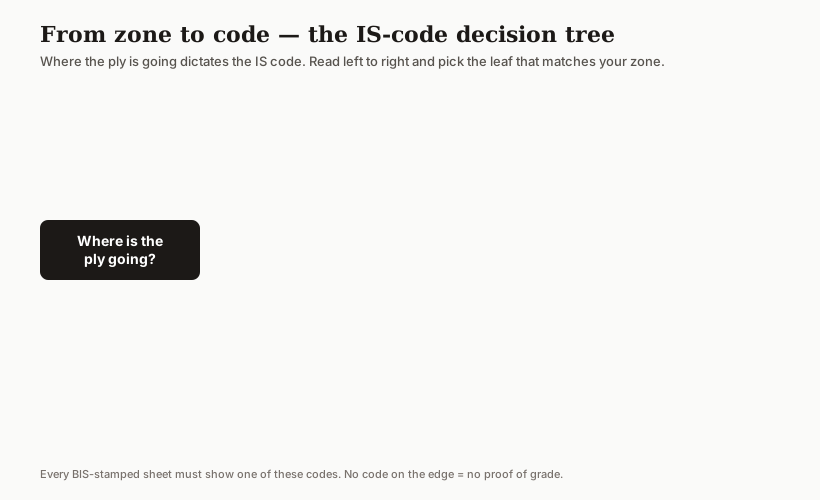
Every BIS-stamped sheet must show one of these codes on the edge. If a delivered sheet shows no IS code on its visible edge, no licence number from BIS, and no manufacturer batch number, it is not certified at the grade it was sold as — regardless of what the invoice says. There is a deep dive on the full code family in understanding IS codes in interior design.
Cost versus life — the wrong grade is the most expensive grade
This is where the choice settles. The chart below plots cost-per-square-foot against expected service life. Two facts stand out: when the grade matches the zone, more cost buys roughly proportionally more life. When the grade is wrong for the zone, the relationship collapses — MR in a wet zone is the cheapest grade to buy and by far the most expensive grade to own.
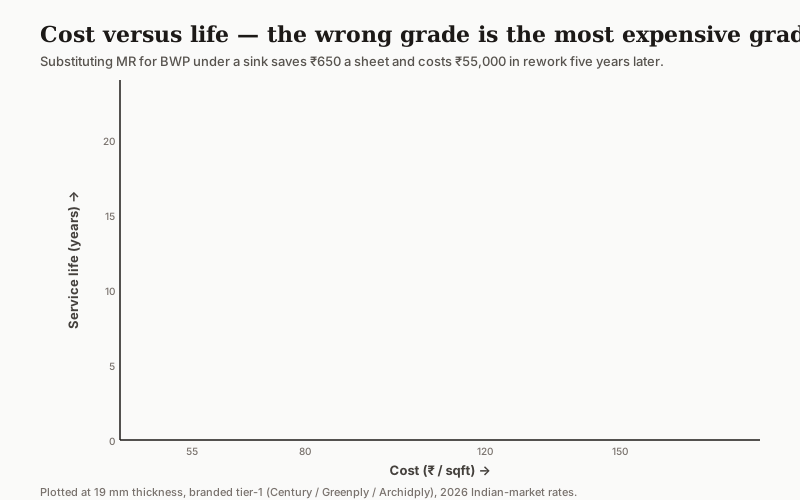
The arithmetic, on a single sink-base cabinet (roughly 1.0 sheet of 19 mm plywood):
| Choice | Material saving | Replacement cost at year 2–3 | Net cost over 10 years |
|---|---|---|---|
| BWP from the start | — (baseline) | 0 | ~₹2,500 (counter reseal, hardware refresh) |
| MR substituted in | ₹650 saved on day one | Replace cabinet + dismantle counter + reroute plumbing ≈ ₹55,000 | ₹54,350 over baseline |
The trade is never about the saving — it is about the obligation. You cannot replace a sink-base cabinet without dismantling the kitchen above it. The cost of MR in a wet zone is the cost of replacing everything built on top of it.
The deep dive on this for the kitchen specifically is in why most Indian kitchens fail after 5 years, and the broader version is in why cheap interiors become expensive later.
How to verify ply on site — five tests
The hard fact about plywood in India is that the invoice does not prove the grade. Substitution at delivery — the contractor was quoted BWR and supplied MR — is common, and it is the moment to catch it, not after the carcases are built. Five tests, in order, settle it.
1. Look for the BIS mark. Every certified Indian plywood sheet must carry the BIS / ISI mark stamped on its visible edge, along with the IS code (IS 303 or IS 710), grade designation (MR / BWR / BWP), licence number, and manufacturer batch. No mark, no proof. A reputable mill will mark every sheet; an unmarked sheet is at best uncertified and at worst counterfeit.
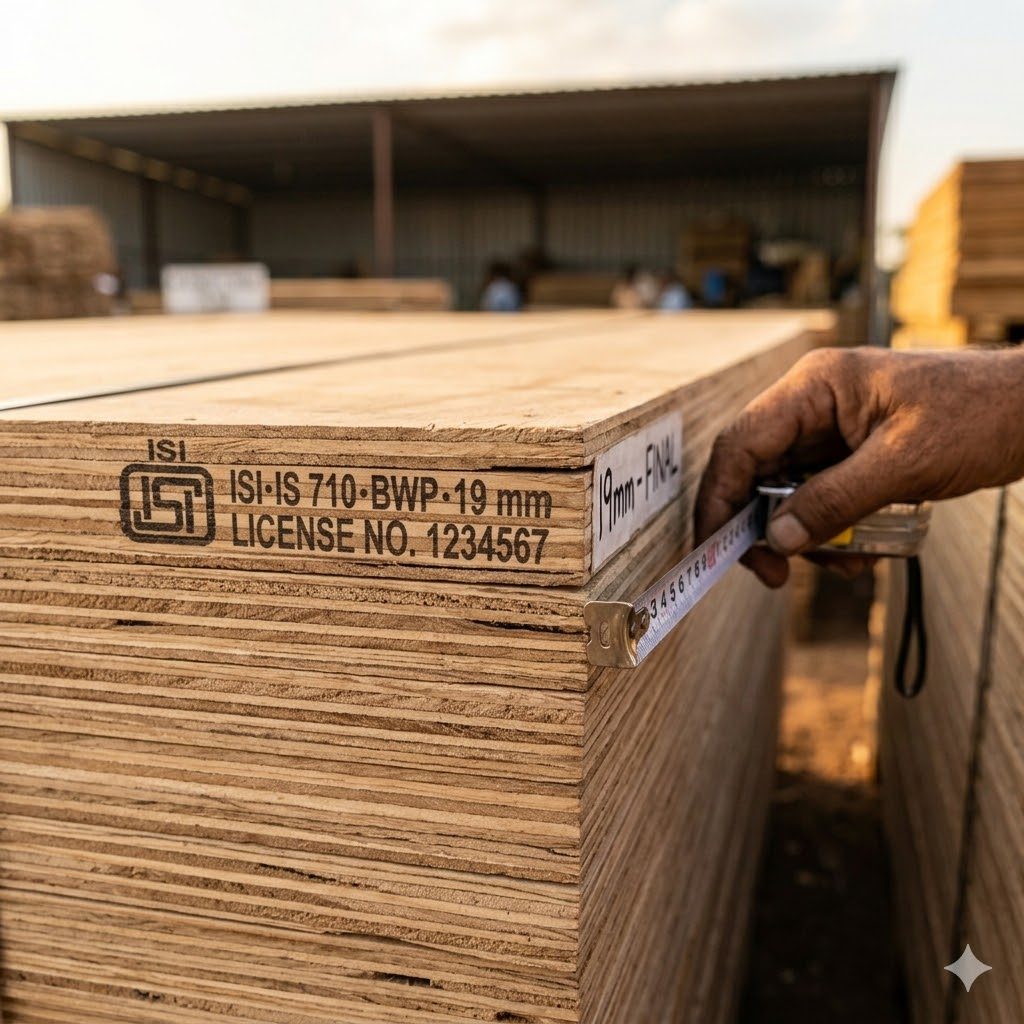
2. Edge inspection. Run your eye along the cut edge. The plies should be uniform in thickness, the glue lines should be tight and unbroken, no gaps or "core overlaps" should be visible, and the colour of the glue lines should be consistent — darker for PF (BWR/BWP), lighter for UF (MR). A BWP sheet feels heavier than the same thickness MR; the hardwood veneers are denser.
3. Knife test. Push a knife edge into a glue line. On a true BWP / IS 710 sheet, the glue line should refuse to part — the wood will splinter before the bond breaks. On an MR sheet sold as BWP, the glue line opens cleanly.
4. Burn test (off-cut only). Burn a small off-cut. PF resin (BWR/BWP) produces a dark, oily smoke and a hard glassy char that does not crumble. UF resin (MR) produces a lighter smoke and a brittle ash. This is destructive and only useful on a sample sheet for major orders.
5. Boil test. The lab version of grade verification. Boil a 25 mm × 25 mm sample in water for 72 hours (BWR) or 72 hours followed by drying cycles (BWP / IS 710). The plies must remain bonded. Mills will perform this on request for a documented batch; large contracts should specify it in the contract.
For a complete on-site materials verification routine across plywood, laminate, hardware and stone, use the Studio Matrx material quality checklist.
The Indian brand landscape
Branded ply costs roughly 20–35% more than unbranded at the same nominal grade — and is worth it, because the BIS licence and process control are real. The Indian market in 2026 is dominated by what the trade calls the "Big 9": CenturyPly, Greenply, Archidply, Greenam (Greenlam), Sharon, Kitply, Sarda, Action Tesa and Crown. Within these, CenturyPly and Greenply are the price leaders for tier-1 BWP, with Archidply and Greenam carrying a slight premium and a stronger marine specification.
Choose by IS grade first, brand second, thickness third. A Greenply BWP IS 710 sheet and a CenturyPly BWP IS 710 sheet are interchangeable for almost any residential use. An unbranded "BWP" sheet at half the price is rarely true to grade, and the saving is exactly the discount you take on the lifespan of every cabinet built from it.
The nine deep dives
This guide is the hub. Each spoke below goes deep on one material decision — read the ones that match your specification.
1. Marine Ply vs HDHMR vs MDF — when each engineered-wood substrate is the right answer.
2. Best Laminate Finishes for Indian Homes — gloss, matte, suede, textured; brand tiers and ₹/sqft.
3. How to Choose Flooring for Indian Weather — vitrified, wood, SPC, stone, by climate zone.
4. Matte vs Glossy Interiors — fingerprint, scratch and ageing behaviour compared.
5. PU Finish vs Laminate Cost Comparison — when the spray-paint premium earns its keep.
6. Complete Guide to Interior Hardware — hinges, slides, locks, dampers, tracks.
7. Understanding IS Codes in Interior Design — the full code family every BOQ should cite.
8. Why Cheap Hardware Destroys Expensive Interiors — the failure modes that take the kitchen with them.
9. Best Materials for Moisture-Prone Homes — coastal, monsoon and basement specifications.
The fix, in order
1. Map every zone in the flat to its IS-code grade before the BOQ is drawn — kitchen carcase, sink, bath, pooja, balcony.
2. Hold the grade strictly — never substitute MR where BWR is specified, never BWR where BWP is specified.
3. Cite the IS code in every line of the BOQ — not "BWP" alone, but "BWP to IS 710".
4. Verify on delivery — BIS mark, edge inspection, knife test on at least one sheet per batch.
5. Specify by-zone in writing so the contractor cannot down-substitute at site.
6. Budget the upgrade — moving every wet zone from MR to BWP adds roughly 5–8% to the carcase line and is the highest-ROI line in the entire interior.
7. Pair the grade with the right laminate, hardware and edge band — the ply is the substrate, not the finished product.
Plywood is the substrate everything else sits on. Get this one decision right and every laminate, every hinge, every counter top above it gets ten more years.
Studio Matrx makes the specification effortless: DesignAI drafts an IS-code-aware material schedule and BOQ for your floor plan in minutes, with the grade pinned per zone — so the substitution that costs the most never happens.
References
- Bureau of Indian Standards (1989, reaff. 2018) IS 303: Plywood for General Purposes — Specification. New Delhi: BIS.
- Bureau of Indian Standards (2010) IS 710: Marine Plywood — Specification. 3rd rev. New Delhi: BIS.
- Bureau of Indian Standards (2000, reaff. 2020) IS 5509: Fire-Retardant Plywood — Specification. New Delhi: BIS.
- Bureau of Indian Standards (1995) IS 1659: Block Boards — Specification. New Delhi: BIS.
- Bureau of Indian Standards (2016) National Building Code of India 2016, Part 4: Fire and Life Safety. New Delhi: BIS.
- Forest Products Laboratory, USDA (2010) Wood Handbook — Wood as an Engineering Material. General Technical Report FPL-GTR-190. Madison, WI: U.S. Department of Agriculture.
- Sellers, T. (1985) Plywood and Adhesive Technology. New York: Marcel Dekker.
This guide is the pillar of the Studio Matrx Materials & Finishes series. Deep-dive companions: Marine Ply vs HDHMR vs MDF, Best Laminate Finishes for Indian Homes, How to Choose Flooring for Indian Weather, Matte vs Glossy Interiors, PU Finish vs Laminate Cost Comparison, Complete Guide to Interior Hardware, Understanding IS Codes in Interior Design, Why Cheap Hardware Destroys Expensive Interiors, and Best Materials for Moisture-Prone Homes.
Export this guide
Related Guides — Deep-dive reading
Complete Guide to Interior Hardware
The 8–12% of the interior budget that decides whether everything else works
Materials & FinishesMarine Ply vs HDHMR vs MDF
When each engineered-wood substrate is the right answer for an Indian interior
Materials & FinishesThe Homeowner's Guide to Interior Design Budgets in India
Where the money really goes in an Indian fit-out — realistic 2026 ranges, cost-per-sqft truths, bang-for-buck upgrades, life-cycle costing and contracts
Home PlanningRelated Tools — Try Free
Full-Room BOQ — Living, Bedroom, Kitchen, Bath
Room-wise BOQ across living, bedrooms, kitchen, utility, and bathrooms with line-item pricing.
Full-Room BOQHome Building & Interior Cost Calculator — 20 Cities
Construction + interior costs for 20 Indian cities across kitchen, wardrobes, flooring, painting, ceiling.
Cost CalculatorMaterial Comparison Sheet
India's interior material cheatsheet — plywood, finishes, hardware, countertops, paints, waterproofing.
Reference Guide