
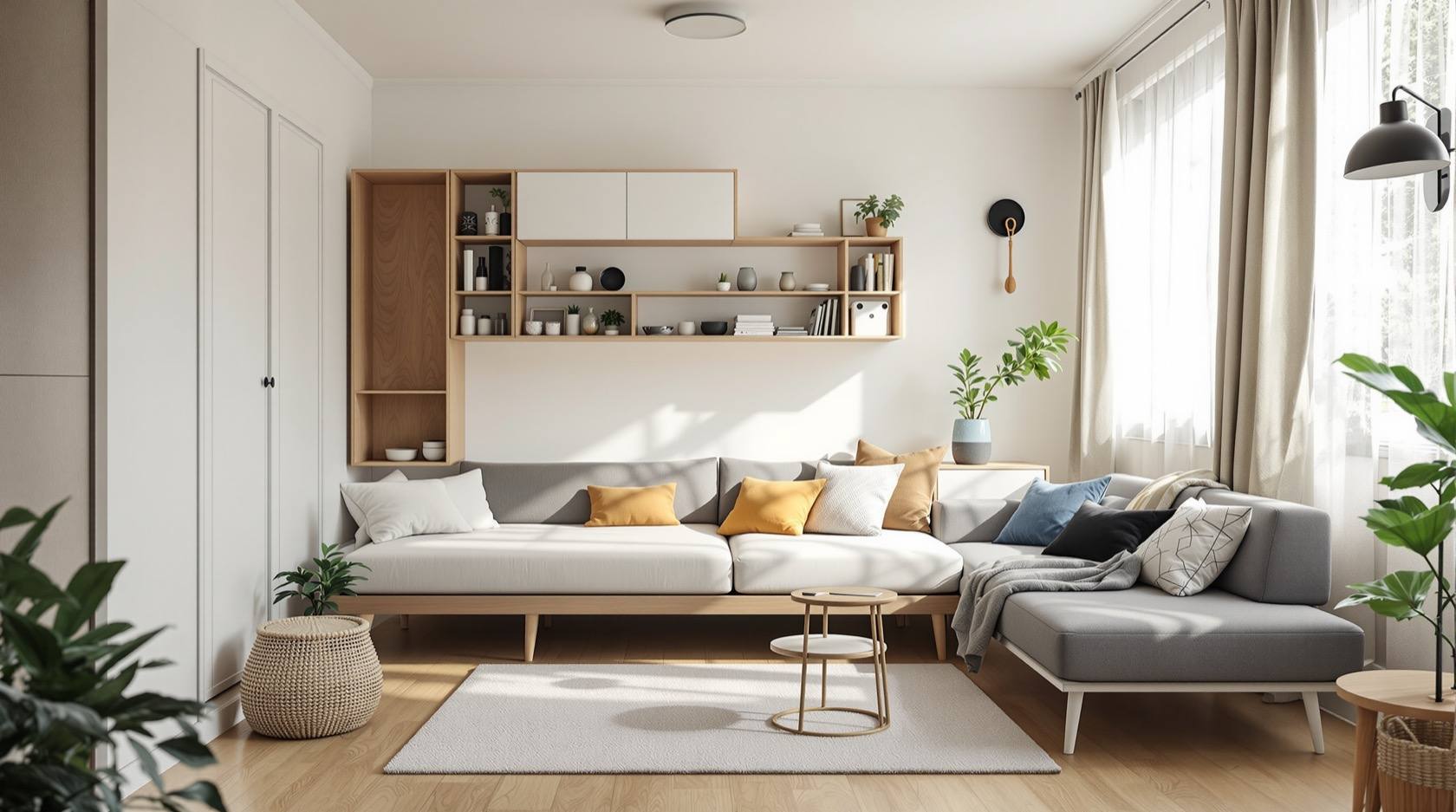
Furniture for Small Homes & Apartments in India: Fit More, Feel Bigger (2026)
How to choose furniture for a compact Indian flat — the principles that make a small room feel bigger, the multi-function and transforming pieces that earn their footprint, the storage tricks, room-by-room quick wins, what to avoid, and renting-friendly picks.
A small flat is not a big flat with less money — it is a different design problem. In a 1BHK, a studio or a compact 2BHK, every piece of furniture is competing for the same square metres, the same daylight and the same walk-path. Buy for a showroom that has none of those constraints and you end up with a beautiful room you cannot move through. Buy with the constraints in mind and a 500-600 sq ft flat can seat guests, sleep two, dine, store a household and still feel open.
This guide is the small-home playbook: the handful of principles that make a compact room read as bigger, the multi-function and transforming pieces worth their footprint, how to squeeze real storage out of thin air, room-by-room quick wins, the pieces to avoid, and picks that survive a rental move. It sits inside the complete guide to furniture in India — start there for the big picture, then use this for the compact-flat lens.
Scope & how to read this. This is a planning and selection guide, not a fabrication or firm-quote guide. Every cost cue is an indicative band to help you shortlist — get local quotes before you buy. Heavy sizing and clearances (sofa depths, bed sizes, dining seating, desk heights) live in the dedicated ergonomics and sizing guides, which we link to at each hand-off; a small room punishes a wrong size twice as hard, so use them. Safety-critical items — anti-tip anchoring of tall units, child-safe corners, and low-VOC / low-formaldehyde (E1/E0) boards in a small, poorly-ventilated flat — are flagged seriously and are not optional.
The principles: how to make a small room feel bigger
Before you buy a single piece, internalise these. They cost nothing and they decide more than any individual product.
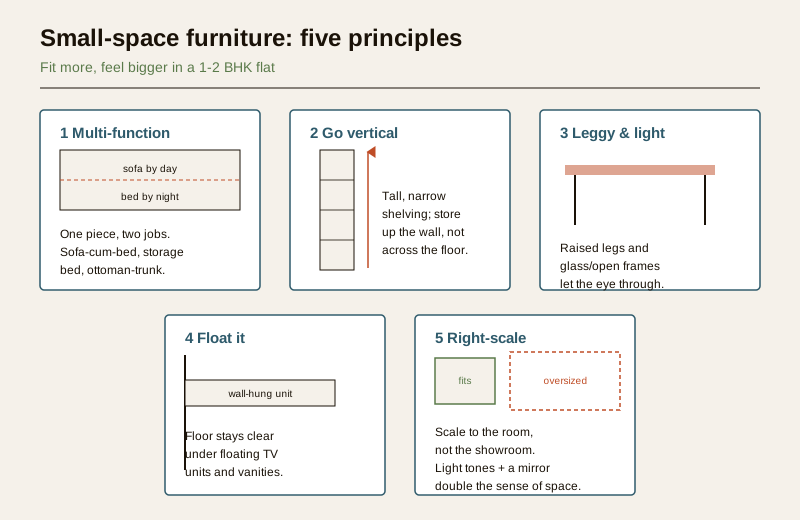
- Multi-function first. In a compact flat the best piece does two jobs — a sofa that becomes a bed, an ottoman that stores linen, a bench that seats and hides shoes. One footprint, two functions.
- Go vertical. Floor area is scarce; wall height is not. Tall, narrow shelving and wardrooms that run to the ceiling store far more per square foot than low, sprawling units.
- Leggy and see-through feels lighter. Furniture raised on visible legs, and pieces in glass or open frames, let the eye and the light travel underneath and through — the room reads as larger even when it holds the same volume. A skirted sofa that meets the floor reads as a solid block; a leggy one floats.
- Wall-mount and float. A wall-hung TV unit, a floating vanity, a cantilevered bedside shelf all keep the floor visible — and a visible floor is the single strongest cue that a room is spacious.
- Nest, fold and stack. Nesting tables, folding chairs and stackable stools expand for guests and disappear the rest of the time.
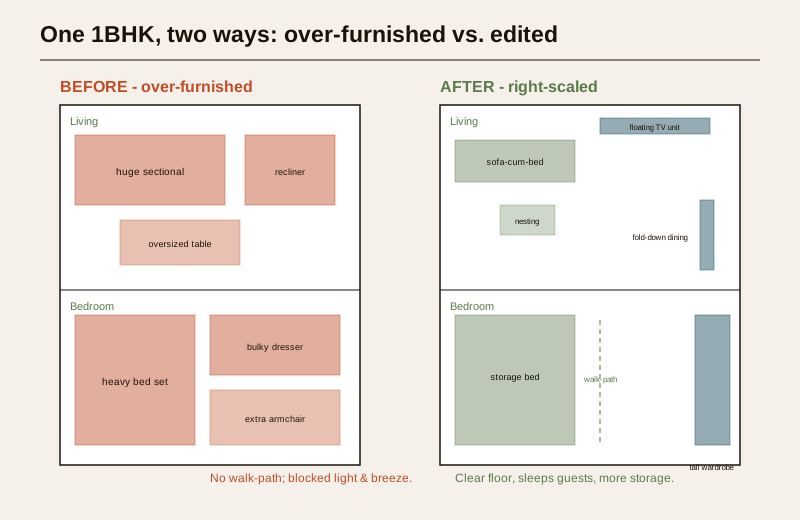
- Right-scale, never oversized. Scale furniture to the room, not to the showroom. A slim 2-seater and a 5-seater cost similar effort to choose; only one fits. Fewer, correctly-sized pieces beat many crammed ones.
- Light colours and a mirror. Pale upholstery, light wood and off-white laminates bounce light and recede; one well-placed mirror facing a window can visually double a room. This is the cheapest space-maker there is.
Multi-function and transforming pieces
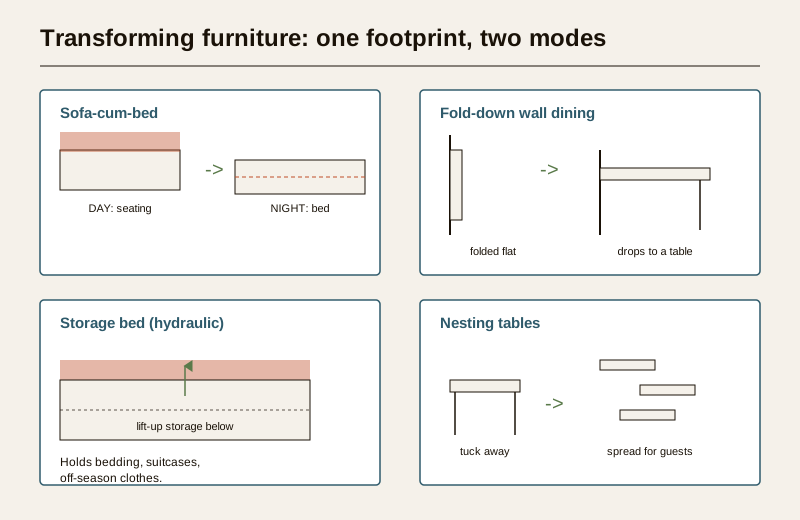
This is where a small flat is won or lost. A transforming piece pays for a whole extra function without paying for the floor it would otherwise need. Studio Matrx has a dedicated deep-dive — space-saving furniture — for the full catalogue and mechanisms; this section is the shortlist and what to watch for, not a repeat of it.
| Transforming piece | The two jobs it does | Watch out for |
|---|---|---|
| Sofa-cum-bed | Daytime seating + a guest or nightly bed | Mattress thinness on cheap folding frames; buy for comfort if it is your main bed |
| Storage bed (hydraulic / box) | Sleep + bulk storage below | Gas-lift quality; ventilate stored bedding in humid, monsoon India to avoid mildew |
| Fold-down / wall-mounted dining | Table when needed, flat wall the rest of the time | Wall must be solid; fixings rated for the load — a fabrication and anchoring job |
| Nesting tables | One table or several, on demand | Stability of the smallest table; leggy metal versions read lightest |
| Ottoman / trunk with storage | Extra seat or footrest + hidden storage | Hinge and lid safety near children; soft-close is worth it |
| Murphy / wall bed | A whole bedroom that folds into a cabinet by day | Serious carpentry + wall anchoring; best for studios, get it engineered |
| Extendable dining table | Everyday small, festive large | Leaf mechanism smoothness; needs clear room to extend |
Two cautions. First, a transforming piece is only a bargain if you actually use both modes — a sofa-cum-bed that never unfolds is just a stiff sofa. Second, the moment a piece is fixed to a wall or built as joinery (fold-down dining, Murphy bed, loft storage), it becomes fabrication and anchoring work: brief a carpenter or manufacturer, specify the wall type and load, and treat the anchoring as safety-critical. The built-in vs modular vs loose furniture guide is the decision tool for when to build in versus keep loose — a call that matters more in a small home than anywhere else.
Built-in and bespoke: putting awkward corners to work
Loose furniture leaves dead zones — the gap beside the fridge, the space under a staircase, an odd nook by the entry, the sliver above a door. Bespoke joinery is how a small flat reclaims them. A carpenter can build a study desk into a 600 mm alcove, a shoe bench into an entry recess, a loft over the bedroom door, or a pooja niche into a corner that loose furniture would only block.
The trade-off: built-ins fit perfectly and add storage, but they are fixed — which is wrong for a rental, and permanent if your needs change. Route this decision through custom furniture vs ready-made and bespoke furniture explained, and budget it with the custom furniture estimator. When you do build in, specify E1 or E0 low-formaldehyde boards (per the plywood/MDF/particle-board IS grades) — in a small, closed flat, indoor-air quality matters more, and the MDF vs particle board and plywood furniture guides cover which board to trust where.
Storage: the small-home battleground
A compact flat rarely lacks furniture; it lacks storage, which is why floors and surfaces end up cluttered and the room feels smaller than it is. Attack storage vertically and in the dead spaces:
- Go up. Take wardrobes and shelving to the ceiling; the top 600 mm holds off-season and rarely-used items. A loft over the bathroom or entry passage is prime bulk-storage in Indian flats.
- Under everything. Storage beds, drawers under the sofa, risers under a divan, storage inside ottomans and benches. The volume under a bed alone can equal a small wardrobe.
- Behind doors and on walls. Over-door racks, pegboards, wall-hung units and slim niches use surfaces that would otherwise stay blank.
- Wardrobe efficiency, not size. A well-planned 4 ft wardrobe with the right mix of hanging, shelving and drawers out-stores a badly-planned 6 ft one. Plan it with wardrobe and closet planning and the wardrobe storage capacity calculator.
For the full compact-home storage system — including kitchens, utility and small-flat strategies — use storage solutions for compact apartments and the storage hub; this guide only sets the furniture-side moves. Anchor tall storage: a top-heavy wardrobe or open shelving unit that is not wall-fixed can tip onto a child — anti-tip strapping is not optional in a home with kids.
Room-by-room quick wins
The same principles land differently in each room. The quick wins below are the highest-return moves for a compact Indian flat.
| Room | Do this | Route sizing to |
|---|---|---|
| Living | Leggy 2- or 3-seater over a bulky sectional; nesting tables; floating TV unit; a mirror facing the window | Sofa buying and sizing, sofa size calculator |
| Bedroom | Storage bed; slim tall wardrobe; wall-hung bedside shelf instead of two side tables | Bed and mattress sizes, bedroom retreat |
| Dining | Fold-down or wall-mounted table; extendable table; benches that tuck fully under | Dining table sizing and seating, compact dining solutions |
| Work-from-home | Fold-down or floating desk in an alcove; a compact ergonomic chair, not a bulky executive one | Home office furniture and ergonomics, desk and chair height calculator |
Do not eyeball dimensions in a small room — a sofa 150 mm too deep or a bed that blocks a wardrobe door is a daily irritation. The furniture ergonomics guide and the furniture size chart give the clearances; the furniture layout designer and furniture layout validator let you test the plan against the walk-paths before you buy anything. For the deeper craft of planning tight rooms, the small-space design course is the long-form companion.
What to avoid in a small flat
Some choices quietly eat a compact room. Steer clear of:
- Bulky recliners and oversized sectionals. They swallow a small living room and kill circulation; a leggy 2-seater plus a light armchair seats the same people in half the visual weight.
- Matching heavy "sets." A dark, matching sofa-set-plus-centre-table-plus-corner-tables bought as one bundle rarely fits a small room; it reads as one heavy block. Mix lighter, individually-scaled pieces instead.
- Over-furnishing. The commonest small-home mistake is too many pieces, not the wrong ones. Empty floor is a feature. If a piece has no daily job, it is stealing space.
- Deep, low, floor-hugging pieces. Deep skirted sofas and low platform beds without storage waste the volume they sit on.
- Dark, heavy finishes on large surfaces. They advance visually and shrink the room; save deep tones for small accents.
Renting-friendly picks
If you rent — as most compact-flat dwellers in Indian cities do — favour loose, portable, damage-free pieces you can carry to the next flat:
- Loose over built-in. Freestanding wardrobes, bookcases and units move with you; joinery does not. Save built-ins for a home you own.
- Modular and knock-down. Pieces that flat-pack or unbolt survive a move and a narrow staircase — a real constraint in older buildings and small lifts.
- Damage-free fixings. Prefer freestanding tall units (still anti-tip strapped) and tension-rod or adhesive solutions over anything that needs holes in a landlord's wall.
- Neutral and adaptable. Light, plain pieces suit whatever the next flat looks like and resell easily.
The renting angle is one axis of the wider buy-well decision — pair this with the furniture buying guide for how to shop, and the homeowner's guide to buying furniture for the end-to-end journey.
How it connects
- Start at the complete guide to furniture in India, then use space-saving furniture for the full transforming-piece catalogue and storage solutions for compact apartments for the storage system.
- Decide built-in vs loose with built-in vs modular vs loose furniture and custom furniture vs ready-made; estimate bespoke work with the custom furniture estimator.
- Get the sizing right with the furniture ergonomics guide, sofa buying and sizing and bed and mattress sizes; test the layout with the furniture layout designer and furniture layout validator.
- Plan rooms with compact dining solutions, wardrobe and closet planning and the apartment living hub; browse ideas in living room and bedroom galleries.
- Buy well with the furniture buying guide; go long-form with the small-space design course.
Key takeaways
- A small flat is a different problem, not a cheaper one — furniture competes for floor, light and walk-path, so plan for all three.
- The principles that make a room feel bigger cost nothing: multi-function, vertical, leggy/see-through, wall-mounted, nesting/folding, right-scale, light colours and a mirror.
- Transforming pieces (sofa-cum-bed, storage bed, fold-down dining, Murphy bed, nesting tables) earn their footprint — but only if you use both modes, and anchored/built-in ones are safety-critical fabrication work.
- Win the storage battle vertically and in dead spaces; a well-planned smaller wardrobe beats a badly-planned bigger one.
- Avoid bulky recliners, oversized sectionals, matching heavy sets and over-furnishing — empty floor is a feature.
- If you rent, favour loose, modular, damage-free pieces that move with you.
- Route heavy sizing and clearances to the ergonomics/sizing guides and layout tools; anti-tip anchoring and low-VOC (E1/E0) boards are not optional.
References
- The IS furniture standards — furniture safety, strength, stability and durability (named generally; confirm current parts with BIS).
- Plywood and engineered-board grades — IS 303 / IS 710 (plywood, MR/BWR/BWP), IS 3087 / IS 3097 (particle board), IS 12406 (MDF), IS 1659 (blockboard), IS 1734 (plywood tests) — for board choice and low-formaldehyde selection.
- Formaldehyde emission classes E0 / E1 / E2 (CARB / EN 13986 context) — indoor-air-quality benchmark for boards in small, closed flats (named generally).
- IGBC / Indian Green Building Council and CRI GreenPro — eco-certification context for low-emission furniture.
- Manufacturer fittings and anchoring specifications — gas-lift, hinge, fold-down and anti-tip hardware load ratings; confirm with the maker and a carpenter.
All sizes, material notes and cost cues here are indicative planning aids only; confirm dimensions and clearances against the linked ergonomics and sizing guides, specify low-formaldehyde (E1/E0) boards and anti-tip anchoring for tall or built-in units, and get local quotes before you buy.
Export this guide
Related Guides — Deep-dive reading
The Complete Guide to Furniture for Indian Homes (2026)
The start-here master guide for furnishing an Indian home — what furniture actually does, the five families of pieces, the decisions in the order you face them (space and needs, loose vs modular vs built-in, materials, size and layout, budget, buy, maintain), an honest read on plywood, humidity and termites, and where every choice hands off to the carpenter, the brand or the fixer.
FurnitureSpace-Efficient Homes — A 2026 Working Reference for Compact Indian Apartments
Five spatial multipliers · Floor plan tricks · Dual-purpose furniture
Room PlanningStorage Planning Before Interior Design
Why storage must be planned first — audited, budgeted and given its floor area — before a single layout, colour or sofa is chosen. The homeowner's plan-it-first master guide for Indian homes.
StorageRelated Tools — Try Free
Apartment Furniture Size Chart
Standard furniture dimensions for Indian apartments — sofas, beds, tables, dining, storage.
Reference ChartWardrobe Storage Capacity Calculator
India-specific garment math — sarees, lehengas, kurtas, shirts, shoes. Pick a layout (2-door → walk-in), see live fill and saturation gauges.
Capacity CalculatorFull-Room BOQ — Living, Bedroom, Kitchen, Bath
Room-wise BOQ across living, bedrooms, kitchen, utility, and bathrooms with line-item pricing.
Full-Room BOQ