
False Alarm Prevention for Burglar Alarms in India: Causes & Fixes (2026)
Why home alarms cry wolf — ceiling fans, pets, heat, insects, weak batteries, power blips and poor door alignment — and how correct placement, the right sensors and simple upkeep keep the system trusted and armed.
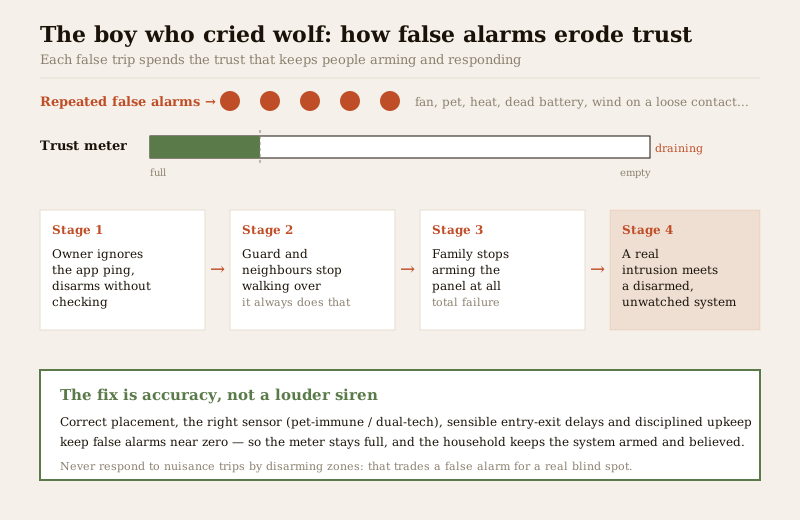
An alarm that goes off for no reason is worse than annoying — it is corrosive. The first false alarm at 2 a.m. gets everyone out of bed. The third one gets the society guard rolling his eyes. By the fifth, the family has quietly stopped arming the system "because it keeps going off," and now the house has an expensive box on the wall protecting nothing. This is the boy who cried wolf, told in electronics: every false trip spends a little of the trust that makes people arm the system and makes a neighbour actually walk over to check.
False alarm prevention is therefore not a minor tuning job — it is what keeps a burglar alarm believed and switched on. This guide is part of the Studio Matrx burglar alarm hub and the complete guide to burglar alarms in India. It walks through why Indian homes get false alarms — fans, pets, heat, insects, weak batteries, power blips, loose wiring, RF interference and monsoon grime — and, for each, the honest fix: correct placement, the right sensor, sensible entry/exit delays and disciplined upkeep.
Scope & safety. This is about accuracy — making the alarm fire when it should and stay quiet when it should not. It is never about creating blind spots, muting zones, or leaving areas unprotected. Every fix here keeps full coverage while removing the false triggers. Panel wiring, mains connection and mounting at height are a licensed installer's or electrician's job; the homeowner plans sensor positions, chooses the right detector, and does safe upkeep. This is educational guidance, not legal advice.
The real cost of a system that cries wolf
Before the causes, be clear about why this matters so much in the Indian context. Most home alarms here are self-monitored: a siren sounds, and a GSM or app-based notification pings the owner and a call-list. There is no verified-alarm auto-dispatch to police — a human has to decide the alert is real and dial 112 or 100. The practical first responders are the family, the society guard, and neighbours.
Every one of those humans runs on trust. A system that false-alarms teaches them to ignore it:
- The owner stops treating the app notification as urgent, or disarms remotely without checking.
- The guard and neighbours stop walking over — "it always does that."
- The family stops arming the panel at all, which is the total failure: a disarmed system detects nothing.
So a false alarm is not a harmless nuisance. It is a slow withdrawal from the trust account that makes the whole monitoring and response chain work. Keeping the false-alarm rate near zero is what keeps the system armed and believed.
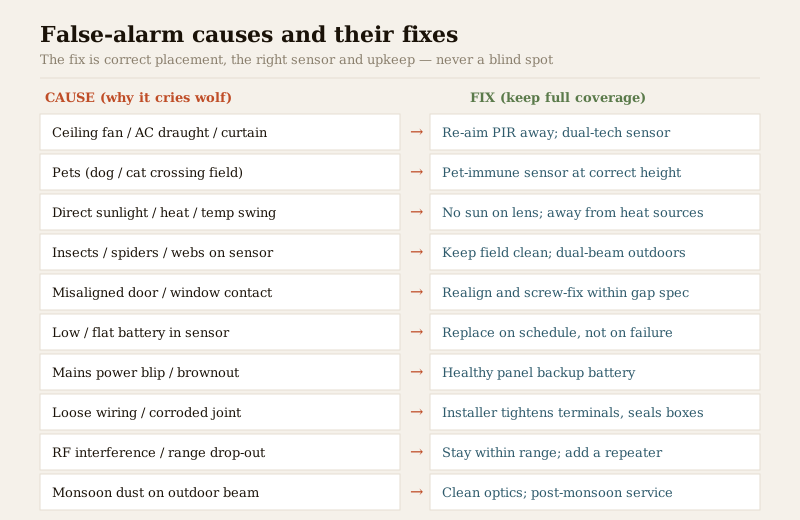
Why alarms cry wolf: causes and fixes
Almost every false alarm traces back to one of a handful of causes. The table below is the quick map; the sections after it explain each fix in plain terms. Notice that the fix is almost never "make the sensor less sensitive everywhere" — that just creates the blind spots we are trying to avoid. The fix is correct placement, the right sensor, and upkeep.
Ceiling fans, AC draughts and blowing curtains
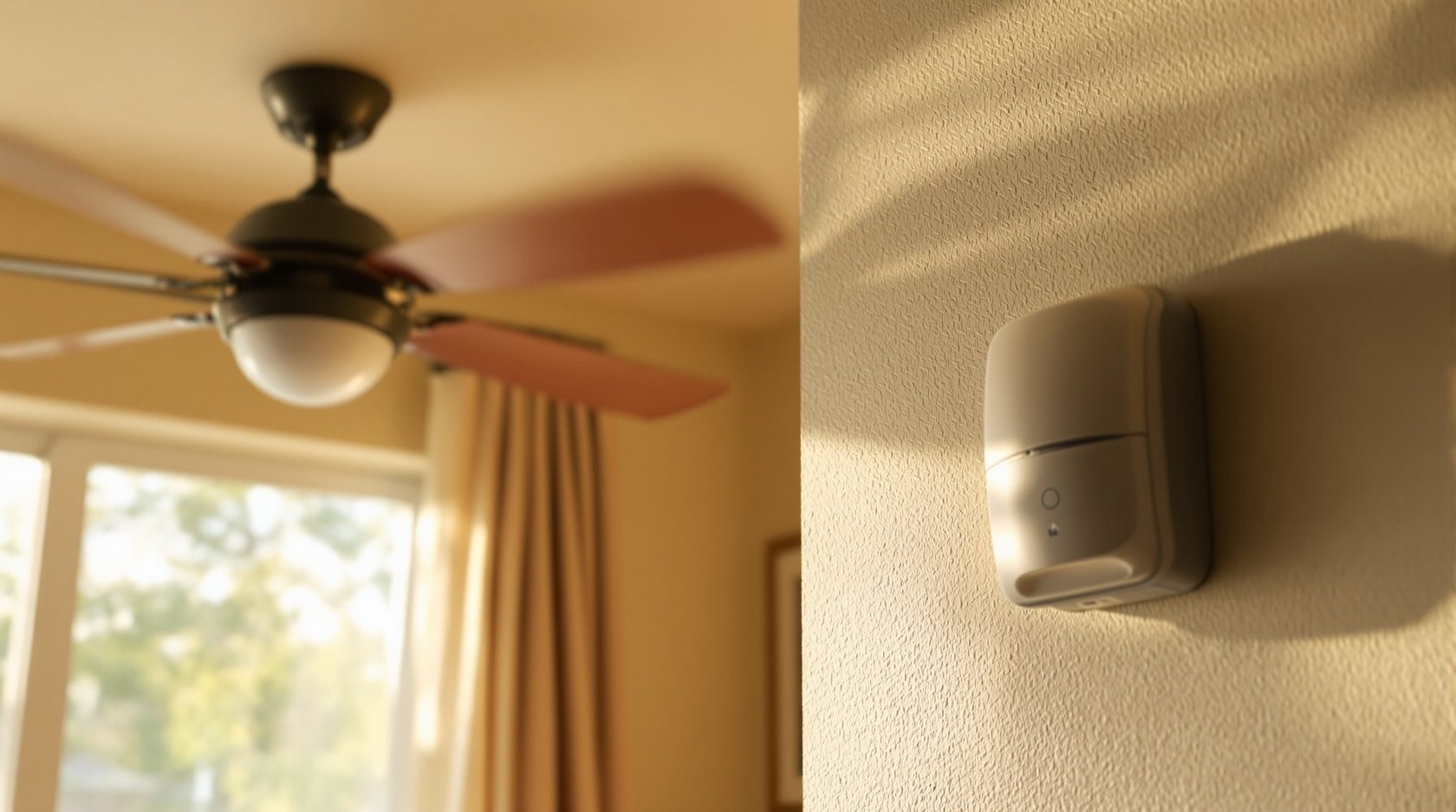
The single most common false alarm in an Indian home. A PIR (passive infrared) sensor does not "see" movement — it detects changes in heat across its field of view. A ceiling fan stirring warm air, an air-conditioner or cooler blowing a draught, or a curtain billowing in front of a warm window all create moving heat patterns that a PIR can read as a person walking.
The fix — placement first:
- Mount the PIR so its field of view does not cross a ceiling fan, an AC/cooler vent, or a curtain that moves. Aim it along a wall or across an entry path, not up into the fan's sweep.
- Keep it away from heat sources generally (more below).
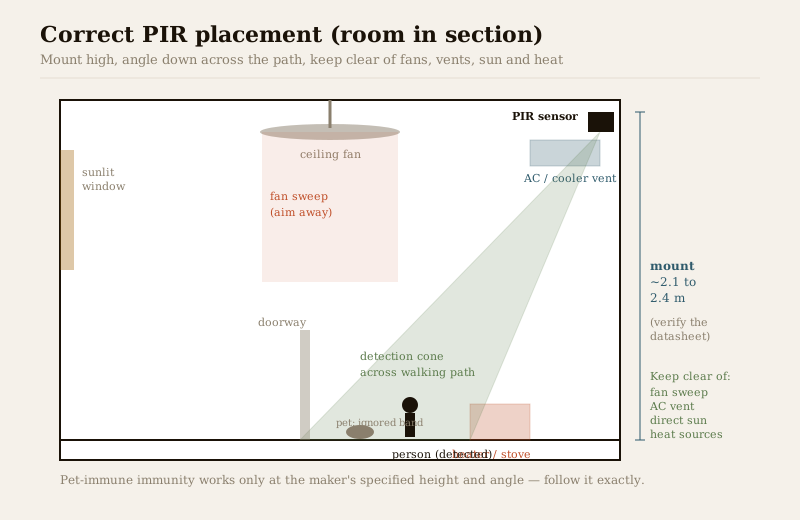
- Where a draught is unavoidable, choose a dual-technology sensor that must confirm heat and microwave movement before it triggers — a moving curtain will not fool both. See the correct-placement figure below.
- Tuck loose curtains back from the sensor's line of sight when arming for the night.
Pets
A dog or cat walking through the motion sensor field is warm, moving, and — to a basic PIR — indistinguishable from a small person. Homes with pets that false-alarm nightly are the classic case of a family that stops arming.
The fix — the right sensor, not a disabled zone:
- Use a pet-friendly (pet-immune) motion sensor, designed to ignore mass below a rated weight (commonly up to around 15–25 kg, per the manufacturer's datasheet — treat the figure as indicative and verify it) while still detecting an adult.
- Mount at the correct height and angle so the pet stays in the "ignored" lower band — follow the maker's pet-immune mounting instructions exactly, because the immunity only works at the specified geometry.
- For a large dog, prefer dual-technology detection or protect that room with door and window contacts plus a glass-break sensor instead of a floor-sweeping PIR — you keep the room covered without the pet tripping it.
Never "solve" pets by leaving a room unarmed. That is a blind spot, not a fix.
Direct sunlight, heat and temperature swings
Because a PIR reads heat, a fast temperature change in its field can look like motion. Direct sunlight tracking across the sensor through the day, a patch of floor heating up in the afternoon, a heater, a kitchen stove, or headlights sweeping through a window can all trigger it.
The fix:
- Position the sensor so direct sunlight never falls on it and it does not stare at a window that gets strong sun.
- Keep it away from heaters, stoves, hot appliances and hot-air vents.
- Mount on a stable interior wall, not above a radiator or a west-facing glass wall.
Insects and spiders on the sensor
A tiny insect crawling directly on the PIR lens is, from centimetres away, a large moving heat source — a guaranteed trigger. Spiders love the warmth of electronics and spin webs across sensors and outdoor beams; a swinging web reads as motion.
The fix — upkeep:
- Keep the detection face and its housing clean and clear. Wipe sensors gently during routine checks; clear webs and dust.
- Use insect-repellent measures around outdoor detectors, and choose sealed, gasketed outdoor housings.
- For outdoor perimeter beams, a dual-beam design (both beams must break together) rejects a single insect, a falling leaf or a bird — a genuine intruder breaks both.
Misaligned door and window contacts
A door or window sensor is a magnet and a reed switch that must sit close and aligned. If the gap grows — a sagging door, a warped frame, a monsoon-swollen window, or a contact stuck on with tape that peeled — the switch flickers open and closed on its own and false-alarms, especially in wind.
The fix — alignment and mounting:
- Mount magnet and switch firmly and correctly aligned, within the maker's specified gap (typically a small number of millimetres). Screw-fix rather than rely on adhesive alone for anything that gets used daily.
- Re-check alignment after the monsoon and whenever a door or window starts to drag or rattle.
- On a door that never seals tightly, a wired contact on a solid frame is more stable than a stick-on wireless one.
Low or flat batteries, and why battery backup matters
A weak battery is a leading cause of nuisance trips and "sensor trouble" signals. A wireless sensor running low can send spurious signals or drop offline; the panel may fault or false-alarm. And because Indian mains power blinks constantly, the panel's own backup battery is central to reliability.
The fix — disciplined maintenance and backup:
- Replace sensor batteries on schedule, not when they die. Note the model's expected battery life (often one to three years for a wireless sensor, per the datasheet) and diarise replacement; act the moment the panel shows a low-battery warning.
- Ensure the panel and siren have a healthy backup battery so a power cut or a brief mains blip does not fault the system or trigger a "power fail" alarm. See wired and hybrid systems for how mains and backup are wired — that connection is an electrician's job; see the electrical hub.
- Keep a small stock of the right battery types so a warning is fixed the same week.
Mains power blips and brownouts
Beyond the backup battery, unstable power itself causes trouble: a brownout can reset a poorly protected panel or send a communicator into an error state that reads as an alarm. This is squarely an Indian reality.
The fix:
- A properly sized and healthy backup battery rides through the typical cut — this is the primary defence.
- Ensure the installer has provided clean, protected power to the panel; surge protection on the supply helps. Anything touching the mains is a licensed electrician's job.
Loose wiring and corroded connections
In a wired or hybrid system, a loose terminal, a nicked cable, a corroded junction or a rat-chewed run creates intermittent open/short conditions the panel reads as sensor activations — random, maddening, and worst in humid and monsoon months.
The fix:
- Have the installer inspect and tighten terminations, check junction boxes for moisture and corrosion, and look for rodent damage — especially after the monsoon.
- Use proper glands and sealed boxes outdoors. This is installation and maintenance work, not a homeowner DIY on live wiring.
RF interference on wireless systems
A wireless system can be disturbed by RF noise on its frequency, or a sensor mounted too far from the panel (or behind metal or a lift shaft) that drops in and out — read by the panel as trouble or, occasionally, as activity.
The fix:
- Site the panel and sensors within the rated range, avoiding thick RC walls, metal cupboards and lift machinery between sensor and panel.
- Use a repeater where a far sensor is marginal, rather than accepting a flaky link.
- Prefer systems with supervised, encrypted links that report a genuinely lost sensor as a fault (so you fix it) instead of silently failing.
Monsoon dust and grime on outdoor sensors and beams
Outdoor beam sensors and perimeter detectors take the full force of dust, monsoon film, cobwebs and the odd bird. A grimy lens scatters the beam; a web across it swings in the wind. Both read as a break.
The fix — disciplined upkeep, timed to the season:
- Clean outdoor optics and housings regularly, and do a thorough clean just after the monsoon (around October for most of India), when grime and webs peak.
- Choose weather-sealed housings and dual-beam geometry outdoors so a single leaf or insect does not trip the perimeter.
Correct PIR placement — the diagram that prevents most false alarms
Get the placement right and you eliminate the majority of false alarms before they ever happen. The figure below shows the geometry: mounted at the recommended height (commonly around 2.1–2.4 metres — verify the model's datasheet), angled to sweep an entry path, and kept clear of the fan sweep, the AC vent, direct sun and any heat source.
| Placement rule | Why it prevents false alarms |
|---|---|
| Mount at the maker's recommended height (often ~2.1–2.4 m), angled down across the path | Puts people squarely in the field; keeps pets in the ignored lower band |
| Do not aim across a ceiling fan's sweep | Removes the number-one moving-heat false trigger |
| Keep away from AC/cooler vents and blowing curtains | Draughts and billowing fabric no longer read as motion |
| No direct sunlight on the sensor; avoid staring at a sunlit window | Stops sun-tracking and heat-swing trips |
| Away from heaters, stoves, hot appliances | Removes fast temperature-change triggers |
| Face into the room, not at reflective glass or mirrors | Prevents phantom heat reflections |
| Within rated wireless range; add a repeater if marginal | Avoids drop-outs read as trouble/activity |
Entry and exit delays: letting people in and out without a false trip
A large share of "false" alarms are really the household itself — someone opening the door to leave before the system fully arms, or coming home and not reaching the keypad in time. The fix is not to under-protect the door; it is to configure sensible entry and exit delays and staged arming.
- Exit delay — a few seconds (typically 30–60) after you arm, to walk out and lock up without tripping the entry sensor.
- Entry delay — a matching window when you open the main door, to reach the keypad or app and disarm before the siren sounds.
- Staged / partial arming — "night" or "stay" modes arm the perimeter (doors, windows, glass-break) while leaving interior PIRs off so the family can move around at night without tripping it. This is coverage design, not a blind spot: the shell stays protected. See the zoning guide.
- Keep delays short — long delays are a real security trade-off. Give the audible siren and any silent alarm or panic button their correct, immediate behaviour.
A maintenance discipline that keeps false alarms near zero
Most of the fixes above are placement and sensor choice done once. The rest is a light, repeatable routine — the same discipline that keeps any security system trustworthy.
| When | Task | Prevents |
|---|---|---|
| Monthly | Walk-test each zone; confirm every sensor reports and the siren/app responds | Undetected dead or drifting sensors |
| Monthly | Note any low-battery or trouble warnings and act on them the same week | Weak-battery nuisance trips |
| Quarterly | Wipe sensor faces and outdoor beams; clear webs, dust and insects | Insect/spider and grime false alarms |
| Quarterly | Re-check door/window contact alignment; tighten any that drifted | Misalignment flicker in wind |
| Post-monsoon | Thorough clean of outdoor optics; installer checks seals, wiring, corrosion, rodent damage | Monsoon grime and loose-wiring trips |
| Annual | Installer tests panel/siren backup battery; replaces sensor batteries on schedule | Power-blip faults and flat-battery trips |
| Annual | Confirm SIM validity and that the system is on a 4G-capable communicator (2G is sunsetting) | Silent loss of alerting |
Do the monthly walk-test and cleaning yourself; leave battery replacement in the panel, wiring, and anything at height to the installer under an AMC or on call.
When to bring in a professional. You can plan sensor positions, run monthly walk-tests, wipe reachable sensors, tuck curtains clear, and act on low-battery warnings. Hand the initial placement and mounting, panel and mains wiring, backup-battery service, RF-range fixes with repeaters, and any work at height to a licensed installer or electrician. If a system false-alarms repeatedly despite the basics, get the installer to log which zone trips and when — a pattern (always the fan room, always after a power cut, always in wind) points straight to the cause. Never respond to nuisance alarms by disarming zones and leaving coverage gaps; fix the cause instead. Use the system selector and cost estimator when planning, and see the installation and cost guides.
Key takeaways
- The real cost of a false alarm is lost trust — repeated cries of wolf make owners, guards and neighbours ignore the system and, worst of all, make the family stop arming it. Accuracy is what keeps a burglar alarm believed and switched on.
- Most false alarms come from a short list of causes — ceiling fans and AC draughts across a PIR, pets, direct sun and heat, insects and webs, misaligned door/window contacts, weak batteries, power blips, loose wiring, RF interference and monsoon grime.
- The fix is placement, the right sensor and upkeep — never a blind spot. Aim PIRs away from fans, vents, sun and heat; use pet-immune or dual-technology sensors; keep the detection field clean and clear; align contacts firmly.
- Battery backup and battery discipline are central in India — a healthy panel backup rides through power cuts, and replacing sensor batteries on schedule stops nuisance trips.
- Entry/exit delays and staged arming let the household live in the home without false trips, while keeping the shell fully protected — configure short delays and lean on the zoning guide.
References
- Manufacturer datasheets for PIR, dual-technology, pet-immune and beam sensors — verify mounting height, detection angle, pet-immunity weight, wireless range and battery life on the maker's own document before placing or buying; treat all figures here as indicative.
- National Emergency Number 112 (and legacy Police 100) — India's self-monitored alarms rely on a human verifying an alert and dialling in; keeping false alarms near zero protects the credibility of that response chain.
- National Building Code of India (SP 7), Bureau of Indian Standards, for any electrical, wiring or mains-connection aspect of an alarm install or backup-battery service; verify the current edition via the BIS catalogue: https://www.services.bis.gov.in/
This is an educational overview, not legal advice. Panel wiring, mains connection, backup-battery service and any work at height are qualified professional tasks — engage licensed installers and electricians, and verify any standard's current status via the BIS catalogue before relying on it.
Export this guide
Related Guides — Deep-dive reading
Security Sensor Testing in India (2026): A Homeowner's Monthly Walk-Test
How to regularly test the detectors your alarm depends on — PIR motion, door and window contacts, glass-break and vibration, and perimeter beams — safely and without setting off a real monitored alarm, so an untested sensor never becomes a silent gap the night it matters.
SecurityHow to Choose a Burglar Alarm in India (2026): Sensors, Alerts and What Actually Matters
A homeowner's guide to selecting an intruder alarm that fits your flat, villa or shop and alerts you the way you want — matching the sensor mix, control panel and the big siren-versus-monitored decision to your real risk, and dodging the false-alarm traps that make people switch systems off.
SecuritySecurity for People Living Alone in India (2026): Calm, Practical Habits When There Is No Second Person to Notice
Living alone is an ordinary and growing part of Indian life - the student in a new city, the working single, the elder whose children are abroad, the person after a separation. It does not call for fear. It calls for a few deliberate habits, because there is no second person in the home to notice trouble, raise the alarm, or catch an accident. This is calm self-reliance, layer by layer.
SecurityRelated Tools — Try Free
Window Cleaning Cost Calculator
Estimate professional window cleaning cost per visit and per year by access and frequency.
Window CalculatorCCTV Mounting Height & Angle Calculator
Height, target distance and lens angle to the downward tilt, the blind dead-zone below and where coverage begins and ends.
Height & AngleBurglar Alarm System Selector
Answer a few questions about your property, cabling, coverage, monitoring and power and get the right burglar alarm — wired / wireless / hybrid, self or professionally monitored — with the design non-negotiables.
Alarm Selector