
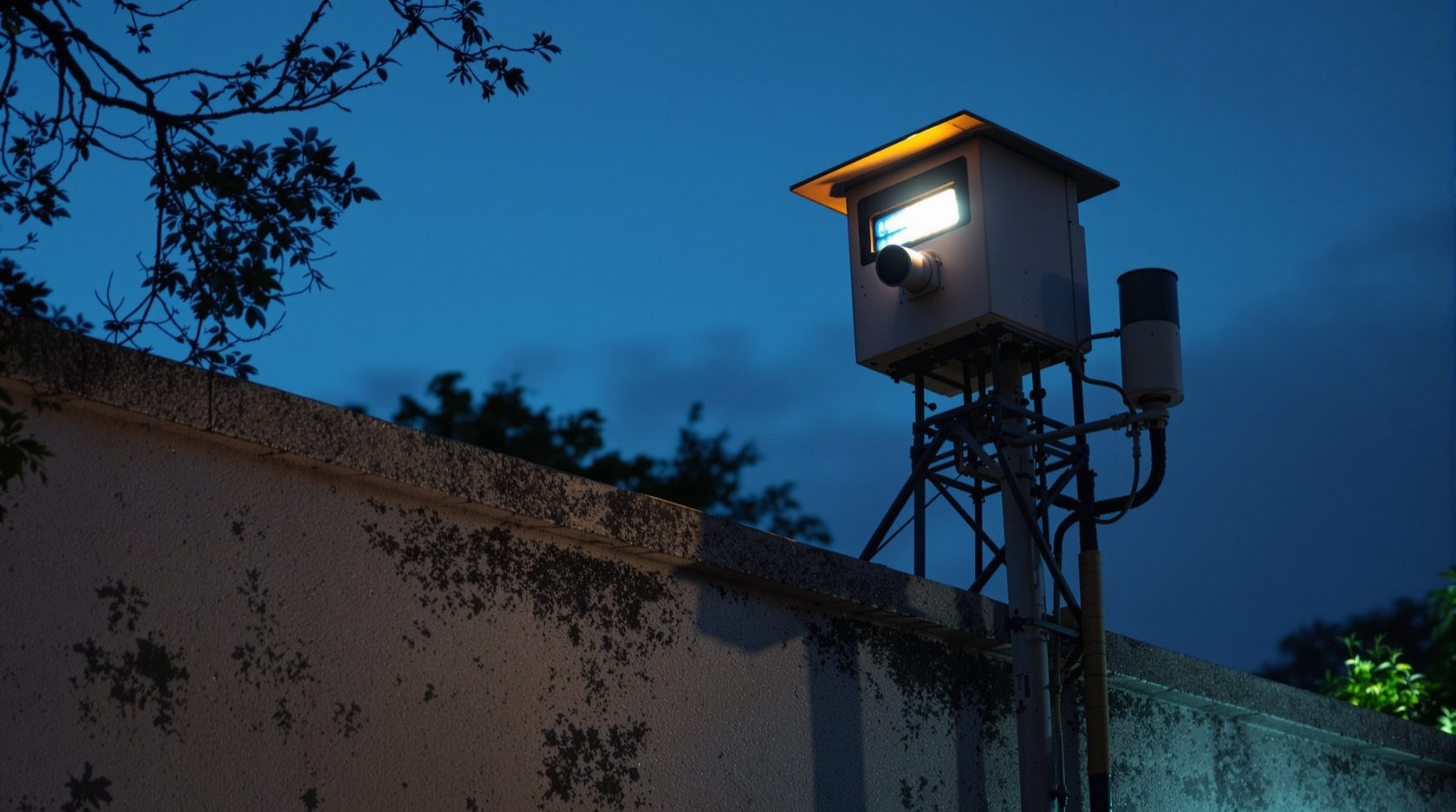
Perimeter Alarm Systems in India (2026): Detect an Intruder at the Boundary
How an outer detection layer — outdoor motion sensors, beam barriers, fence and wall-top sensors and gate contacts — warns you the moment someone crosses your compound wall, and how to design it for Indian weather without endless false alarms.
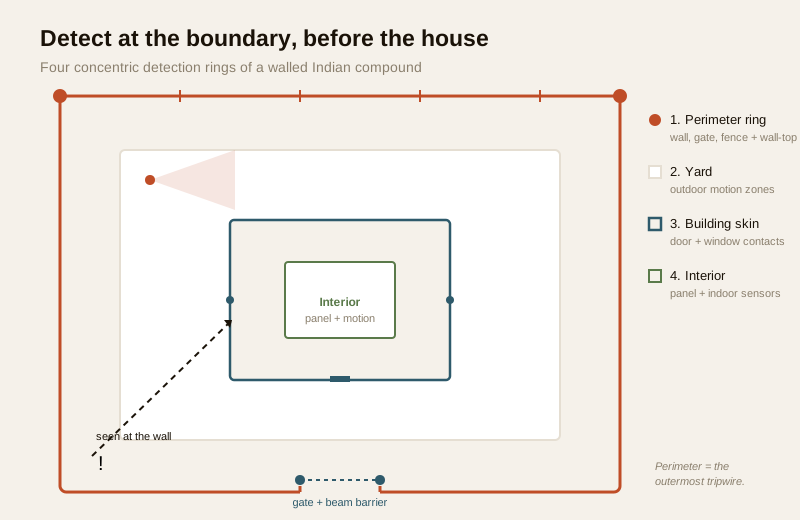
Most home alarms wait until the intruder is already inside — a door contact trips as the door opens, a motion sensor sees someone in the living room. By then they are in your home. Perimeter alarm systems flip that timeline. They watch the outermost line — the compound wall, the gate, the boundary fence — and raise the alarm the moment someone crosses it, while the intruder is still outside, in the open, and has done nothing but climb a wall.
That head start is the whole point. A perimeter layer is the first ring of a layered security design: detect early, deter loudly, and buy the minutes that let you respond, call for help, switch on lights, or simply scare an opportunist off before anything is broken. For Indian compounds, villas, farmhouses, open plots and society boundaries — where a walled perimeter already exists and there is real distance between the gate and the front door — an outer detection layer fits naturally. This guide is part of Studio Matrx's burglar and intrusion alarm library; it explains the perimeter detection family at an overview level, why the outer layer matters, and — honestly — the false-alarm problem outdoors and how to design around it.
Scope, honesty & safety. This guide helps you plan, choose and coordinate a perimeter system, and it is strictly about detection — how to see an intruder arriving, never how to defeat one. Two India realities to hold onto: most Indian alarms are self-monitored (they alert you, a neighbour or a guard by siren, call, SMS or app — not an automatic police dispatch, which remains limited here), and every outdoor sensor and the panel behind it need battery or solar backup or they die with the mains during a power cut. Mounting at height, mains wiring and any monitoring contract are licensed-professional work. This is educational guidance, not legal advice.
Why an outer layer is worth building
Think of your property as a set of concentric rings: the boundary wall or fence, the yard or setback, the building skin (doors and windows), and the interior. An intruder has to cross each in turn. The perimeter vulnerability assessment is where you map those rings and find the weak points; a perimeter alarm is how you put the earliest possible tripwire on the outermost one.
- It buys time. Detecting someone at the wall rather than at the door can add crucial minutes. In those minutes an app alert reaches your phone, a siren sounds, floodlights come on, and a casual intruder — who wants an easy, quiet target — very often simply leaves.
- It deters before entry. A visible sensor, a beam housing on the gate pillars, or lights that snap on the instant someone approaches all say "you have been seen." Deterrence that happens before entry protects the building itself, not just its contents.
- It suits Indian layouts. A city apartment has no perimeter of its own to defend — that is the society's job. But a villa, farmhouse or independent house with a compound wall, and a gated community with a boundary, have exactly the kind of clear outer line a perimeter system is built for. See the villas and independent houses and gated communities security guides for how this fits each setting.
An important honest caveat: an outer layer is a first warning, not a wall. It tells you someone is there; it does not stop them. That is why perimeter detection is always paired with the inner rings — door and window contacts, indoor sensors, good locks and cameras — never used alone.
The perimeter detection family
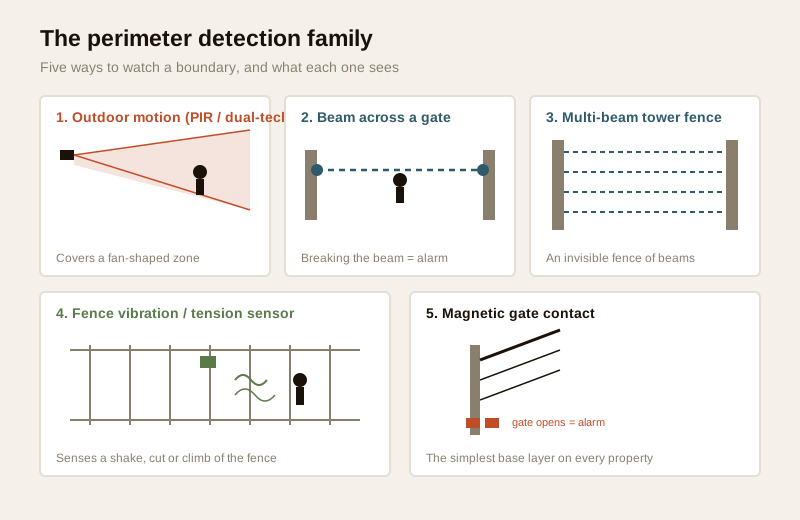
"Perimeter alarm" is not one device but a family, each member watching the boundary in a different way. You mix and match them to the shape of your plot. The deep-dives on each come later in this library; here is what each one is and where it earns its place.
- Outdoor motion detectors. The outdoor cousin of the familiar indoor PIR (passive infrared) sensor, hardened for weather and tuned for open ground. Mounted on a wall corner, a pillar or a pole, one covers a fan-shaped zone — a driveway, a side passage, a stretch of lawn. The best outdoor units are dual-technology (see below) and pet-tolerant, because open ground is full of moving warm bodies that are not intruders.
- Photoelectric / infrared beam barriers. A transmitter on one side sends one or more invisible infrared beams to a receiver on the other; interrupting a beam raises the alarm. A single-beam pair guards a gateway or a doorway; a multi-beam "tower" pair, mounted vertically on two posts, creates an invisible fence of beams along a wall or open boundary. Beams are precise and give a clean detection line, which is why they suit gates and long straight runs.
- Fence-mounted vibration and tension sensors. These attach to an existing boundary fence or wall-top and sense the shake, cut or climb of someone disturbing it — vibration sensors feel the knock; tension/strain sensors on a wired fence feel the pull. Ideal where you already have a long fence or grille and want the fence itself to become the sensor.
- Wall-top sensors. A compound-wall variant — sensors or a taut-wire/beam line run along the top of the boundary wall, the exact place an intruder must cross. They watch the line people actually climb rather than the open ground beyond it.
- Gate contacts. The simplest and cheapest perimeter device: a magnetic contact (like a door sensor, in a weatherproof housing) that trips when the main gate or wicket gate is opened. It will not catch someone climbing over, but it reliably flags the ordinary way in and pairs well with everything above.
| Detection type | Watches | Best for | Main false-alarm sensitivity |
|---|---|---|---|
| Outdoor motion (PIR / dual-tech) | An open zone (driveway, side, lawn) | Villas, farmhouses, courtyards | Animals, heat shimmer, moving foliage |
| Beam barrier (single) | A line across a gate or door | Gateways, entrances, gaps | Heavy rain/fog, large birds, misalignment |
| Beam barrier (multi-beam tower) | A vertical "fence" of beams | Long walls, open boundaries | Fog, dense insect swarms, foliage growth |
| Fence vibration / tension | The fence being shaken or climbed | Existing fences, grilles, farm plots | Wind, storms, large animals leaning |
| Wall-top sensor / taut wire | The top line of a compound wall | Walled villas, society boundaries | Monkeys, cats, birds landing, wind |
| Gate contact (magnetic) | The gate opening | Every property, as a base layer | Very few — a robust, low-noise device |
There is no single "best" — a real perimeter usually combines two or three: a gate contact everywhere, beams across the gateway and any wide gap, and either outdoor motion zones or fence/wall-top sensors along the run, chosen for your plot. The burglar alarm system selector is a good way to narrow the shortlist for your layout, and the wired versus wireless choice below decides how each sensor connects back to the panel.
The honest challenge: false alarms outdoors
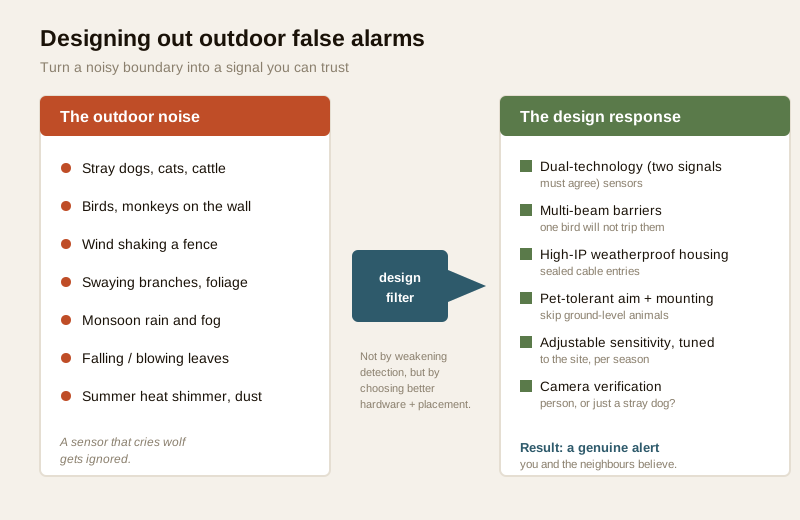
Here is the truth every perimeter-system owner learns: the outdoors is a noisy place. An indoor sensor lives in a still, controlled room. An outdoor sensor lives in wind, rain, heat, dust, insects and wildlife — and every one of those can look, to a simple sensor, like an intruder. Get this wrong and you build the worst kind of alarm: one that cries wolf so often that everyone starts ignoring it. In India specifically, the usual culprits are:
- Animals and birds — stray dogs and cats crossing a zone, cattle near a farm boundary, monkeys on a compound wall, birds landing on a beam or a wall-top line.
- Wind and weather — a gusty night shaking a fence, branches swaying into a motion zone, leaves blowing across a beam, heavy monsoon rain and fog scattering an infrared beam.
- Falling leaves and foliage growth — a creeper that grows into a beam over a season, or dry leaves drifting through a detection zone.
- Heat and dust — summer heat shimmer off a driveway confusing a single-technology PIR, and dust or spider webs building up on a lens or beam window.
None of this is a reason to skip a perimeter layer. It is a reason to design and specify it properly so it fires on people and stays quiet for everything else. The good news is that the mitigations are well understood, and they are all about choosing and placing the right hardware — never about weakening detection.
Designing out the false alarms
| Cause | Design response (what to specify) |
|---|---|
| Small animals, birds, pets | Choose pet-tolerant / pet-immune outdoor motion sensors; mount and aim zones to skip ground level where animals roam; prefer dual-technology units |
| Wind shaking a fence | Choose fence sensors with adjustable sensitivity and set it for a genuine climb/cut signature, not every gust; avoid over-sensitive single-vibration units on flimsy fencing |
| Rain, fog, monsoon | Use weatherproof housings with a high IP rating (see below); for beams prefer multi-beam designs so a single obstruction does not trip the alarm; keep beam paths clear |
| Heat shimmer, sun, dust | Prefer dual-technology motion sensors (they need two independent signals to agree); shade sensors from direct low sun; clean lenses and beam windows regularly |
| Foliage growing into a zone | Trim vegetation on the beam and zone paths each season; survey the run after the monsoon growth |
| A single point of failure firing | Layer sensors so one nuisance trip is cross-checked by a camera or a second sensor before you treat it as real |
Two ideas do most of the heavy lifting. Dual-technology motion sensors combine PIR (heat-movement) with a second method (typically microwave) and only alarm when both agree there is a person-sized, moving, warm target — a blowing leaf triggers one but not the other, so it stays quiet. Beam-break designs, especially multi-beam, are inherently selective: a person breaks the beam cleanly, while a bird crossing a single beam of a multi-beam array may not trip it if the device is set to require more than one beam broken together. Choosing these designs, and giving each sensor an adjustable sensitivity you can tune to your site, is the honest, defensive way to cut false alarms — you are making the sensor better at telling a person from a pigeon, not making it easier to sneak past.
A note on monitoring and false alarms: because Indian alarms are overwhelmingly self-monitored, a nuisance trip at 2 a.m. mainly costs you sleep and credibility. But if you use any professional monitoring or auto-dial service, remember that repeated false alarms waste a responder's time and can carry real consequences — one more reason to invest in dual-tech, weatherproofing and sensible placement up front.
Weatherproofing, power and wiring
Outdoor perimeter kit lives its whole life exposed, so three practical things decide whether it survives an Indian year.
- Weatherproofing (IP rating). Every outdoor sensor should carry a suitable Ingress Protection (IP) rating — the two-digit code for how well the housing keeps out dust and water. For monsoon-facing hardware look for a high rating (commonly IP65 or better for driving rain and dust); mount devices under an eave or shield where you can, and seal cable entries so water cannot track in. Poor sealing is the number-one cause of a "randomly firing" outdoor sensor after the first monsoon.
- Power and backup. Outdoor sensors are powered from the panel or a local supply, and the whole chain — panel, sensors, sirens and the network — must ride through a power cut on battery backup, or the perimeter simply switches off with the mains. For a far gate, a farm boundary or a spot with no cabling, solar-powered wireless sensors with their own battery are a common Indian answer; check the panel and repeaters are backed up too. This is not optional in a load-shedding country: an alarm that dies during a cut is exactly the alarm an intruder waits for.
- Wiring: wired or wireless. A wired perimeter is robust and needs no sensor batteries but means trenching or conduit out to the boundary — easiest in new-build or when the compound is being done up. A wireless perimeter avoids the digging and reaches distant gates and fences easily, at the cost of sensor batteries to maintain and a need for good radio range across the plot (repeaters help on large farmhouses). Many real properties end up hybrid — wired where cabling already runs, wireless out to the far boundary. Any mains connection, and any mounting at height on a pillar or pole, is a job for a licensed electrician or installer; see the electrical hub.
Perimeter works best with light and cameras
A perimeter alarm is one instrument in an ensemble. Two partners multiply its value.
- Perimeter lighting. Motion-triggered floodlights turn detection into visible deterrence: the sensor sees the intruder, the lights come on, and suddenly the "easy, dark, unseen" target is lit and exposed. Light also makes any cameras far more useful at night. (An outdoor motion sensor and a security light are often the same trigger.)
- CCTV for verification. Detection tells you that something crossed the line; a camera tells you what — a person, or a stray dog. Pairing perimeter sensors with cameras set up for the boundary lets you verify an alarm before you react, which is the single best cure for false-alarm fatigue. Studio Matrx's guide to CCTV intrusion and zone detection covers using camera-based line-crossing and zone rules alongside physical sensors, and the broader burglar alarm pillar shows how the alarm, cameras, locks and door phones fit one system.
Remember what a perimeter alarm is and is not. It detects and alerts; it does not lock, record or grant entry. It complements — never replaces — your locks, cameras and door phones, each of which has its own Studio Matrx library. Build the outer ring as one layer of a whole, not as a standalone gadget.
When to bring in a professional. You can plan the layout, choose the sensor family, and decide wired-versus-wireless yourself. Hand over the parts that need expertise: mounting sensors at height on pillars, walls or poles; any mains-connected power or lighting; trenching and outdoor cabling; and aligning beam barriers (a mis-aligned beam is a false-alarm machine). For a farmhouse or a large plot, have the installer do a proper site survey — plot shape, distances, radio range and power runs decide what actually works. For a society or RWA perimeter, treat it as a shared project with a written spec and a maintenance plan, and remember any professional monitoring or response contract, and its data handling, belongs in writing with a reputable provider.
Key takeaways
- A perimeter alarm detects at the boundary, before entry — the outermost ring of a layered security design — buying time and deterring an intruder while they are still outside.
- It is a family, not one device: outdoor motion detectors, infrared beam barriers across gates and along walls, fence vibration/tension sensors, wall-top sensors and gate contacts — usually combined to suit a villa, farmhouse, plot or society boundary.
- Outdoors means false alarms from animals, birds, wind, leaves, monsoon and stray dogs — design them out with dual-technology and multi-beam designs, high-IP weatherproofing, pet-tolerant placement and tunable sensitivity, never by weakening detection.
- Power and weather decide reliability: specify a suitable IP rating, seal every cable entry, and back the whole chain — panel, sensors, sirens, network — with battery or solar, because a perimeter that dies in a power cut is no perimeter at all.
- Pair it with light and cameras: motion-triggered perimeter lighting deters, and CCTV verification confirms a real intruder versus a stray dog — an alarm complements, and does not replace, your locks, cameras and door phones.
References
- Digital Personal Data Protection Act, 2023 — where a perimeter system feeds cameras, app alerts or any professional monitoring, the resulting footage and data are personal data; agree access, storage and any monitoring/response terms in writing with a reputable provider and keep credentials private.
- Manufacturer specifications and datasheets — verify each outdoor sensor's IP (Ingress Protection) rating, detection range and pattern, dual-technology/multi-beam behaviour and battery/solar life on the maker's own datasheet before ordering, and confirm it is rated for continuous outdoor Indian conditions.
- National Building Code of India (SP 7), Bureau of Indian Standards, and local municipal bye-laws for any electrical, lighting or life-safety aspect of an outdoor install; verify the current edition via the BIS catalogue: https://www.services.bis.gov.in/
This is an educational overview, not legal advice. It is strictly about detecting an intruder, never defeating detection. Work at height, outdoor cabling, mains-connected power and lighting, and beam alignment are qualified professional tasks — engage licensed installers, and verify any standard's current status via the BIS catalogue before relying on it.
Export this guide
Related Guides — Deep-dive reading
False Alarm Prevention for Burglar Alarms in India: Causes & Fixes (2026)
Why home alarms cry wolf — ceiling fans, pets, heat, insects, weak batteries, power blips and poor door alignment — and how correct placement, the right sensors and simple upkeep keep the system trusted and armed.
SecurityPerimeter Beam Sensors in India (2026): Invisible Trip-Lines Along the Boundary
How stacked active-infrared and laser photo-beams strung between towers along a wall, gap or long straight run raise the alarm the moment someone crosses the boundary — and how to place them so fog, birds and foliage do not.
SecurityBeam Sensors in India (2026): Active-Infrared Perimeter Detection for Gates, Walls and Farmhouse Boundaries
How active-infrared beam sensors work, where they earn their place on Indian plots, single-beam versus multi-beam towers, and how to tame the outdoor false-alarm problem with sound design.
SecurityRelated Tools — Try Free
Burglar Alarm System Selector
Answer a few questions about your property, cabling, coverage, monitoring and power and get the right burglar alarm — wired / wireless / hybrid, self or professionally monitored — with the design non-negotiables.
Alarm SelectorApartment vs Villa Interior Planning Guide
Compare ceiling height, structural flexibility, lighting, storage, and services between apartments and villas.
Planning GuideCCTV System Type Selector
Answer five questions and get the right CCTV setup — analog / IP / hybrid, wired / wireless, local / cloud — with reasons.
CCTV Selector