
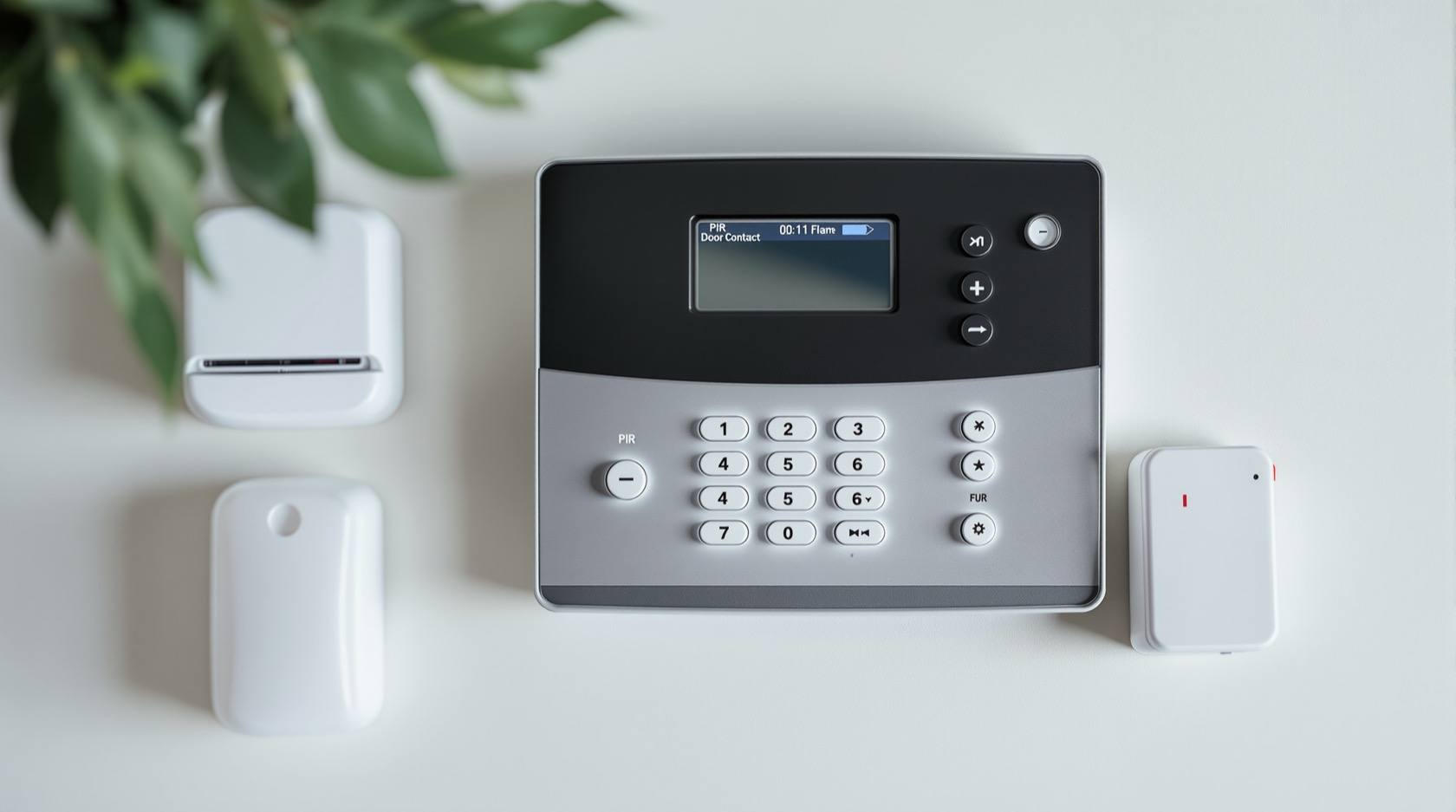
How to Choose a Burglar Alarm in India (2026): Sensors, Alerts and What Actually Matters
A homeowner's guide to selecting an intruder alarm that fits your flat, villa or shop and alerts you the way you want — matching the sensor mix, control panel and the big siren-versus-monitored decision to your real risk, and dodging the false-alarm traps that make people switch systems off.
A burglar alarm is one of the few security purchases where the cheapest option and the most expensive option can both be the wrong one. A single motion sensor and a screamer siren bought off a marketplace will annoy your neighbours and teach your family to ignore it. A sprawling professionally-monitored system sold to a two-bedroom flat is money spent on doors that were never the risk. The right alarm is the one matched to your home's actual weak points and to the way you genuinely want to be told that something is wrong.
Because that is the heart of it. Choosing an intruder alarm is really two decisions wearing one label. The first is which sensors, on which openings — the detection layer that decides whether the alarm even notices a break-in. The second, and the one most buyers underthink, is how you get alerted — a loud siren only, an auto-dial to your phone, an app push, or a professionally-monitored line. Get the sensor mix wrong and the alarm stays silent when it matters. Get the alerting wrong and it screams into an empty street while you sit in a meeting two cities away, none the wiser.
This guide walks the decision the way a careful homeowner should: understand the parts, match them to a flat, a villa or a shop, learn which specifications earn their money and which are marketing, and — above all — avoid the false alarms that are the single commonest reason a household stops arming its system at all.
Scope and how to use this. This is a selection guide, not an installation manual and not a price list. It helps you specify the right alarm and brief a competent installer; it does not tell you to wire it yourself, and it deliberately avoids rupee figures — for the numbers, see the burglar alarm cost guide. A burglar alarm is a property-protection device, but any part of it that touches escape — never let a locked or armed system trap someone inside during a fire. Keep intruder alarms and life-safety cleanly separate: this is not a smoke or heat alarm, and for that read how to choose a fire alarm. This guide sits under the broader how to choose a security system pillar; an alarm is one layer of that whole.
First, the parts of an alarm
Every intruder alarm, cheap or serious, is built from the same handful of parts. Knowing them makes every later choice obvious.
- Sensors — the eyes and ears. Door and window contacts, motion detectors, glass-break and vibration sensors, perimeter beams. They detect the intrusion and report to the panel.
- The control panel — the brain. It receives sensor signals, decides whether the system is armed, sounds the siren and sends the alert. Everything hangs off it.
- The keypad or app — how you arm and disarm. A wall keypad by the door, a key fob, or a smartphone app; often more than one.
- The siren or sounder — the loud deterrent, indoor and/or outdoor. Its only job is to make the intrusion noisy and unwelcome.
- The alerting path — how the outside world learns. A SIM auto-dialler, an internet app push, or a link to a monitoring station. This is the part people forget to specify, and the part that decides whether the alarm actually protects you when you are away.
A good alarm is not the one with the most sensors. It is the one where these parts are matched to your home and, crucially, where the alerting path suits how you live.
Wired or wireless
The first fork. It is less about which is "better" and more about which suits your building and your appetite for disruption.
| Wired | Wireless | |
|---|---|---|
| Best for | New build, or a home under renovation where cables can be run in walls | Finished home, rented flat, retrofit where you can't chase walls |
| Robustness | Very stable; no batteries in sensors, no radio interference | Depends on battery health and radio range; modern systems are reliable but need battery upkeep |
| Install disruption | High — cabling behind walls | Low — stick-and-screw sensors, minimal mess |
| Tamper / jamming | Cut a cable and that zone drops (good panels detect the cut) | Radio can, in theory, be jammed; good systems detect jamming and supervise each sensor |
| Ongoing upkeep | Almost none | Replace sensor batteries on a schedule; heed low-battery warnings |
For most Indian homeowners fitting an alarm into a finished flat or house, wireless wins simply because you are not tearing open plaster. For a new build or a deep renovation, wired is worth specifying while the walls are open — it is the most robust option and it never nags you about batteries. A hybrid panel that accepts both lets a wired core carry wireless extensions later. Whichever you choose, insist the panel supervises its sensors — a supervised wireless sensor reports if it goes silent or its battery dies, so a dead sensor cannot masquerade as a quiet, safe one.
The sensor mix — the decision that decides everything
This is where an alarm is made or wasted. Sensors are not interchangeable; each type answers a different kind of risk, and the art is putting the right one on the right opening rather than buying a pile of the cheapest.
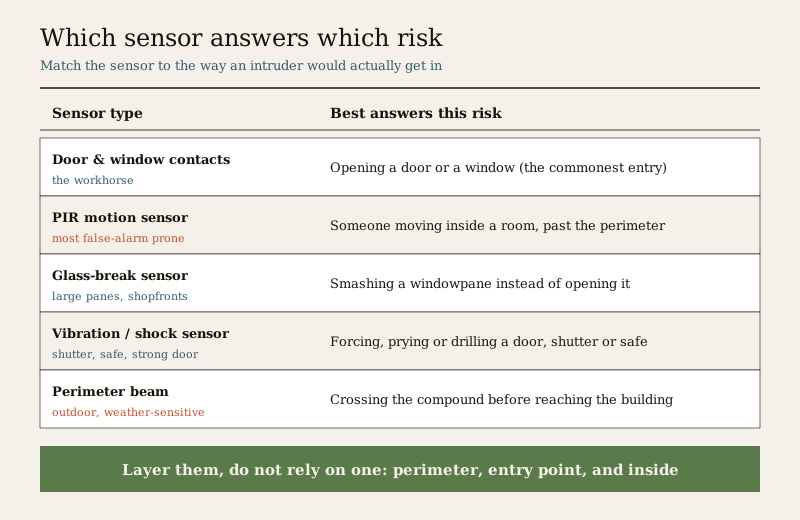
- Door and window contacts are the workhorses. A magnetic reed switch that trips the instant a protected door or window is opened. They catch the most common entry — through a door or window — and they are cheap and reliable. Put them on every accessible external door and every reachable window.
- PIR motion sensors watch a whole room for body heat in motion. One well-placed motion detector covering a hallway or living room catches an intruder who got past the perimeter — the classic "trap" sensor across the path anyone would take. These are also the sensors most prone to false alarms, so choice matters (more below).
- Glass-break sensors listen for the specific acoustic signature of breaking glass. Worth it where a burglar is likely to smash rather than open — large panes, glazed doors, shopfronts.
- Vibration and shock sensors feel the impact of someone forcing, prying or drilling. Useful on a strong-room, a shutter, a safe, or a door a determined intruder would attack rather than open.
- Perimeter beams detect someone crossing the compound before they reach the building — an outer trip line for a villa with grounds. They buy warning time but are the most false-alarm-prone outdoors (animals, foliage, weather), so specify them carefully.
The principle is defence in depth: detect at the perimeter, at the entry point, and inside. A serious burglar who defeats one sensor should still cross another. A home protected by a single sensor — one motion detector, say — is trivially defeated: block it, avoid its cone, or trip it once and let the household dismiss it. The mix, not the count, is what protects you. For a deeper look at how motion detection specifically works and where it belongs, see motion sensors.
The control panel and how you arm it
The panel is the brain, and two of its properties matter to a buyer.
Zones and partitioning. A zone is a group of sensors the panel can treat separately. Good zoning lets you arm "night" mode — perimeter doors and windows live, interior motion off, so the family can move around upstairs while the ground floor is guarded — and arm "away" mode with everything active when the house is empty. A villa or a shop-with-residence particularly benefits from partitioning: arm the shop while the flat above lives normally. If a panel cannot part-arm, you will end up leaving it off rather than tripping it every time someone gets up at night — and an alarm left off protects nobody.
How you arm and disarm. A keypad by the main door is the baseline. An app adds remote arming and, more importantly, remote awareness. A key fob suits those who dislike codes. Whatever the method, the disarm should be quick enough that you are not tempted to leave the system off, and the entry delay long enough that you can disarm on the way in without a false trip.
How you get alerted — the big choice
Here is the decision most buyers skate over, and it matters more than any sensor. When a sensor trips, what actually happens next? There are four broad answers, and they are not equal.
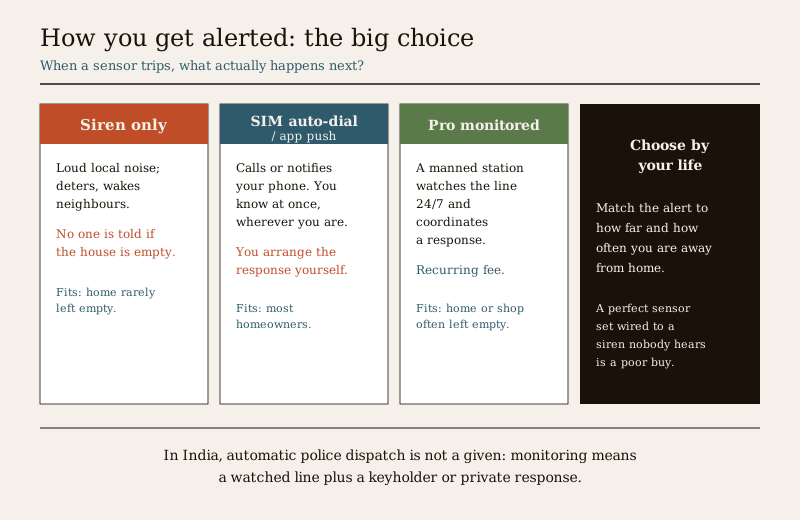
- Siren only. The alarm makes noise locally and nothing else. It deters, and it alerts neighbours — but if the house is empty and the street indifferent, no one who cares is told. Fine as a bare minimum for a home that is rarely left empty; weak for anyone who travels.
- SIM auto-dial / self-monitored. The panel has a SIM or internet link and calls or messages you, or pushes to an app, when it trips. You know immediately, wherever you are — a genuine step up. The catch: you are the response. You must decide, at that moment, who to call — a neighbour, a guard, the police. This suits most homeowners who want to stay in the loop without a recurring bill.
- Professionally monitored. A manned monitoring station watches your alarm around the clock and coordinates a response — typically calling you, then a keyholder or a patrol — for a recurring fee. This is the strongest option for a home often left empty, a shop, or an owner who wants someone else awake at 3 a.m. Understand honestly what it does and does not promise before you buy: in India, automatic police dispatch is not a given, and the realistic model is monitoring plus a keyholder or private response. Read alarm monitoring services before committing, and see the burglar alarm cost guide for what monitoring adds to the running cost.
The honest way to choose: match the alerting to how often and how far you are away. A retired couple almost always home is well served by a siren plus app push. A family that travels, or a shopkeeper whose premises sit empty all night, should look seriously at monitoring. This single choice reshapes the value of the whole system — a perfect sensor mix wired to a siren nobody hears is a poorer buy than a modest sensor mix that reliably reaches your phone.
Power, backup and tamper — the quiet essentials
These are the specifications that never appear on the box front and separate a real alarm from a toy.
- Battery backup is non-negotiable. Power cuts are a fact of Indian life, and a burglar can simply flip the mains. An alarm without a backup battery is an alarm that dies the moment the power does — which is exactly when you need it. Insist on a panel with a rechargeable backup that holds the system live for hours, and on wireless sensors whose batteries are supervised.
- Tamper protection. Good panels, sirens and sensors have a tamper switch that triggers the alarm if the case is opened or the unit prised off the wall — so an intruder cannot quietly defeat the box before entering. An outdoor siren especially should be tamper-protected and ideally self-powered so cutting its wire still sounds it.
- Communication supervision. If the alarm relies on a SIM or internet link to reach you, the panel should notice and warn you when that link drops — otherwise a cut line or a dead SIM silently disconnects your protection.
Red flag. No battery backup, no tamper protection, no supervision of sensors or the communication link. Any one of these turns a plausible-looking alarm into something a competent intruder — or a plain power cut — defeats without effort. Treat their absence as a reason to walk away, not a discount to enjoy.
False alarms — the problem that actually decides success
Ask anyone whose alarm sits switched off why, and the answer is almost always the same: it kept going off for nothing. False alarms are the real-world enemy. Every false trip erodes trust until the household stops arming the system, at which point it protects nothing regardless of how good the sensors are. Beating false alarms is therefore not a nicety; it is the difference between an alarm that gets used and one that gets ignored.
The commonest culprit is the PIR motion sensor reacting to pets, sunlight, moving curtains near a warm draught, or a ceiling fan stirring hot air. Two specifications directly address this and are worth paying for:
- Pet-immune PIR ignores movement below a mass threshold, so a cat or a small dog does not trip it. Essential in any home with pets; specify the weight rating to match your animal.
- Dual-technology sensors require two independent detections — infrared heat-motion and microwave, say — before they alarm. Because a curtain or a sunbeam trips only one, the false-alarm rate falls sharply. For any motion sensor covering a tricky space, dual-tech is the single best money you can spend on reliability.
Good placement matters as much as good sensors: keep PIRs away from windows in direct sun, from air-conditioner and heater vents, from fans, and from the pet's favourite perch. A thoughtfully specified, well-placed sensor set that almost never cries wolf is worth far more than a larger set that the family has learned to ignore.
Match it to your situation
The same catalogue suits different homes very differently. Right-size to yours.
| Home | Sensor emphasis | Alerting that fits | Notes |
|---|---|---|---|
| Flat / apartment | Contacts on the entry door and accessible windows; one interior PIR (pet-immune if needed) | Siren plus app push is usually enough; monitoring if often empty | Perimeter beams rarely relevant; keep it simple and reliable |
| Independent villa | Contacts on all external openings, interior PIRs, glass-break on large panes, optional perimeter beams for the grounds | Monitoring or robust app push — grounds mean more to watch and more time away | Partitioning for night arming pays off; more openings, more zones |
| Shop / commercial | Contacts and shock sensors on shutters and doors, glass-break on the shopfront, interior PIR | Monitoring is strongly worth it — premises sit empty all night | Consider the security system pillar for the wider commercial picture |
The through-line: a flat needs a tight, false-alarm-proof core, not a fortress; a villa earns layering and partitioning; a shop earns monitoring above all because it is the property most often left empty and most attractive after dark.
Specs that matter versus marketing fluff
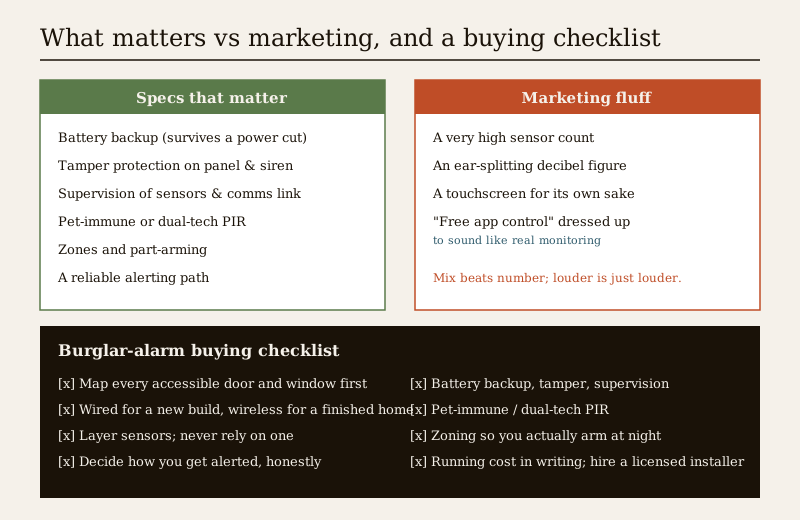
Worth paying for: battery backup, tamper protection, supervision of sensors and the comms link, pet-immune or dual-tech PIRs where false alarms threaten, sensible zoning with part-arming, and an alerting path that genuinely reaches you. These are the properties that decide whether the alarm works when tested by a power cut, a pet or a real intruder.
Usually marketing: a headline sensor count offered as proof of strength (mix beats number every time); an ear-splitting decibel rating (past a point, louder is just louder); a glossy touchscreen that adds cost but not detection; and "free app control" dressed up to sound like monitoring when in truth you are still the only responder. None of these is bad in itself — they simply are not the reasons to buy, and a vendor who leads with them is selling the wrong things.
Red flags in a quote or product
Walk away if you see: no battery backup; a design that leans on a single sensor to protect a whole home; no tamper protection on the panel or outdoor siren; no way to part-arm, so the system is all-or-nothing; a siren-only design sold to a household that is frequently away with no alerting path offered; or a vendor who cannot explain, plainly, what happens the moment a sensor trips and who gets told. A quote that dodges the alerting question is dodging the most important question.
Buying checklist
- Map the risk first. Walk your home and list every accessible door and window, and the routes an intruder would take inside. That map, not the catalogue, sets the sensor mix.
- Choose wired or wireless by your building — wired for a new build or open walls, wireless for a finished or rented home; insist on sensor supervision either way.
- Layer the sensors — contacts on openings, at least one interior PIR, glass-break where panes invite smashing, shock on shutters or safes, beams only where grounds justify them. Never rely on one sensor.
- Decide how you get alerted — siren only, SIM/app self-monitoring, or professional monitoring — and match it honestly to how often you are away. This is the biggest single choice.
- Demand the quiet essentials — battery backup, tamper protection, and supervision of both sensors and the communication link.
- Beat false alarms — pet-immune or dual-tech PIRs, and thoughtful placement away from sun, vents and fans.
- Insist on zoning and part-arming so you will actually arm it at night.
- Get the running cost in writing — any monitoring or SIM fee — via the burglar alarm cost guide, and hand the specification to a competent, licensed installer.
Where to go next
- How to choose a security system — the pillar an alarm is one layer of.
- Alarm monitoring services — what monitoring really promises before you pay for it.
- Motion sensors — how the trickiest, most false-alarm-prone sensor works and where it belongs.
- Burglar alarm cost — the numbers, upfront and recurring, deferred from this guide.
- How to choose a fire alarm — the life-safety alarm this guide is deliberately not.
- The burglar alarms sub-hub, the buying guides sub-hub and the main security hub.
Key takeaways
- Choosing a burglar alarm is two decisions — which sensors match your home's real weak points, and how you want to be alerted when one trips. The second is the one buyers most underthink.
- The sensor mix beats the sensor count — layer contacts, motion, glass-break and, where justified, shock and beams; never rely on a single sensor a burglar can simply avoid.
- The alerting path is the biggest choice — siren only suits a home rarely empty; app push keeps you aware; monitoring suits homes and shops often left empty. Match it to how far and how often you are away.
- Battery backup, tamper protection and supervision are non-negotiable — their absence is a walk-away red flag, not a bargain.
- False alarms decide success — pet-immune and dual-tech PIRs plus careful placement keep the family arming the system instead of switching it off.
- Right-size to your home — a tight reliable core for a flat, layering and partitioning for a villa, monitoring above all for a shop.
References
- Digital Personal Data Protection Act, 2023 — an alarm with cameras or an app that stores footage or logs holds personal data; agree who can view it, how long it is kept, and how it is secured before you buy.
- Bureau of Indian Standards (BIS) — look for the ISI mark and current IS certification on alarm equipment where it applies, and verify any claimed standard's current status via the BIS catalogue: https://www.services.bis.gov.in/
- National Building Code of India (SP 7:2026), Bureau of Indian Standards — where an intruder system interacts with doors on an escape route, life-safety and unobstructed egress take priority over any lock or armed state.
This is an educational selection guide for homeowners — not an installation manual, a price list, or legal advice. Specify the right alarm, then engage a competent, licensed installer; keep intruder alarms cleanly separate from life-safety fire detection; and verify any standard's current status via the BIS catalogue before relying on it.
Export this guide
Related Guides — Deep-dive reading
Glass-Break Sensors in India (2026): Catching a Smashed Pane Before Entry
How acoustic glass-break sensors listen for the twin sound of breaking glass, why they cover what door and window contacts miss, and how to place one sensor to protect a whole room of windows in an Indian home or shop.
SecurityFalse Alarm Prevention for Burglar Alarms in India: Causes & Fixes (2026)
Why home alarms cry wolf — ceiling fans, pets, heat, insects, weak batteries, power blips and poor door alignment — and how correct placement, the right sensors and simple upkeep keep the system trusted and armed.
SecurityHow to Choose a Security System (2026): The Master Buying Guide for Indian Homes and Buildings
The mental model that ties the whole buying decision together: start from your own risk, not a product; build the layers your situation actually needs; make the big architecture choices (wired vs wireless, local vs cloud, DIY vs professional); tell real product quality from marketing; and choose a vendor you can trust.
SecurityRelated Tools — Try Free
Access-Control Battery-Backup Calculator
Size the standby battery so an access system keeps running through a power cut, with an egress life-safety note.
Battery BackupAcoustic Privacy (STC) Visualizer
Indian healthcare acoustic visualizer — compare wall assemblies and noise sources, see received SPL after STC attenuation, and check FGI 2018 / IS 1950 / NABH speech-privacy compliance with live dual-canvas waveform.
Acoustic ToolRenovation vs New Build Calculator
Compare renovating vs building new interiors city-wise across 13 work scopes with GST and per-sqft rates.
Cost Comparison