
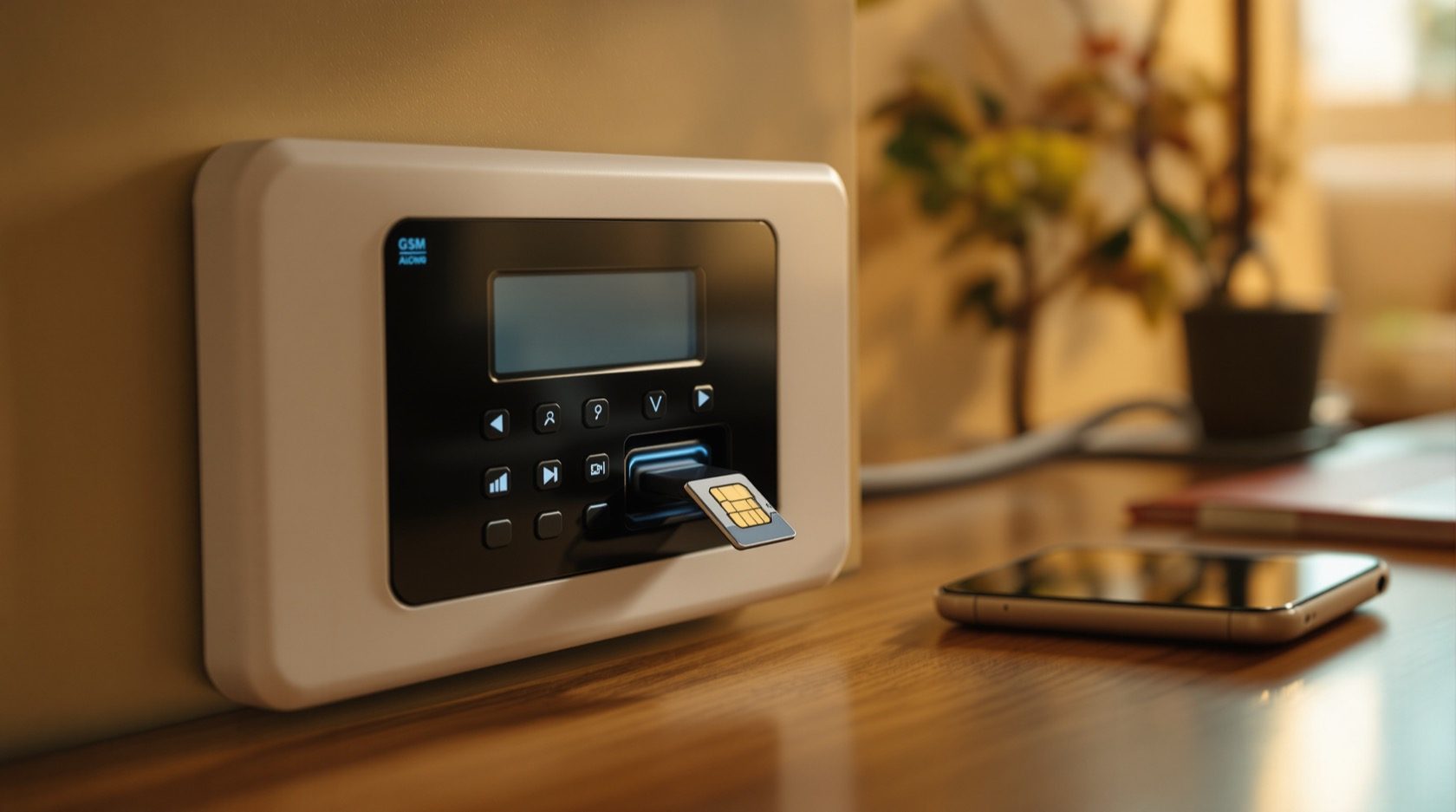
GSM Alarm Systems in India (2026): The Alarm That Calls Your Phone
A GSM alarm has its own SIM card and phones or texts you and your call-list the instant it triggers, so it works without home broadband; here is how it works, why it dominates India, and the SIM and signal gotchas that silently kill it.
Most alarms in India are not watched by anyone in a control room. When they go off, they have to reach the one person who can act: you. The cheapest, most reliable way an alarm does that in an Indian home is the humble mobile SIM. A GSM alarm system puts a SIM card inside the alarm panel so that, the moment a sensor trips, the panel itself dials your phone and sends a text to a stored list of numbers. No app, no broadband, no monthly service fee. Your own phone rings.
That directness is why GSM alerting is the backbone of self-monitored security across the country. This guide, part of the Studio Matrx burglar alarm hub, explains how a GSM alarm actually reaches you, why it suits Indian homes so well, and the handful of honest gotchas that can silently switch it off without you ever knowing.
Scope & reality check. A GSM alarm is self-monitored: it alerts you and the people on your call-list, and its siren rallies neighbours and the society guard. It does not call the police or dispatch anyone automatically. There is no verified-alarm-to-police auto-dispatch scheme in India the way there is in some other countries. Realistically, a person on your list verifies the alert and then rings the police helpline (Dial 112 or 100). Plan your response as siren plus neighbours plus guard first, then a verified call to the police. This is educational guidance, not legal advice; leave SIM, mains and panel wiring to a qualified installer or electrician.
How a GSM alarm actually works
Strip away the marketing and a GSM alarm system is simple. The control panel has a small cellular module and a SIM card slot, exactly like a very basic phone. You program a list of numbers into it during setup. When any connected sensor triggers, the panel does three things at once:
- It dials. It calls the first number on your list. If you do not answer, it moves to the next, and the next, cycling through family, a neighbour and the guard until someone picks up.
- It texts. It sends an SMS to those numbers saying the alarm has triggered, often naming the zone (for example "front door" or "living room PIR").
- It sounds the siren. The local siren goes off at the same time, so the alert is not only travelling to your phone but also filling the street.
Many GSM panels also let you control the system by phone: arm or disarm it with an SMS command, or check its status with a missed call. Some send you a text if the mains power fails or the SIM balance runs low. None of this needs the internet, a router, or an app store account.
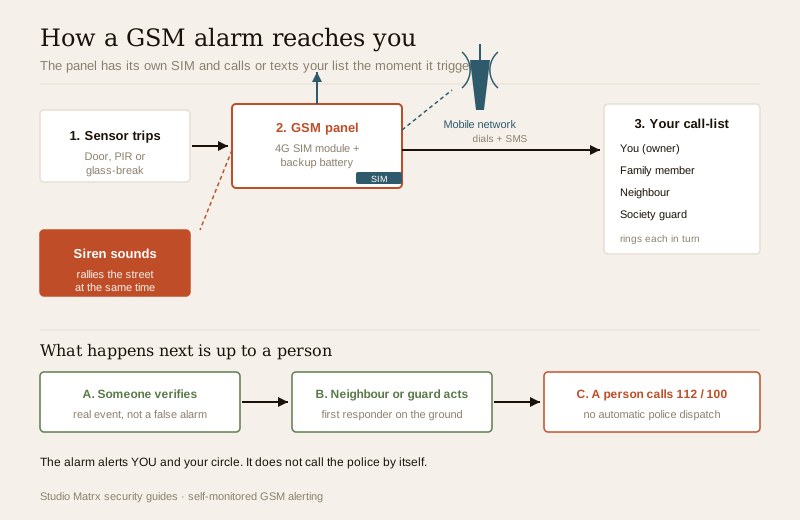
The key mental model: the alarm is a device that makes a phone call. Everything good about it and everything that can go wrong follows from that one fact.
Why GSM dominates the Indian home
App-based and internet-connected alarms are excellent (see app-based alarm systems), but GSM has three advantages that fit Indian conditions almost perfectly.
- It works without home broadband or Wi-Fi. A huge share of Indian homes have patchy fixed-line internet, or none at all, while mobile coverage is nearly everywhere. A GSM alarm rides the same network your phone uses, so it works in a village home, a construction-phase house, a farm outbuilding or a shop where there is no router at all.
- It rings your own phone directly. A phone call is the hardest alert to miss. It overrides silent mode in a way a push notification does not; it wakes you at night; and it reaches an elderly parent or a guard who has a basic phone and no smartphone app.
- It is cheap to run. The recurring cost is a prepaid SIM recharge, often just a few hundred rupees a year, with no subscription to a monitoring company. For a homeowner who wants alerts without a monthly bill, that is compelling.
This is why GSM is the default alerting layer bolted onto wireless burglar alarms, wired systems and hybrid panels sold across India. Even a perimeter alarm at a farm gate can call you over GSM where nothing else would reach.
The honest India gotchas
This is the part the shop will not stress, and it matters more than any feature list. A GSM alarm can appear perfectly healthy, armed and beeping, while quietly having lost its ability to call you. Four failure modes cause almost all of it.
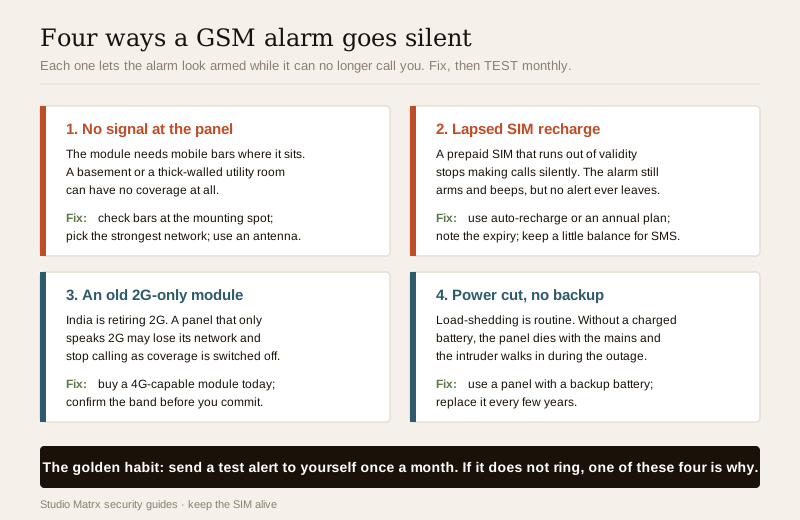
1. It needs mobile signal at the panel
The alarm can only call if it has bars where it is mounted. Panels often sit in a utility cupboard, a basement, or a thick-walled corner, exactly the spots where coverage is weakest. Before finalising a location, have the installer confirm the module gets a solid signal there on the network whose SIM you will use, and choose the strongest-covering operator for your address. An external antenna helps a marginal spot.
2. A lapsed SIM recharge silently kills it
This is the single most common real-world GSM failure, and it is heartbreaking because it is so avoidable. A prepaid SIM has a validity window. If the recharge lapses, the operator quietly stops letting it make calls and send texts, even though it still shows on the network. The alarm arms, the sensors work, the siren still sounds locally, but no alert ever leaves the house. You only discover it the night you needed the call.
The fixes are simple, and you should do all of them:
- Prefer an annual or long-validity plan, or better, set up auto-recharge so it can never lapse.
- Note the SIM's expiry date in your calendar with a reminder a week before.
- Keep a small balance, since some panels use SMS, which needs credit.
- Test the alarm monthly by triggering it and confirming the call and SMS actually reach your phone. If they do not, this is usually why.
3. The 2G sunset means you need a 4G module
India's networks are steadily switching off old 2G service. Many older and bargain GSM alarm panels are 2G-only. As 2G coverage is withdrawn in your area, a 2G-only panel can lose its network and stop calling, with no warning. When you buy, insist on a 4G-capable (LTE) module and confirm it supports your operator's bands. If you already own a 2G panel that still works, plan to replace the module before 2G leaves your area rather than after.
4. A power cut must not disable it
Load-shedding is a fact of Indian life, and an intruder is more likely, not less, during a blackout. A GSM alarm with no battery backup dies the instant the mains goes off, taking its ability to call with it. Choose a panel with a built-in rechargeable backup battery that keeps it armed and calling through an outage, and replace that battery every few years as it ages, the same way you would service any backup power. For a power-cut-proof alerting chain, the router-free nature of GSM is actually an advantage: there is no broadband modem that also needs its own backup.
| Gotcha | What you see | What is really happening | The fix |
|---|---|---|---|
| Weak signal at panel | Alarm looks fine | No coverage to place the call | Check bars at the mount spot; strongest network; antenna |
| Lapsed SIM recharge | Arms and beeps normally | Operator has barred calls/SMS | Auto-recharge or annual plan; test monthly |
| 2G-only module | Worked for years | Network being switched off | Buy a 4G-capable module; replace old 2G panels |
| No battery backup | Dies in a power cut | Panel loses power with the mains | Panel with backup battery; replace battery periodically |
GSM is not police response
It is worth saying plainly, because the sales pitch can blur it: a GSM alarm alerts you and your circle, not the authorities. There is no button on it that summons a patrol car. In India, "police response" realistically means a human, you, a family member, a neighbour or the society guard, verifies that something is genuinely wrong and then calls the police helpline (Dial 112, or the older 100). That verification step matters: repeated false alarms waste responders' time and erode your credibility, so the chain is deliberately siren-and-people first, then a considered call.
Design your response chain around that reality:
1. The siren sounds locally and rallies the street and the guard.
2. The GSM call and SMS reach your call-list, so someone knows within seconds.
3. A person verifies (a quick look, a call to the guard) that it is real, not the cat or a swinging door.
4. If confirmed, that person calls 112 or 100 and, in a society, the guard or RWA coordinates.
For the deeper detail on who watches an alarm and how professional central-station monitoring fits (it exists in India but is limited, paid, and mostly metro), see alarm monitoring services and police response integration. For the loud layer that does the neighbourhood work, see audible sirens; for the quiet variant used in a hold-up, see silent alarms.
GSM and an app: use both
GSM and app-based alerting are not rivals; the strongest home setups run both. GSM is the fail-safe that always gets through on a bare mobile signal; the app adds rich detail, event history, remote arming and, on camera-enabled systems, a live look. Where GSM depends on a live SIM and signal, the app depends on working internet at home and a phone that is not on silent. Each covers the other's blind spot.
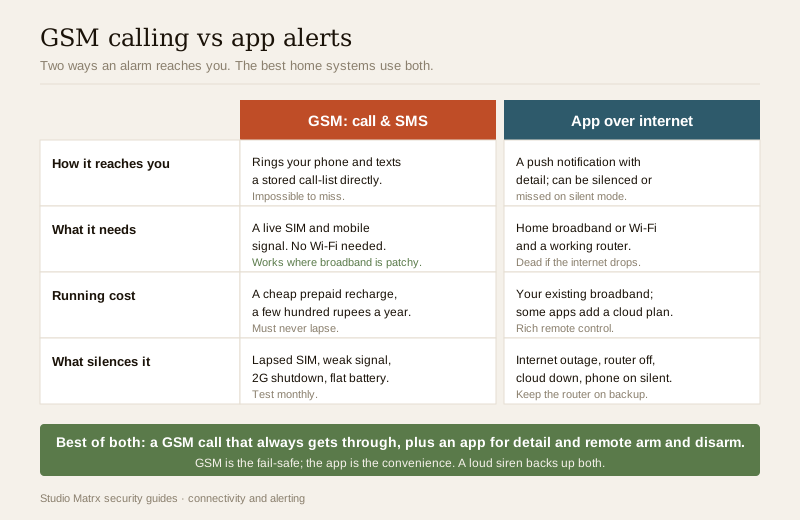
| GSM (call & SMS) | App (over internet) | |
|---|---|---|
| How it reaches you | Rings your phone, texts the call-list; hard to miss | Push notification; can be silenced or missed |
| What it needs | A live SIM and mobile signal; no Wi-Fi | Home broadband or Wi-Fi and a working router |
| Remote control | Arm/disarm by SMS or missed call; status only | Full remote control, history, live camera view |
| Running cost | Cheap prepaid recharge; must never lapse | Uses your broadband; some add a cloud plan |
| What silences it | Lapsed SIM, weak signal, 2G shutdown, flat battery | Internet outage, router off, cloud down, phone on silent |
A common, sensible pattern for an Indian home: a hybrid panel that sends a GSM call as the guaranteed alert and a push notification through the app for the detail and controls, with a loud siren backing up both. If you are weighing which alerting mix suits your home, size and budget, the burglar alarm system selector walks you through it, and the complete guide to burglar alarms in India sets the whole picture.
Keeping it secure and private
A GSM panel is a networked device, and a modern one that also touches an app or cloud deserves the same care as any connected security gear.
- Set a strong, unique panel password/PIN, not the factory default, and restrict who can send it arm/disarm SMS commands. On many panels only stored numbers may control it, keep that list tight.
- On any app or cloud account tied to the system, turn on two-factor authentication and apply firmware updates when the maker issues them; the same discipline covered for cameras in CCTV remote access security applies here.
- Treat the alert data as personal. Who is on the call-list, when the house is armed and empty, all of it is sensitive under the Digital Personal Data Protection Act, 2023. Do not share panel access casually.
When to bring in a professional. You can choose the system, manage the SIM recharge, program your own call-list and run the monthly test yourself. Hand the panel wiring, mains connection, sensor mounting and antenna placement to a licensed installer or electrician, see the electrical hub. For a society, coordinate the guard and RWA response chain and, if you want a watched system, contract a reputable monitoring service in writing. Where a shared building is involved, the apartment and gated-community security guides set the wider context.
Key takeaways
- A GSM alarm has its own SIM and calls plus texts your stored call-list the instant it triggers — no broadband, no app and no subscription needed, which is why it is the backbone of self-monitored security in India.
- It alerts you and your circle, not the police. There is no auto-dispatch; a person verifies the alert and calls Dial 112 or 100. Plan a siren-and-neighbours-first, then-police response chain.
- The SIM is the weak point. A lapsed prepaid recharge silently stops the alarm calling while it still looks armed, keep it on auto-recharge or an annual plan, note the expiry, and test monthly.
- Buy a 4G-capable module and a panel with battery backup — 2G is being switched off, and a power cut must not be allowed to disable the alarm.
- Use GSM and an app together, backed by a loud siren: GSM is the fail-safe that always gets through, the app adds detail and remote control. Use the system selector to pick the right mix.
References
- National Emergency Response System — Dial 112 (and the legacy 100) is the official route to reach the police in an emergency; a GSM alarm does not dispatch anyone automatically, a person must place the call. See https://112.gov.in/
- Digital Personal Data Protection Act, 2023 — alarm alert data, call-lists and arming schedules are personal data; keep panel access and the call-list restricted and share them only with people who need them.
- Manufacturer specifications — before buying, verify on the maker's own datasheet that the module is 4G/LTE-capable, that it supports your operator's bands, and that the panel has a rated backup battery; confirm the SIM plan's validity terms with the mobile operator.
- National Building Code of India (SP 7), Bureau of Indian Standards, for any mains-connected or life-safety aspect of the install; verify the current edition via the BIS catalogue at https://www.services.bis.gov.in/
This is an educational overview, not legal advice. SIM, mains and panel wiring are qualified professional tasks — engage a licensed installer or electrician, and verify any standard's current status via the BIS catalogue before relying on it.
Export this guide
Related Guides — Deep-dive reading
Police-Response Integration for Alarms in India (2026): The Honest Reality
What police response really means for a home or shop alarm in India: not an automatic police car, but a fast verified alert, a siren, neighbours and the guard first, then a person calling 112.
SecurityHow to Choose a Burglar Alarm in India (2026): Sensors, Alerts and What Actually Matters
A homeowner's guide to selecting an intruder alarm that fits your flat, villa or shop and alerts you the way you want — matching the sensor mix, control panel and the big siren-versus-monitored decision to your real risk, and dodging the false-alarm traps that make people switch systems off.
SecurityDuress Alarms in India (2026): The Silent Code That Summons Help While You Comply
A duress alarm lets you signal that you are being forced or threatened while appearing to switch the system off normally. This guide explains how a duress code works, how to set one up, and the honest India catch: it only helps if someone actually responds.
SecurityRelated Tools — Try Free
Burglar Alarm System Selector
Answer a few questions about your property, cabling, coverage, monitoring and power and get the right burglar alarm — wired / wireless / hybrid, self or professionally monitored — with the design non-negotiables.
Alarm SelectorSecurity Backup Power Calculator
Size a UPS/inverter and battery to keep CCTV, NVR, router and alarm running through a power cut — load, Ah, VA and cost.
Backup PowerBefore vs After — Cost Reality Check
Compare what you expected to pay vs what you actually paid, category by category.
Reality Check