
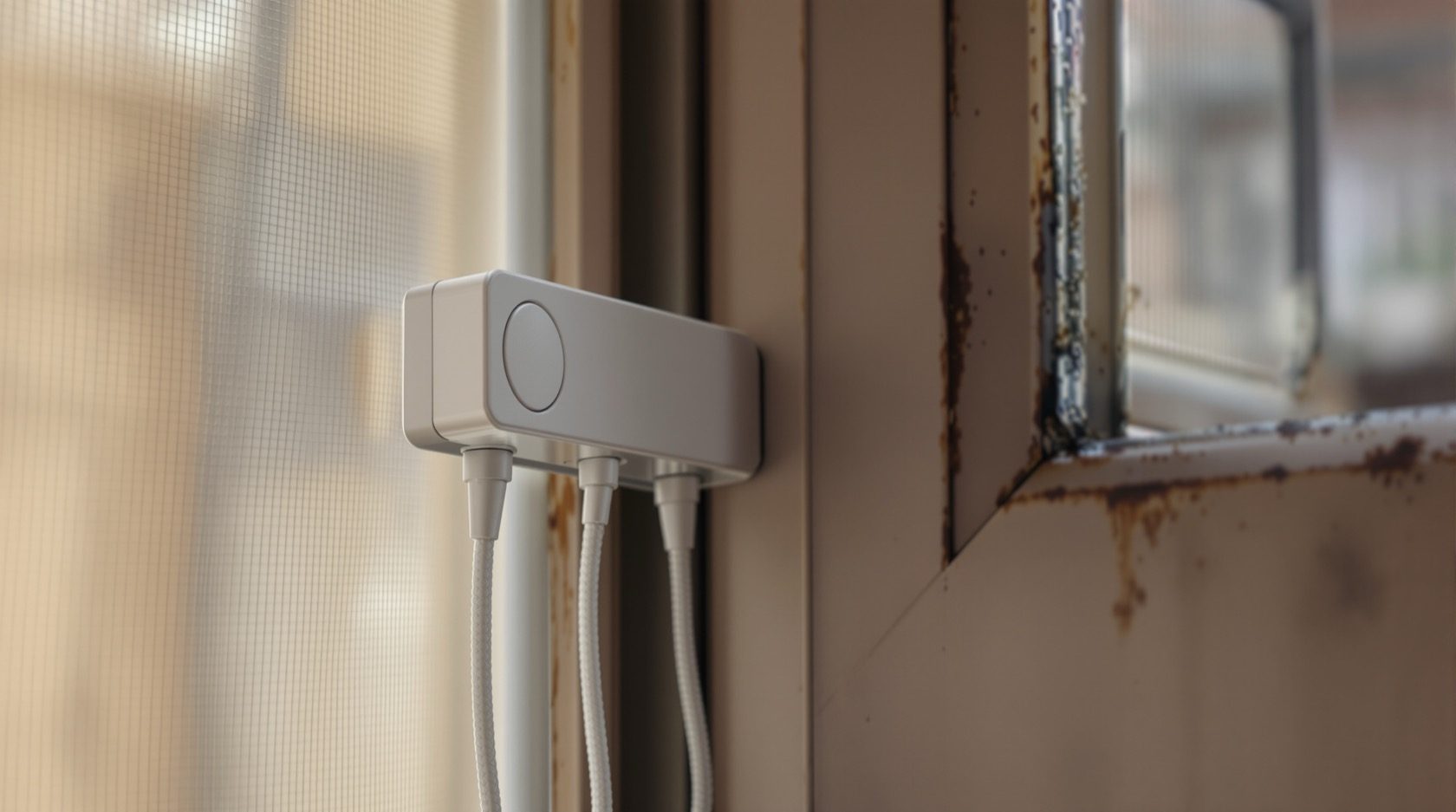
Window Sensors in India (2026): Placing Contact Sensors on Sliding, Casement and Grilled Windows
How magnetic window contact sensors detect a window being opened, why that is different from a glass-break sensor, and exactly where to fit them on the sliding, casement and grilled windows found in Indian homes.
A burglar rarely picks the front door. In most Indian homes the softest point is a window — a ground-floor sliding pane behind a car porch, a bathroom ventilator, a kitchen window beside the drainpipe, or the hidden side of the house that no neighbour overlooks. A window sensor is the small, cheap device that turns each of those openings into a tripwire: the moment the window slides or swings open, the alarm knows.
This guide is part of Studio Matrx's burglar and intrusion alarm hub and sits right beside its twin, door contact sensors — the two share the exact same magnetic principle. Here we focus on what makes windows different: the sliding tracks, the swinging casements, the ever-present safety grille, and the monsoon that sits on the outer frame for three months a year. By the end you will know which windows to sensor first and precisely where the sensor and its magnet go on each Indian window type.
Scope & safety. This guide helps you choose and place window sensors yourself — most are peel-and-stick and need no tools. It is strictly about detecting an intrusion, never about defeating one. Any sensor tied into a mains-powered alarm panel, or fitted at height on an upper floor, is a licensed professional's job. A sensor must never obstruct a window that doubles as a fire-escape or ventilation route, and where a sensor's app can log when a window opens, treat that as personal data under the Digital Personal Data Protection Act, 2023. This is educational guidance, not legal advice.
What a window contact sensor actually is
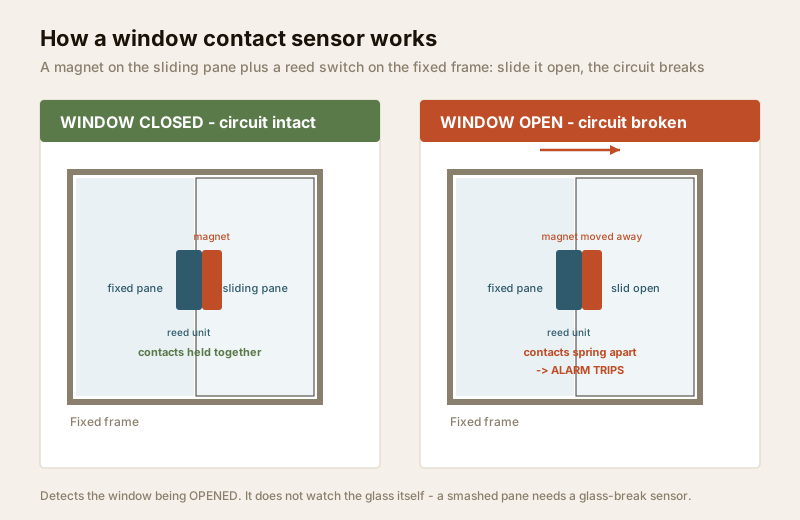
A window sensor — properly a magnetic contact sensor — is a two-piece device. One piece is a small electronic unit containing a reed switch; the other is a plain magnet. You fit the electronic piece to the fixed window frame and the magnet to the moving pane, lined up so they sit a few millimetres apart when the window is shut.
Inside the electronic piece, the reed switch is a pair of thin metal contacts sealed in glass. When the magnet is close — window closed — its field holds those contacts together, completing a circuit: the alarm reads the window as closed and secure. Slide or swing the window open and the magnet moves away; the field weakens, the contacts spring apart, the circuit breaks, and the sensor reports open. If the alarm is armed, that is your trigger.
That is the whole trick. There is no camera, no clever electronics, nothing to calibrate. It is exactly the mechanism described in the door sensor guide — a window is simply a door that slides or swings, so the same reed-switch-and-magnet pairing works, just fitted to a different-shaped opening.
The one distinction that matters: opened versus broken
This is the single most important thing to understand before you buy, and it is where people most often go wrong.
A contact sensor detects a window being OPENED. It watches the join between the moving pane and the frame. If someone slides, swings or lifts that pane, the magnet parts from the reed switch and the alarm fires. What it does not watch is the glass itself.
A glass-break sensor is a different device for a different attack: it listens for (or feels) the pane being BROKEN — the sharp acoustic signature of shattering glass, or the shockwave through the frame. If an intruder smashes a fixed pane and climbs through the hole without ever unlatching the window, a contact sensor sees nothing, because from its point of view the window was never opened. Only a glass-break or vibration sensor catches that.
Neither is "better" — they cover different moves, and on an important window you often want both. Glass-break, vibration and shock sensors are their own topic with their own deep-dive later in this hub; for now, just hold onto the rule:
| The attack | What catches it |
|---|---|
| Window slid, swung or lifted open | Contact (magnetic) sensor — this guide |
| Fixed pane smashed, intruder climbs through | Glass-break / vibration sensor (separate topic) |
| Someone moving inside the room after entry | Motion sensor / PIR |
The honest takeaway, which we will return to at the end: a contact sensor is a superb, cheap first line on any window that can open — and most Indian windows open. It is not a complete answer on a large fixed pane of glass, which is why the layers above exist.
Placing sensors on Indian window types
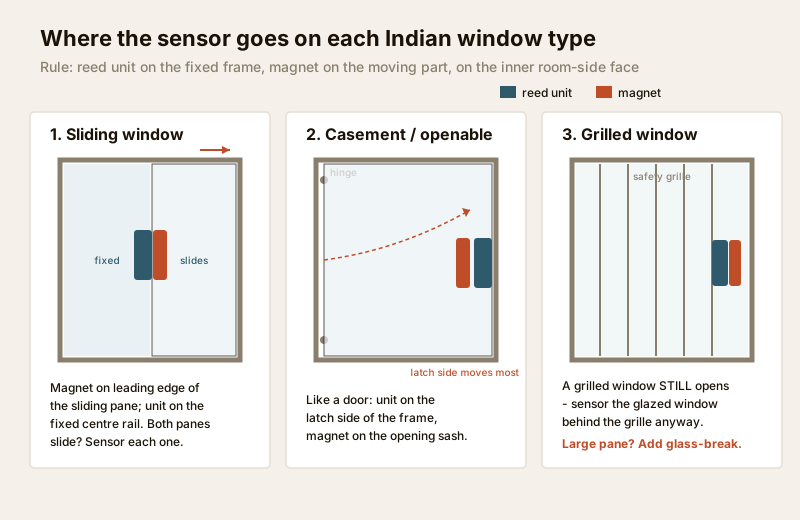
The principle never changes — electronic unit on the fixed frame, magnet on the moving part, aligned and close when shut. What changes is which part moves, and that is where Indian windows need thought.
Sliding windows — the most common, and the most important
The aluminium or uPVC sliding window is the default in modern Indian flats and villas, and it is exactly where most break-in attempts start. On a two-track slider, typically one pane is fixed and one slides.
- Fit the electronic sensor unit to the fixed frame (the outer channel or the fixed pane's edge) and the magnet to the leading edge of the sliding pane, so they meet when the window is fully closed.
- Mount them on the inner face of the window, inside the room, not on the weather side. This keeps the sensor out of the rain and out of easy reach.
- On a window where both panes slide, you need the sensor to catch whichever one is opened — put the unit on the fixed centre meeting-rail (or add a second magnet) so that moving either pane breaks the pairing. When in doubt, a slim recessed or surface sensor on each moving pane is the safe choice.
- Watch the gap: sliders can rattle in their tracks, so keep magnet and sensor within the maker's stated gap (often 10–20 mm) even at the loosest point of the pane's travel, or you will get false "open" alerts every time the wind shakes the window.
Casement and openable windows — treat them like a door
A casement or side-hung window swings open on hinges, exactly like a door. Fit the sensor unit to the fixed frame on the latch side (the edge that moves furthest, opposite the hinge) and the magnet to the matching edge of the opening sash. Because the latch side travels the most, a sensor there reacts to the smallest opening. Top-hung, awning and the tall French windows common in villas follow the same logic: sensor on the frame, magnet on the moving sash, on the edge that separates first.
Grilles — a grilled window still opens, so sensor it
This is the great Indian misunderstanding. A safety grille is a genuine physical deterrent, and many owners assume a grille means the window needs no sensor. It does.
A grilled window still opens — you open it every day for air. If the grille is ever unlocked, left open, cut, or simply is not there on an upper floor, the window behind it is unprotected. So:
- Sensor the window itself, exactly as above, regardless of the grille. The contact sensor detects the glazed window being opened, which is what you actually care about.
- If the grille has an opening section (a hinged grille "door" for cleaning or escape), that too can take its own contact sensor so you know if the grille is opened.
- On a large glazed pane behind a decorative grille, remember the opened-versus-broken rule: the contact sensor catches the window sliding open, but a determined intruder reaching through a wide grille could attack the glass. That is the classic case for layering a glass-break sensor on the pane alongside the contact sensor on the opening — belt and braces on your most exposed windows.
Which windows to prioritise
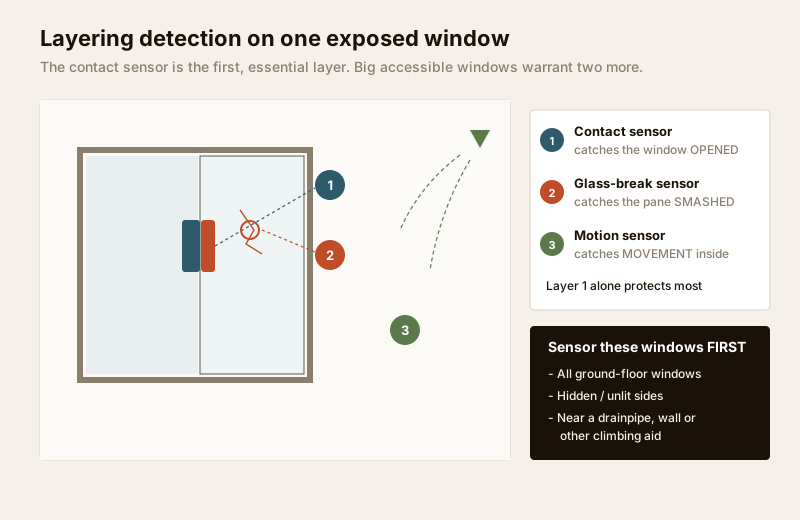
You do not have to sensor every window on day one, and a good alarm budget spends first where a burglar looks first. Walk your home from an intruder's point of view and rank the windows:
| Priority | Which windows | Why |
|---|---|---|
| First | All ground-floor and stilt-level windows | Reachable from the ground without a ladder — where the overwhelming majority of window entries happen |
| First | Windows on hidden or unlit sides — rear, side setback, blind gable | No neighbour or street overlooks them, so an intruder has time to work |
| High | Windows near a climbing aid — a drainpipe, boundary wall, parapet, water tank, tree, AC outdoor unit or sunshade that gives a leg-up to the first floor | A "safe" upper window stops being safe with a ladder built into the wall |
| High | Large accessible sliders behind a porch, balcony or terrace | Big, quiet, and often the least-watched glass in the house |
| Later | High upper-floor windows with no access route and bathroom ventilators too small to climb through | Genuinely low-risk; sensor them last or not at all |
The point of a perimeter alarm is to catch entry at the skin of the building, before an intruder is inside. Window and door sensors together are that perimeter layer for a home. If you are unsure which of your windows are truly exposed, a structured perimeter vulnerability assessment walks the whole envelope and ranks it for you.
Wired versus wireless window sensors
Window sensors come in the same two families as the rest of the alarm world, and the choice mirrors the wired versus wireless system decision.
| Wired window sensors | Wireless window sensors | |
|---|---|---|
| Best for | New construction / renovation, where cable can be hidden in the wall and window reveal | Existing finished homes, rented flats, retrofits |
| Power | Drawn from the panel — no sensor battery to change | Small coin/AA cell in each sensor, lasting 1–3 years |
| Install | Cable run to each window; professional, disruptive in a finished home | Peel-and-stick, done yourself in minutes |
| Reliability | No radio, no battery — very robust once in | Depends on radio range and battery health; needs low-battery alerts |
| Cost | Lower per sensor, higher labour | Higher per sensor, near-zero labour |
For a home that is already built and lived in — most retrofits — wireless is almost always the practical answer: nothing to chase into the wall, and you can start with the priority windows and add more later. Reserve wired sensors for windows you are building or renovating anyway, or where a mixed hybrid system already runs cable nearby — the hybrid alarm guide explains combining both. Whatever you choose, insist on per-window low-battery and tamper alerts so a dead cell or a sensor being prised off tells you, instead of silently leaving a gap.
The honest limits — and how to cover them
A contact sensor is one of the best-value pieces of security you can buy, but sold honestly it has clear edges. These are placement and buying considerations, not weaknesses to hide:
- It only sees the window OPEN. As covered above, a pane broken without opening the window slips past a contact sensor. On a big, exposed, accessible glazed window, layer a glass-break or vibration sensor on the pane so both the "open it" and "smash it" moves are covered.
- It stops at the window line. A contact sensor says a window opened; it says nothing about what happens next inside the room. Pair perimeter contacts with an interior motion sensor or two so that if a window entry is somehow missed — or an intruder enters another way — the movement inside still trips the alarm. This "skin plus space" layering is the core idea of the layered security design guide.
- A left-open window cannot be armed. If a family member leaves a sensored window open, arming the system will flag it as a fault. That is the system working, not failing — but it means good habits matter. A panel that shows which window is open makes this painless.
- Monsoon on outer sensors. India's three-month monsoon punishes anything on the weather side of a window. Keep sensors on the inner, room-side face wherever possible; where an outer-mounted sensor is unavoidable, use a properly weather-rated (IP-rated) sensor and check it after the first heavy rains. Damp behind a cheap indoor sensor is a common cause of nuisance faults.
- Alignment drift. Windows warp, tracks loosen, stick-on magnets creep in summer heat. A sensor that worked in January can throw false "open" alerts by May. A quick seasonal check that every window still reads "closed" when shut keeps trust in the system — the same discipline as any alarm maintenance routine.
None of this argues against window sensors — it argues for using them as the first, essential layer and adding glass-break and motion on the few windows that truly warrant it. To size the whole package and see how contact, glass-break and motion sensors combine for a specific home, run the burglar alarm system selector.
When to bring in a professional. Fitting peel-and-stick wireless sensors on reachable ground-floor windows is a confident DIY job. Bring in a licensed alarm installer or electrician for: any sensor wired into a mains-powered panel; sensors on upper-floor windows that need a ladder or height access; running concealed cable in a renovation; and commissioning the panel so every window's zone is correctly named and tested. For apartments, check society rules first — see the apartment security guide; for independent houses, the villa security guide covers the wider envelope.
Key takeaways
- A window sensor detects a window being OPENED — it is a magnetic reed-switch that trips when the pane slides or swings away from its magnet, the same principle as a door contact sensor.
- Opened is not the same as broken. A contact sensor does not catch a pane smashed without opening the window — that needs a separate glass-break sensor. On a large exposed pane, use both.
- Place by window type: on sliders the magnet goes on the moving pane and the unit on the fixed frame, on the inner face; on casements put the sensor on the latch side; and a grilled window still opens, so sensor it anyway.
- Prioritise the reachable windows — ground floor, hidden and unlit sides, and any window near a drainpipe, wall or other climbing aid — before spending on safe upper-floor openings.
- Wireless suits most retrofits; keep sensors on the room-side face against the monsoon, insist on low-battery and tamper alerts, and layer with motion sensors so entry is caught even if one window is missed. Size the whole set with the system selector.
References
- Manufacturer specifications — confirm the reed-switch magnetic gap (working distance), IP weather rating for any outer-mounted sensor, wireless range and battery life on the maker's own datasheet before buying for a specific window type.
- Digital Personal Data Protection Act, 2023 — where a window sensor's app logs when a window is opened or who armed the system, that record is personal data; keep the account private and share access deliberately.
- National Building Code of India (SP 7), Bureau of Indian Standards — for the life-safety rule that a security fitting must never obstruct a window used as an escape or ventilation opening, and for any mains-connected alarm wiring; verify the current edition via the BIS catalogue: https://www.services.bis.gov.in/
This is an educational overview, not legal advice. Mains-connected alarm wiring, work at height and any electrical task are qualified professional jobs — engage a licensed installer or electrician and verify any standard's current status via the BIS catalogue before relying on it.
Export this guide
Related Guides — Deep-dive reading
Glass-Break Sensors in India (2026): Catching a Smashed Pane Before Entry
How acoustic glass-break sensors listen for the twin sound of breaking glass, why they cover what door and window contacts miss, and how to place one sensor to protect a whole room of windows in an Indian home or shop.
SecurityHow to Choose a Burglar Alarm in India (2026): Sensors, Alerts and What Actually Matters
A homeowner's guide to selecting an intruder alarm that fits your flat, villa or shop and alerts you the way you want — matching the sensor mix, control panel and the big siren-versus-monitored decision to your real risk, and dodging the false-alarm traps that make people switch systems off.
SecurityWindow Security Guide
The layered-defence model for Indian homes — frame, glass, locks, grille and sensors working together
Windows & GlazingRelated Tools — Try Free
Burglar Alarm System Selector
Answer a few questions about your property, cabling, coverage, monitoring and power and get the right burglar alarm — wired / wireless / hybrid, self or professionally monitored — with the design non-negotiables.
Alarm SelectorWindow Cleaning Cost Calculator
Estimate professional window cleaning cost per visit and per year by access and frequency.
Window CalculatorWindow Grill Design Selector
Pick a window grille style and material by priority — security, looks, budget, view — and estimate cost.
Window Tool