
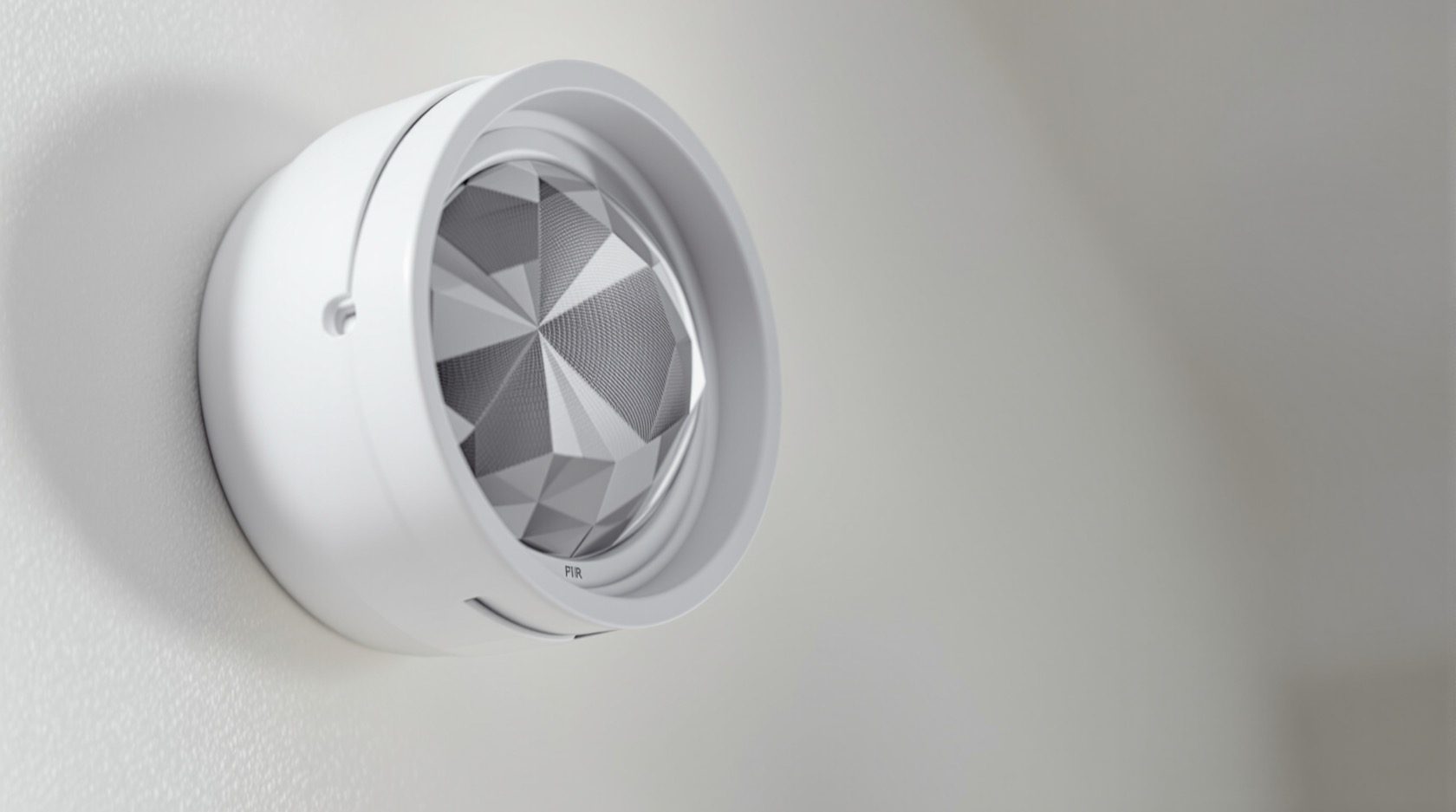
PIR Sensors in India (2026): How Passive Infrared Motion Detection Works and Where to Place It
The most common motion sensor, explained for homeowners: how PIR reads a moving warm body, why it dominates, how Indian summer heat affects it, and how to place one so it catches an intruder and ignores fans, vents and pets.
Open up almost any burglar alarm sold in India and the little white eye watching the room is a PIR sensor. It is the workhorse of home security: cheap, low-power, and reliable indoors, which is exactly why it dominates. But a PIR only earns its keep if you understand what it actually senses and where to put it. Placed well, it catches an intruder the moment they enter and stays quiet the rest of the time. Placed badly, it either misses movement or cries wolf at the ceiling fan until someone switches the whole system off.
This guide is part of Studio Matrx's burglar alarm library and sits under the broader motion sensors family. It explains passive infrared in plain language: how it works, why it is everywhere, the honest limits you should design around, and exactly how to place one in an Indian home.
Scope & safety. This guide helps you choose and place motion sensors well. A battery-powered wireless PIR you can reach from the ground is a genuine do-it-yourself job. Anything that needs mains wiring, a ladder, or work near the electrical board belongs to a licensed professional — see the electrical hub. Indoor motion sensing also touches privacy: a sensor records that something moved, not who, but be thoughtful about where it "sees," in keeping with the Digital Personal Data Protection Act, 2023. This is educational guidance, not legal advice.
What "passive infrared" actually means
Every warm object — a person, a dog, a radiator — gives off infrared energy, which is just heat you cannot see. A PIR sensor contains a small component called a pyroelectric element that produces a tiny electrical signal when the amount of infrared heat falling on it changes.
The word passive is the key to the whole technology. Unlike a microwave sensor, a PIR sends nothing out into the room. It emits no beam, no radio wave, no light. It simply sits there and watches the heat pattern in front of it. That is why it sips battery power and why a wireless PIR can run for a year or more on a couple of cells.
The clever part is the lens. In front of the pyroelectric element sits a Fresnel lens — a ridged plastic dome that divides the sensor's view into a fan of separate "beams" or zones, some pointed at slightly different patches of the room. As a warm body walks across the room, it moves out of one zone and into the next. Each crossing makes the heat landing on the element rise and fall, and that changing signal is what the sensor reacts to.
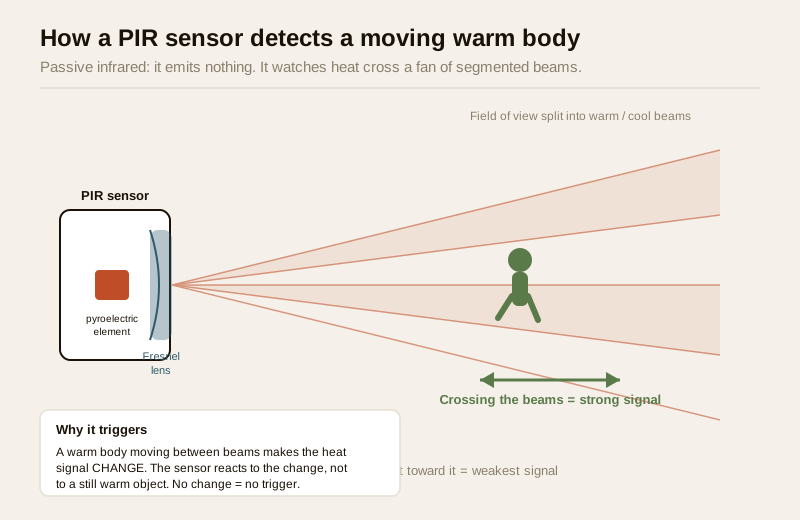
The single most important consequence of this design: a PIR reacts to change, not to a warm object standing still. A person frozen in place, or one moving so slowly the heat pattern barely shifts, is much harder for it to see. And because motion is detected as a body crossing from one beam to the next, a PIR is least sensitive to movement heading straight toward it and most sensitive to movement across its field of view. This is not a flaw to hide; it is the single fact that dictates how you aim the sensor, which we come to below.
Why PIR dominates Indian homes
There are half a dozen ways to detect a person, but PIR won the home market for solid reasons:
- It is cheap. A wireless PIR costs a few hundred rupees to a couple of thousand, far less than radar-based or beam-based alternatives.
- It is low-power. Because it is passive, a battery PIR runs a long time between changes — a real advantage in a country of frequent power cuts, where mains-independent devices matter.
- It is reliable indoors. In a normal room, a moving person creates a clear, easy-to-read heat contrast against cooler walls and floor.
- It resists some false alarms better than radar. A PIR only "sees" heat in its direct line of sight, so it does not trigger on movement in the next room the way a microwave sensor can through a wall.
For most homes, a set of well-placed PIRs covering the entry points and main circulation route is the backbone of the alarm. Whether those PIRs are wired, wireless, or part of a hybrid system is a separate choice covered in the burglar-alarm family; the sensing technology inside is usually the same passive infrared.
The honest limits — and how to design around them
A good sensor guide tells you where the technology struggles, because every limit is really a placement or buying instruction. None of this is about defeating a sensor; it is about getting reliable detection and few false alarms.
1. It needs a temperature difference (the India heat problem)
A PIR works by spotting a warm body against a cooler background. The bigger that difference, the easier the detection. This is where India's climate matters more than in most countries. On a peak summer day, an un-cooled room can sit around 37 degrees Celsius — almost the same as human skin temperature. When the background is that close to body heat, the contrast a PIR relies on shrinks, and its sensitivity genuinely drops.
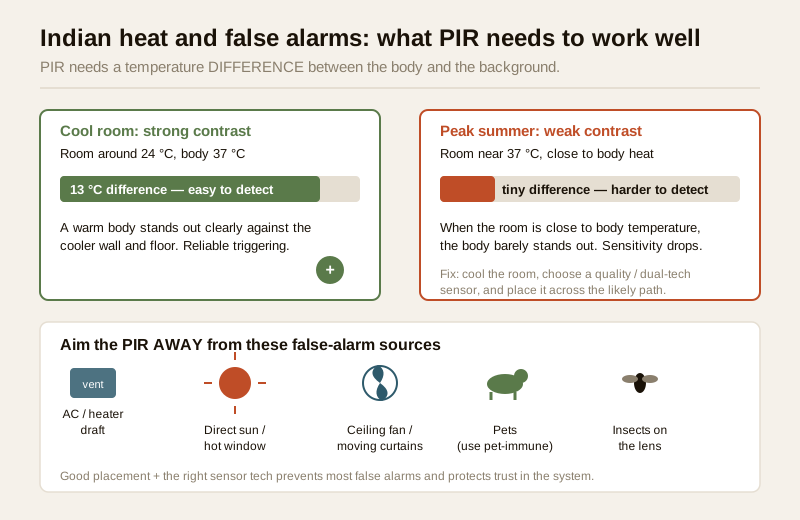
This is a real consideration, not a reason to avoid PIR. You design around it:
- In rooms you actively cool (bedrooms, living rooms with AC), the problem rarely bites, because the room stays well below body temperature.
- For a hot, un-cooled space where reliable detection matters, step up to a dual-technology sensor that pairs PIR with microwave — the microwave half does not depend on a heat difference, so detection holds up when the room is hot.
- Buy a quality sensor. Better PIRs use temperature compensation to adjust their threshold as the ambient temperature climbs.
2. It is weakest to motion heading straight at it
As explained above, a PIR sees a body crossing between its beams. So the classic mistake is to point a PIR straight down a corridor at an approaching person — that is the one direction it detects worst. The fix is simple and is the golden rule of PIR placement: mount it so an intruder walks ACROSS its field of view, not toward it.
3. False alarms come from anything that changes the heat pattern
A PIR cannot tell a burglar's warmth from any other rapid heat change. In Indian homes the usual culprits are:
- AC and heater vents, whose blasts of warm or cool air the sensor reads as movement.
- Direct sunlight and hot windows, where a sunbeam tracking across the floor, or a window heating up, shifts the heat pattern.
- Ceiling fans and billowing curtains, especially if the moving fabric is warmed by sun or a lamp.
- Pets, whose body heat and motion look a lot like a small person's.
- Insects crawling directly on the lens — a big, close heat source filling the view.
Every one of these is solved by aiming and mounting, which is the next section. Getting false alarms under control is not a nicety; a system that cries wolf gets muted, and a muted system protects nothing. The motion sensors overview covers the wider trade-offs across sensor types.
How to place a PIR properly
Placement is where a homeowner adds the most value, and it needs no electrician for a wireless unit. The plan below is the standard, reliable arrangement.
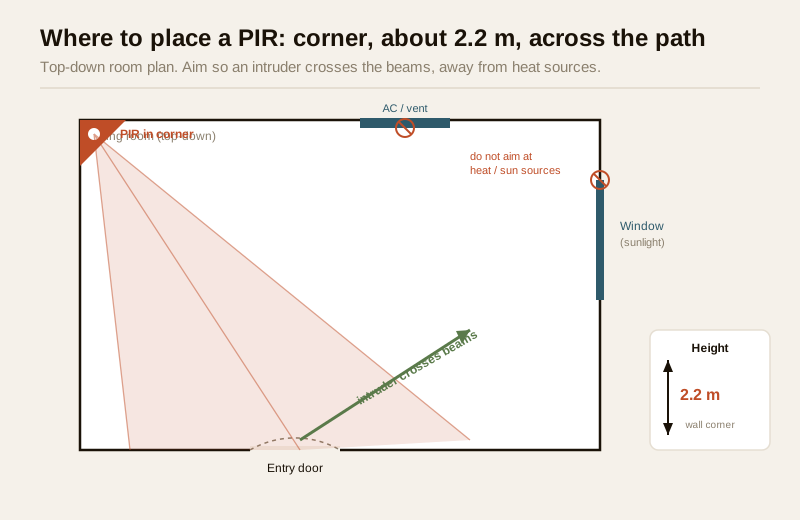
| Placement rule | Why it matters |
|---|---|
| Mount in a room corner | A corner gives the widest fan of coverage across the whole room from one unit. |
| About 2.0–2.4 m high (roughly 2.2 m) | High enough to see over furniture and below most fan blades; follow the maker's stated height. |
| Aim so intruders cross the beams | A PIR detects crossing motion best; face it across the likely path, not down a corridor. |
| Cover the entry, from inside | Point it to catch someone who has just come through the main door or a vulnerable window. |
| Away from AC/heater vents | Direct airflow of hot or cold air is the number-one false-alarm source. |
| Away from direct sunlight and hot windows | A moving sunbeam or a sun-heated pane shifts the heat pattern. |
| Clear of ceiling fans and curtains | Warmed moving fabric and blades read as motion; keep them out of the direct view. |
A single corner PIR in the main living space, aimed across the route from the front door, plus one covering a hallway or landing, is enough to give most homes a solid inner ring. This is the "trap" or interior layer that backs up your perimeter protection on doors and windows — if someone gets past the door and window contacts, the PIR catches them moving inside. That layered thinking is the heart of good layered security design.
Living with pets: pet-immunity
If a dog or cat has the run of the house at night, a standard PIR will trigger on them. The answer is a pet-immune PIR, tuned to ignore heat sources below a stated weight (commonly up to around 18–25 kg), usually by ignoring the lowest beams where a pet moves along the floor while still watching the upper beams where a standing person appears.
Pet immunity has real limits — a cat that climbs onto the sofa rises into the "person" beams, and two dogs together can add up to a person-sized heat signature. The full trade-offs, weight thresholds and mounting tricks are covered in the dedicated guide on pet-friendly motion sensors. If pets and reliable detection are both non-negotiable, a dual-technology sensor with a pet setting is often the more dependable route.
When PIR is not enough: stepping up
PIR is the sensible default, but some situations call for more:
| Situation | Better choice | Why |
|---|---|---|
| Hot, un-cooled room where contrast is poor | Dual-technology (PIR + microwave) | Microwave half does not need a heat difference |
| High false-alarm risk you cannot design out | Dual-technology | Requires BOTH technologies to agree before triggering |
| Need to sense through a partition or wide area | Microwave sensor | Radar-based; not limited to line-of-sight heat |
| Large or complex space, many sensors | Compare the whole family | Use the motion sensors overview |
| Not sure which to buy | — | Run the burglar alarm system selector |
A dual-technology sensor deserves a special mention because it directly answers PIR's two biggest weaknesses. It contains both a PIR and a microwave detector and only raises the alarm when both agree that a person is present. A ceiling fan fools the PIR but not the microwave; a heat wave fools neither together — so false alarms plummet, at a higher price. For most homes a well-placed PIR is enough; for a tricky room, dual-tech is the upgrade.
When to bring in a professional. Fitting a battery-powered wireless PIR you can reach is a fine do-it-yourself task — you choose the corner, the height and the aim. Bring in a licensed installer or electrician for mains-wired sensors, any mounting that needs a ladder or work at height, and integration with a hardwired panel — see the electrical hub. For a whole-home layout across an apartment or villa, a professional walk-through catches the blind spots a single homeowner misses.
Key takeaways
- A PIR sensor is passive — it emits nothing and simply watches for a change in the infrared heat in front of it, which is why it is cheap, low-power and the default motion sensor in Indian alarms.
- It detects crossing motion best: mount it in a corner at about 2.2 m and aim it so an intruder walks across its beams, never straight toward it.
- Extreme Indian summer heat reduces its reliability — when an un-cooled room nears body temperature the heat contrast shrinks; cool the room or step up to a dual-technology sensor.
- Most false alarms are placement problems: keep the PIR aimed away from AC and heater vents, direct sunlight and hot windows, ceiling fans and curtains, and use a pet-immune model if pets roam.
- Know when to upgrade: for hot rooms, high false-alarm risk, or sensing beyond line-of-sight, compare microwave and dual-technology options, or use the system selector; PIR anchors the layered plan in the burglar alarm pillar guide.
References
- Manufacturer specifications — verify a PIR's stated detection range, coverage angle, mounting height, temperature-compensation and pet-immunity weight threshold on the maker's own datasheet before buying, as figures vary by model.
- Digital Personal Data Protection Act, 2023 — indoor motion sensing records that movement occurred; place sensors thoughtfully and handle any linked footage or logs as personal data.
- Bureau of Indian Standards and the National Building Code of India (SP 7) for any mains-wired or life-safety aspect of an alarm install; confirm the current edition via the BIS catalogue: https://www.services.bis.gov.in/
This is an educational overview, not legal advice. Mains wiring, work at height and hardwired-panel integration are qualified professional tasks — engage licensed installers and verify any standard's current status via the BIS catalogue before relying on it.
Export this guide
Related Guides — Deep-dive reading
Motion Sensors for Home Security in India (2026): The Complete Guide
The umbrella guide to indoor motion detection: how PIR, microwave, dual-technology and ultrasonic sensors work, where to place them in an Indian home, and how good placement designs out false alarms from fans, AC, heat and pets.
SecurityPIR vs Microwave Sensor (2026): Which Motion Sensor for Indian Homes?
A neutral head-to-head between passive-infrared (PIR) and microwave (radar) motion sensors for intruder detection in an Indian home — how each detects, where each false-triggers, how they cover a room, and why their opposite weaknesses make dual-technology the honest best-of-both.
SecurityFalse Alarm Prevention for Burglar Alarms in India: Causes & Fixes (2026)
Why home alarms cry wolf — ceiling fans, pets, heat, insects, weak batteries, power blips and poor door alignment — and how correct placement, the right sensors and simple upkeep keep the system trusted and armed.
SecurityRelated Tools — Try Free
Cross-Ventilation Analyzer
Estimate airflow and air changes per hour (ACH) from room size, window areas, layout, and local wind — with NBC 2016 Part 8 compliance check.
Ventilation CalculatorBurglar Alarm System Selector
Answer a few questions about your property, cabling, coverage, monitoring and power and get the right burglar alarm — wired / wireless / hybrid, self or professionally monitored — with the design non-negotiables.
Alarm SelectorAcoustic Privacy (STC) Visualizer
Indian healthcare acoustic visualizer — compare wall assemblies and noise sources, see received SPL after STC attenuation, and check FGI 2018 / IS 1950 / NABH speech-privacy compliance with live dual-canvas waveform.
Acoustic Tool