
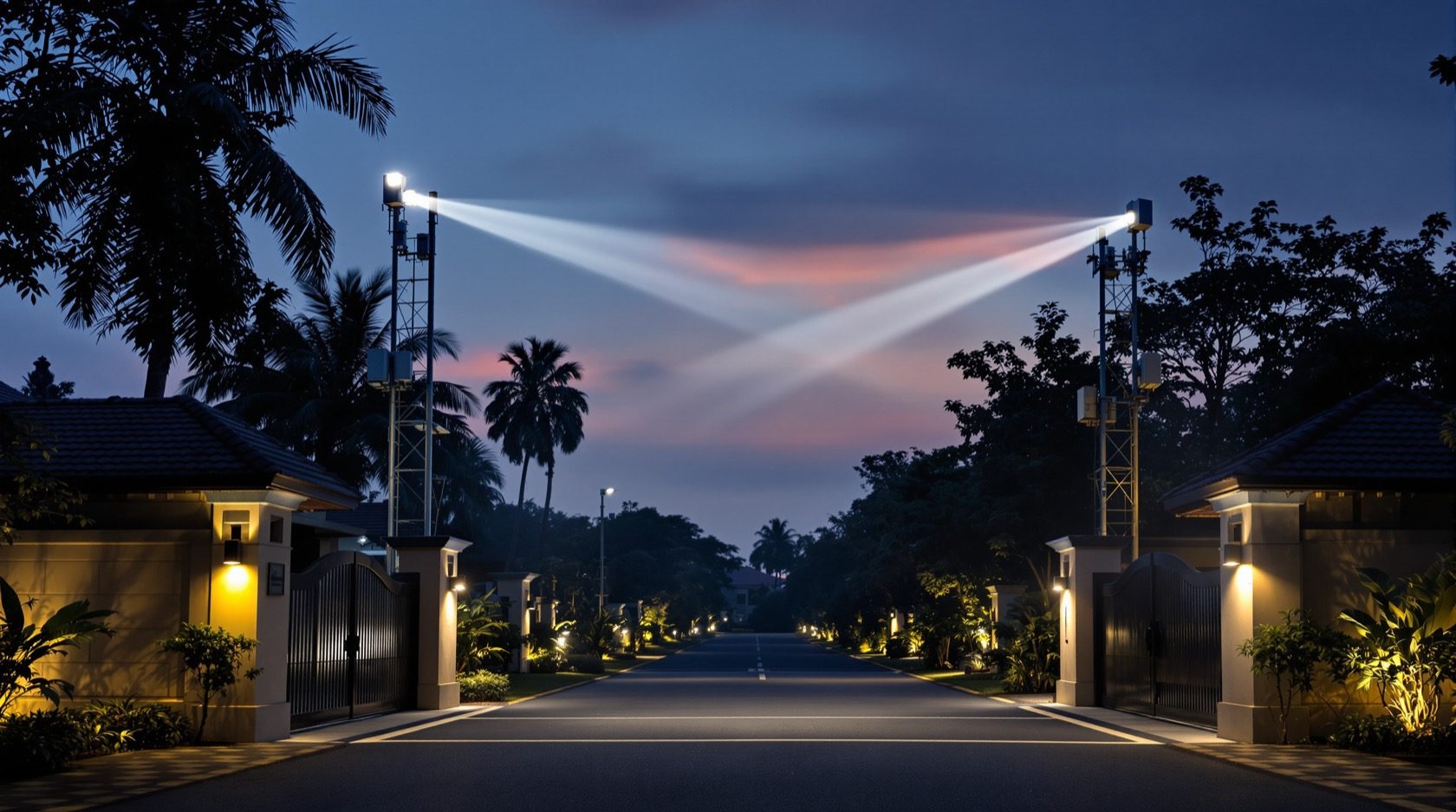
Beam Sensors in India (2026): Active-Infrared Perimeter Detection for Gates, Walls and Farmhouse Boundaries
How active-infrared beam sensors work, where they earn their place on Indian plots, single-beam versus multi-beam towers, and how to tame the outdoor false-alarm problem with sound design.
Most alarm sensors wait for an intruder to already be at your door, your window, or inside a room. Beam sensors work further out. A transmitter shoots an invisible infrared beam across a space to a receiver facing it; the moment a person walks through and breaks that beam, the alarm triggers. That makes the beam an outer detection line — it can catch someone crossing your compound gate, climbing over the boundary wall, or moving along a long farmhouse or factory perimeter before they ever reach the building.
For Indian plots — walled compounds, gated driveways, sprawling farmhouse and factory boundaries, long verandahs and facades — this is exactly the layer that a house full of door sensors and motion sensors usually lacks. This guide explains how active-infrared beams sense, where they belong, how single-beam differs from far more reliable multi-beam towers, and — honestly — how to handle the real outdoor headache of animals, birds, leaves, fog and monsoon setting them off. It sits inside Studio Matrx's burglar-alarm hub and pairs closely with perimeter alarm systems and fence-intrusion detection.
Scope & safety. This guide helps you choose and PLACE beam sensors well and coordinate the install. It describes how detection works and how to design a reliable perimeter — never how to defeat one. Beam heads on gate pillars, wall-tops and at height involve outdoor cabling, weather sealing and sometimes mains power: route that work to a licensed electrician or alarm installer, and never let any device block a fire-escape route or gate egress. Outdoor sensors that watch a boundary can also capture the road or a neighbour, which touches personal data under the Digital Personal Data Protection Act, 2023 — aim them at your own land. This is educational guidance, not legal advice.
How an active-infrared beam sensor works
A beam sensor is a matched pair. One head is the transmitter (TX) — it emits one or more pulsed, invisible near-infrared beams. The other is the receiver (RX) — it sits facing the transmitter and continuously "listens" for that beam. As long as the receiver keeps seeing the light, the zone is clear and nothing happens. When an opaque body — a person, a vehicle — passes between the two heads and interrupts the beam for a set fraction of a second, the receiver loses the signal and tells the alarm panel to trigger.
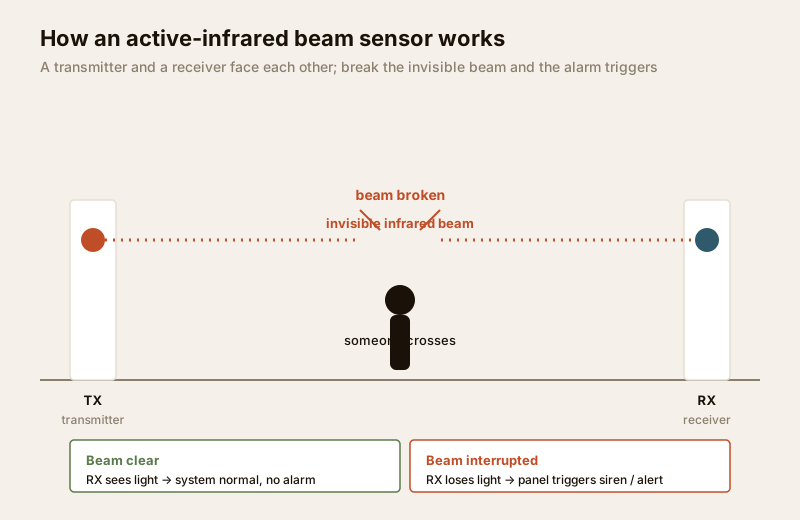
Two design details make this practical rather than twitchy:
- The beam is pulsed and coded, not a plain torch. This lets the receiver reject sunlight, headlights and other infrared "noise" and only respond to its own transmitter's signal.
- There is an interruption time. A quality beam only triggers if the beam stays broken for a minimum period (often tens of milliseconds). A bird flicking across in a flash may not qualify; a person walking through does. This single setting is one of your main tools against false alarms outdoors.
Because the beam itself is invisible and silent, a beam sensor is unobtrusive — but remember, it only detects a crossing of the line between the two heads. It is a tripwire in light, not an area detector. That is a strength (predictable, low false-alarm when placed right) and a limit (it guards a line, so you place lines where crossing matters). For area coverage inside a room you would reach for a PIR or dual-technology sensor instead; beams are for the perimeter and the long run.
Beam sensors versus the other perimeter detectors
| Detector | What it guards | Best use in India | Watch-outs |
|---|---|---|---|
| Beam sensor (this guide) | A line across a space | Gate, driveway, wall-top run, verandah, gap between buildings | Needs clear line of sight; outdoor false alarms; alignment |
| Fence-intrusion sensor | The fence fabric itself | Long boundary fences, factory perimeters | Wind sensitivity; needs a real fence |
| Curtain sensor | A thin vertical "curtain" at a facade | Windows, balconies, along a wall face | Shorter range; a facade layer, not a full boundary |
| Motion / PIR sensor | An area / volume | Rooms, garages, covered areas | Not for open outdoors in heat; area not line |
Where beams earn their place on an Indian plot
The art of beam sensors is choosing the lines that an intruder must cross, and putting a beam on each. On a typical Indian walled plot, four lines usually matter.
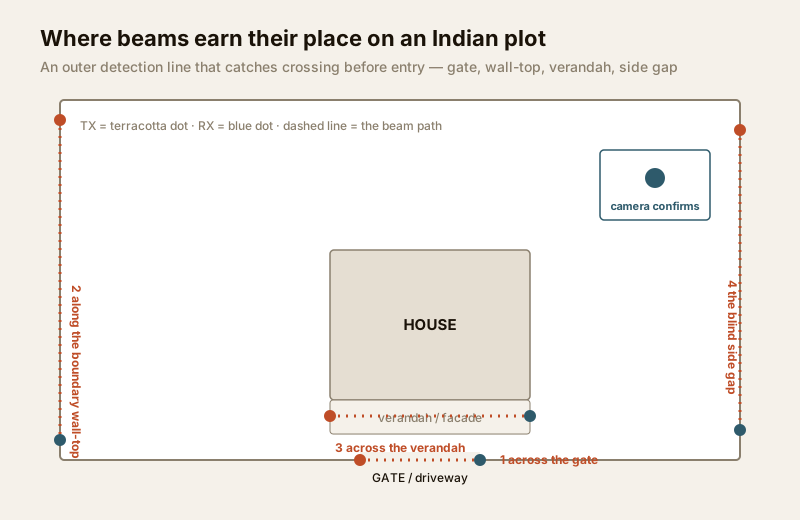
- Across the gate and driveway. A short beam across the main gate opening flags anyone or any vehicle entering after hours — the single highest-value line on most plots. Pair it with your gate video door phone and a camera so a legitimate late arrival does not become a nuisance.
- Along the top of the boundary wall. A long beam running the length of a compound wall catches someone who has climbed onto or over it — the classic entry route for a walled Indian home. This is where beams shine over a bare wall: the wall stops nothing on its own; the beam turns it into a detection line.
- Across a long verandah or facade. A beam parallel to the front of the house guards the approach to doors and windows, an early warning before glass or a lock is touched.
- The blind side gap. The narrow, unlit strip between the house and the compound wall — the spot no one watches — is a natural beam run.
For farmhouses and factories, the same logic scales up: beams close off long straight boundary runs and the gaps between godowns or blocks where a fence would be expensive. Because a single pair can span a long distance, a few well-placed beams can outline a large perimeter far more cheaply than a continuous fence sensor. This layered thinking — outer beams, then fence and wall, then door/window contacts, then indoor motion — is the heart of layered security design and a perimeter vulnerability assessment.
Range: indoor versus long outdoor
Beam heads are sold by rated range, and the outdoor figure is always much shorter than the "up to" number on the box, because rain, fog and dust scatter infrared.
| Setting | Typical rated range | Plan for | Notes |
|---|---|---|---|
| Indoor (corridor, hall, warehouse) | up to ~60–100 m and more | Rated range is realistic indoors | Clean air, no weather |
| Outdoor, clear conditions | rated outdoor figure, e.g. ~30–100 m per pair | Comfortably under the max | Leave headroom for weather |
| Outdoor, monsoon / fog country | Derate hard | Use ~50–60% of the outdoor rating, or split into shorter spans | Heavy rain and fog cut range sharply |
The practical rule: for outdoor runs in India, buy more range than the straight-line distance needs, and for very long boundaries use several shorter beam pairs rather than one heroic span. Shorter spans hold alignment better, degrade less in weather, and let you zone the perimeter so you know which stretch tripped.
Single beam versus multi-beam towers
This is the most important reliability choice, and it is worth understanding as a design decision — not as anything to do with getting past a beam.
A single-beam sensor is one beam between two heads. It is cheap and fine indoors, but outdoors a single beam is easily nuisance-tripped: one bird, one falling leaf, one gust-blown branch across the line is enough. It is also a thin, single line.
A multi-beam tower stacks several beams vertically between two taller posts and uses AND-logic: the alarm only fires when two or more adjacent beams are broken at the same instant. A person crossing is tall and solid, so they break several stacked beams together — a clear alarm. A bird, a leaf or a low-flying insect crosses only one beam at a time, so the tower ignores it. The result is dramatically fewer false alarms and a far more dependable detection line for a boundary that matters. (This stacked, multi-height design is presented purely as a reliability and coverage improvement.)
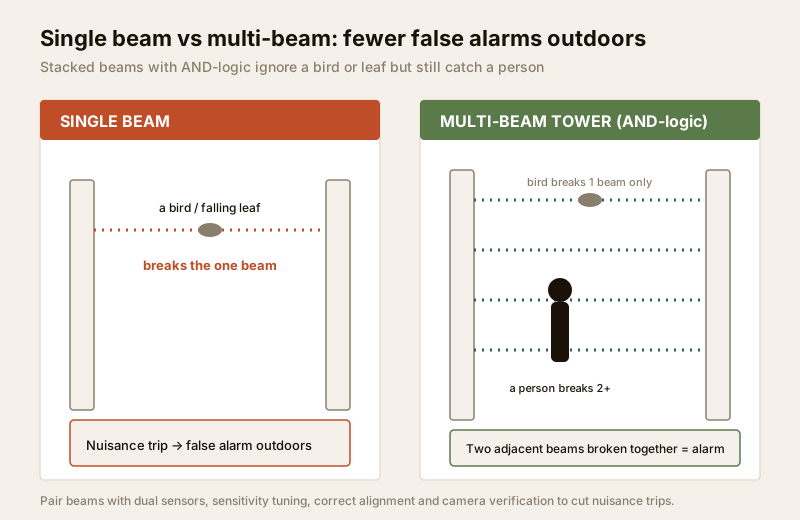
| Feature | Single beam | Multi-beam tower |
|---|---|---|
| Beams between heads | One | Two, three, four or more, stacked |
| Trigger logic | Any break | AND — two+ adjacent beams together |
| Outdoor false alarms | High (birds, leaves, animals) | Much lower |
| Best for | Indoor corridors, short spans | Outdoor boundaries, gates, walls |
| Cost | Lower | Higher, but far more usable outdoors |
For any serious outdoor perimeter in India — a farmhouse boundary, a factory fence line, an exposed compound wall — a multi-beam tower with AND-logic is the honest default. A single beam belongs indoors or on a short, sheltered indoor-grade run.
The honest outdoor false-alarm challenge
Outdoors is where beams get a bad name, and it is only fair to be straight about why. In Indian conditions a poorly chosen or poorly installed beam will false-alarm on:
- Animals and birds — stray dogs, cats, monkeys, cattle, and birds crossing the line.
- Falling leaves and blown debris — trees near the beam are a constant source.
- Fog and heavy monsoon rain — dense fog or a downpour can scatter the beam enough to look like an interruption; this is a weather limit stated as a design consideration.
- Beam misalignment — the biggest installer-side cause. Heads knocked, posts that shift, or thermal movement can drift the beam off the receiver so it drops out on its own.
None of these mean beams do not work — they mean beams must be designed for the site. The mitigations, all legitimate good practice, stack up well:
1. Use multi-beam AND-logic so single-object crossings (birds, leaves) are ignored by design.
2. Tune the interruption time and sensitivity so momentary flickers do not qualify, without missing a walking person.
3. Pair beams with a second technology — a "dual" arrangement where the beam and, say, a nearby motion sensor or fence sensor must both agree before an alarm is confirmed.
4. Mount and align properly — rigid posts on stable foundations, heads at matched height, protected from being knocked, re-checked after monsoon. Alignment is not a one-time job in India.
5. Verify with a camera. Point a CCTV camera at each beam line and link it to the alarm so every trip is confirmed on video before anyone acts. This is the single biggest nuisance-killer and ties into CCTV intrusion-zone detection. It is verification, never evasion — you are confirming what tripped, not hiding it.
6. Keep the line clear. Trim branches, clear the beam path, and keep the run away from washing lines, flags and swaying plants.
Done this way — multi-beam, tuned, camera-verified — a beam perimeter is dependable enough that the family and the guard start trusting the alarm again, which is the whole point.
Weatherproofing, power and mounting
Because beam heads live outdoors on the boundary, the physical spec matters as much as the electronics.
| Consideration | What to look for | Why it matters in India |
|---|---|---|
| Weather sealing | High IP rating (e.g. IP65 and above), UV-stable housing, sun-hood | Monsoon, dust storms and 45°C sun sit on these heads year-round |
| Optics protection | Hood/visor over the lens, easy-wipe face | Rain film and dust on the lens weaken the beam |
| Power | Wired low-voltage from the panel, or solar panel + rechargeable battery for far corners | Long farmhouse boundaries have no mains at the fence; power cuts are common |
| Mounting | Rigid, plumb posts on firm footings; matched TX/RX heights | Misalignment is the top false-alarm cause; a wobbly post ruins a good beam |
| Tamper & supervision | Tamper switch; the panel should flag a beam that stops reporting | You want to know if a head is knocked, blocked by grime, or loses power |
On power: wired heads fed from the alarm panel are the cleanest indoors and on short outdoor runs. For distant boundary corners with no cabling, solar-plus-battery beam heads (or wireless heads with their own battery reporting to the panel) avoid trenching a cable across the plot — but budget for a battery that survives a run of monsoon days with little sun, and make sure low-battery is reported to the panel and your app. Given India's power cuts, the whole perimeter must ride through an outage on panel and head batteries; see how wired, wireless and hybrid alarm systems handle backup.
Most Indian setups are self-monitored: the beam trip drives a siren and a GSM/app alert to the owner or guard, since professional monitoring with police auto-response is limited here. That makes camera verification and a reachable responder — a guard, a neighbour, the family — even more important than the sensor itself.
When to bring in a professional. Choosing the beam lines and the single-versus-multi-beam decision is yours to make. But mounting heads on gate pillars and wall-tops, running weatherproof outdoor cabling, wiring mains for solar controllers, aligning multi-beam towers, and integrating beams with the panel, sirens and cameras is skilled work. A licensed alarm installer or electrician should do the at-height, outdoor and mains parts, seal every entry against monsoon, and hand you an aligned, tested, camera-verified perimeter — plus a post-monsoon re-alignment as part of the maintenance plan. If in doubt, start from the burglar-alarm selector and the pillar guide.
Fitting beams into the whole plan
Beams are one layer, not the whole system. On a villa or independent house they add the outer detection line that door and window contacts cannot; in a gated community they can guard the community boundary and vehicle gates; on a factory or farmhouse they close off long runs cheaply. Layer them with fence sensors, wall-top runs, door/window sensors and indoor motion, all verified by CCTV, and you have depth — the principle behind the ultimate home-security guide and building security systems. For the electrical and backup side of any outdoor install, cross-check the electrical guides.
Key takeaways
- A beam sensor is a light tripwire: a transmitter shoots an invisible infrared beam to a receiver; break the beam across the line and the alarm triggers. It guards a line, so place lines where crossing matters — gates, wall-tops, verandahs, side gaps and long boundaries.
- Multi-beam towers with AND-logic are the honest outdoor default. Requiring two adjacent beams to break together ignores birds and leaves while still catching a person; single beams belong indoors or on short sheltered runs.
- Buy extra range and split long spans. Outdoor range is far below the box figure in monsoon and fog; shorter spans hold alignment, weather better, and zone the perimeter.
- Design out false alarms with AND-logic, tuned interruption time, dual-sensor confirmation, rigid aligned mounting, a clear beam path, and — above all — camera verification of every trip.
- Spec for the outdoors: high IP weather sealing, sun-hoods, wired or solar-plus-battery power that survives power cuts, tamper and supervision, and a professional for the at-height, outdoor-cabling and alignment work.
References
- Bureau of Indian Standards — standards portal for electrical installation, enclosure ingress-protection (IP) and outdoor low-voltage wiring references: https://www.services.bis.gov.in/
- Digital Personal Data Protection Act, 2023 — governs personal data captured when a boundary sensor or verification camera views beyond your own land: https://www.meity.gov.in/
- Manufacturer datasheets for active-infrared beam detectors (e.g. Optex, Takex, Honeywell, Hikvision) — for rated indoor/outdoor range, IP rating, beam count, interruption time and alignment procedure; verify the current model sheet before specifying.
- Studio Matrx — perimeter alarm systems and fence-intrusion detection for the surrounding perimeter layers.
This guide is educational information for planning and coordinating a security system, not legal, electrical or professional-security advice. Have outdoor, at-height and mains work carried out by licensed professionals and comply with local regulations.
Export this guide
Related Guides — Deep-dive reading
Perimeter Beam Sensors in India (2026): Invisible Trip-Lines Along the Boundary
How stacked active-infrared and laser photo-beams strung between towers along a wall, gap or long straight run raise the alarm the moment someone crosses the boundary — and how to place them so fog, birds and foliage do not.
SecurityPerimeter Alarm Systems in India (2026): Detect an Intruder at the Boundary
How an outer detection layer — outdoor motion sensors, beam barriers, fence and wall-top sensors and gate contacts — warns you the moment someone crosses your compound wall, and how to design it for Indian weather without endless false alarms.
SecurityFalse Alarm Prevention for Burglar Alarms in India: Causes & Fixes (2026)
Why home alarms cry wolf — ceiling fans, pets, heat, insects, weak batteries, power blips and poor door alignment — and how correct placement, the right sensors and simple upkeep keep the system trusted and armed.
SecurityRelated Tools — Try Free
Access-Control Battery-Backup Calculator
Size the standby battery so an access system keeps running through a power cut, with an egress life-safety note.
Battery BackupVideo Door Phone Type Selector
Answer a few questions about your building, cabling, budget and internet and get the right video door phone — analog / wired / wireless / IP, single-home or multi-apartment, monitor or app.
Door Phone SelectorCCTV System Type Selector
Answer five questions and get the right CCTV setup — analog / IP / hybrid, wired / wireless, local / cloud — with reasons.
CCTV Selector