
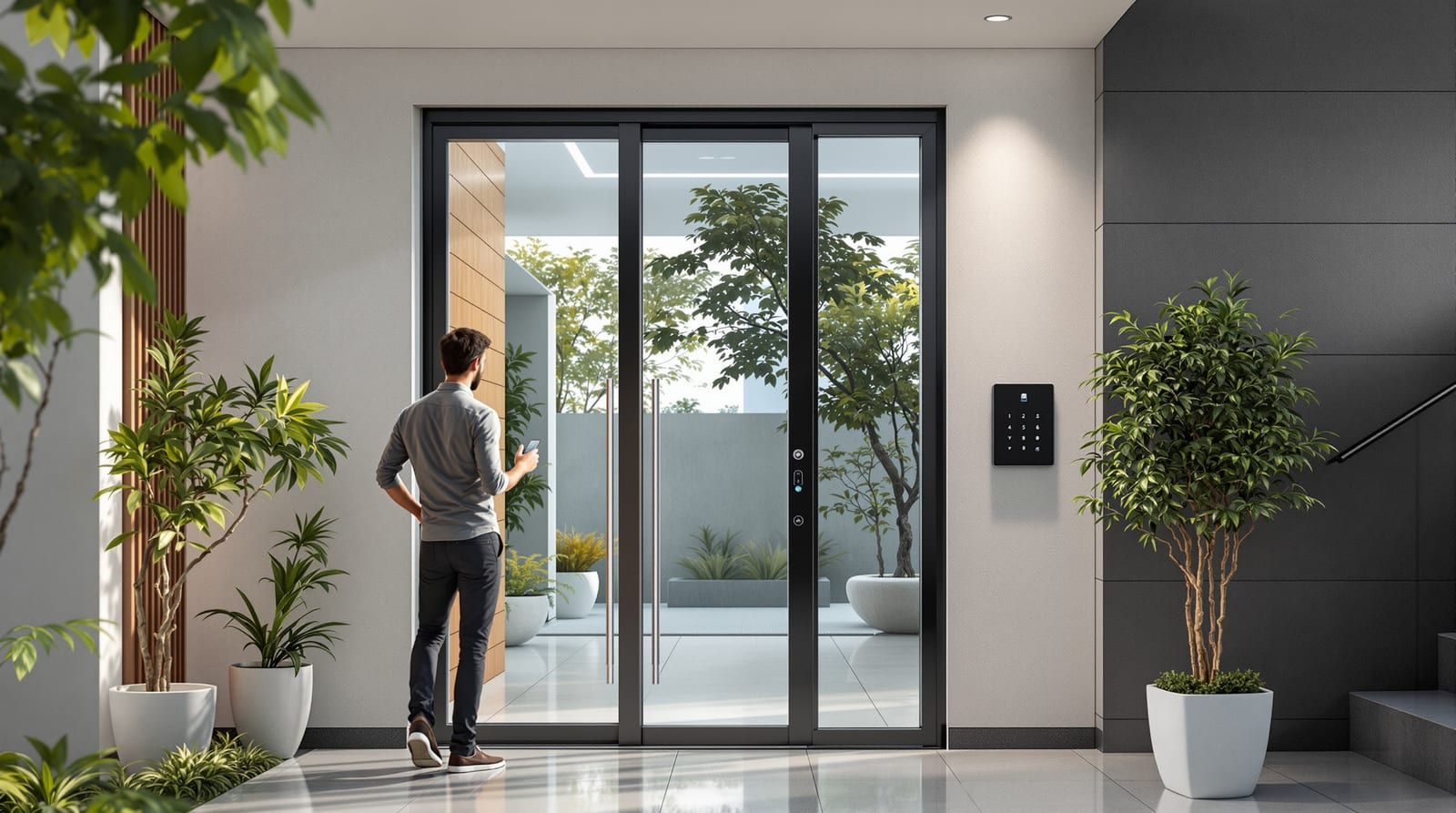
Door Automation Guide: Access Control for India 2026
The complete map of smart locks, automatic operators, access control and intercom for Indian buildings, with the standards and power-cut realities.
A good door automation guide starts not with a product but with a decision: what should the door do when a person, a power cut, or a fire arrives? Automating an entrance in an Indian building means choosing among smart locks, access-control systems, automatic operators and video intercom, then wiring them to behave correctly under load-shedding and to obey the life-safety law that an escape door must always open from the inside. This pillar maps the whole landscape, shows how to decide by building type and goal, and routes you to the deep-dive spokes and the access-control system designer tool.
The door automation guide landscape: four layers
Modern door automation is best understood as four overlapping layers, each solving a different problem. Most projects use two or three of them together.
1. Smart locks replace or augment the lock cylinder with electronic credentials — PIN, RFID card, fingerprint, face, palm-vein, Bluetooth/app, Wi-Fi or OTP, almost always with a mechanical-key override. They suit individual flats and main doors. See smart door locks, choosing a smart lock and smart lock vs traditional lock.
2. Access-control systems add a controller, reader and an electric lock (maglock or strike) so an organisation can grant, log and revoke entry across many doors. This is the office, society and campus layer — covered in access-control systems.
3. Automatic door operators physically open the leaf — swing or sliding — for accessibility, throughput or hygiene. See automatic door operators.
4. Video intercom and visitor management verify who is at the door before you let them in, from a single villa unit to a multi-tower IP system — see video intercom systems.
Around all four sits the connectivity and power fabric — protocols, hubs, backup batteries — and the standards that govern egress, accessibility and data. The whole picture is the cluster pillar complete door guide.
Decide by goal, not by gadget
The single most useful question is why you are automating. Each goal points to a different primary layer and a different acceptance test.
| Goal | Primary layer | Typical India choice | Acceptance test |
|---|---|---|---|
| Convenience / keyless living | Smart lock | Fingerprint + Wi-Fi lock | Family can enter with no key; OTP for guests |
| Security / audit trail | Access control | Card or biometric reader + controller | Every entry time-stamped, revocable instantly |
| Accessibility (RPwD) | Auto operator | Low-energy swing operator + push-plate | Wheelchair user opens unaided |
| Throughput / hygiene | Auto sliding | Sensor-driven sliding operator | Hands-free flow at peak |
| Visitor screening | Video intercom | IP video door phone + VMS | Resident sees and admits remotely |
Most real projects blend goals: a gated society wants security and throughput and visitor screening, which is why whole-system design beats buying parts piecemeal.
Decide by building type
| Building type | Recommended stack | Notes |
|---|---|---|
| Independent home / villa | Smart lock + video door phone | Battery + key override essential; see video door phones |
| Apartment flat | Smart lock + building IP intercom | Coordinate with society panel — apartment smart access |
| Gated society / tower | Networked access control + IP intercom + VMS | gated society access control |
| Office / corporate | Card/biometric access control + auto entrance + VMS | office access control |
| Hotel | RFID/mobile-key locks + low-energy entrance | hotel door lock systems |
| Coworking / shared | Mobile + card access, time-bound | coworking access control |
How the pieces wire together
At component level an automated door is a small control system: a credential is presented, a controller decides, and an electric lock or operator acts — all backed by a power supply that must survive India's frequent outages.
The credential technologies
How a person proves they belong is the most visible design choice. Each method trades convenience against security and privacy.
| Method | Convenience | Security | Watch-outs | Deep dive |
|---|---|---|---|---|
| PIN code | High | Medium | Shoulder-surfing; share rotation | pin code door locks |
| RFID card / fob | High | Medium | Cloning of low-end cards | rfid door access |
| Fingerprint | High | High | Wet/worn fingers fail | biometric door locks |
| Face recognition | Very high | High | Privacy, DPDP consent | face recognition access |
| Mobile app / BLE | High | High | Phone battery, app uptime | mobile app door access |
| Multi-factor | Medium | Very high | Cost, friction | multi-factor door access |
Biometrics deserve a legal flag: under the DPDP Act 2023, fingerprints and face templates are sensitive personal data — store them encrypted, obtain consent, and prefer on-device matching over cloud where you can.
The electric lock: fail-safe vs fail-secure
The most consequential hardware decision is what the lock does when power dies. A maglock (EM lock) at 280 or 600 kg holding force is fail-safe — it unlocks on power loss, which is exactly what you want on an escape door. An electric strike can be configured fail-safe or fail-secure; a fail-secure lock stays locked without power, suitable only where egress is guaranteed by other means. This single choice is governed by fail-safe vs fail-secure locks and the selector under magnetic door locks and electric strike locks.
Indicative costs (India 2026, installed, ex-GST)
| Item | Band (₹) | Note |
|---|---|---|
| Entry smart lock (BLE/keypad) | 7,000 – 12,000 | DIY-friendly |
| Fingerprint + Wi-Fi lock | 12,000 – 20,000 | Most popular tier |
| Premium / face / VDP-integrated | 18,000 – 35,000 | Project-grade |
| Access control per door (card/keypad) | 8,000 – 25,000 | Controller + reader + lock |
| Access control per door (biometric) | 15,000 – 60,000+ | Networked, software |
| Video door phone (wired) | 3,000 – 8,000 | 4.3–7" monitor |
| IP / villa / Wi-Fi intercom | 10,000 – 25,000 | Per unit |
| Auto swing operator | 30,000 – 1,50,000 | Accessibility / heavy leaf |
| Auto sliding (complete) | 45,000 – 2,80,000 | Throughput / hygiene |
Add GST 18%. Multi-door and automated kit is quote-driven; size it with the door automation cost calculator or access control cost estimator, then validate against automatic door cost.
The power-cut reality
India's load-shedding makes power planning non-negotiable. Smart locks run on AA batteries or rechargeable packs — keep the mechanical key and watch the low-battery alert (see smart lock battery guide). Wired access control and operators need a backup battery on every controller and ideally a UPS; IP devices can draw clean PoE power. Plan this explicitly with door access power backup, and never let a power cut become a lockout — or, worse, a locked-in. Wiring detail lives in door automation wiring.
Connectivity and smart-home integration
Protocols decide how the door talks to phones, hubs and the building system: Wi-Fi and Bluetooth for standalone locks; Zigbee, Z-Wave and increasingly Matter for smart-home interoperability; TCP/IP and cloud for networked access control. Whole-home control is covered in smart home door integration, and building-management tie-ins in access control BMS integration.
Standards you cannot skip
- NBC 2016 — escape-route doors must allow free egress; maglocks on such doors must release on fire alarm and on power loss. This overrides any convenience feature.
- RPwD Act 2016 + Harmonised Guidelines — accessible entrances need low-energy operators and reachable push-buttons; see accessible doors.
- DPDP Act 2023 — consent and protection for biometric and video data. Standards detail sits in access control standards.
Operations: don't forget the AMC
Automation is a living system. Budget for an annual maintenance contract, firmware updates, audit-log review and credential housekeeping (revoke ex-staff, rotate PINs) — see door automation AMC and door access audit logs. Brands to shortlist generically include Godrej, Yale, Qubo, Hikvision and CP Plus; balance features against local service support.
Frequently asked questions
What is the difference between a smart lock and an access-control system?
A smart lock is a self-contained electronic lock for one door, usually managed by a household. An access-control system uses a central controller to manage credentials, logs and rules across many doors — the right choice for offices, societies and campuses where you must grant and revoke entry at scale.
Will my automated door open during a power cut?
It depends on the lock. Maglocks are fail-safe and release on power loss; battery-powered smart locks keep working until the battery dies (and have a key override). Fail-secure electric strikes stay locked. On any escape route, NBC 2016 requires the door to permit free egress, so a fail-safe configuration plus exit button is mandatory.
Are biometric door locks legal in India?
Yes, but fingerprint and face data are sensitive personal data under the DPDP Act 2023. Take informed consent, store templates encrypted, prefer on-device matching, and have a deletion process for people who leave.
How much should I budget for a whole building?
Per door, expect ₹8,000–25,000 for card/keypad access and ₹15,000–60,000+ for networked biometric, plus controllers, backup power and software, all before 18% GST. Use the access control cost estimator for a building-level figure and get an integrator quote.
Can I install door automation myself?
A battery smart lock is often DIY. But any system that uses mains power, maglocks on escape doors, or building wiring needs a qualified electrician or integrator to isolate power, ensure fire-alarm release and meet life-safety codes. Don't improvise on egress.
Do I need an automatic operator for accessibility?
If the entrance must be usable by wheelchair users unaided, a low-energy swing or sliding operator with a reachable push-plate is the RPwD-compliant answer. See automatic door operators and wheelchair accessible doors.
Export this guide
Related Guides — Deep-dive reading
Fail-Safe vs Fail-Secure Locks: The Guide (India 2026)
Why fail-safe vs fail-secure is the single most important access-control decision, and how to get it right for every door.
Home Doors & EntrancesAccess Control Maintenance in India (2026): Readers, Locks and Fail-Safe Egress
How to keep a card, keypad, fingerprint or face access-control system reading reliably and locking securely — and, above everything, how to test that its doors still release on a fire alarm and on power loss, so an access-controlled door never becomes a life-safety trap.
SecurityDoor Access Control for Indian Homes, Villas & Societies: RFID, PIN, Biometric & Networked Systems (2026)
How access control moves you from a single smart lock to managed entry across flats, villas and society gates - RFID cards, PIN keypads, biometrics, app and intercom integration, standalone vs networked controllers, audit logs, visitor and maid management, and what a basic vs networked system really costs in India.
Home Doors & EntrancesRelated Tools — Try Free
Video Door Phone Type Selector
Answer a few questions about your building, cabling, budget and internet and get the right video door phone — analog / wired / wireless / IP, single-home or multi-apartment, monitor or app.
Door Phone SelectorAccess-Control Battery-Backup Calculator
Size the standby battery so an access system keeps running through a power cut, with an egress life-safety note.
Battery BackupApartment Video Door System Planner
Enter flats, entrances, floors and guard desk for a first-pass building intercom plan — door stations, indoor monitors, guard station, the right architecture and an indicative cost band.
Building Planner