
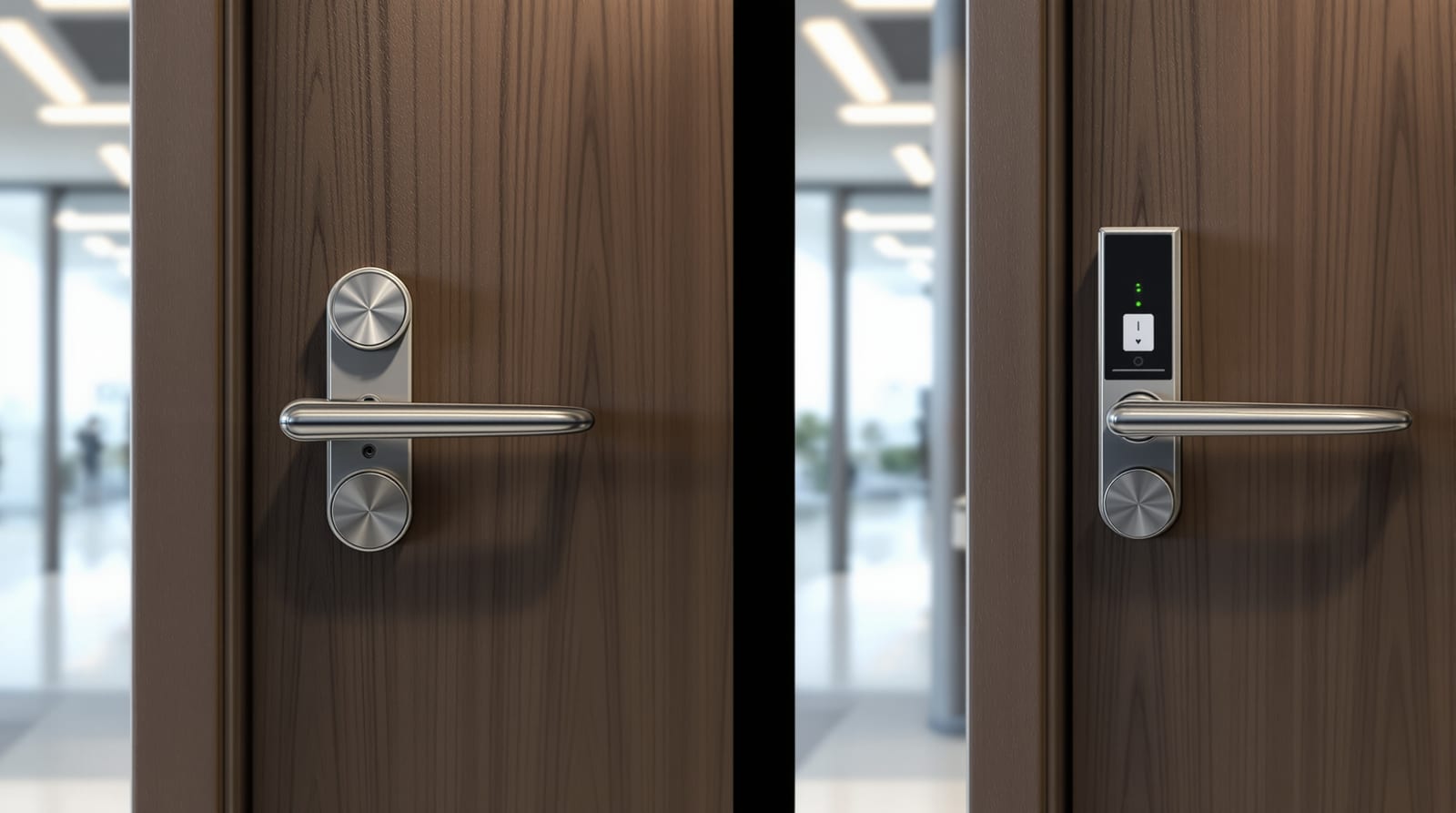
Fail-Safe vs Fail-Secure Locks: The Guide (India 2026)
Why fail-safe vs fail-secure is the single most important access-control decision, and how to get it right for every door.
Before you choose a reader, a controller or a brand, you must answer one question for every electrified door: what should it do the instant the power dies? The choice of fail-safe vs fail-secure is the single most important decision in any access-control design, because it is a life-safety decision, not a convenience one. Get it wrong and you either trap people behind a locked door during a fire, or leave a strongroom standing open through an Indian power-cut. This guide gives you a decision matrix by door function, explains which lock hardware does which, covers the mandatory fire-alarm interface, and flags the code rule you cannot break.
What fail-safe vs fail-secure actually means
The terms describe the de-energised state of the lock — its behaviour when it loses power, whether from a blackout, a tripped breaker, or a deliberate fire-alarm release.
- Fail-safe (fail-open): the lock is held locked by power and unlocks when power is removed. Power loss equals an open door. This is the correct choice for escape routes and any door where life safety outranks security.
- Fail-secure (fail-locked): the lock is held unlocked by power (or simply locked by default) and stays locked when power is removed. Power loss equals a locked door. This protects assets on doors that are never part of an escape route.
Note the deliberate ambiguity in the word "safe": fail-safe is safe for people, not for property. A facility manager worried about theft and an architect worried about fire are pulling in opposite directions, and the door function — not personal preference — decides who wins.
The golden rule that overrides everything else: in India, any access-controlled door on an escape route must allow free egress at all times. The National Building Code (NBC 2016) requires that occupants can always leave a building without a key, card, special knowledge or tool. On such doors the locking hardware must be fail-safe and must release on fire alarm. This is non-negotiable.
The decision matrix by door function
The single most reliable way to specify a door is to ask: "Is this door part of a designated escape route, and on which side is the threat?" The answer chooses the mode for you.
| Door function | Egress role | Choose | Why |
|---|---|---|---|
| Stairwell / final exit / fire door | Escape route | Fail-safe | NBC free egress; must open in fire/blackout |
| Main lobby entrance (occupied building) | Usually escape route | Fail-safe + fire release | People must get out; secured by other layers |
| Office floor entry door | Often escape route | Fail-safe | Defaults open in fire; controlled in normal use |
| Server room / data centre | Not egress (people exit, never trapped) | Fail-secure | Asset protection; must stay locked in outage |
| Cash room / strongroom / pharmacy store | Not egress | Fail-secure | Security must survive power loss |
| Stockroom / records / IT closet | Not egress | Fail-secure | Protect contents during blackout |
| Perimeter gate (vehicle/pedestrian) | Site-specific | Depends | Match to evacuation plan; often fail-safe at staffed gates |
| Lift lobby smoke door | Escape route | Fail-safe | Fire compartmentation + egress |
A useful sanity check: for a fail-secure door, ask "can a person always leave from the secure side without electricity?" A server room satisfies this because the exit side has mechanical free egress (handle/REX dump), even though entry stays locked. If a person could be trapped, the door cannot be fail-secure.
Which lock hardware does which
The lock type strongly influences — and sometimes dictates — the mode.
Magnetic locks (EM locks) are always fail-safe
A magnetic lock (maglock, 280 kg or 600 kg holding force) is an electromagnet that grips a steel armature plate. It holds only while energised, so cutting power always releases it. A maglock is inherently fail-safe — it cannot be made fail-secure. That makes it ideal for escape doors, but it also means a maglock must never be the sole lock on a fail-secure door, and it must always be tied to fire-alarm release and a battery-backup plan.
Electric strikes can be either
An electric strike replaces the strike plate; the lockset's latch still throws into it, and the strike's keeper pivots to release the latch on signal. Strikes are sold in two modes — and many are field-selectable:
- Fail-safe strike: keeper is locked by power, releases on power loss.
- Fail-secure strike: keeper is locked by default, releases only when energised; power loss leaves it locked.
Because the door's own lever still provides mechanical egress from inside, a fail-secure strike is the classic, code-friendly way to secure a non-egress door while preserving free egress from the secure side.
Solenoid bolts and electric deadbolts
Electric bolt locks (solenoid-driven) also come in both modes; specify carefully. A fail-secure bolt on an egress door is a code violation waiting to happen.
| Hardware | Fail-safe? | Fail-secure? | Best for |
|---|---|---|---|
| Magnetic lock (EM) | Always | Never | Escape doors, glass doors, high-traffic |
| Electric strike | Yes (mode) | Yes (mode) | Non-egress doors with a latching lockset |
| Solenoid / electric bolt | Yes (mode) | Yes (mode) | Frameless / specialised doors |
| Electronic deadbolt (battery) | Battery-dependent | Battery-dependent | Residential; not for code escape routes |
For a deeper look at each, see magnetic door locks and electric strike locks, and the broader electronic deadbolts overview.
The fail-safe unlock flow on fire alarm
Here is what should happen on an escape door the moment the fire panel activates.
The fire-alarm interface is mandatory for maglocks on escape and compartment doors: the access controller (or a dedicated relay supervised by the fire panel) must cut maglock power on alarm so the door opens regardless of the access system's state. Wiring this correctly is part of door automation wiring, and integrating release with building systems is covered in access control BMS integration.
Power-cut reality and battery backup in India
India's frequent power-cuts make mode selection more than theoretical. A fail-secure door will lock people out every time the supply drops unless it has battery backup; a fail-safe door will unlock every time, defeating security, unless it has backup keeping it energised.
The answer is the same for both modes: a dedicated access-control power supply with a sealed lead-acid backup battery (typically 4–8 hours autonomy), or a UPS on the controller. With backup, a fail-safe door stays locked through a routine blackout but still releases on a genuine fire signal, and a fail-secure door keeps its keeper powered so authorised cards still work. Specifying this is the heart of door access power backup. One caution: backup must never override fire release — the fire relay sits downstream of the battery so an alarm always wins.
Code and compliance you cannot skip
- NBC 2016 — free egress: escape-route doors must open from the egress side without a key, card or special knowledge; access locks must be fail-safe and release on fire alarm.
- Fire-alarm release: maglocks on egress/compartment doors must be supervised and de-energised on alarm.
- RPwD Act 2016 / Harmonised Guidelines: accessible doors should not require force or dexterity that excludes people with disabilities; pair access control with push-button door openers where needed.
- DPDP Act 2023: if your access method captures biometrics or footage, the data rules apply regardless of lock mode.
When in doubt, isolate the circuit and bring in a licensed electrician and a fire consultant — incorrect fire-release wiring is a life-safety defect, not a snag. Map the whole picture against access control standards, and treat this decision as foundational within an access control systems design and the complete door guide.
To settle a specific door, run the fail-safe vs fail-secure selector and size the rest of the project with the access control cost estimator.
Frequently asked questions
Is fail-safe or fail-secure safer?
They protect different things. Fail-safe is safer for people — it unlocks on power loss so no one is trapped, which is why it is mandatory on escape routes. Fail-secure is safer for property — it stays locked in a blackout. The door's function, and whether it lies on an escape route, decides which applies.
Can a magnetic lock be fail-secure?
No. A maglock holds only while energised, so it always releases when power is removed — it is inherently fail-safe and cannot be configured fail-secure. If you need a non-egress door to stay locked in a power-cut, use a fail-secure electric strike or bolt instead.
Won't a fail-safe door be wide open during every power-cut?
It would be unlocked, but a properly designed door also has battery or UPS backup, so it stays locked through routine outages while still releasing on a true fire alarm. The fail-safe behaviour is the last-resort guarantee that people can always escape.
Which mode do I use for a server room?
Fail-secure. A server room is not an escape route — people exit it and are never trapped — and its assets must remain locked during a power-cut. Free egress from the inside is preserved through the lockset's mechanical lever and a request-to-exit device.
Do fail-secure doors still need free egress?
Yes, from the secure side. A fail-secure strike works precisely because the door's own lever still opens it mechanically from inside. The mode only governs entry control and behaviour on power loss; it must never prevent someone leaving.
Is the fire-alarm interface really compulsory?
For maglocks on escape and fire-compartment doors, yes. NBC requires that such doors release on fire alarm and on power loss, so the fire panel must be wired to drop lock power independently of the access controller. Skipping it is a life-safety violation.
Export this guide
Related Guides — Deep-dive reading
Fire-Egress Compatibility for Smart Locks in India (2026): Never Trap Anyone
How to make sure a smart lock or access-controlled door on an escape route always lets people out in a fire or emergency: fail-safe hardware, free egress, fire-rated doors, and the fire-alarm interlock.
SecurityStaircase Access Control in India (2026): Securing the Stair Without Locking In Escape
How to control who can enter a stair from a floor while guaranteeing that anyone inside can always walk out - free-exit egress hardware, fail-safe locks that release on fire and power loss, monitored doors, and coordinating the whole thing with your fire officer and the NBC.
SecurityAccess Control Maintenance in India (2026): Readers, Locks and Fail-Safe Egress
How to keep a card, keypad, fingerprint or face access-control system reading reliably and locking securely — and, above everything, how to test that its doors still release on a fire alarm and on power loss, so an access-controlled door never becomes a life-safety trap.
SecurityRelated Tools — Try Free
Access-Control Battery-Backup Calculator
Size the standby battery so an access system keeps running through a power cut, with an egress life-safety note.
Battery BackupEmergency-Egress Checker
A life-safety self-check that access-controlled doors on escape routes still let people out in an emergency.
Egress CheckAccess-Control Power Calculator
Total current and power an access system draws, to size the power supply — locks, readers and controllers.
AC Power