
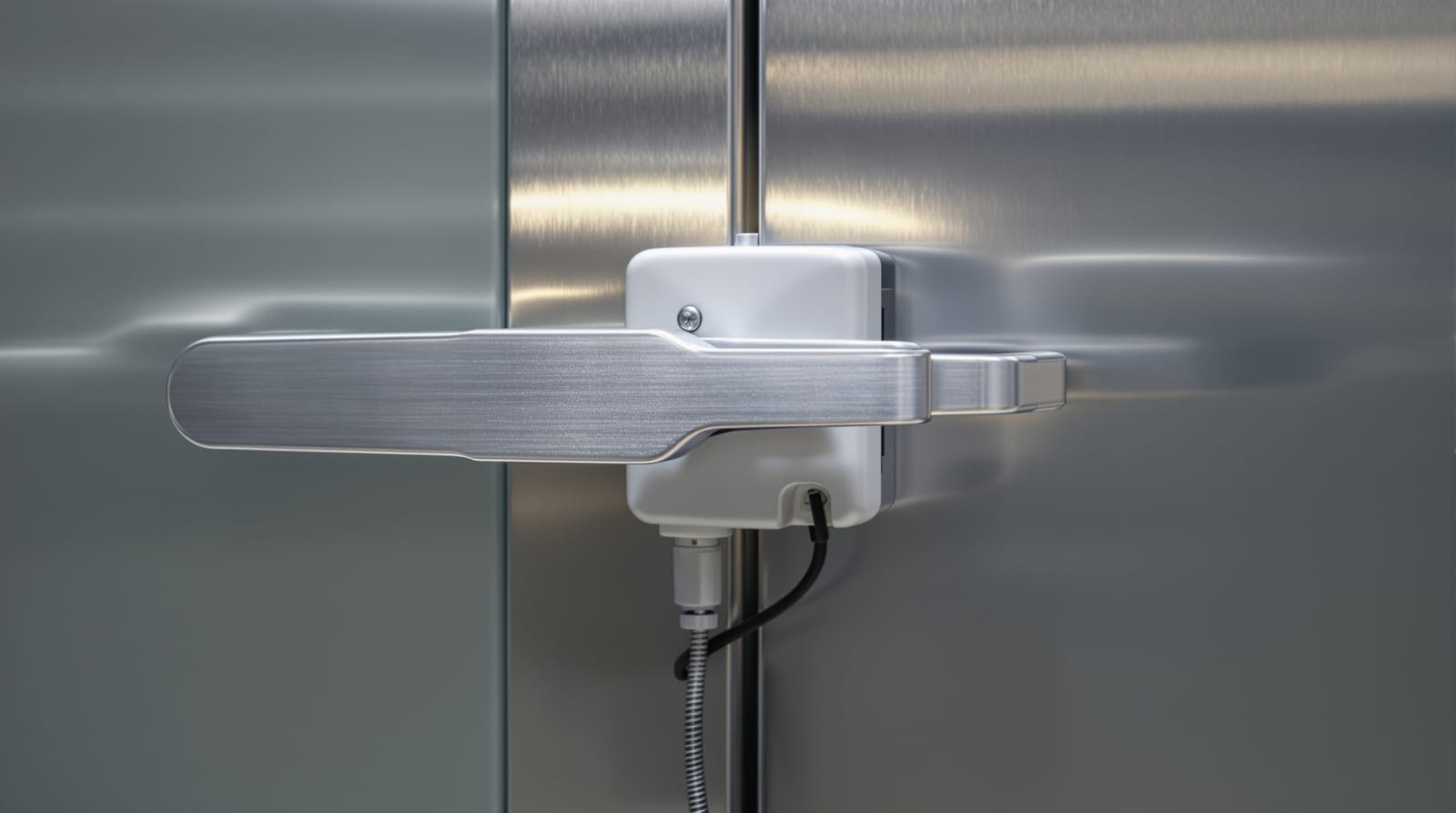
Electric Strike Locks Explained: Fail-Safe vs Secure India 2026
How the powered strike plate releases your existing latch, the fail-safe versus fail-secure choice, AC versus DC buzz, and where it beats a maglock.
Most access-control upgrades do not need a new lock at all. Electric strike locks replace the fixed metal strike plate in your door frame with a powered version: the latch of your existing mortise or cylindrical lock still slides into the frame, but the plate's keeper can now pivot or release on an electrical signal, letting the door swing open without anyone turning a handle. Press a buzzer, tap a card, key in a PIN, and the strike clicks free. It is the quiet workhorse of Indian access control — cheaper than a magnetic lock, able to keep mechanical key override and the deadlatch security you already paid for, and available in both fail-safe and fail-secure forms. This guide explains exactly how an electric strike works, the life-safety choice that defines which variant you fit, how it pairs with your present hardware, and where it beats a maglock. Pair it with our fail-safe vs fail-secure locks primer and the magnetic door locks comparison.
How an electric strike lock works
A standard strike plate is just a slotted piece of steel the latch bolt drops into. An electric strike swaps that static keeper for a hinged, spring-loaded one controlled by a solenoid or motor.
- Latched (locked): the keeper is held rigid, so the latch bolt cannot pull out — the door behaves exactly as a normal locked door.
- Released (unlocked): when the controller sends power (or, in a fail-safe unit, removes it), the keeper is free to pivot. A push on the door swings the latch past it, and the door opens. The lock body never moves; the frame side yields.
Crucially, the lock cylinder and handle stay fully functional. Anyone inside can turn the knob or lever and walk out by retracting the latch normally — which is why a correctly fitted strike preserves free egress. From outside, a mechanical key still works as a fallback when the electronics or power fail. That dual nature — electric convenience plus mechanical override — is the strike's biggest advantage over a maglock, which has no key.
A strike is rated by its static holding force (how much pull the keeper resists, commonly 450-1,500 kg-force depending on grade) and by whether it is continuous-duty (can stay energised indefinitely without overheating) — essential for fail-secure doors that are powered while locked.
Fail-safe vs fail-secure: the choice that defines the door
This single decision matters more than the brand. It governs what happens in a power cut, which in India is a frequent, not theoretical, event.
- Fail-safe (fail-open): the strike is energised to lock. Remove power and the keeper releases — the door can be pushed open. Use on escape-route doors, because people must be able to leave during a fire or outage. The trade-off: a power cut leaves the door insecure, so it suits internal doors more than a building's outer line of defence.
- Fail-secure (fail-locked): the strike is energised to unlock. Remove power and it stays locked — but the inside lever still retracts the latch, so people can always exit by hand. Use on perimeter and high-value doors (main entrances, stockrooms, server rooms) where you do not want the door to fall open in an outage. It draws power only at the moment of release, so it is energy-thrifty.
The legal must, non-negotiable under NBC 2016 life-safety provisions: any access-controlled door on a designated escape route must allow free egress and, where it could trap people, release on the fire-alarm signal. A fail-secure strike satisfies egress through the inside lever; a fail-safe strike (or maglock) must be tied into the fire panel so it drops on alarm.
Fail-safe vs fail-secure matrix
| Aspect | Fail-safe (fail-open) | Fail-secure (fail-locked) |
|---|---|---|
| Power applied | To keep locked | To release |
| On power loss | Unlocks | Stays locked |
| Egress on power loss | Door free to push | Inside lever still works |
| Best for | Internal escape doors | Perimeter, high-value doors |
| Power draw | Continuous (needs continuous-duty) | Momentary, energy-thrifty |
| Outage security | Insecure | Secure |
| Fire-alarm tie-in | Usually required | Egress via lever |
Many strikes are field-selectable between the two modes via a small jumper or tab — handy, but it must be set correctly at commissioning and documented. Decide deliberately with the fail-safe vs fail-secure selector.
AC vs DC, buzz vs silent, and monitored types
Electric strikes come in variants that confuse buyers; the differences are practical.
AC vs DC. An AC-powered strike emits a loud, continuous buzz while released — the classic apartment-gate "bzzzt" that signals "push now." It is cheap and the audible cue is useful for visitors, but it cannot run continuously without overheating, so AC strikes are almost always fail-secure (momentary release). A DC-powered strike is silent (just a soft click) and, when continuous-duty rated, can be held energised, which is what fail-safe operation needs. For most modern access control, specify DC, continuous-duty, with a silent release; reserve the AC buzzer for simple intercom-and-gate setups where the noise is a feature.
Monitored strikes. A monitored unit adds internal sensors that report two things back to the controller: latch monitoring (is the door latch actually seated?) and keeper/strike monitoring (did the keeper return to the locked position?). This lets the system raise a "door forced" or "door held open" alarm and feed accurate audit logs — see door access audit logs. For any security-graded door, monitored is worth the modest premium.
| Variant | Sound | Duty | Typical mode | Where it fits |
|---|---|---|---|---|
| AC strike | Loud buzz | Intermittent | Fail-secure | Gate + intercom, visitor doors |
| DC strike | Silent click | Continuous-duty available | Either | Modern access control |
| Dual AC/DC | Selectable | Mixed | Either | Flexible retrofits |
| Monitored DC | Silent | Continuous-duty | Either | Security-graded, audited doors |
Working with your existing mortise or cylindrical lock
The strike's appeal in retrofits is that it leaves the door leaf alone. You keep your current mortise lock, cylindrical lockset or rim lock; only the frame is modified to take the powered keeper, and a cable is run to the controller.
Fit matters, though. Three checks decide whether a strike will work:
- Latch type. A plain spring latch suits most strikes. A deadlatch (anti-shim plunger) is good, but the strike must be one designed for it. A deadbolt generally cannot be released by a strike — for keyed deadbolts use an electronic deadbolt or a maglock instead.
- Frame material and depth. Steel and timber frames take a mortised strike readily; thin aluminium glazing profiles or narrow stiles may need a surface-mount or a maglock — see magnetic door locks.
- Faceplate and lip. The strike's faceplate and keeper lip must match the existing latch geometry so the door closes cleanly and the latch seats every time. A mismatched lip causes the commonest fault: the door not latching and the strike not re-locking.
Because the keeper does the releasing, a strike does not weaken the lock's resistance to a forced push — a well-fitted strike with a deadlatch can be more attack-resistant than a maglock, which relies solely on holding force at the head of the door.
Electric strike vs maglock: which to choose
The two dominate Indian access control, and they suit different doors.
| Factor | Electric strike | Magnetic lock (maglock) |
|---|---|---|
| Mechanism | Releases existing latch | 280/600 kg electromagnet holds door |
| Mechanical key override | Yes (keeps your lock) | No |
| Fail mode | Fail-safe OR fail-secure | Fail-safe only (unlocks on power loss) |
| Power use | DC continuous or AC momentary | Continuous (always energised) |
| Outage behaviour | Choosable | Always unlocks |
| Forced-entry resistance | High with deadlatch | Depends on holding force, bonding |
| Best door | Standard swing with a lock | Glass, frameless, no good latch |
| Fire-escape doors | Fail-secure (lever egress) or tied-in | Must tie into fire alarm |
| Installed cost (₹) | 1,500-6,000 + fit | 1,500-5,000 + fit |
Rule of thumb: choose a strike when the door already has a sound mortise or cylindrical lock you want to keep, and a maglock when there is no usable latch (glass doors, frameless gates) or when you need a clean fail-safe behaviour with no mechanical override. For the whole picture see access control systems and the magnetic door locks guide.
Cost, wiring and where strikes are used
Indicative cost (India 2026, ex-GST)
| Item | Band (₹) |
|---|---|
| AC buzz strike (basic) | 1,500-3,000 |
| DC silent / continuous-duty strike | 2,500-5,000 |
| Monitored / heavy-duty strike | 4,000-6,000+ |
| Power supply + backup battery | 2,500-6,000 |
| Exit button + door sensor | 1,000-3,000 |
| Installation per door | 1,500-4,000 |
Add 18% GST. A networked multi-door rollout with a controller, readers and software is quote-driven — engage an integrator. Estimate yours with the access control cost estimator.
Wiring and power. A strike needs a regulated DC (or AC) supply matched to its voltage and current, run through the controller's lock-relay output, with a back-EMF suppression diode on DC units to protect the electronics. Because India's power-cuts are routine, a battery-backed supply is essential — and your fail mode must reflect that: a fail-safe strike will sit unlocked through an outage unless backed up, while a fail-secure strike needs a UPS so authorised people can still get in. Mains and 230V work must be isolated by a qualified electrician. Read door access power backup and, for the wiring detail, door automation wiring.
Where strikes shine: office interior doors, gated-society gates with intercom buzz-in (see gated society access control), apartment lobby doors, stockrooms and server rooms (fail-secure), and any retrofit where keeping the existing lock saves cost. For the cluster overview see the complete door guide and door automation.
Frequently asked questions
Should I choose a fail-safe or fail-secure electric strike?
Match it to the door's job. Fail-safe (unlocks on power loss) suits internal escape-route doors where people must get out in an outage. Fail-secure (stays locked, but the inside lever still opens it) suits main entrances, stockrooms and server rooms where you do not want the door falling open. Either way, escape doors must allow free egress and may need a fire-alarm release under NBC 2016.
Can I use an electric strike with my existing lock?
Usually yes — that is its main advantage. The strike replaces the fixed plate in the frame, so your existing mortise or cylindrical lock with a spring latch or deadlatch keeps working, including the mechanical key. Deadbolts generally cannot be released by a strike; for those use an electronic deadbolt or a maglock. Check the latch type and frame depth first.
What is the difference between an AC and a DC electric strike?
AC strikes emit a loud continuous buzz while released (the classic gate "bzzzt") and are intermittent-duty, so they are almost always fail-secure. DC strikes release silently with a soft click and, when continuous-duty rated, can be held energised — which fail-safe operation needs. For modern access control, specify DC continuous-duty; keep the AC buzzer for simple intercom-and-gate setups.
Electric strike or maglock — which is more secure?
A well-fitted electric strike with a deadlatch resists a forced push very well and keeps a mechanical key override, while a maglock relies entirely on its holding force and has no key. Maglocks suit glass or frameless doors with no usable latch and always fail safe. Choose a strike for standard swing doors with a good lock; a maglock when there is no latch to release.
What happens to an electric strike during a power cut?
It depends on the mode. A fail-safe strike unlocks, so the door can be pushed open — good for egress, bad for perimeter security unless you accept that. A fail-secure strike stays locked, but the inside lever always retracts the latch so people can still exit. Either way, fit a battery-backed power supply; in India outages are routine, not rare.
Export this guide
Related Guides — Deep-dive reading
Fail-Safe vs Fail-Secure Locks: The Guide (India 2026)
Why fail-safe vs fail-secure is the single most important access-control decision, and how to get it right for every door.
Home Doors & EntrancesFire-Egress Compatibility for Smart Locks in India (2026): Never Trap Anyone
How to make sure a smart lock or access-controlled door on an escape route always lets people out in a fire or emergency: fail-safe hardware, free egress, fire-rated doors, and the fire-alarm interlock.
SecurityAccess Control Maintenance in India (2026): Readers, Locks and Fail-Safe Egress
How to keep a card, keypad, fingerprint or face access-control system reading reliably and locking securely — and, above everything, how to test that its doors still release on a fire alarm and on power loss, so an access-controlled door never becomes a life-safety trap.
SecurityRelated Tools — Try Free
Access-Control Battery-Backup Calculator
Size the standby battery so an access system keeps running through a power cut, with an egress life-safety note.
Battery BackupApartment Video Door System Planner
Enter flats, entrances, floors and guard desk for a first-pass building intercom plan — door stations, indoor monitors, guard station, the right architecture and an indicative cost band.
Building PlannerDoor Lock Selector
Answer a few questions and get the right lock type — mortise, multipoint, deadbolt, privacy or smart — for any door.
Door Tool