
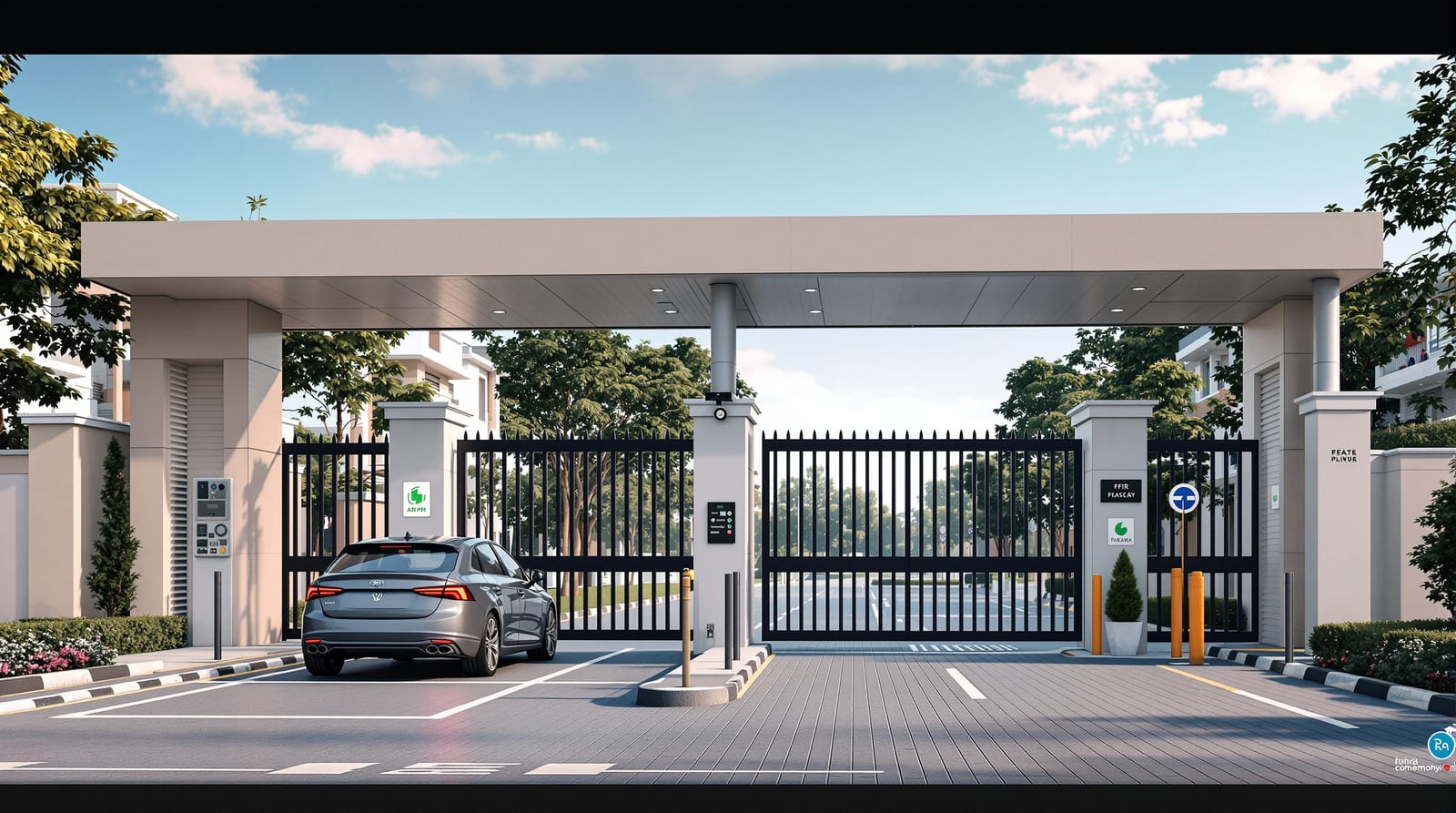
Gated Society Access Control in India 2026: Layered RWA Guide
Layered access control for a gated community — boom barriers, FASTag/RFID tags, ANPR, visitor apps and guard kiosks, new build vs RWA retrofit.
A modern gated society access control system is not one product — it is a layered architecture stitched together from a vehicle lane, a pedestrian lane, a visitor workflow, resident credentials and a software back office, all watched over by a guard at a kiosk. Done well, it cuts unauthorised entry, gives the Resident Welfare Association (RWA) an audit trail, and makes life frictionless for the 300 families who live behind the gate. Done badly, it becomes a queue at peak hour and a stack of dead RFID tags. This guide explains the layers, the technology behind each, the real costs, and how planning differs between a new project and retrofitting an existing RWA. For the wider picture, start with our access control systems guide and the cluster complete door guide.
The layered model for a gated community
Think of society access control as concentric rings, each with its own gate, credential and failure mode. A car entering touches the vehicle lane; a resident's maid touches the pedestrian gate and the visitor workflow; a member entering the gym touches amenity access. Each layer should fail gracefully and never block emergency egress.
- Perimeter / main gate: boom barrier + RFID/FASTag vehicle reader + ANPR camera.
- Pedestrian gate: turnstile or swing gate with card/face/app credential for residents and staff.
- Visitor layer: app-based pre-approval, OTP gate-pass, delivery and cab handling.
- Resident & staff credentials: RFID tags, mobile app, biometrics for staff.
- Amenity access: clubhouse, gym, pool, EV charging — separately permissioned.
- Back office: society management software + guard kiosk + CCTV.
Vehicle lane: boom barrier, FASTag/RFID and ANPR
The vehicle lane is where most of the friction and most of the budget sits. A boom barrier (₹40,000-1,50,000 installed, more for high-speed or anti-crash arms) is triggered by one of three methods, often layered together.
| Vehicle method | How it works | Speed at gate | Clone/spoof risk | Best for |
|---|---|---|---|---|
| RFID windscreen tag (UHF) | Long-range reader (3-8 m) reads a sticker tag, opens barrier | Fast, no stop | Moderate — UHF tags copyable | Resident cars, the society default |
| FASTag (NHAI / NPCI) | Reads the existing toll FASTag via UHF reader | Fast | Low-moderate, bank-linked | Societies wanting one tag for tolls + gate |
| ANPR camera | Camera reads the number plate, matches a whitelist | Fast if plate clean | Plate spoofing possible | Visitor/overflow lanes, backup to tags |
A robust design uses RFID/FASTag as the primary credential and ANPR as a second factor or audit layer — the camera logs every plate even when the tag opens the barrier, so a stolen tag on the wrong car gets flagged. FASTag re-use is attractive because residents already own one, but remember it bills a bank account, so societies usually issue society-specific UHF tags for free entry and keep ANPR for everything else. Loop detectors or safety photocells must stop the arm dropping on a vehicle. For the underlying tag technology, see RFID door access.
Pedestrian gate and resident credentials
Residents on foot, domestic staff, drivers and walkers use a separate pedestrian gate — a tripod turnstile, full-height turnstile or a swing gate with a maglock or electric strike. Credentials here are cards/fobs, the resident app (BLE/QR), or face recognition for high-end projects.
- Residents: RFID fob or mobile app; face recognition where privacy policy allows.
- Domestic staff / drivers: time-bound RFID cards or biometric enrolment, with shift schedules.
- Anti-tailgating: turnstiles physically enforce one-person-one-credential; swing gates rely on the guard.
For the credential technologies and trade-offs, see card access systems, mobile app door access and face recognition access control. Whatever you pick, the maglock on any pedestrian escape gate must be fail-safe and release on fire-alarm — covered below.
Visitor management: the daily reality
In an Indian society the visitor flow — guests, maids, cooks, cabs, e-commerce and food deliveries — dwarfs resident traffic. A visitor management app (MyGate, ADDA, NoBrokerHood and similar) is now the norm: the guard logs or the resident pre-approves a visitor, an OTP or QR gate-pass is generated, and entry/exit are timestamped. This replaces the paper register and gives the RWA a searchable log.
Good visitor workflows handle the awkward cases: a delivery rider who needs the lobby not the flat, a cab waiting for a resident, a maid who works in six flats. For the full design, see visitor management systems. Pair the app with apartment intercom systems so the guard or resident can verify a visitor by video before approving entry.
Society management software and the guard kiosk
The layers only become a system when a single society management platform ties them together: it holds the resident database, the vehicle whitelist, the visitor log, amenity bookings, and (in integrated suites) maintenance billing and notices. The guard kiosk — a tablet or PC at the gate — is the human interface: the guard searches a flat, calls a resident, approves or denies, and raises an SOS. The platform should expose audit logs the managing committee can review; see door access audit logs.
Amenity access — clubhouse, gym, swimming pool, EV charging — is best handled by the same credential with separate permissions, so a defaulting member can be barred from the gym without losing gate access. For broader system tie-ins, see access control BMS integration.
New project vs retrofitting an RWA
The single biggest variable is whether you are wiring a greenfield project or bolting access control onto a society that already has 200 families and a creaky gate.
| Factor | New project (greenfield) | Retrofit (existing RWA) |
|---|---|---|
| Cabling | Conduit + structured cabling in civil works | Surface conduit, often messy; PoE/wireless preferred |
| Vehicle lane | Designed-in lane width, loops, kiosk | Squeeze into existing driveway; queue risk |
| Credential rollout | Issue at handover, clean database | Re-enrol every resident, vehicle, staff — the hard bit |
| Decision-making | Builder/architect specifies | RWA committee vote + AMC budget |
| Power | UPS room planned | Add UPS/battery at gate; power-cut planning critical |
| Budget | Capex in project cost | Maintenance corpus / special levy |
For a new project, specify the lanes, conduit, UPS room and a vendor-neutral software API at design stage. For a retrofit, the technology is the easy part — the enrolment drive (collecting every resident's car, tag, photo and consent) and the committee buy-in are what make or break the rollout. Phase it: vehicle lane first, then visitor app, then pedestrian and amenity layers. Budget against alternatives with our access control cost estimator and the access control ROI calculator.
Indicative costs (India 2026)
Society access control is project-engineered and quote-driven; treat these as installed bands with GST 18% extra.
| Component | Indicative installed cost (₹) | Notes |
|---|---|---|
| Boom barrier (per lane) | 40,000 - 1,50,000 | High-speed / anti-crash dearer |
| Long-range RFID / FASTag reader | 15,000 - 60,000 | UHF, per lane |
| ANPR camera + software | 40,000 - 1,50,000 | Per lane; whitelist matching |
| RFID windscreen tag | 30 - 150 per tag | Society-issued |
| Pedestrian turnstile | 60,000 - 2,00,000 | Tripod to full-height |
| Guard kiosk (tablet/PC) | 15,000 - 60,000 | Plus mounting |
| Society management software | per-flat SaaS, free tiers exist | MyGate/ADDA-style |
| UPS / battery backup at gate | 20,000 - 1,00,000 | Essential in India |
| Annual AMC | 8-15% of capex/year | Tags, support, software |
Power-cuts, free egress and data privacy
Three non-negotiables sit on top of everything above. First, power-cut reality: a boom barrier and pedestrian maglock must have UPS/battery backup, with a clear manual-override (manual arm release, mechanical gate key) the guard can use in seconds. Plan this explicitly — see door access power backup.
Second, the legal must under NBC 2016: any access-controlled door or pedestrian gate on a designated escape route must allow free egress — people get out without a credential — and maglocks must release on fire-alarm. Use fail-safe locks on escape gates; reserve fail-secure for non-escape security doors. The detail is in fail-safe vs fail-secure locks.
Third, data privacy: resident faces, vehicle plates, visitor phone numbers and CCTV footage are personal data under the DPDP Act 2023. The RWA is a data fiduciary — collect with consent, retain only as long as needed, secure the database, and have a deletion policy. Always engage a qualified integrator and a licensed electrician to isolate and wire gate power safely.
For unit-level access behind the gate, residents can layer their own apartment smart access.
Frequently asked questions
Can residents use their existing FASTag for the society gate?
Yes — a UHF reader can read the NHAI FASTag, so one tag covers tolls and the gate. But FASTag bills a bank account, so most societies issue a separate, free society RFID windscreen tag for entry and keep FASTag/ANPR as backup or for visitor lanes.
Is ANPR enough on its own, without RFID tags?
ANPR alone works but is slower and can be fooled by a dirty, damaged or spoofed plate. Best practice is RFID/FASTag as the primary credential that opens the barrier, with ANPR running alongside to log and cross-check every plate as a second factor.
How do we handle the daily flood of maids, cooks and deliveries?
Use a visitor management app: residents pre-approve regular staff with time-bound passes, and one-off visitors get an OTP or QR gate-pass the guard verifies, ideally over a video intercom. Every entry and exit is timestamped, replacing the paper register.
What happens at the gate during a power cut?
Nothing should trap residents. Fit a UPS or battery on the barrier and pedestrian maglock, and ensure a manual arm-release and a mechanical key the guard can use. On escape routes, fail-safe maglocks must unlock on power loss and on fire-alarm, as NBC 2016 requires.
Should an RWA build the system in-house or buy a managed platform?
Most societies buy a managed society-management platform (SaaS) plus a hardware integrator for the gate, rather than building bespoke. It is cheaper, gives residents a polished app, and shifts maintenance to an AMC — just insist on data ownership and an export path so you are not locked in.
How long does a retrofit rollout take?
The hardware can go in within weeks, but the real timeline is the enrolment drive — collecting every resident's vehicle, tag, photo and consent and getting committee sign-off. Phase it: vehicle lane first, then the visitor app, then pedestrian and amenity layers, over one to three months.
Export this guide
Related Guides — Deep-dive reading
Access Control Maintenance in India (2026): Readers, Locks and Fail-Safe Egress
How to keep a card, keypad, fingerprint or face access-control system reading reliably and locking securely — and, above everything, how to test that its doors still release on a fire alarm and on power loss, so an access-controlled door never becomes a life-safety trap.
SecurityFail-Safe vs Fail-Secure Locks: The Guide (India 2026)
Why fail-safe vs fail-secure is the single most important access-control decision, and how to get it right for every door.
Home Doors & EntrancesVisitor Screening Areas in India (2026): Verifying People at the Gate, With Dignity
How to design the space and procedure where visitors are identified, verified and admitted or turned away — a controlled airlock that verifies before the gate opens, respects DPDP privacy, and never humiliates the people it screens.
SecurityRelated Tools — Try Free
Access-Control Battery-Backup Calculator
Size the standby battery so an access system keeps running through a power cut, with an egress life-safety note.
Battery BackupApartment Video Door System Planner
Enter flats, entrances, floors and guard desk for a first-pass building intercom plan — door stations, indoor monitors, guard station, the right architecture and an indicative cost band.
Building PlannerGate Access Planner
Size a vehicle gate or boom barrier — lanes needed at peak and the right credential speed (RFID, ANPR, manual).
Gate Flow