
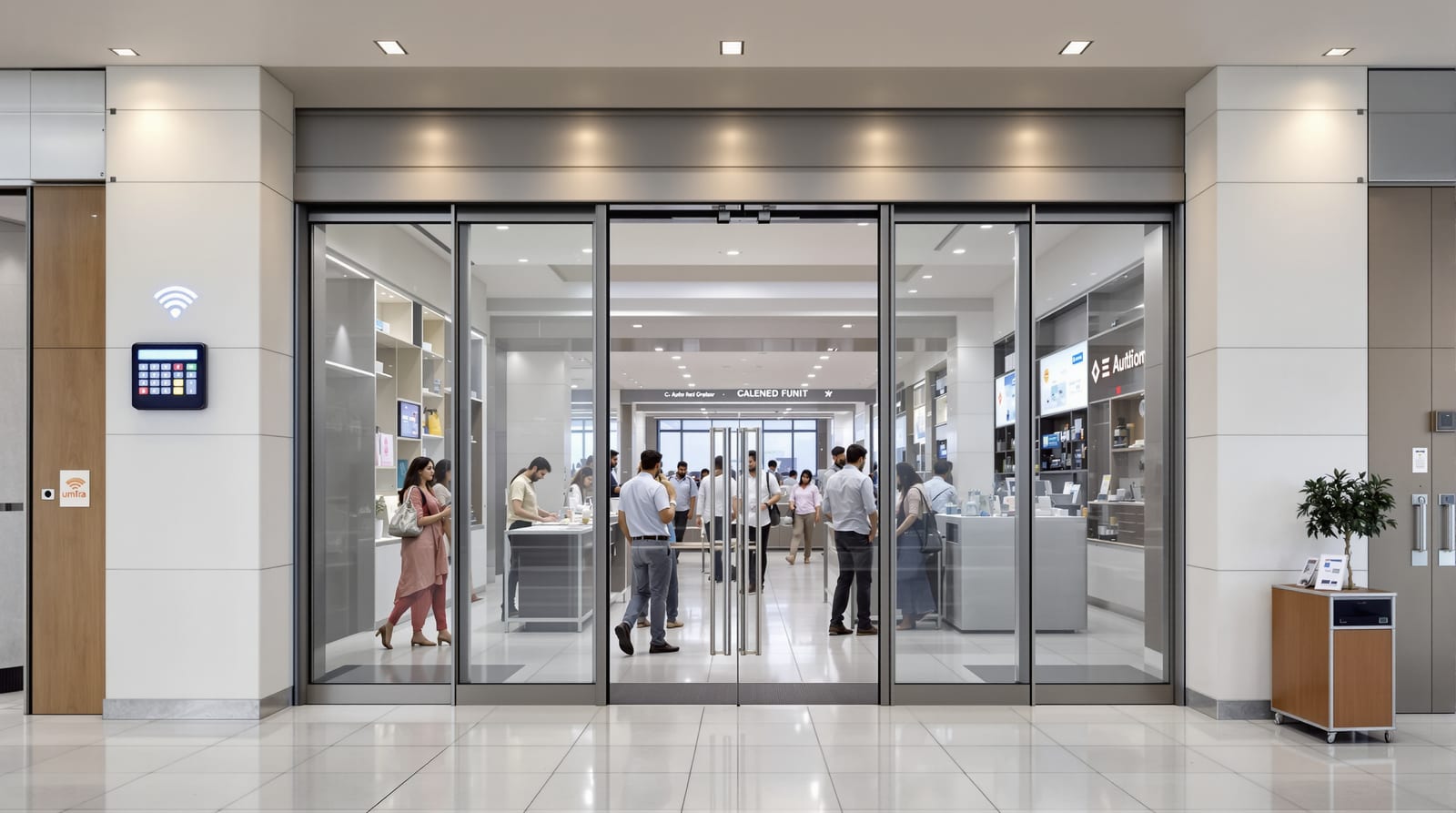
Automatic Door Cost India 2026: Full Price Bands
What it really costs to automate a swing, sliding or revolving door in India — cost bands, price drivers, installation, AMC and payback.
The automatic door cost India question rarely has a single answer, because "automatic door" covers everything from a ₹25,000 retrofit kit on an existing sliding panel to a ₹3 lakh complete glass entrance with twin safety sensors, backup battery and an annual maintenance contract. What you actually pay depends on the door type, its weight, how clever the sensing has to be, and whether you are automating a door that already exists or buying the whole assembly new. This guide lays out realistic 2026 price bands for the Indian market, explains what drives each number, and helps you judge whether the convenience, throughput and energy savings justify the spend. All figures below are indicative and exclude 18% GST unless stated; specialty and large-format jobs are quote-driven, so treat these as planning bands, not quotations.
Automatic door cost India: the headline bands
The cleanest way to budget is by mechanism. As a rule of thumb, the operator (the motor and controller) is the core spend, sensors and safety devices are the next layer, and installation plus civil/electrical work is the bit most homeowners forget. Here are the 2026 bands for the common types, installed but before GST.
| Door type | Operator / unit (installed, ex-GST) | Typical use case |
|---|---|---|
| Swing door operator (single leaf, retrofit) | ₹30,000 — ₹1,50,000 | Existing timber/glass door, clinics, offices, accessible entries |
| Low-energy operator (accessibility / RPwD) | ₹40,000 — ₹1,20,000 | Push-button assisted doors, slow safe opening |
| Sliding operator / retrofit kit only | ₹25,000 — ₹80,000 | Automating an existing sliding panel |
| Complete automatic sliding door (glass + frame + operator) | ₹45,000 — ₹2,80,000 | Showrooms, hospitals, hotel lobbies, malls |
| Telescopic / bi-parting sliding (wide openings) | ₹1,20,000 — ₹4,00,000+ | Wide entrances, narrow side-room |
| Revolving door (manual-assist to fully automatic) | ₹3,50,000 — ₹15,00,000+ | High-footfall lobbies, air-conditioned entrances |
For most Indian homes considering automation, the realistic conversation is a swing or sliding operator in the ₹25,000–₹1,50,000 zone. Revolving doors are a commercial and luxury-lobby item; they appear here only so you can see where the curve goes. For the wider context of door pricing across materials and types, see our door cost guide, and for the full menu of doors and hardware the complete door guide.
What drives the price
Two identical-looking automatic doors can differ in price by a factor of three. The drivers below explain why, and they are also the levers you can pull to bring a quote down.
Door weight and size
Operators are rated by leaf weight and width. A light interior glass leaf needs a modest motor; a heavy solid-timber or large laminated-glass panel needs a higher-torque operator and sturdier hardware, which costs more and may rule out the cheapest kits. Wider openings push you toward telescopic or bi-parting mechanisms, which multiply the operator and track cost. Always give the integrator the exact leaf weight and dimensions — guessing here is the single biggest cause of an under-specified, failure-prone install.
Sensors and safety
This is where budgets quietly inflate. A bare motion sensor is cheap, but a code-compliant entrance needs both an activation sensor (microwave motion, to open) and a presence/safety sensor (active-infrared, to stop the door closing on a person). Add push-plates or touchless wave switches for accessibility and the sensor line grows. See automatic door sensors and automatic door safety for what each device does and why skimping here is unsafe.
| Component | Indicative price (ex-GST) |
|---|---|
| Microwave activation sensor | ₹3,000 — ₹9,000 |
| Active-infrared safety/presence sensor | ₹4,000 — ₹15,000 |
| Push-plate / wave (touchless) switch | ₹1,500 — ₹6,000 |
| Backup battery / UPS module | ₹6,000 — ₹25,000 |
| Access-control integration (reader + interface) | ₹8,000 — ₹40,000 |
| Floor guide / track + civil work | ₹3,000 — ₹20,000 |
Backup power — the India tax
Power-cuts make a battery backup or UPS module close to essential, not optional. Without it, an automated door fails on every outage — and how it fails matters for safety. Plan the backup at the design stage; retrofitting it later is fiddlier and costlier. This overlaps heavily with door access power backup and the door automation wiring guide.
Glass and finishes
When you buy a complete automatic door rather than just the operator, the glazing dominates. Toughened safety glass, larger panes, framed versus frameless detailing and premium header cladding can each add tens of thousands. A bare operator kit on your existing door is therefore far cheaper than a new glass assembly — the main reason retrofit and new prices diverge so sharply.
The unlock-to-open cost flow
The diagram below maps where the money goes from the moment someone approaches to the moment the door opens, so you can see which boxes are mandatory and which are optional upgrades.
Retrofit versus new
If you already have a sound door, automating it is the cheaper route. A retrofit swing or sliding operator clamps onto the existing frame and leaf, so you pay for the operator, sensors and labour — not new glazing. A complete new assembly buys you a purpose-matched door, header and glass, which looks better and performs more reliably, but the glass and frame can easily double the bill.
| Approach | Typical all-in (ex-GST) | Best when |
|---|---|---|
| Retrofit operator on existing door | ₹35,000 — ₹1,20,000 | Door is structurally sound, opening is standard |
| Complete new automatic sliding door | ₹70,000 — ₹2,80,000 | New build, showroom front, wider opening |
| Low-energy accessibility retrofit | ₹45,000 — ₹1,00,000 | Adding RPwD-compliant assisted opening |
For mechanism-specific detail, see automatic swing door operators, the automatic sliding door mechanism and low-energy door operators.
Installation, GST and AMC
Installation is rarely free. Expect ₹5,000–₹30,000 for fitting depending on civil and electrical work — a clean threshold and a nearby power point keep it low; cutting floors for a track guide or running a new mains spur pushes it up. Always isolate the power and use a qualified electrician for the supply side; the operator wiring and sensor commissioning should be done by the manufacturer's integrator.
Then add 18% GST on goods and services — on a ₹1,00,000 system that is ₹18,000, so budget for it from the start rather than being surprised at invoicing.
Finally, automatic doors are mechanical and run thousands of cycles a day in commercial use, so an annual maintenance contract (AMC) is wise. As a rule of thumb, AMC runs 5–10% of the system value per year, often ₹6,000–₹30,000, covering sensor calibration, belt/roller checks and battery replacement. See door automation AMC for what a good contract should include.
To turn these bands into a number for your specific door, run the door automation cost calculator, and if you are weighing the spend against benefits, the access control ROI calculator helps frame payback.
Is it worth it? Convenience, throughput and energy
The payback case is strongest in three places. First, throughput — a busy retail or clinic entrance moves more people hands-free, and the door is never left ajar. Second, energy — in air-conditioned lobbies a door that opens only when needed and closes promptly cuts cooling loss, and that saving compounds across India's long summers. Third, accessibility and dignity — a low-energy operator with a push-plate makes an entrance usable by wheelchair users, parents with prams and elderly residents, which is both a courtesy and, on public buildings, an RPwD expectation. For a home, the honest answer is that automation is a comfort-and-prestige purchase more than a money-saver; for a commercial entrance it can pay for itself in throughput and energy over a few years.
Whatever the door, two non-negotiables apply. On any escape route, an automatic or access-controlled door must permit free egress without special knowledge or a key, and must release on a fire-alarm signal — this is an NBC 2016 life-safety requirement, not a feature. And plan for power-cuts: decide in advance how the door behaves when the supply drops, and budget the backup so a blackout never traps anyone inside. For the bigger picture of automating doors end to end, see the door automation guide and the automatic door operators overview.
Frequently asked questions
What is the cheapest way to get an automatic door in India?
Retrofitting an operator onto an existing, structurally sound sliding or swing door. A sliding retrofit kit starts around ₹25,000 ex-GST, plus sensors and fitting — far less than a complete new glass assembly, because you are not paying for new glazing and frame.
How much does a complete automatic sliding glass door cost?
A complete unit — glass leaves, frame, operator and twin sensors, installed — typically runs ₹45,000 to ₹2,80,000 ex-GST, depending on size, glass spec and finish. Wider telescopic or bi-parting openings can exceed ₹4,00,000. Add 18% GST on top.
Do I need to pay for backup power separately?
Usually yes, and you should. A battery or UPS module adds roughly ₹6,000–₹25,000 but keeps the door working — and failing safely — during India's power-cuts. Skipping it means the door is dead on every outage, which is both an inconvenience and a potential safety problem on exits.
What does an automatic door AMC cost and is it needed?
An annual maintenance contract typically costs 5–10% of system value, often ₹6,000–₹30,000 a year. For any door cycling heavily it is strongly advised — it covers sensor calibration, belt and roller wear, and battery replacement, and prevents the small faults that lead to dangerous mis-operation.
Is GST included in these prices?
No. The bands above are ex-GST. Automatic doors attract 18% GST on goods and installation, so add that to your budget — on a ₹1,00,000 system that is an extra ₹18,000.
Will an automatic door save me money?
In a commercial or air-conditioned entrance, often yes — through higher throughput and reduced cooling loss, with payback over a few years. In a typical home it is mainly a comfort, accessibility and prestige upgrade rather than a direct saving.
Export this guide
Related Guides — Deep-dive reading
Automatic Swing Door Operators: Retrofit Guide India 2026
How to retrofit a normal hinged door to open by itself — full-energy vs low-energy operators, activation, safety and cost for Indian buildings.
Home Doors & EntrancesOffice Entrance Door in India: Automatic, Revolving and Frameless Glass Entrances (2026)
The main entrance for offices and commercial buildings in India - what makes a first impression, moves footfall, controls access and seals in the AC, with system costs and standards.
Home Doors & EntrancesTouchless Sensor Doors: Wave-to-Open Hygiene India 2026
How microwave-and-infrared sensor-activated doors work, get tuned and stay safe across hospitals, labs, food plants and offices in India.
Home Doors & EntrancesRelated Tools — Try Free
Access-Control Battery-Backup Calculator
Size the standby battery so an access system keeps running through a power cut, with an egress life-safety note.
Battery BackupDoor Cost Calculator
Estimate the all-in cost of a door — leaf, frame, hardware, fitting and GST — by type, material and size.
Door CalculatorHealing View Impact Calculator
Evidence-Based Design dashboard quantifying the recovery impact of nature view + daylight factor on analgesic use, length of stay, and HCAHPS patient-experience uplift. Calibrated against Ulrich 1984 (Science), Park & Mattson 2008, and the CHD EBD evidence base.
EBD Calculator