
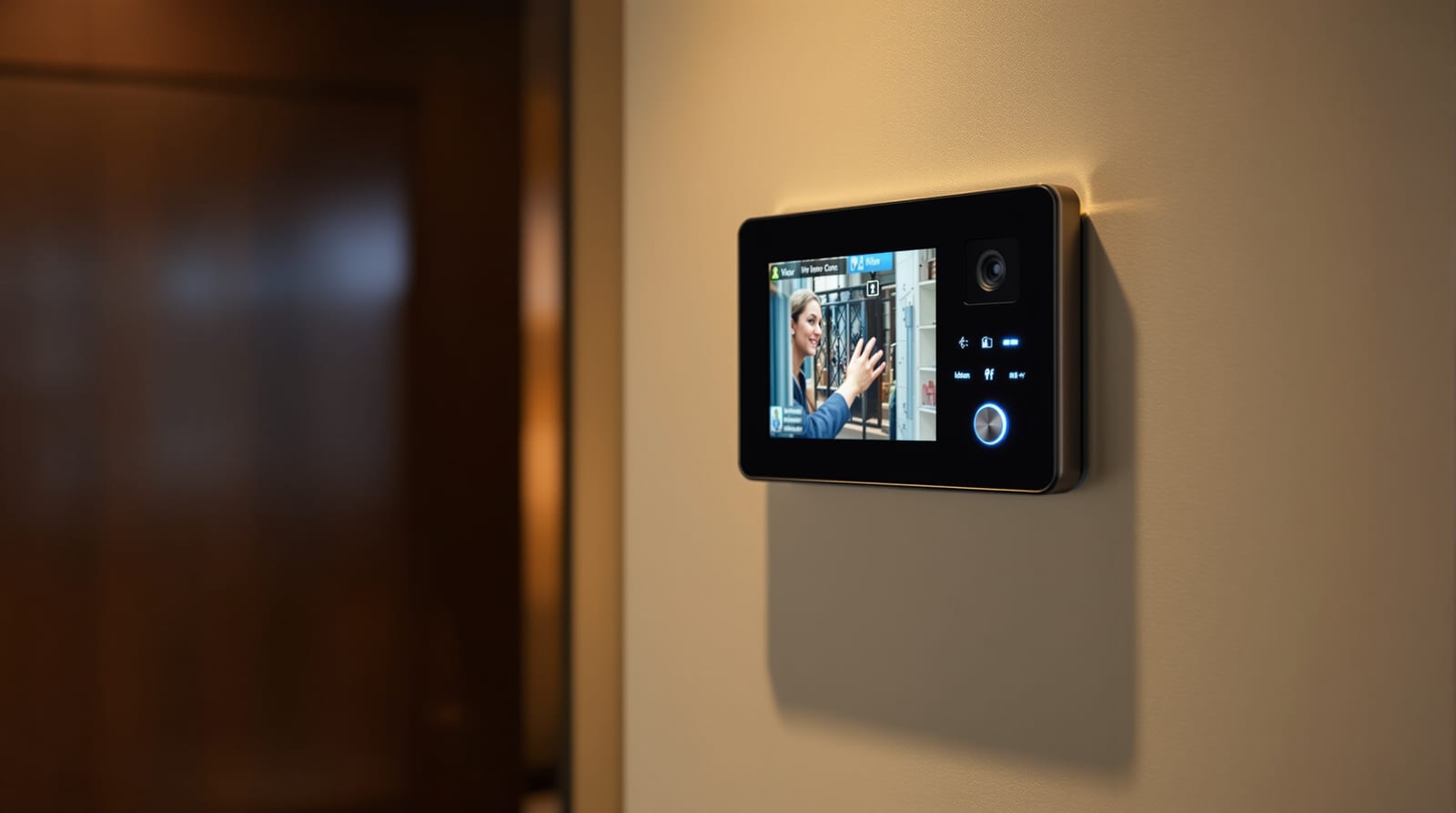
Video Intercom Systems for Buildings: Full Guide India 2026
Beyond a single villa unit: whole-building video intercom — 2-wire, 4-wire and IP topologies, multi-monitor homes, door-release and app forwarding.
A single villa video door phone answers one question — who is at my gate. Video intercom systems answer a harder one: how does a whole building see, talk to and admit visitors across many flats, multiple gates, a guard desk and everyone's phones, reliably, during a power cut, without breaking fire-escape rules. This guide is the systems layer above the single unit covered in video door phones in India: the wiring topologies, the components, door-release integration, recording and the choices that differ for a villa, an apartment block and an office. If you only need one camera-and-monitor at one door, start with that single-unit guide; if you are wiring a building, stay here.
What video intercom systems actually are
Strip away the marketing and every video intercom is the same three layers. An outdoor (door/gate) station carries the camera, microphone, speaker and call button (or a name directory and keypad on multi-flat units). One or more indoor monitors ring, show the caller, let you talk and carry the door-release button. Between them sits the transport — the cabling and, on larger systems, a switch or a small management server — plus a power supply and a door release (electric strike or maglock) at the door itself.
The jump from a villa to a building is really a jump in that middle layer. A villa runs point-to-point; a block runs many stations and many monitors over shared infrastructure, which is why topology — 2-wire, 4-wire or IP — becomes the first real decision rather than an afterthought.
2-wire vs 4-wire vs IP: the core decision
The physical wiring scheme sets your cost ceiling, your future flexibility and how many monitors and stations you can run.
4-wire is the traditional analogue villa wiring — separate conductors for video, audio, power and ground (often more for door-release). It is cheap, simple and forgiving for a single door to a few monitors, but it does not scale gracefully and is sensitive to cable length and quality.
2-wire (bus) systems send video, audio, data and power over a single polarity-free pair, daisy-chained or branched. They were built for apartments — you can hang many monitors and several stations on one bus with far less cabling, which is why most multi-flat analogue blocks use them.
IP intercom puts every station and monitor on the building network as an addressable device, powered by PoE, recorded by an NVR and managed by software. It scales almost without limit, integrates with CCTV, access control and a building management system, and forwards calls to phones natively — at the highest cost and with a real dependency on a well-built, backed-up network.
| Topology | Cabling | Best for | Scale | Indicative ₹ band |
|---|---|---|---|---|
| 4-wire analogue | Multi-core, point-to-point | Villa, 1 door, 1-4 monitors | Low | Outdoor + monitor ₹3,000-15,000 |
| 2-wire bus | Single pair, daisy-chain | Apartment block, many flats | Medium-high | Per-flat monitor ₹4,000-12,000 + bus kit |
| IP / PoE | Cat6 + switch + NVR | Office, large/multi-gate, smart blocks | Very high | Station ₹10,000-25,000; monitor ₹8,000-20,000 + switch/NVR |
All figures are installed, indicative bands before 18% GST. Large blocks and offices are quote-driven and project-engineered — get an integrator.
Components and where the rupees go
Knowing the parts list keeps you from over- or under-buying. A villa might need only the first three rows; a block needs almost all of them, per gate and per flat.
| Component | Role | Indicative ₹ band |
|---|---|---|
| Outdoor/door station | Camera, mic, speaker, call button/keypad/directory | ₹3,000-25,000 |
| Indoor monitor | Ring, view, talk, door-release | ₹3,000-20,000 each |
| Guard/master station | Concierge desk, calls all flats, opens gates | ₹15,000-60,000 |
| Network switch (PoE) | Powers and links IP devices | ₹6,000-40,000 |
| NVR / recording | Stores snapshots and call video | ₹8,000-40,000+ |
| Door release (strike/maglock) | Unlocks the door on command | ₹1,500-6,000 |
| Power supply + battery backup | Keeps the system alive in a power cut | ₹2,000-12,000 |
| Management software / app gateway | Directory, mobile forwarding, logs | Bundled to ₹50,000+ |
Brands you will meet in India span CP Plus, Hikvision, Godrej, Panasonic and Aiphone among others; choose by ecosystem and after-sales reach in your city rather than a single spec sheet.
System topology at a glance
The diagram below shows an IP building system: the outdoor stations and indoor monitors are all devices on one PoE network, the recorder captures events, the door release sits at the door, and the gateway pushes calls to residents' phones.
Door-release integration and the free-egress rule
The single most important wiring decision is how the intercom opens the door — and what happens to that door when the power dies or the fire alarm sounds. A monitor's release button drops voltage to an electric strike or cuts power to an electromagnetic (maglock) lock. Strikes can be wired fail-safe or fail-secure; maglocks are inherently fail-safe, releasing the moment power is lost.
For any door on a designated escape route, NBC 2016 fire and life-safety provisions require free egress — people must always be able to get out without a key, card or app, and access-controlled escape doors must release automatically on the fire-alarm signal. That makes a maglock (or fail-safe strike) plus a fire-alarm interface mandatory on those doors, never a fail-secure lock that traps occupants. The deeper trade-off is set out in fail-safe vs fail-secure locks and the device choices in magnetic door locks and electric strike locks; pull the wiring detail together with door automation wiring.
Multi-monitor homes and recording
A villa rarely wants only one monitor. The natural pattern is a master monitor near the main entry plus slave monitors in the living room, kitchen and master bedroom, all ringing together and any one able to release the gate. 2-wire and IP systems handle several monitors easily; 4-wire ones need a distributor and can be cable-length limited, so confirm the rated monitor count before buying.
Recording matters more than most buyers expect. Basic monitors store snapshots to internal memory or an SD card when a call goes unanswered; IP systems push continuous or event video to an NVR. Snapshots-on-missed-call is the practical minimum for security and disputes. Anything that records faces and footage now falls under the DPDP Act 2023 — you are a data fiduciary, so retain footage only as long as needed, restrict access and post notice, especially in a society or office.
Mobile-app forwarding
App forwarding is the feature that sells modern systems: when a visitor calls and no monitor is answered, the call rings on residents' phones over the internet, letting them see, talk and release the door from anywhere. IP systems do this natively through a cloud or local gateway; many Wi-Fi villa units do it per door. Treat it as a convenience layer, not the backbone — depend on a reliable indoor monitor for the core, because a flaky broadband line or a cloud outage must never be the only way to admit a visitor. The app, account and OTP hardening overlaps with mobile-app door access.
Power cuts, backup and the India reality
India's power situation makes battery backup a specification line, not an option. Put the controller, switch and door release on a UPS or backup battery so the system rides through a cut; size it for your typical outage. Remember the asymmetry: a fail-safe maglock unlocks when power dies, so backup keeps the door secure during a cut, while a fail-secure door could lock people in or out. Plan this deliberately with door access power backup, and never leave residents unable to enter or — worse — unable to leave when the grid drops.
Choosing for a villa vs apartment vs office
| Scenario | Recommended topology | Stations | Monitors | Key extras |
|---|---|---|---|---|
| Villa | 4-wire or Wi-Fi/IP single door | 1-2 gates | 2-4, multi-room | App forwarding, SD snapshots |
| Apartment block | 2-wire bus or IP | Lobby + per-block | 1 per flat + guard | Directory, guard station, NVR |
| Office | IP / PoE | Reception + service doors | Reception + security | Access-control + CCTV + BMS integration |
For a society, the system has to talk to the guard desk and visitor flow — read it alongside apartment intercom systems and the gated-society view in gated society access control. For the modern, network-native specification, IP video door intercom goes deeper on PoE, NVR and software. Offices should fold the intercom into the wider office access control and access-control systems design rather than buying it standalone. Everything sits under the cluster complete door guide, and the operator/release side connects to door automation.
To size and compare before you commit, the video door phone selector helps shortlist a unit and the access control cost estimator puts a budget around the whole-building build.
Frequently asked questions
Is a 2-wire system better than 4-wire?
For a single villa door to a few monitors, 4-wire is cheap and perfectly fine. For an apartment block with many flats, 2-wire wins on far less cabling and easy expansion. For a large, multi-gate or office building, skip both and go IP/PoE for unlimited scale and integration.
Can I forward intercom calls to my phone?
Yes. IP systems do it natively via a cloud or local gateway, and many Wi-Fi villa units do it per door, letting you see the visitor and release the door remotely. Keep a working indoor monitor too — never rely on broadband or the cloud as the only way to answer the gate.
What happens to the door during a power cut?
It depends on the lock. A fail-safe maglock or strike unlocks when power is lost, so put the system on a UPS or battery to stay secure through a cut. A fail-secure lock stays locked — which is why escape-route doors must be fail-safe and release on the fire alarm for free egress under NBC 2016.
Does recording intercom footage have legal implications?
Yes. Capturing visitor faces and video makes you a data fiduciary under the DPDP Act 2023. Retain footage only as long as needed, limit who can view it, and post clear notice — particularly in a society or office where many people are recorded.
Do I need a professional to install a building intercom?
A single villa unit can be a careful DIY job, but anything with maglocks, fire-alarm release, multiple gates or an NVR should be done by an integrator and a licensed electrician who isolates power before working. Building systems are project-engineered and quote-driven for good reason.
How much does a building video intercom cost?
As a rule of thumb, a villa setup runs ₹3,000-25,000 per door plus monitors, an apartment block is roughly ₹4,000-12,000 per flat plus bus or network and a guard station, and an office IP system is quote-driven once you add stations, a PoE switch, an NVR and software. Add 18% GST and budget for backup power and the door release.
Export this guide
Related Guides — Deep-dive reading
Fail-Safe vs Fail-Secure Locks: The Guide (India 2026)
Why fail-safe vs fail-secure is the single most important access-control decision, and how to get it right for every door.
Home Doors & EntrancesAccess Control Maintenance in India (2026): Readers, Locks and Fail-Safe Egress
How to keep a card, keypad, fingerprint or face access-control system reading reliably and locking securely — and, above everything, how to test that its doors still release on a fire alarm and on power loss, so an access-controlled door never becomes a life-safety trap.
SecurityDoor Access Control for Indian Homes, Villas & Societies: RFID, PIN, Biometric & Networked Systems (2026)
How access control moves you from a single smart lock to managed entry across flats, villas and society gates - RFID cards, PIN keypads, biometrics, app and intercom integration, standalone vs networked controllers, audit logs, visitor and maid management, and what a basic vs networked system really costs in India.
Home Doors & EntrancesRelated Tools — Try Free
Security Cabling & PoE Planner
Estimate cable length, drops, PoE power budget, the right switch, conduit and cost for a CCTV/security cabling plan.
Cabling PlannerApartment Video Door System Planner
Enter flats, entrances, floors and guard desk for a first-pass building intercom plan — door stations, indoor monitors, guard station, the right architecture and an indicative cost band.
Building PlannerVideo Door Phone Type Selector
Answer a few questions about your building, cabling, budget and internet and get the right video door phone — analog / wired / wireless / IP, single-home or multi-apartment, monitor or app.
Door Phone Selector