
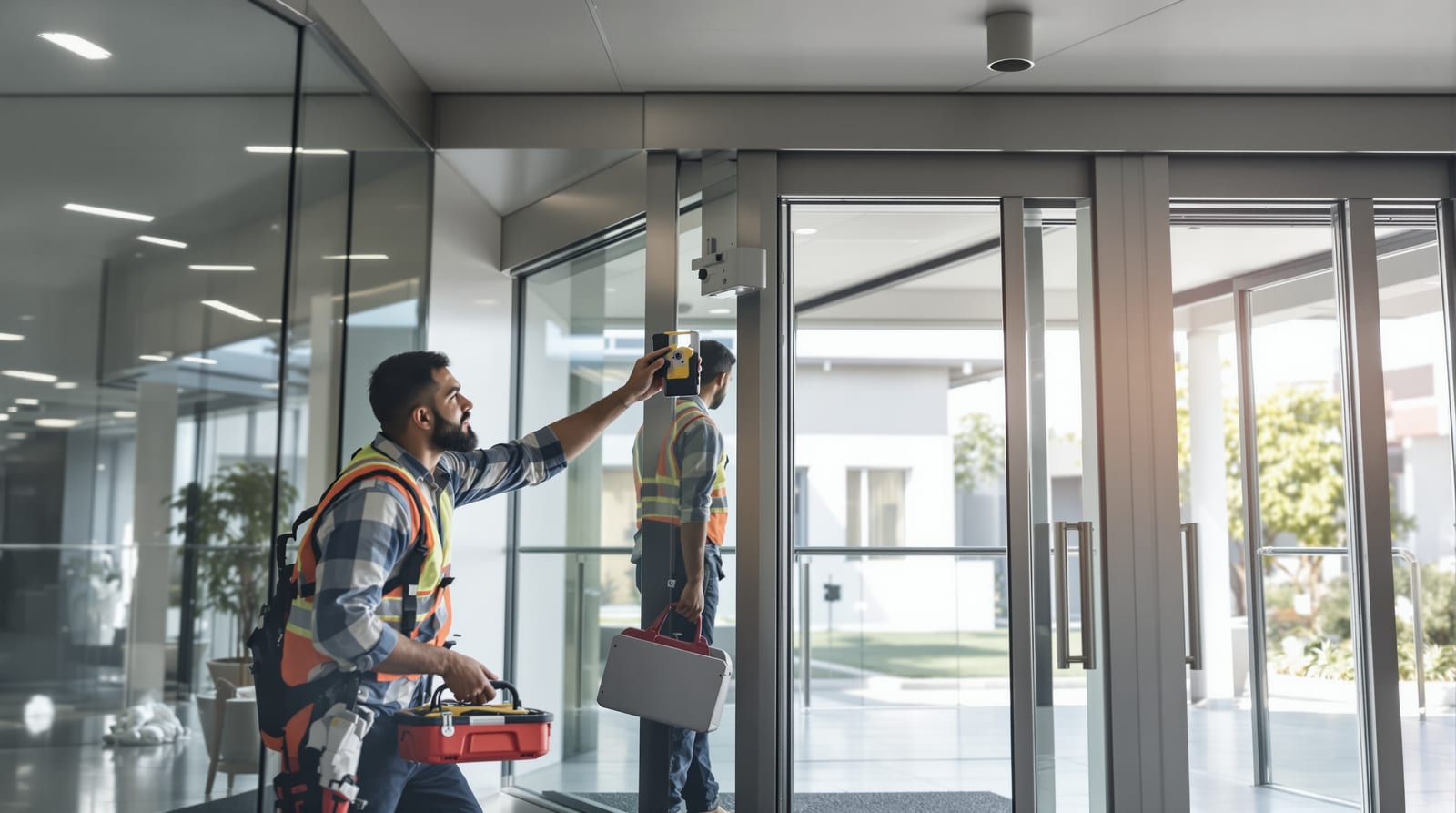
Door Automation AMC & Maintenance Contracts India 2026
Why automatic and access-controlled doors need a service contract, what comprehensive vs non-comprehensive AMC covers, SLAs and annual cost.
An automatic door or access-controlled entry is not a fit-and-forget product — it is a mechatronic system of motors, gearboxes, sensors, electronic locks, controllers and batteries that drift, wear and degrade with every cycle. A busy retail entrance can clock 1,500-3,000 open-close cycles a day; a society gate reader is touched thousands of times a month. A door automation AMC (annual maintenance contract) is the planned-service wrapper that keeps these systems safe, compliant and running — and it is the single biggest difference between a door that lasts a decade and one that strands people on a power-cut evening. This Studio Matrx guide explains why automated and access-controlled doors need a service contract, what comprehensive and non-comprehensive AMCs actually cover, the response SLAs to insist on, and the indicative annual cost in India for 2026.
Why automated and access-controlled doors need a service contract
Manual doors fail gracefully — a hinge squeaks for months before it seizes. Powered doors fail suddenly and unsafely. Six things drift or wear in ways an annual contract is built to catch:
- Sensor calibration drift. Active-infrared and microwave motion sensors lose alignment from vibration, monsoon humidity, dust films and seasonal floor changes. A drifted safety sensor either nuisance-triggers (door cycles all day, burning the operator) or — far worse — stops detecting a person in the door path. Safety sensors must be tested and re-calibrated, not assumed good.
- Operator and mechanism wear. Belts, rollers, carriages, gearbox grease, swing-arm bushes and limit switches all wear with cycles. Caught early they are cheap; caught late they cascade into a burnt motor or jammed leaf.
- Lock cycling and electronic-lock health. Maglocks lose holding force if the armature plate misaligns; electric strikes and solenoid bolts wear their keepers; the lock relay and wiring corrode. Each must be cycle-tested.
- Battery, UPS and power-backup checks. This is the India-specific killer. Backup batteries in controllers, smart locks and UPS units silently die in 2-3 years. The day a power-cut coincides with a dead backup is the day a fail-secure door traps people inside or a fail-safe door is left wide open. AMC battery testing is non-negotiable.
- Software, firmware and credential hygiene. Access controllers and smart locks need firmware updates (often security patches), database backups, time-sync, and removal of stale credentials. Out-of-date firmware is the commonest smart-lock security risk.
- Fire-release / free-egress test. Any maglock or access-controlled door on an escape route must drop open on a fire-alarm signal and must always allow free egress — this is a National Building Code (NBC 2016) life-safety requirement, not an option. The fire-alarm interface and the request-to-exit (REX) path must be tested at every visit and logged. See our fail-safe vs fail-secure locks and magnetic door locks guides for the underlying life-safety logic.
What an AMC actually covers
'''
SVG below: the AMC service loop across a visit.
'''
A proper visit walks the whole chain — operator, mechanism, electronic lock, sensors, power backup, software, and the life-safety interface — and produces a signed report. The depth of what is included depends on which AMC tier you buy.
Comprehensive vs non-comprehensive AMC
This is the central decision. The two models differ in who pays for parts.
| Feature | Non-comprehensive AMC | Comprehensive AMC |
|---|---|---|
| Scheduled preventive visits | Yes | Yes |
| Labour for repairs | Included | Included |
| Spare parts (sensors, belts, batteries, locks) | Billed extra at MRP | Included (usually capped/with exclusions) |
| Breakdown call-outs | Included (labour); parts extra | Fully included |
| Annual cost | Lower (typically 5-8% of system value) | Higher (typically 10-15% of system value) |
| Budget predictability | Poor — surprise parts bills | High — fixed annual outlay |
| Best for | New systems under warranty; low-traffic doors | High-traffic, ageing or mission-critical doors |
Rule of thumb: keep new equipment on non-comprehensive while the manufacturer warranty covers parts, then move high-cycle or older doors to comprehensive once warranty lapses. Read the exclusions carefully — most comprehensive contracts still exclude glass breakage, vandalism, water/flood damage, power-surge damage (insist on surge protection), consumable batteries beyond a cap, and software-licence renewals. Get those exclusions in writing before you sign.
Response SLAs — what to insist on
For a powered or access-controlled door, downtime is a safety and security event, not an inconvenience. A locked-out entrance can violate free-egress rules; a failed reader can force a gate open. Tie the contract to measurable service-level agreements:
| SLA term | Standard entrance | Mission-critical (hospital, society main gate) |
|---|---|---|
| Preventive visits / year | 2 (half-yearly) | 4 (quarterly) or monthly |
| Phone/remote response | Same business day | Within 1-2 hours, 24x7 |
| On-site response | Next business day | Within 4-8 hours, 24x7 |
| Resolution / temporary fix | 48 hours | 24 hours, with safe interim mode |
| Critical spares held | On request | Buffer stock with integrator |
| Penalty for SLA breach | None | Service-credit / penalty clause |
Insist that the contract names the safe interim mode for a breakdown — for an escape-route door that means it defaults to free egress (fail-safe), never trapped occupants. Also require that every visit and every call-out is logged; for access systems, audit-log integrity matters as much as the hardware, as covered in our door access audit logs guide.
Indicative annual cost by system (India 2026)
AMC is usually priced per door/operator or as a percentage of installed system value. All figures below are indicative bands, exclusive of 18% GST, and assume parts-extra (non-comprehensive) unless stated. Specialty and networked systems are quote-driven — get an integrator to scope.
| System | Non-comprehensive / year | Comprehensive / year |
|---|---|---|
| Single smart lock (residential) | ₹800-2,000 | ₹1,500-3,500 |
| Standalone access door (reader + maglock) | ₹2,500-6,000 | ₹5,000-12,000 |
| Automatic swing door operator | ₹4,000-9,000 | ₹8,000-18,000 |
| Automatic sliding door (operator + sensors) | ₹5,000-12,000 | ₹10,000-25,000 |
| Networked access control (per door, multi-door site) | ₹3,000-7,000 | ₹6,000-15,000 |
| Video intercom / IP intercom system | ₹3,000-8,000 | ₹6,000-16,000 |
| Society / campus integrated system | Project-quoted | Project-quoted |
For sizing the underlying systems before you negotiate an AMC, the Studio Matrx door automation cost calculator and access control cost estimator give a quick installed-value baseline you can apply the 5-15% AMC rule to.
Spares availability — the quiet make-or-break
An AMC is only as good as the parts behind it. Before signing, verify: which spares the integrator stocks locally, lead times for operator-specific belts/boards (imported operators can mean weeks), whether the brand still supports your model (orphaned controllers are a real risk), and whether firmware/software is still being updated. Standardising on widely-distributed Indian and global brands — Godrej, Yale, Hikvision, CP Plus, Dorset and the like — generally means better spares depth than obscure imports. For the upstream specification choices that make a system serviceable in the first place, see our automatic door operators and automatic door safety guides, the phase pillar door automation, and the cluster pillar complete door guide.
When to call a professional integrator
Never attempt operator, maglock or controller service in-house unless your facility team is trained and the power is properly isolated — these systems carry mains voltage, store energy in capacitors and batteries, and are tied into fire-alarm and life-safety circuits. Sensor calibration, fire-release testing and electronic-lock cycling are skilled, instrument-assisted tasks. An AMC exists precisely so a qualified integrator owns this risk. Treat any door on an escape route as a life-safety asset: it must always allow free egress and must release on fire alarm, full stop.
Frequently asked questions
Is an AMC really worth it for a single residential smart lock?
For one Wi-Fi smart lock, a full AMC is often overkill — the bigger wins are firmware updates and timely battery replacement, which you can do yourself. AMCs earn their keep on automatic operators, multi-door access systems and any escape-route lock, where calibration, fire-release testing and spares matter and downtime is costly.
Comprehensive or non-comprehensive — which should I choose?
Keep new, in-warranty equipment on non-comprehensive (you only pay for labour while the maker covers parts). Move high-traffic, ageing or mission-critical doors to comprehensive once warranty lapses, so a single board or operator failure does not blow your budget. Always read the exclusions.
How often should automatic doors be serviced?
Two preventive visits a year is the baseline; high-traffic entrances (retail, hospitals, society main gates) warrant quarterly or monthly visits. Every visit must include a safety-sensor calibration, a battery/UPS load test, and a documented fire-release and free-egress test for any escape-route door.
What does an AMC not cover?
Most contracts exclude glass and physical damage, vandalism, flood/water ingress, power-surge damage, software-licence renewals and consumables beyond a cap. Comprehensive contracts include routine spares within limits. Get the exclusion list in writing before signing.
What is the most important test in any door automation AMC?
The life-safety test: confirming the door allows free egress at all times and releases on a fire-alarm signal, as required by NBC 2016. A door that locks people in or out during a power-cut or fire is the failure that matters most, and the one an AMC must guarantee against.
Export this guide
Related Guides — Deep-dive reading
Access Control Maintenance in India (2026): Readers, Locks and Fail-Safe Egress
How to keep a card, keypad, fingerprint or face access-control system reading reliably and locking securely — and, above everything, how to test that its doors still release on a fire alarm and on power loss, so an access-controlled door never becomes a life-safety trap.
SecurityFail-Safe vs Fail-Secure Locks: The Guide (India 2026)
Why fail-safe vs fail-secure is the single most important access-control decision, and how to get it right for every door.
Home Doors & EntrancesAutomatic Door Safety & Compliance: Full Guide India 2026
Risks, sensors, force limits, break-out and free-egress rules that keep automatic doors safe and code-compliant in India.
Home Doors & EntrancesRelated Tools — Try Free
Access-Control Battery-Backup Calculator
Size the standby battery so an access system keeps running through a power cut, with an egress life-safety note.
Battery BackupSecurity System Cost Estimator
Estimate the all-in capex with GST, annual running cost and 5-year total cost of ownership of a home or building security system.
Cost EstimatorMonsoon-Readiness Checklist
Pre-rain home audit across 9 categories — terrace, drains, waterproofing, electrical, HVAC, pest, vehicles, documents.
Seasonal Audit