
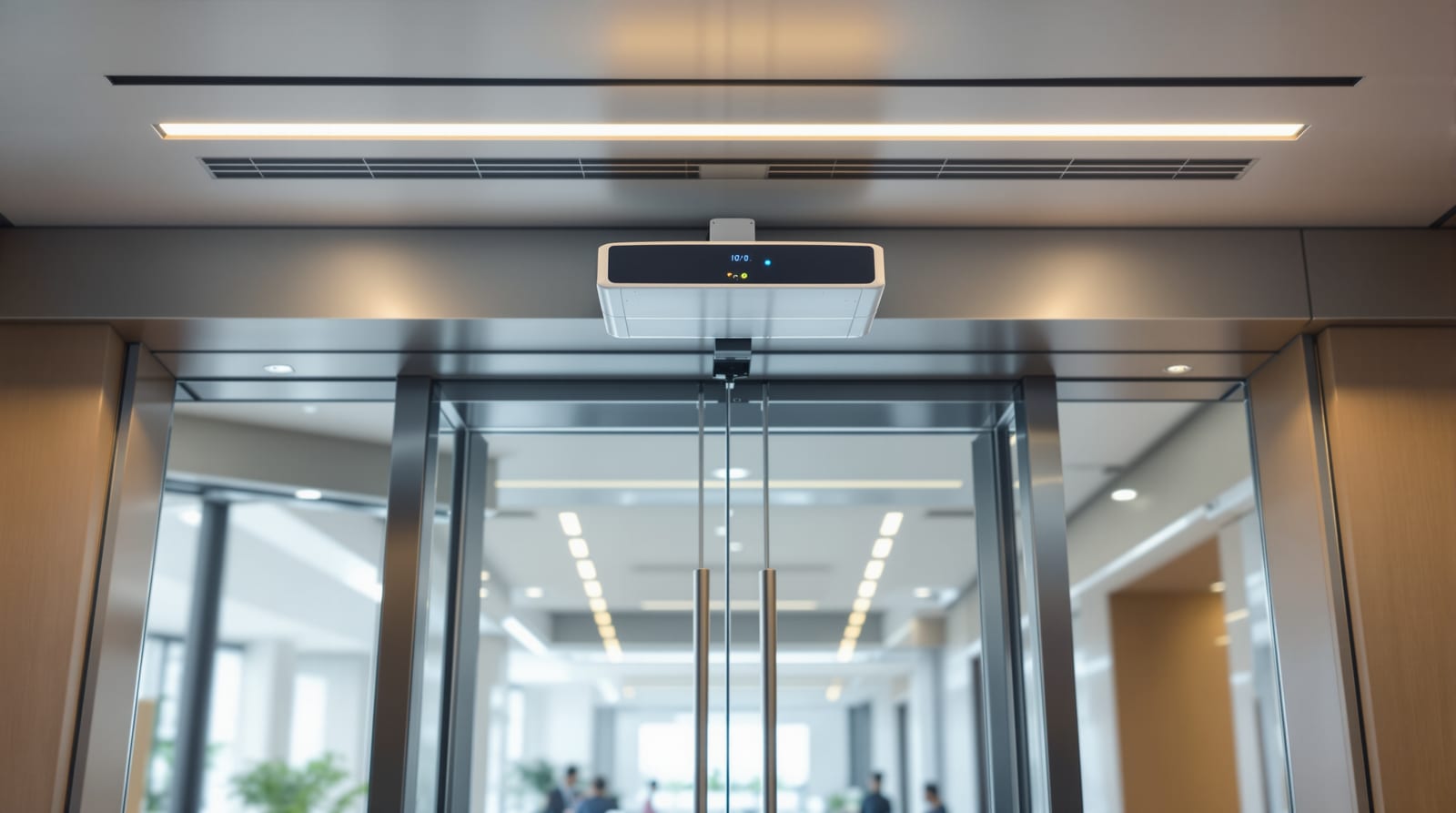
Automatic Door Operators: Types & Sizing Guide India 2026
How automatic door operators work, the operator types, sizing by door weight and traffic, activation, accessibility low-energy mode and ₹ cost bands.
An automatic door operator is the motorised drive unit that physically opens and closes a door — distinct from the lock that secures it or the sensor that decides when to act. Choosing the right operator is the single most important engineering decision in any automated entrance, because it must match the door's weight, width and the traffic it carries, while staying compliant with NBC 2016 free-egress rules and the RPwD Act's accessibility expectations. This guide, prepared by Studio Matrx for architects, facility managers and integrators, walks through the operator types available in India, how they work internally, how to size them, your activation options, low-energy accessibility mode and realistic ₹ cost bands.
What an automatic door operator is — and is not
The operator is the powered heart of the system. It contains a motor, a gearbox or drive belt, a control board (the "brain"), and the mechanical linkage — an arm for swing doors, a belt-and-carriage for sliding doors. Around it sit the activation devices (motion sensors, push-plates, access readers) and the safety devices (active-infrared presence beams). Together these form the automated entrance, but the operator is the part that does the work and the part you size.
A properly specified operator must always include a manual override so the door can be opened by hand during a power cut — an everyday reality in India. For more on activation, see automatic door sensors; for the safety beams that prevent the door striking a person, see automatic door safety.
The four operator types
Swing operators
The most common type for existing doorways. A motor in the overhead header drives an arm that pushes or pulls a hinged leaf open. Sizing is governed mainly by leaf weight and width — wide or solid timber/metal leaves need more torque. Detailed selection lives in automatic swing door operators.
Sliding operators
A belt-driven carriage slides the leaf sideways along a track. Best for high-traffic entrances where a swinging leaf would obstruct the approach. Sizing is by leaf weight and opening speed. The full mechanism is covered in automatic sliding door mechanism, and finished installations in automatic sliding doors.
Folding operators
Leaves fold concertina-style into a compact stack — useful where lateral space for a full slide is unavailable. Project-engineered and quote-driven.
Revolving operators
Motorised revolving doors for large lobbies, hotels and airports — they manage airflow and continuous footfall but demand integrated safety sensing and an emergency break-out mode for egress. Always project-engineered.
| Operator type | Best for | Sized chiefly by | Typical installed ₹ band |
|---|---|---|---|
| Swing | Existing doorways, offices, clinics | Leaf weight, leaf width | ₹30,000 – ₹1,50,000 |
| Sliding | High-traffic mains entrances, showrooms | Leaf weight, opening speed | ₹45,000 – ₹2,80,000 |
| Folding | Tight reveals, wide spans | Span, leaf count | Quote-driven |
| Revolving | Hotel/airport/large lobbies | Diameter, throughput | Quote-driven |
All figures exclude GST at 18% and are indicative bands, not quotes.
How an operator works inside
At the core sits a DC or BLDC motor turning a gearbox (swing) or a toothed belt over pulleys (sliding). A control board reads the activation signal, ramps the motor up and down for smooth motion, monitors current draw to detect obstructions, and enforces hold-open and re-close timing. The board also takes inputs from the safety beams and, critically, from the building's fire-alarm interface so the door reverts to a compliant state in an emergency.
Because India sees frequent power interruptions, every operator must offer a manual override on power cut. On swing operators this is usually a clutch that disengages the arm so the leaf can be pushed by hand; on sliding operators a break-out or hand-slide mode. As a rule of thumb, specify a UPS or battery pack for the control board on any door that must keep cycling through short outages, and confirm the door fails to a state that allows free egress.
Sizing the operator
Get sizing wrong and the door either stalls under its own weight or slams shut as a hazard. Three variables drive selection.
- Leaf weight — heavy timber, solid-core or framed-glass leaves need higher motor torque. Manufacturers publish a maximum leaf-weight rating; specify with headroom.
- Leaf width / span — wider leaves apply more leverage on a swing arm and demand longer travel on a slide.
- Traffic / duty cycle — a clinic entrance cycling thousands of times daily needs a heavy-duty, continuous-rated operator; a low-use accessible side door can use a lighter low-energy unit.
| Variable | Light duty | Standard | Heavy duty |
|---|---|---|---|
| Typical leaf weight | up to ~80 kg | ~80–150 kg | 150 kg+ |
| Cycles per day | low | moderate | continuous |
| Suitable operator | low-energy / compact swing | standard swing or sliding | heavy-duty sliding / engineered |
| Indicative ₹ band | ₹30,000–60,000 | ₹60,000–1,50,000 | ₹1,50,000+ / quote |
For a structured walk-through of the numbers, use the automatic door operator selector and the door automation cost calculator. The full money picture is in automatic door cost.
Activation options
The operator only acts when triggered. Common methods:
- Microwave motion sensors — detect approach and open hands-free; ideal for busy mains entrances.
- Push-plates and wave (touchless) switches — deliberate activation for accessible and controlled doors; see push-button door openers.
- Access-control release — an access control system or a card/RFID reader can trigger the operator after authenticating, combining security with convenience.
Whatever the trigger, NBC 2016 requires that escape-route doors permit free egress at all times — the operator and any access control on it must release and allow manual exit on power loss or fire-alarm signal.
Low-energy mode for accessibility
Low-energy operators open slowly and gently, with reduced force and longer opening times, so they are inherently safe to approach without the full safety-beam array. They are the standard answer for RPwD Act 2016 accessibility on doors used by wheelchair users and elderly residents, typically paired with a push-plate. They are also the most economical entry into door automation. Read more in low-energy door operators and how they fit accessible doors and wheelchair-accessible doors.
Cost bands and procurement
As a rule of thumb, budget ₹30,000–₹1,50,000 for a swing operator and ₹25,000–₹80,000 for a sliding operator kit, rising to ₹45,000–₹2,80,000 for a complete auto-sliding entrance. Sensors add ₹3,000–₹15,000 and push-plates ₹1,500–₹6,000. All attract 18% GST, and revolving/folding and high-throughput jobs are project-engineered and quote-driven. Always engage a qualified integrator and a licensed electrician to isolate power before installation — never DIY the mains and fire-alarm interface. Plan for an automation AMC so the operator is serviced and the override tested regularly.
For the wider context, see the door automation guide and the cluster's complete door guide.
Frequently asked questions
What happens to an automatic door operator during a power cut?
A compliant operator includes a manual override — a clutch or break-out mode — so the leaf can be opened by hand. On escape routes the door must default to free egress. For doors that must keep cycling through short outages, add a UPS or battery pack to the control board.
How do I know which operator size to choose?
Size by leaf weight, leaf width and daily traffic, always with torque headroom. Light low-use doors suit low-energy units; busy heavy leaves need standard or heavy-duty operators. The automatic door operator selector structures the decision.
Are low-energy operators less secure?
No. Low-energy refers to the gentle opening force and speed for accessibility, not security. Security comes from the lock and any access control paired with the operator, not from how forcefully the door swings.
Can an automatic door operator be fitted to an existing door?
A swing operator can often retrofit to an existing hinged door if the leaf weight and frame are within rating. Sliding, folding and revolving operators usually require a new door assembly. Have an integrator survey the opening first.
Is an automatic door operator legal on a fire-escape door?
Yes, provided it allows free egress at all times. Under NBC 2016 the operator and any access control must release on power loss and on a fire-alarm signal, letting people exit manually without keys, codes or power.
Export this guide
Related Guides — Deep-dive reading
Automatic Swing Door Operators: Retrofit Guide India 2026
How to retrofit a normal hinged door to open by itself — full-energy vs low-energy operators, activation, safety and cost for Indian buildings.
Home Doors & EntrancesFail-Safe vs Fail-Secure Locks: The Guide (India 2026)
Why fail-safe vs fail-secure is the single most important access-control decision, and how to get it right for every door.
Home Doors & EntrancesAutomatic Sliding Door Mechanism Explained (India 2026)
Inside the operator kit, sensors, breakout and battery backup that make an automatic sliding door open, cushion and stay safe.
Home Doors & EntrancesRelated Tools — Try Free
Access-Control Battery-Backup Calculator
Size the standby battery so an access system keeps running through a power cut, with an egress life-safety note.
Battery BackupMotorized Curtain Cost Calculator
Estimate the all-in cost to motorise curtains — motors, tracks, hub and installation.
Cost CalculatorDoor Cost Calculator
Estimate the all-in cost of a door — leaf, frame, hardware, fitting and GST — by type, material and size.
Door Calculator