
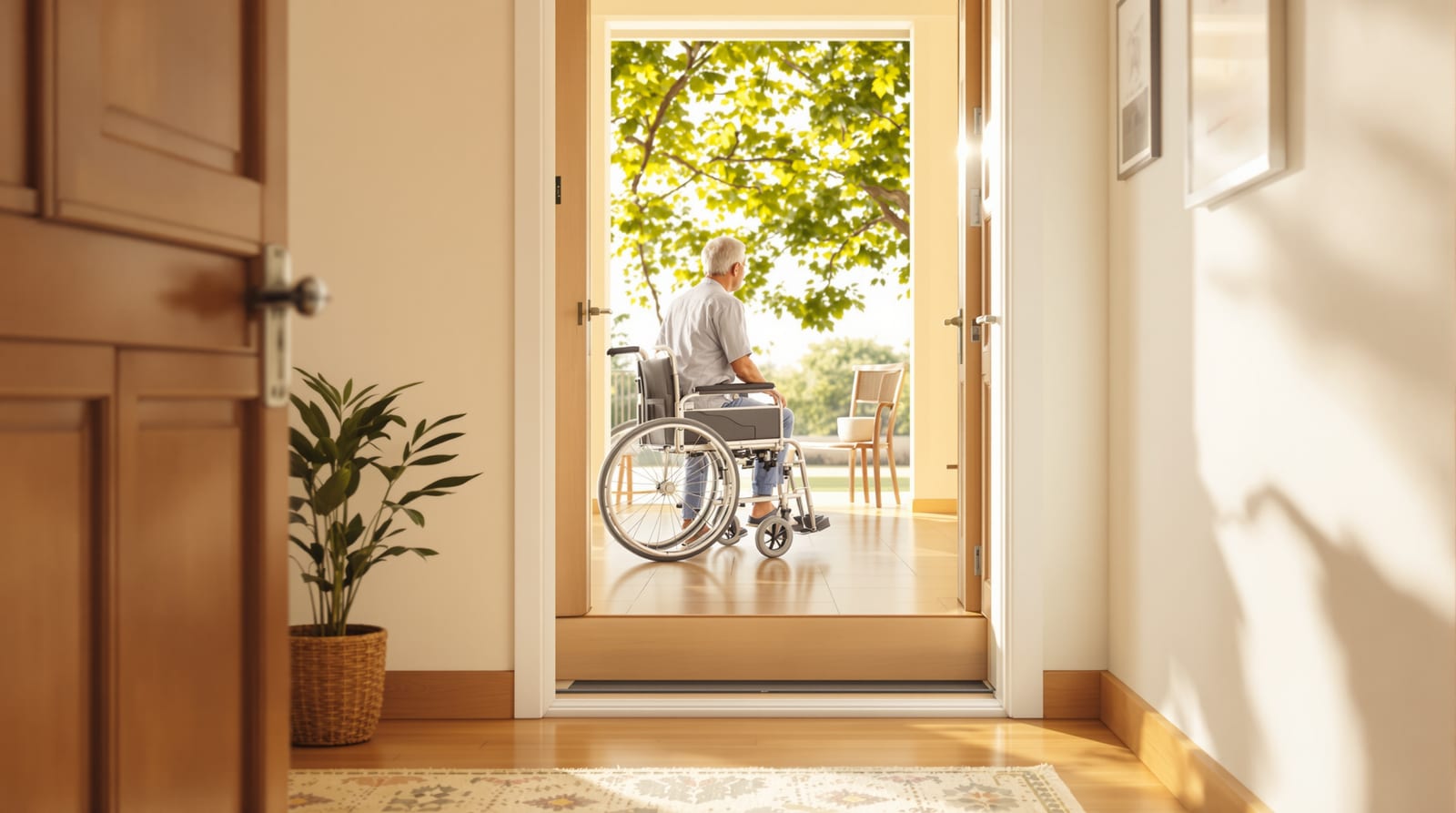
Wheelchair Accessible Doors for Indian Homes: Clear Width, Thresholds & Hardware (2026)
The exact specs that make a door usable from a wheelchair - clear opening width, near-flush threshold, lever hardware, approach clearance and low-force or auto operation, mapped to the RPwD Harmonised Guidelines 2021.
A door that an able-bodied family member never thinks about can stop a wheelchair user at the doorway every single day. The difference is rarely the door leaf itself - it is a handful of unglamorous dimensions: how much clear space you actually get when the door is open, whether the threshold is a gentle bevel or a tripping kerb, whether the handle is a lever you can hook an elbow under or a knob you cannot grip, and how much floor you have to position the chair. This guide gives you the exact, build-ready numbers for an Indian home, mapped to the RPwD Harmonised Guidelines 2021 and NBC 2016, so the door works on the first try. It complements the broader accessible-doors-india pillar and the whole-home view in accessible-home-design-india - here we go deep on the wheelchair-specific dimensions.
The single number that matters most: clear opening width
The figure on a brochure is the leaf size; the figure that decides whether a wheelchair gets through is the clear opening width - measured from the face of the open door leaf to the opposite stop, at the narrowest point. A standard 762 mm (2'6") bedroom door, very common in Indian flats, gives only about 680-700 mm clear once you subtract the leaf thickness sitting in the opening, the stop and the hinge offset. That is below what a manual wheelchair needs for a comfortable straight approach.
The RPwD Harmonised Guidelines 2021 ask for a clear opening width of at least 900 mm for accessible doors, with 800 mm treated as the absolute minimum in tight retrofits. Because the leaf eats roughly 50-90 mm of its own nominal width, you size up:
- A 900 mm leaf yields roughly 810-850 mm clear - acceptable, and the practical default for Indian homes.
- A 1000 mm leaf yields roughly 910-940 mm clear - the comfortable target, and what you should specify for the main entrance and at least one bathroom.
Use offset (swing-clear / cranked) hinges to claw back the last 25-50 mm when you cannot widen the structural opening - they let the leaf swing fully clear of the frame. See door-width-standards-india for the full size table and nbc-door-requirements-india for how these map onto the code.
Manoeuvring and approach clearance - the floor, not the door
A wheelchair user does not walk up to a door and pull it open in one motion; they must position the chair, reach the handle, open the leaf and then move through while the leaf clears the chair. That needs floor space on both sides, and it is the part most Indian retrofits forget because the door alone looks fine.
Two clearances matter:
- Latch-side (pull-side) clearance: beside the handle, on the side the door pulls toward, you need roughly 450-600 mm of clear wall so the user can sit alongside the leaf and pull it past the chair. A door tucked hard against a return wall is unusable even at 1000 mm wide.
- Manoeuvring / turning space: a 1500 mm clear circle (or a 1500 x 1500 mm square) in front of the door lets a chair turn and align. Where a full circle will not fit, a 1200 mm deep clear approach is the working minimum.
Sliding doors and automatic doors are powerful here precisely because they collapse this requirement - a slider needs almost no swing clearance, which is why it is often the best accessible choice for a tight bathroom or pooja room. universal-design-doors-india covers the design philosophy behind providing for everyone by default.
The threshold: a 12 mm bevel, not a kerb
Nothing defeats a wheelchair faster than a raised threshold. Traditional Indian doors carry a dehleez (raised sill) for both practical reasons (keeping water and dust out) and Vastu/cultural meaning. For accessibility the rule is firm: the threshold should be no more than 12 mm high, and any lip above about 6 mm must be bevelled (chamfered) so a small front castor rides over it instead of jamming.
This is also your monsoon and bathroom problem. A bathroom needs to keep water in; a flush threshold seems to fight that. The accessible answer is a shallow bevelled aluminium threshold strip with a slope-graded floor behind it, or a low compression drop seal on the leaf bottom, rather than a kerb. For external doors in coastal or heavy-rain locations, pair the low threshold with a generous overhang/chajja and a graded approach so water never reaches the line. door-threshold-standards-india covers the detailing and the seal options in depth.
Hardware you can operate without a firm grip
Accessible hardware is operable with a closed fist, a loose grip or an elbow - never anything that needs pinching, tight grasping or twisting of the wrist.
- Lever handles, not knobs. Round knobs require a grip and a twist many users cannot make; specify a return-to-frame lever (the end curls back toward the door so a sleeve or wheelchair armrest cannot catch on it). Mortise lever sets from Godrej, Dorset, Europe and Yale all offer compliant lever ranges. See door-handles-guide-india and the lock body in mortise-locks-india.
- Handle height centred around 900-1100 mm above finished floor - reachable from a seated position. Avoid handles set high "for children's safety," which is exactly wrong for a seated user.
- Locks: prefer thumb-turn or lever-action locking over small key cylinders; better still, a wifi-smart-locks-india or keyless-entry-systems-india setup removes the key-and-grip problem entirely.
- Pulls on sliders: fit a D-pull and an edge flush pull so the door can be both opened and finally closed from a seated reach.
Closing force, vision and protection
A door that slams shut behind a slow-moving chair, or takes two hands to push open, is not accessible even if every dimension is right.
- Closer force: if a door closer is fitted, keep the opening force low - aim for under ~22 N (about 2.2 kg) of push at the handle for interior doors. Many standard hydraulic closers (door-closers-india) are too stiff; specify an adjustable closer set to its lightest setting, a delayed-action closer that holds open longer, or skip the closer on interior doors. For the main entrance, a low-energy automatic operator or automatic-sliding-doors-india is the gold standard.
- Vision panel: a glazed strip with its lower edge around 900 mm lets a seated user and a standing user both see someone on the other side - vital where doors swing into circulation.
- Kick plate: a stainless or brass kick plate ~300-400 mm high on the push face protects the leaf from footplate and castor scuffs and saves the finish on a door that gets nudged open daily.
What it costs to make a door wheelchair-accessible in India
The upgrade is mostly hardware and a little carpentry, not a whole new door - which makes retrofitting realistic. Figures below are indicative and vary by city and vendor; add 18% GST and fitting labour.
| Accessibility feature | Typical spec | Indicative cost (₹) | Why it matters |
|---|---|---|---|
| Wider leaf + frame | 900-1000 mm leaf, widen opening | 3,000-12,000 (leaf) + masonry | Delivers 810-940 mm clear width |
| Offset / swing-clear hinges | Cranked hinges, SS | 300-1,200 / pair | Recovers 25-50 mm clear without widening wall |
| Lever handle set | Return-to-frame mortise lever | 600-6,000 / set | Operable with fist or elbow, no grip |
| Bevelled threshold strip | Aluminium, <=12 mm + bevel | 150-900 + fitting | Castors ride over; keeps water control |
| Adjustable / delayed closer | Low-force or delayed-action | 800-3,500 | Door opens with <~2.2 kg push, stays open longer |
| Vision panel | Toughened glazed strip, sill ~900 | 800-3,000 | Mutual sightline, seated and standing |
| Kick plate | SS/brass, 300-400 mm | 400-1,500 | Protects leaf from castor and footplate scuffs |
| Low-energy auto operator | Swing or sliding operator | 25,000-80,000+ | Hands-free; best for the main entrance |
| Automatic sliding door | Sensor slider, single panel | 45,000-1,50,000+ | Near-zero swing clearance, easiest access |
A pragmatic, high-impact retrofit of an existing interior door - offset hinges, lever set, bevelled threshold, delayed closer - typically lands around ₹3,000-10,000 plus labour, far cheaper than people fear. Estimate your own door using the /utilities/door-size-calculator and /utilities/door-cost-calculator.
Putting it together: a priority order
If you can only do a few things, do them in this order: (1) get the clear width to 810 mm or more; (2) lever handle at reachable height; (3) bevel the threshold to 12 mm; (4) clear the floor on both sides; (5) tame the closing force or go automatic. A bathroom and a bedroom served this way, plus an accessible main entrance, cover the daily journey most wheelchair users in an Indian home actually make. Where culture and Vastu favour a raised dehleez, the accessible compromise is a low bevelled sill rather than abandoning the threshold entirely - see entrance-vastu for reconciling the two.
Frequently asked questions
What is the minimum door width for a wheelchair in India?
The RPwD Harmonised Guidelines 2021 call for a clear opening width of at least 900 mm, with 800 mm as the absolute minimum for tight retrofits. Because the leaf and frame eat 50-90 mm, fit a 900 mm leaf for roughly 810-850 mm clear, or a 1000 mm leaf for about 910-940 mm clear at the main entrance and bathroom.
Are sliding or automatic doors better for wheelchair access?
Often yes. Sliding doors need almost no swing clearance, so they suit tight bathrooms, pooja rooms and lobbies where a 1500 mm turning circle plus latch-side space will not fit. A low-energy automatic sliding or swing operator removes the push-force and grip problems entirely and is the strongest choice for the main entrance.
Can I make a bathroom door accessible without losing water control?
Yes. Replace the raised kerb with a shallow bevelled aluminium threshold strip (<=12 mm) and grade the bathroom floor to fall toward the drain, or fit a compression drop seal on the leaf bottom. This keeps water in while letting castors roll over the line.
How high should the handle be for a seated user?
Centre lever handles around 900-1100 mm above finished floor so they are reachable from a wheelchair. Use return-to-frame levers (not knobs), and prefer thumb-turn, lever-action or smart locks over small key cylinders that need a fine grip.
How much does it cost to make an existing door wheelchair-accessible?
A practical retrofit - offset hinges, a lever set, a bevelled threshold and a delayed-action or low-force closer - typically costs around ₹3,000-10,000 plus fitting labour and 18% GST. Widening the structural opening or fitting an automatic operator costs more; figures are indicative and vary by city and vendor.
Export this guide
Related Guides — Deep-dive reading
Universal Design Doors for Indian Homes: Inclusive Doors That Work for Everyone (2026)
How to design and specify doors that serve children, the elderly, pregnant women, the injured and wheelchair users by default - generous width, lever handles, near-flush thresholds, low-force closing, contrast and good lighting - without your home ever looking medical.
Home Doors & EntrancesAccessible Doors in India: Wheelchair & Senior-Friendly Door Design Guide
Clear width, lever handles, flush thresholds, swing vs sliding, lock reach and sensor doors - how to specify wheelchair- and senior-friendly doors to the RPwD Harmonised Guidelines 2021 and NBC 2016.
Home Doors & EntrancesDesigning Adaptable & Universal-Design Homes
Accessibility, Aging-in-Place, and the Multi-Stage Family — Code, Anthropometrics, and Plan-Stage Discipline for Indian Residential Architects
Room PlanningRelated Tools — Try Free
Accessible Door Checker
Check a door against wheelchair-accessibility guidance — clear width, threshold, handle and closer force per RPwD 2021.
Compliance ToolWindow Hardware Cost Calculator
Estimate window hardware cost — hinges, handles, locks, rollers and multipoint gears.
Window CalculatorDoor Size Calculator
Get the standard door and frame size by room, with swing clearance and the accessible clear-width check.
Door Tool