
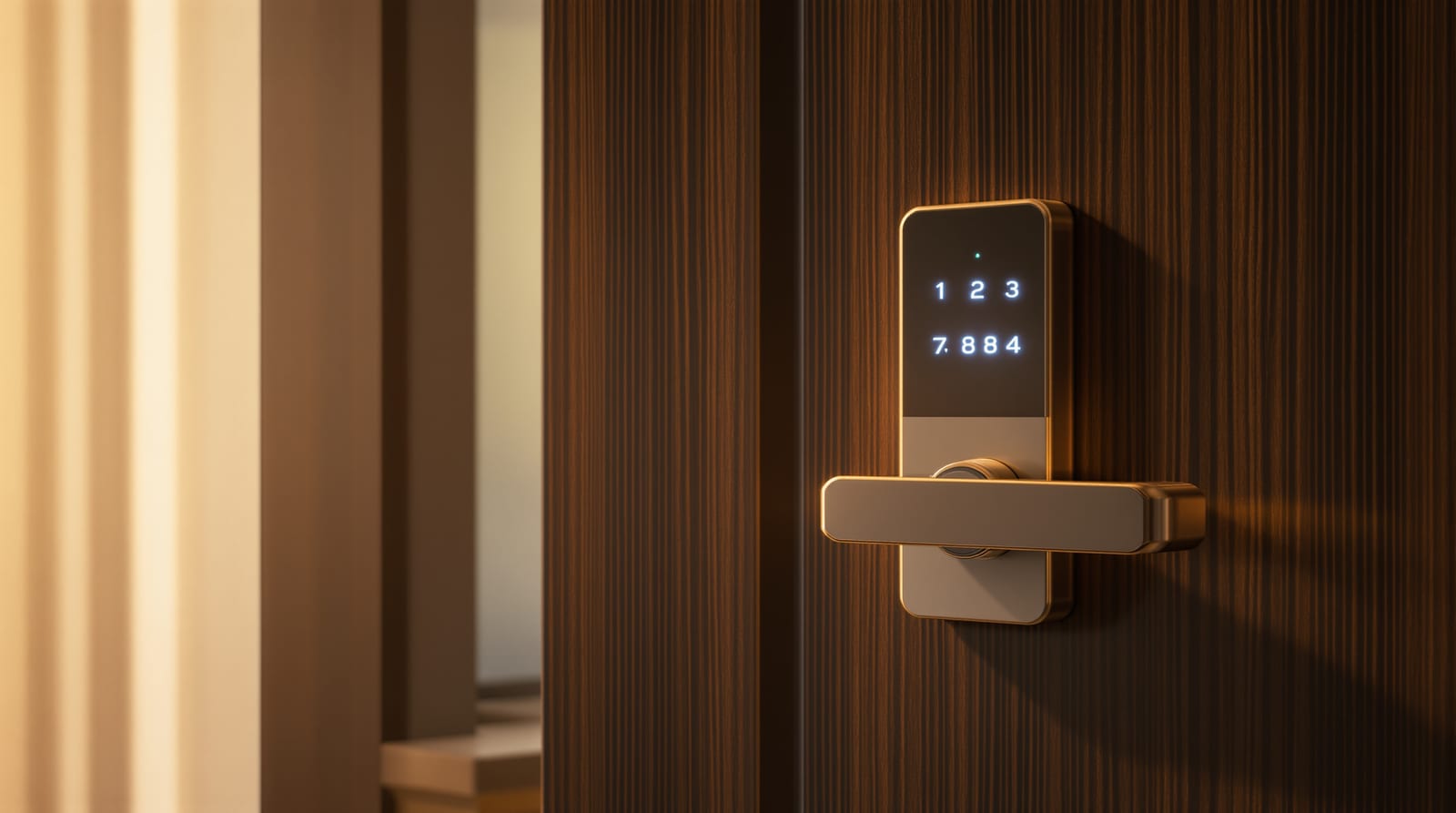
Biometric Door Locks in India: Fingerprint, Face, Palm-Vein & Iris Compared (2026)
How the four biometric modalities really compare on accuracy, spoof-resistance, speed and price — and what they can't do in Indian homes.
A biometric door lock turns a part of your body — a fingertip, a face, the veins in your palm — into the key. No fob to lose, no PIN to forget, no spare key under the mat. For Indian homes that increasingly run on convenience and remote living, it is a genuinely useful upgrade. But "biometric" is not one technology; it is four very different ones, and they are not equally accurate, equally hard to fool, or equally suited to a Chennai summer or a Mumbai monsoon. This is the overview that helps you choose the right modality before you spend.
This guide is the map of the territory. It compares the four biometric methods you will actually encounter, explains the numbers vendors quote (and the ones they hide), and is honest about what biometrics simply cannot do on their own. For component-level depth, the deep guides branch out from here: fingerprint locks, face-recognition locks, the broader smart lock landscape, and keyless entry systems.
What "biometric" actually means on a door
A biometric lock captures a physical or behavioural trait, converts it into a mathematical template (not a stored photo or print — usually an encrypted set of numbers), and compares each new scan against the enrolled templates. If the match score crosses a threshold, the motor retracts the bolt. Everything else — the keypad, the app, the RFID card, the physical key slot — is backup. The biometric part is just the fastest, most personal way in.
Four modalities matter for Indian homes:
- Fingerprint — by far the most common and affordable. A capacitive or optical sensor reads ridge patterns.
- Face recognition — a camera maps facial geometry; mid-to-premium locks now bundle it.
- Palm-vein — an infrared sensor reads the vein pattern beneath your palm skin. Rare in home locks, common in offices/banks.
- Iris — a near-infrared camera reads the iris pattern. Extremely accurate, extremely rare on residential doors (mostly high-security and access-control installs).
Most home buyers will choose between fingerprint and face; palm-vein and iris are included here so you understand the full ladder and why the cheaper options dominate homes.
The numbers vendors quote — and what they mean
Three terms decide whether a biometric lock is good or a gimmick:
- FAR (False Acceptance Rate) — how often it lets in the wrong person. Lower is safer. A FAR of 0.001% means roughly 1 wrong acceptance in 100,000 attempts.
- FRR (False Rejection Rate) — how often it rejects the right person (the annoyance factor). High FRR means you stand outside swiping a wet finger four times.
- Spoof resistance / liveness detection — whether a photo, a lifted print on tape, or a silicone mould can fool it. This is where cheap locks fail.
A lock can have a great FAR on paper and still be easy to spoof, because FAR is measured against real fingers, not attacks. Always ask both "how accurate" and "how hard to fool" — they are different questions.
The four modalities compared
| Biometric modality | Typical accuracy (FAR) | Spoof-resistance | Speed | Indicative ₹ (lock with this as primary) |
|---|---|---|---|---|
| Fingerprint (optical) | ~0.01-0.1% | Low-Medium (photos/moulds can fool basic sensors) | Fast (<1 sec) | ₹5,000-12,000 |
| Fingerprint (capacitive/semiconductor) | ~0.001-0.01% | Medium (reads live skin layer; harder to spoof) | Fast (<1 sec) | ₹9,000-20,000 |
| Face recognition (2D camera) | ~0.01-1% (light-dependent) | Low-Medium (photo/video can fool 2D) | Fast (1-2 sec) | ₹12,000-25,000 |
| Face recognition (3D / IR depth) | ~0.001% | High (depth + liveness defeats photos) | Fast (1-2 sec) | ₹18,000-30,000+ |
| Palm-vein | ~0.00008% (very low) | Very High (veins are internal, need live blood flow) | Fast (1 sec) | ₹20,000-40,000+ (rare in homes) |
| Iris | ~0.0001% or better | Very High | Medium (alignment needed) | ₹30,000+ (mostly commercial) |
All figures indicative, vary by brand/model/city/vendor; add 18% GST and fitting labour. Lab FAR/FRR rarely survive real Indian conditions — treat as relative, not absolute.
The pattern is clear: fingerprint wins on price and ubiquity; capacitive fingerprint and 3D face are the sweet spot for security-conscious homes; palm-vein and iris are overkill (and overpriced) for a residential door. For most families a good capacitive-fingerprint lock from a reputable brand is the right answer.
Why optical vs capacitive matters more than the brochure says
Budget fingerprint locks (₹5,000-9,000) usually use optical sensors — essentially a camera photographing your ridge pattern. They struggle with dry, wet, cut, or worn fingers (common in households that cook and clean) and can be fooled by a high-resolution print or a gummy mould. Capacitive/semiconductor sensors measure the tiny electrical differences between ridges and valleys of live skin, so they are both more reliable on imperfect fingers and harder to spoof. If a vendor cannot tell you which sensor type a lock uses, treat that as a red flag.
A simple diagram of the reader types
Enrolment limits — read the fine print
Every biometric lock caps how many identities it stores. This matters more in India than vendors admit, because of joint families, domestic help, drivers, tenants and frequent guests.
- Budget fingerprint locks: typically 10-50 fingerprints.
- Mid-range: 50-100 fingerprints, plus separate quotas for PINs and RFID cards.
- Premium / access-control units: 100-300+ users.
A useful trick: enrol two fingers per person (one as backup for cuts, mehndi, or a wet hand). That halves your effective capacity, so a "100-print" lock realistically serves a household of ~40-50 people across all members and helpers. For a typical nuclear family that is plenty; for a large joint family with rotating staff, check the number before buying. Face-recognition quotas are usually lower (often 20-50 faces) because face templates are larger.
What biometrics CANNOT do — always keep a backup
This is the most important section. Never buy a biometric-only lock. Biometrics fail in ordinary, predictable ways, and a door you cannot open is worse than one with a simple key.
- Power loss. Most biometric locks run on AA batteries lasting 6-12 months, but they die, and India's power and your forgetfulness both intervene. Good locks offer emergency USB-C / 9V terminal power on the outside to jump-start a dead lock, plus a physical key override behind the fascia. Insist on at least one.
- Wet, cut, dirty, mehndi-covered or aged fingers. Cooking oil, soap, monsoon damp, henna, manual labour and the thinning ridges of elderly hands all raise rejection. A backup PIN or card is essential.
- Children, elderly and guests. A grandparent's worn fingerprints may simply not read. Plan PIN access for them.
- Lockouts and false rejects. Locks lock out after several failed attempts (anti-tamper). You need another route in.
- Liveness limits. Cheap 2D-face and optical-fingerprint locks can be spoofed by a photo or a lifted print. If the lock guards a main door, pay for liveness detection / capacitive sensors / 3D face.
The right configuration for almost every Indian home is biometric as primary + PIN keypad + RFID card + mechanical key override + emergency external power. That redundancy is the whole point of the smart-lock category — see the wider keyless entry systems and the smart lock vs traditional lock comparison for how these layers stack.
Data privacy: where does your fingerprint go?
A reasonable worry: if my fingerprint opens my door, who else has it? The reassuring technical reality is that reputable locks do not store an image of your finger or face. They store a one-way mathematical template that cannot be reverse-engineered back into a usable print. Key questions to ask:
- Local vs cloud storage. Most standalone locks store templates on the device itself, encrypted, never leaving the lock. Wi-Fi locks that sync to an app may upload metadata (who entered, when) but typically keep the biometric template on-device. Prefer on-device, encrypted storage; be cautious of any lock that uploads raw biometric data to a server.
- App permissions and account security. The weak link is often the companion app, not the sensor. Use a strong app password and two-factor authentication if offered.
- Deleting an identity. When a tenant leaves or you change domestic staff, you must be able to delete their enrolment cleanly. Test this before you rely on it.
- Regulatory context. India's Digital Personal Data Protection (DPDP) Act, 2023 treats biometric data as sensitive; serious brands design for on-device storage partly for this reason. Hyper-cheap imported locks may not.
Suitability for Indian conditions
A biometric lock that thrives in an air-conditioned office can struggle on a south-facing flat door in May. Match the lock to the environment:
- Heat & direct sun. Sensors and screens degrade above ~50-60 deg C and can misread when baking in afternoon sun. For an exposed main door, prefer a recessed/shaded mounting and a brand rated for high ambient temperatures.
- Dust. Optical fingerprint sensors smear and misread with dust and oily fingerprints; they need wiping. Capacitive sensors tolerate dust better.
- Humidity & monsoon. Look for an IP-rated (e.g. IP54/IP65) weatherproof body for any door exposed to driven rain. Internal flat doors are gentler on the lock.
- Power reliability. Frequent outages do not affect battery locks, but voltage spikes can fry any mains-connected video/face unit — use a surge protector. Always have the mechanical key override.
- Mounting. Heavy biometric handlesets need a solid leaf. Hollow flush doors may need reinforcement; teak and engineered-wood leaves hold the fixings best. See the broader door hardware guide for fitting on different door types.
Price tiers and brands in India
Indicative, varies by city and vendor; add 18% GST plus fitting labour.
| Tier | Indicative ₹ | What you get | Typical brands |
|---|---|---|---|
| Budget | ₹5,000-9,000 | Optical fingerprint + PIN, on-device storage, key override; basic spoof resistance | Dorset entry models, Ozone, generic imports |
| Mid-range | ₹10,000-17,000 | Capacitive fingerprint + PIN + RFID + app, better sensor, Wi-Fi/Bluetooth | Godrej, Yale, Qubo, Hafele entry, Mi/Aqara |
| Premium | ₹18,000-30,000+ | 3D face + capacitive fingerprint + PIN + RFID + app + camera/video; liveness; IP-rated | Yale premium, Godrej Catus/Pro, Hafele, Philips, Ultraloq |
For the lock-by-lock cost picture, run the numbers through the smart lock cost calculator, and weigh biometric against conventional security in smart lock vs traditional lock.
Frequently asked questions
Can a biometric door lock be fooled by a photo or a fake fingerprint?
A cheap one, sometimes yes. Basic 2D-face locks can be tricked by a printed photo or video, and optical fingerprint sensors by a high-resolution print or a silicone mould. Spend up to capacitive fingerprint or 3D/IR face with liveness detection for a main door, and the practical risk drops sharply.
What happens if the battery dies and I am locked out?
A well-designed lock gives you a way in regardless: an external emergency power port (USB-C or 9V terminal) to momentarily power the lock, plus a mechanical key override hidden behind the fascia. Never buy a biometric lock without at least one of these, and keep a spare key off-site.
Is my fingerprint data safe — can someone steal it from the lock?
Reputable locks store an encrypted mathematical template, not an image, on the device itself, and that template cannot be turned back into a usable fingerprint. Prefer locks with on-device encrypted storage, secure the companion app with a strong password and 2FA, and avoid ultra-cheap units that upload raw biometric data to unknown servers.
How many people can a biometric lock recognise?
Budget locks store around 10-50 fingerprints, mid-range 50-100, premium 100-300+. Enrol two fingers per person as a backup, which halves usable capacity. For a joint family with domestic staff and drivers, confirm the enrolment limit before buying.
Fingerprint or face recognition for an Indian home?
Fingerprint is cheaper, more mature and works in the dark, but struggles with wet, cut, mehndi-covered or worn fingers. Face is hands-free and convenient but needs decent light and, to be secure, a 3D/IR sensor with liveness. Many of the best home locks now combine both — choose a unit that offers fingerprint plus PIN as the dependable core and treat face as a convenience layer.
Export this guide
Related Guides — Deep-dive reading
Fingerprint Door Lock Guide for Indian Homes: How the Sensor Works, Accuracy & Backup (2026)
How biometric fingerprint locks read your finger, why dry, wet or worn fingers fail in Indian heat and monsoon, and how to set up reliable backup access before you buy.
Home Doors & EntrancesFingerprint vs PIN Lock (2026): Which Keyless Entry Suits Your Indian Home?
A neutral head-to-head between the two most common keyless ways to open a smart lock in India — a fingerprint (biometric) and a PIN (code) — across convenience, everyday reliability in Indian conditions, who can use each, security, and privacy, ending in the honest verdict that you rarely have to choose.
SecurityFingerprint Locks in India (2026): How Biometric Door Locks Really Work, and Their Honest Limits
How a fingerprint sensor reads a finger and matches it to enrolled templates, the genuine appeal of nothing to carry, and the wet-finger, elderly, privacy and backup realities every Indian buyer must weigh before choosing one.
SecurityRelated Tools — Try Free
Biometric-Capacity Calculator
Whether a biometric reader can hold all the enrolments and how many devices you need, with a 1:N speed note.
Biometric CapacitySmart Lock Finder
Find the right smart lock — access methods, tier and must-haves like a mechanical override — for your door and budget.
Door ToolBefore vs After — Cost Reality Check
Compare what you expected to pay vs what you actually paid, category by category.
Reality Check