
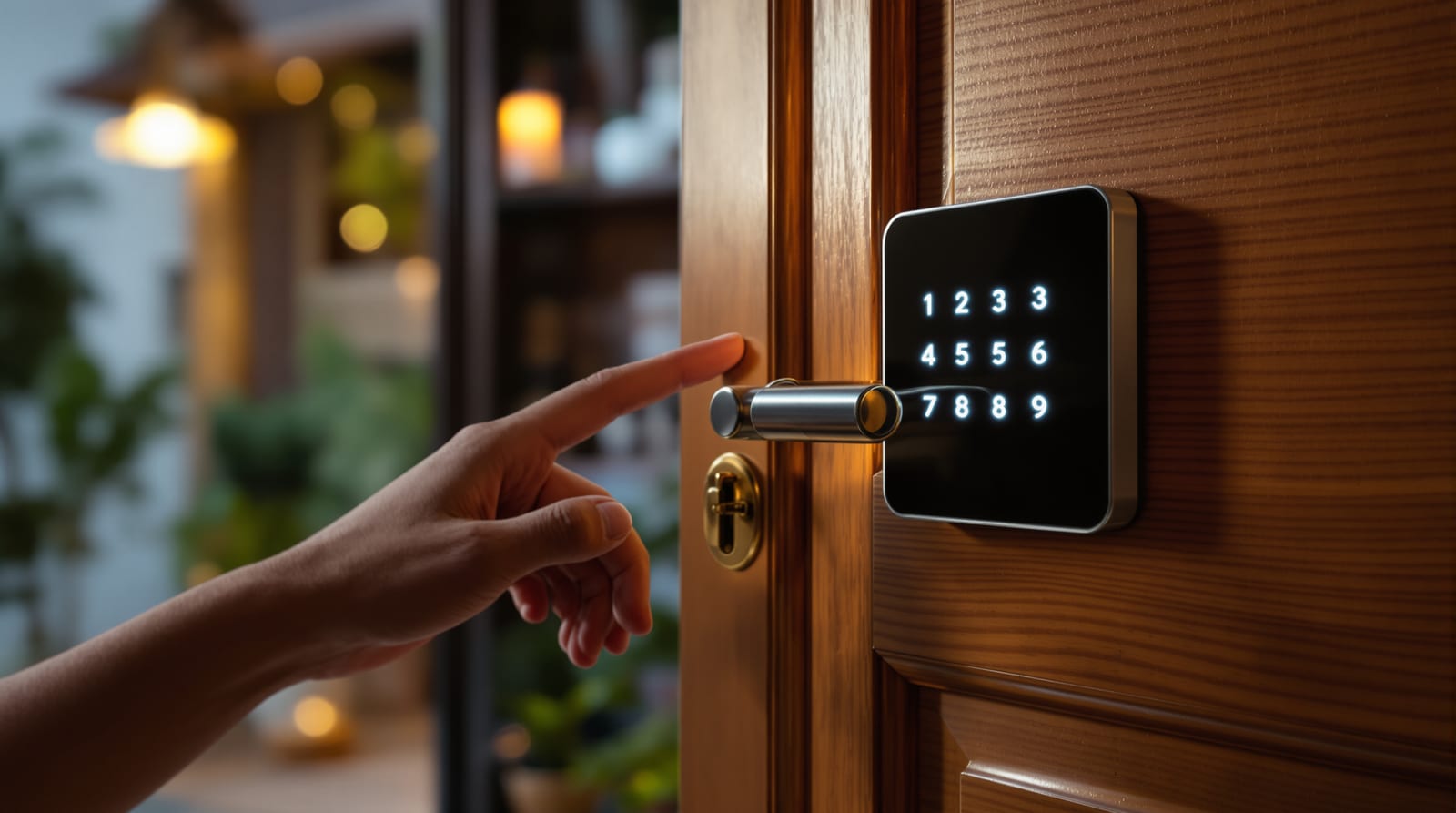
PIN Code Door Locks: Keypad Entry Guide (India 2026)
How keypad and PIN-code door locks work, temporary guest codes, anti-peep features, smudge and battery realities for Indian homes.
The simplest way to stop carrying keys is a number you already remember. PIN code door locks let anyone in your household open the door by tapping a code on a keypad, no key, card or phone required. They are usually the cheapest entry point into keyless living in India, and the PIN method appears on almost every smart lock as a fallback even when fingerprint or app is the headline feature. This Studio Matrx guide explains how PIN code door locks actually work, the difference between mechanical, electronic and touchscreen keypads, how temporary and one-time codes work for guests and staff, and the honest trade-offs around smudge, peeping, batteries and lock-out that decide whether a keypad is right for your door.
How PIN code door locks work
At heart, a PIN lock stores one or more secret number sequences. When you type a code and it matches, the lock releases the bolt; otherwise it stays shut and, after a few wrong tries, usually locks out the keypad for a minute or two. Beyond that shared idea, there are three very different technologies, and they are not equally secure or convenient.
Mechanical code locks
A purely mechanical code lock has push-buttons or a dial connected to an internal combination mechanism. There is no electronics and no battery, so it never goes flat and it cannot be hacked over the air. The code is fixed (changing it means partly dismantling the lock), everyone shares one number, and there is no log of who came in. These are common on side gates, store rooms, terrace doors, server rooms and office back-doors rather than main entrances. They are robust and maintenance-light, but offer no guest codes, no audit trail and limited resistance to someone simply watching you press the buttons.
Electronic keypad locks
An electronic keypad lock uses physical numbered buttons wired to a small circuit board and a motor or solenoid that drives the bolt. You can store multiple PINs, change them in seconds, set temporary codes and often see a basic event history. Physical buttons give clear tactile feedback in the dark and tend to survive India's heat, dust and humidity better than glass. The trade-off is wear: the digits you press most begin to shine or fade over years, which can hint at your code.
Touchscreen keypad locks
Touchscreen locks replace buttons with a flat capacitive or backlit glass panel. They look premium, are easy to wipe clean, and almost always pair with fingerprint, app or card unlocking too. The two weaknesses are fingerprints and smudges left on the glass (which can reveal which digits you use), and reduced sensitivity for wet, very dry or callused fingers, common after housework or a hot Indian afternoon. Good touchscreen locks counter the smudge problem with the anti-peep feature described below.
Mechanical vs electronic vs touchscreen
| Feature | Mechanical code lock | Electronic keypad | Touchscreen keypad |
|---|---|---|---|
| Power needed | None | Batteries | Batteries |
| Change the code | Hard, manual | Seconds, on-device | Seconds, on-device/app |
| Multiple and guest PINs | No | Yes | Yes |
| One-time / temporary codes | No | Often | Usually |
| Event log / audit trail | No | Basic to full | Usually full |
| Anti-peep random digits | No | Sometimes | Usually |
| Wear / smudge clue | Buttons wear | Buttons wear | Fingerprints on glass |
| Typical use | Gates, store rooms | Main and internal doors | Main doors, premium |
| Indicative installed cost | ₹2,500-8,000 | ₹7,000-15,000 | ₹12,000-25,000 |
Most homeowners shopping for a main-door keypad end up choosing between an electronic-button and a touchscreen model, both of which are really smart locks with PIN as one method. Prices include 18% GST and vary with brand, finish and whether the lock is mortise-fit. Real options in India include Godrej (Advantis, Catus), Yale, Qubo, Ozone, Philips and Atomberg; compare across best smart lock brands India before buying.
Temporary, one-time and scheduled PINs
The biggest advantage of an electronic PIN lock over a mechanical one is that you can hand out codes that are not your own and revoke them at will. This is where keypad entry shines for Indian households juggling maids, cooks, drivers, plumbers and weekend guests.
- Permanent user PINs for each family member, so you can see who entered and disable one person's code if a phone or relationship changes.
- Temporary / scheduled PINs that work only during set hours or dates, ideal for a part-time cook who comes 7-9 a.m., or a guest visiting for a week. The code self-expires; you never have to remember to delete it.
- One-time PINs (OTP) that work for a single entry and then die, perfect for a one-off delivery, an AC technician or a courier. Many Wi-Fi-connected locks let you generate and share these from an app while you are at the office.
This is the practical difference from a shared mechanical code: instead of one secret everyone knows forever, you issue and retire codes per person and per visit. For broader keyless options including cards, app and fingerprint, see keyless entry systems India.
The anti-peep (random digit) feature
A real risk with any keypad is shoulder-surfing: someone watching you tap, or reading the smudge pattern on glass. The anti-peep feature defeats this. Before you enter your PIN, the lock lets you type a string of random junk digits before and/or after the real code; as long as your actual sequence appears somewhere inside, the lock opens. So if your PIN is 4-7-2-9, you might tap 8-1-4-7-2-9-3-0, and an onlooker cannot tell where the real code starts or ends.
It also smears fingerprints across many keys rather than four, so the smudge clue disappears. Anti-peep (sometimes called "virtual password" or "random digit") is now common on mid and premium touchscreen locks and is worth insisting on if your door is in a shared lobby, corridor or gated-society passage. It costs nothing extra to use once the lock supports it.
Where PIN locks work best
The diagram below shows the unlock decision flow on a typical electronic keypad, including the wrong-attempt lock-out and the mechanical-key override.
PIN keypads suit doors where you want quick, key-free entry by several people and don't mind sharing or scheduling codes. Good fits include the main door of a family home, an apartment with frequent domestic staff, home-office and clinic doors, a rented flat where tenants change, and internal doors to a study or store. They are less ideal as the sole lock for a high-value door in a busy public corridor (use anti-peep, or add a second factor). For comparison with fingerprint and other biometrics, see biometric door locks India and fingerprint door locks India.
Smudge, wear and battery realities
No keypad is perfect, and India's climate makes some failure modes worse. Be honest with yourself about these before buying.
| Issue | What happens | How to manage it |
|---|---|---|
| Smudge on glass | Oily fingerprints reveal used digits | Use anti-peep; wipe the panel; rotate PINs |
| Button wear | Pressed keys fade or shine over years | Change the PIN periodically; pick longer codes |
| Shoulder-surfing | Someone watches you type | Shield the keypad; use anti-peep random digits |
| Dead battery | Lock stops responding | Keep spares; heed low-battery alerts; know the override |
| Wet / dry fingers | Touchscreen misreads taps | Dry hand first; some locks switch to button mode |
| Heat and dust | Glass and contacts degrade faster | Choose IP-rated locks for outer doors; service yearly |
Most electronic keypad locks run several months to over a year on standard AA cells and warn you well before they die, but a flat battery is the classic lock-out cause. Always buy a lock with a backup: a mechanical-key override, an emergency USB-C or 9V terminal to jump-start the lock, or both. Keep a physical key off-site and don't store it under the doormat. For battery planning and brand differences, see smart lock vs traditional lock India, and to model running costs and life, try the smart lock battery life calculator.
Combining PIN with fingerprint, card or face
Because PIN is almost free to add, most quality smart locks pair it with other methods. This matters for two reasons. First, redundancy: if your finger is wet or cut, the PIN still works; if you forget the PIN, your fingerprint or card does. Second, security: serious doors can require two factors, say PIN plus fingerprint, so a watched code alone is useless.
A sensible household pattern is: family members use fingerprint daily, the PIN is the universal fallback and the way you onboard guests and staff with temporary codes, and an RFID card or fob covers children or elderly relatives who struggle with fingerprints or screens. For the wider device picture and selecting a lock that supports the mix you need, see the home doors complete guide and door locks types India. If you are weighing a fully automated or access-controlled door rather than a single lock, the door automation guide covers the systems layer. To shortlist a specific model, run the smart lock selector.
One legal note that applies to any electrically locked door: if it sits on a designated escape route, the National Building Code (NBC 2016) requires that people can always get OUT freely without a code or key. PIN-only smart locks on flat doors are fine because the inside thumb-turn or handle gives free egress, but never fit a code-controlled lock that traps people inside a fire escape.
Frequently asked questions
Are PIN code door locks safe enough for a main door in India?
For a typical home, yes, provided you choose a lock with auto lock-out after wrong attempts, anti-peep random-digit entry and a reliable backup. The weak points are people watching you type and smudge clues on touchscreens; anti-peep and periodic code changes handle both. For high-risk doors, add a second factor such as fingerprint.
How often should I change my PIN?
Change permanent codes every few months, and immediately if you suspect anyone saw you type or if a staff member or tenant leaves. Always delete temporary and guest codes once the visit is over, or use self-expiring scheduled and one-time PINs so deletion is automatic.
What happens during a power cut or dead battery?
Keypad locks run on their own batteries, so household power cuts, an everyday reality in India, don't affect them directly. A flat lock battery is the real risk. Good locks warn you for weeks beforehand and offer a backup: a mechanical-key override or an emergency 9V/USB-C terminal to power the keypad long enough to enter and replace the cells.
Can I give my maid or a delivery person a temporary code?
Yes, that is one of the best reasons to choose an electronic keypad. Create a scheduled PIN that works only during their hours, or a one-time PIN that dies after a single entry. Many Wi-Fi locks let you generate and share these remotely from an app, with a log of when each code was used.
Mechanical code lock or electronic keypad, which should I buy?
Choose a mechanical code lock only for low-stakes doors like gates, terraces or store rooms where you want zero batteries and one shared, rarely changed code. For a main or internal home door where you want multiple users, guest codes and a record of entries, an electronic or touchscreen keypad lock is the better buy despite the battery dependency.
Export this guide
Related Guides — Deep-dive reading
Mechanical Key Override on Smart Locks (India, 2026): Your Get-In-Anyway Backup
The physical key or backup that opens your smart lock when the electronics fail, why a home main door must never be keyless-only, and how to manage the override key so it protects you without becoming a weak point.
SecuritySmart Lock vs Traditional Lock in India (2026): Which Should Guard Your Door?
An honest, even-handed head-to-head for Indian homes — keyless convenience, e-keys and remote access on one side, simple key-in-hand reliability with no power dependence on the other — ending in a clear verdict by household, and one rule both must obey: never trap anyone inside.
SecurityKeyless Entry Systems for Indian Homes: PIN, RFID, Fingerprint, App & OTP (2026)
How keyless entry actually works in Indian homes, what happens when power or battery fails, and the best lock combinations for safety and convenience.
Home Doors & EntrancesRelated Tools — Try Free
Access-Control Battery-Backup Calculator
Size the standby battery so an access system keeps running through a power cut, with an egress life-safety note.
Battery BackupDoor Lock Selector
Answer a few questions and get the right lock type — mortise, multipoint, deadbolt, privacy or smart — for any door.
Door ToolSmart Lock Finder
Find the right smart lock — access methods, tier and must-haves like a mechanical override — for your door and budget.
Door Tool