
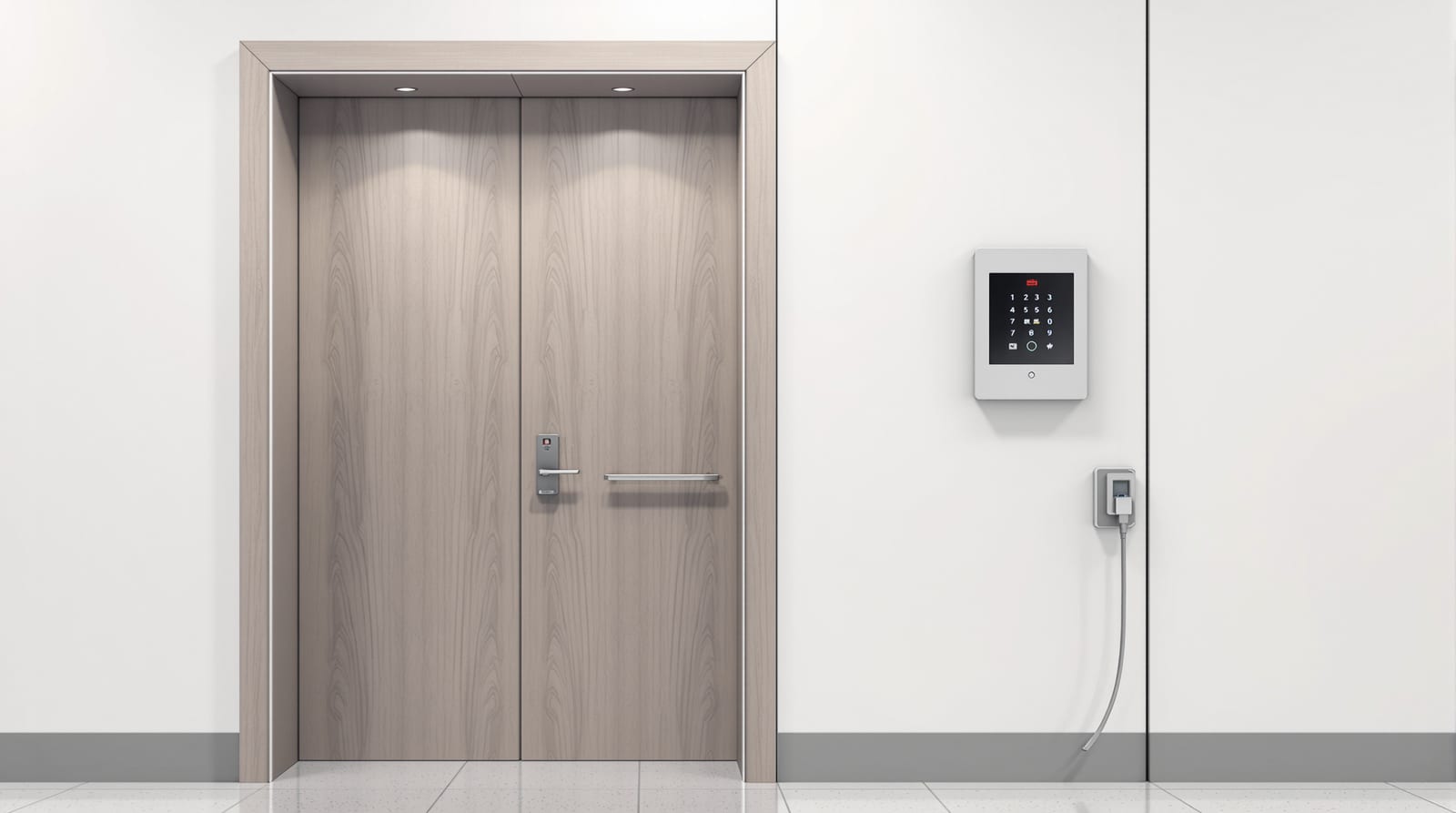
Access Control Systems Guide: Doors & Hardware India 2026
A systems-level breakdown of door access control in India — components, credentials, topologies, per-door cost and a step-by-step design method.
A single smart lock secures one door; access control systems secure a building. The difference is architecture. Once you move beyond a standalone keypad on the front door to a campus, office or gated society where dozens of doors must be governed by policy — who, where, when, and with what audit trail — you are no longer buying a product, you are engineering a system. This guide unpacks that system from first principles for the Indian context: the anatomy of a controlled door, the credential technologies, the three topologies you can build on, a realistic per-door cost build-up, and a disciplined design method. It complements our single-page primer on door access control by going one level deeper into how the pieces actually fit together.
The anatomy of an access control system
Every controlled door, whatever the brand or budget, is assembled from the same functional blocks. Understanding them is the whole game — once you can name each block you can specify, cost and troubleshoot any system.
Controller / panel
The controller is the brain. It stores the access policy (which credentials open which doors at which times), makes the lock/unlock decision, and logs every event. A standalone controller serves one or two doors; a networked panel manages four, eight, sixteen or more doors over a wired bus. The decision must live in the controller, not the reader — a reader that decides on its own can be defeated by attacking its wiring.
Reader
The reader is what the user presents a credential to: a keypad, an RFID/card reader, a fingerprint or face module, a Bluetooth/mobile reader, or a combination. It captures the credential and passes it to the controller. Reader choice drives both user experience and the security ceiling of the whole door.
Lock hardware (EM / strike / bolt)
The electrified lock is the muscle. The three common families are the electromagnetic (EM/maglock) with 280 kg or 600 kg holding force, the electric strike that replaces the door frame keeper, and the solenoid/electric bolt. The choice between them is also the choice between fail-safe and fail-secure behaviour — covered below and in depth in fail-safe vs fail-secure locks.
Exit button / REX
A Request-to-Exit (REX) device — a push button, touch sensor, or motion REX — releases the lock for people leaving from the secure side. On any door that forms part of an escape route, free egress is not optional; it is a legal requirement under NBC 2016 (see the egress note below).
Door sensor
A magnetic door-position sensor tells the controller whether the door is actually open or closed. Without it the system cannot detect door-forced or door-held-open alarms, and it cannot relock precisely as the door shuts.
Power supply + backup
Access control runs on low-voltage DC (typically 12 V). In India, where power-cuts are a daily reality, the power supply must include a backup battery or sit behind a UPS so the system rides through outages. Power planning is so central we treat it separately in door access power backup.
Software
Finally, management software — on-premise, or increasingly cloud-hosted — is where administrators enrol users, set schedules, pull reports and review the audit trail. The richness of the software is what separates a lock from a system; see access control audit logs.
Credential types — what the reader reads
The credential is the user's proof of identity. Each type trades off convenience, security, cost and — critically in India — data-privacy exposure. The table below summarises the practical picture.
| Credential | How it works | Strength | Weakness | Privacy note |
|---|---|---|---|---|
| PIN code | Numeric code on keypad | No token to lose; cheap | Shared/shoulder-surfed; codes leak | Low |
| RFID card / fob | 125 kHz or 13.56 MHz tag | Fast, easy to issue/revoke | Cloning of low-frequency cards; can be lost | Low |
| Fingerprint | Optical/capacitive scan | Tied to person; convenient | Wet/worn fingers fail; spoofable | Biometric — DPDP applies |
| Face recognition | Camera + algorithm | Touchless, fast | Lighting/angle; deepfake risk | Biometric — DPDP applies |
| Mobile / BLE | Phone credential via app | No card; remote issue | Battery/Bluetooth dependency | Medium |
For families of method-specific detail, see RFID door access, PIN code door locks and mobile app door access. For high-security doors, combining two factors — say card plus PIN — is the standard hardening move, explored in multi-factor door access.
A word on biometrics: fingerprints and face templates are sensitive personal data. Under the Digital Personal Data Protection (DPDP) Act 2023 you must have a lawful basis, store templates securely (ideally as non-reversible templates, not raw images), and be able to delete them on request. Do not collect biometrics by default when a card or PIN would do.
Topologies — standalone, networked and cloud
How controllers connect determines what the system can do and what it costs to run.
| Topology | Best for | Connectivity | Pros | Cons |
|---|---|---|---|---|
| Standalone | 1–2 doors, small offices | None (local only) | Cheapest; no IT dependency | No central audit; per-door admin |
| Networked (TCP/IP) | Offices, campuses | Wired LAN to panels | Central policy + audit; reliable | Needs cabling, IT, on-site server |
| Cloud | Multi-site, gated societies | Internet + gateway | Manage anywhere; auto-updates | Internet dependency; subscription |
Standalone units suit a single door where you simply want better-than-a-key control. Networked TCP/IP systems are the workhorse of Indian offices and institutions: panels sit in a server/electrical room, readers cable back to them, and one console governs everything. Cloud systems add remote management and are increasingly chosen by gated society access control and multi-branch businesses — at the cost of an internet dependency and a recurring fee. For large environments, integration with building systems matters; see access control BMS integration.
Fail-safe vs fail-secure — the life-safety choice
This is the single most important decision on any controlled door, and it is a legal one. A fail-safe lock unlocks when power is removed; a fail-secure lock stays locked when power is removed.
| Behaviour on power loss | Lock types | Use on | Egress | Risk |
|---|---|---|---|---|
| Fail-safe (unlocks) | EM/maglock; fail-safe strike | Escape routes, fire doors | Free | Door open during outage |
| Fail-secure (stays locked) | Fail-secure strike; solenoid bolt | Server rooms, stores | Mechanical override needed | Lock-out in outage |
The legal must: any access-controlled door on an escape route must permit free egress at all times and must release on a fire-alarm signal. Under NBC 2016 fire and life-safety provisions, maglocks on escape doors must drop out when the fire-alarm panel triggers — wired so the alarm cuts lock power. Pair this with a REX and a clearly marked break-glass release. Never sacrifice egress for security on an exit door.
Because India's grid is unreliable, also plan the lock-out scenario: a fail-secure door with a flat battery and no mechanical override traps people inside. Battery backup, UPS and a key/mechanical override are not luxuries.
Per-door cost build-up (India, installed)
Cost is best understood by building it up component by component rather than quoting a single number. The bands below are indicative for 2026, exclude 18% GST, and assume professional installation.
| Component | Indicative ₹ band | Notes |
|---|---|---|
| Controller / panel (per door share) | 5,000–30,000 | Multi-door panels lower per-door cost |
| Reader | 2,000–15,000 | Keypad cheapest; biometric highest |
| EM/maglock or electric strike | 1,500–6,000 | 600 kg maglock > 280 kg |
| Exit button / REX | 500–3,000 | Touchless costs more |
| Door sensor | 300–1,500 | Magnetic contact |
| Power supply + backup battery | 2,000–8,000 | UPS extra for panels |
| Software / cloud (per door, annual) | 0–6,000 | Cloud = recurring |
| Typical door total | 8,000–25,000 (card/keypad) | 15,000–60,000+ (biometric) |
Real brands you will encounter in India include Hikvision, ESSL, Matrix, Godrej, Honeywell and Dorset for controllers/readers, with Godrej, Yale and Ozone strong on integrated lock hardware. Model the numbers for your own door count with our access control cost estimator, and weigh the longer-term picture with the access control ROI calculator.
A design method — eight steps
1. Classify every door. Escape route, secure perimeter, internal sensitive (server/cash), or convenience. This drives fail-safe vs fail-secure and credential strength.
2. Choose the topology. Door count, number of sites and IT maturity decide standalone, networked or cloud.
3. Pick credentials per door. Card/PIN for general doors; multi-factor for sensitive ones; reserve biometrics for genuine need.
4. Specify lock hardware. Match fail-safe to escape doors; confirm holding force or strike rating against door weight and frame.
5. Plan power and backup. Size the supply, add battery/UPS, and design the fire-alarm release wiring; see door automation wiring.
6. Design free egress. REX, break-glass, and alarm interlock on every escape door — non-negotiable.
7. Set policy and audit. Schedules, holiday rules, and who reviews the logs.
8. Commission and AMC. Test every door under power-loss and fire-alarm conditions, then put it on a maintenance contract — see door automation AMC.
For whole-building scope, this fits inside the broader door automation picture and the cluster pillar, the complete door guide. Standards-led readers should also see access control standards.
A final caution: access control is low-voltage electrical work that interlocks with life-safety systems. Isolate power before working, and use a qualified integrator/electrician for panel wiring, fire-alarm interfacing and the egress design. The wrong wiring on an escape door is not a glitch — it is a hazard.
Frequently asked questions
What is the difference between a smart lock and an access control system?
A smart lock controls one door and stores its own users. An access control system uses a central controller and software to govern many doors by policy — who, where and when — with a unified audit trail, central credential management and integration with alarms and building systems.
Are maglocks legal on exit doors in India?
Yes, but only if they fail-safe (unlock on power loss), release automatically on a fire-alarm signal, and are paired with a Request-to-Exit device and a clearly marked manual/break-glass release. NBC 2016 requires free egress on escape routes at all times — security must never trap occupants.
What happens to access control during a power-cut?
It depends on the lock. Fail-safe locks unlock, so escape is unaffected but secured doors open. Fail-secure locks stay locked, risking lock-out without a mechanical override. Either way, a backup battery or UPS keeps the system live; always provide a key or mechanical override on critical doors.
Is biometric access control allowed under Indian data law?
Yes, but fingerprints and face templates are sensitive personal data under the DPDP Act 2023. You need a lawful basis, secure (preferably non-reversible) storage, and the ability to delete data on request. Use card or PIN where biometrics are not genuinely required.
Standalone, networked or cloud — which should I choose?
Standalone for one or two doors with no IT support; networked TCP/IP for offices and campuses wanting central audit on a reliable LAN; cloud for multi-site businesses and societies that need remote management and accept an internet dependency plus a subscription.
How much does access control cost per door in India?
As a rule of thumb, a card or keypad door runs ₹8,000–25,000 installed, while a biometric door runs ₹15,000–60,000 or more, before 18% GST. Per-door cost falls when one multi-door panel serves several readers. Use a cost estimator to model your specific door count.
Export this guide
Related Guides — Deep-dive reading
Access Control Maintenance in India (2026): Readers, Locks and Fail-Safe Egress
How to keep a card, keypad, fingerprint or face access-control system reading reliably and locking securely — and, above everything, how to test that its doors still release on a fire alarm and on power loss, so an access-controlled door never becomes a life-safety trap.
SecurityFail-Safe vs Fail-Secure Locks: The Guide (India 2026)
Why fail-safe vs fail-secure is the single most important access-control decision, and how to get it right for every door.
Home Doors & EntrancesAccess Control System Cost in India (2026): Priced Per Door, Per System, Per User
What a building-scale access control system actually costs in India — broken down per controlled door (reader, electric lock, controller, cabling and power) and per system (software, licences, integration and AMC) — with the standalone-versus-networked split, how the bill scales with the number of doors and the credential you choose, and the non-negotiable rule that escape-route doors must fail safe.
SecurityRelated Tools — Try Free
Access-Control Battery-Backup Calculator
Size the standby battery so an access system keeps running through a power cut, with an egress life-safety note.
Battery BackupSecurity System Cost Estimator
Estimate the all-in capex with GST, annual running cost and 5-year total cost of ownership of a home or building security system.
Cost EstimatorCCTV Cloud vs Local Cost Calculator
Compare cloud CCTV subscription against a local NVR + HDD — upfront, 5-year total, monthly fee and break-even.
Cloud vs Local