
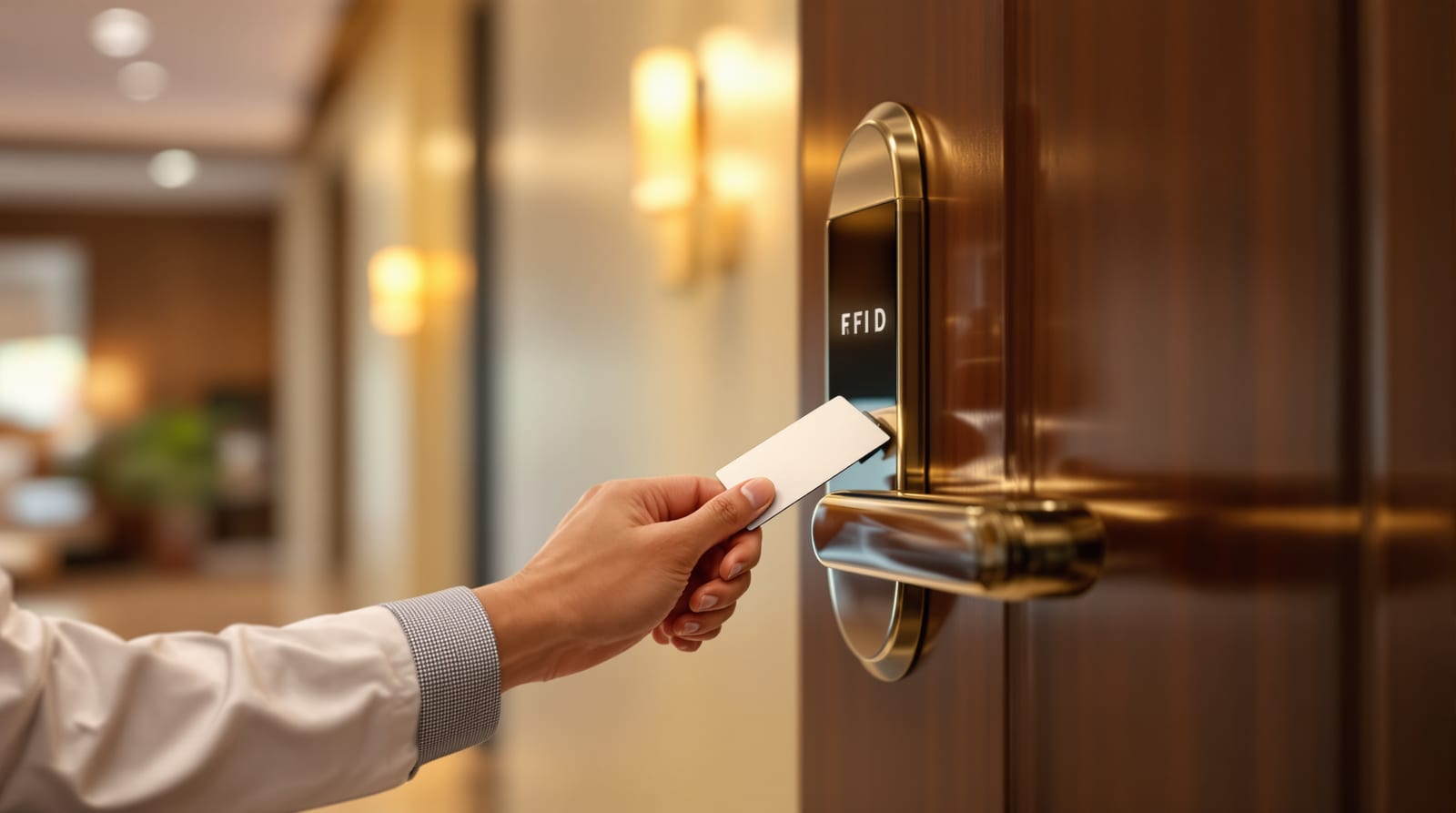
Hotel Door Lock Systems in India 2026: RFID & Mobile Keys
How RFID and mobile keys, PMS integration, key hierarchy, audit trails and energy-saver switches run a secure, guest-friendly hotel.
Hotel door lock systems are the quiet backbone of hospitality security: a guest never thinks about them until a card fails at midnight, yet every room, store, plant area and back-of-house door depends on getting them right. A modern Indian hotel, resort or serviced apartment now runs on RFID key cards moving steadily toward mobile keys, all wired into the property-management system (PMS) so that a key is issued the moment a guest checks in and dies the moment they check out. This guide explains the technology behind each method, the master-key hierarchy, the audit trail every auditor wants, the energy-saver switch that pairs with the card, and the life-safety rules you cannot skip. It complements hotel doors, which covers the door leaf and frame; here we focus on the lock and the system it talks to.
How hotel door lock systems differ from a home smart lock
A residential smart door lock serves one household and a handful of users. A hotel lock serves hundreds of strangers a year, must be re-keyed in seconds, has to survive thousands of cycles, and must roll up into a central management system with a full audit trail. That is why hospitality locks are a category of their own, distinct from the home keyless entry systems most owners know.
The core of a hotel lock is still an electronic deadbolt or mortise lock body, but it is driven by a credential — historically a magnetic-stripe card, today an RFID card, and increasingly a phone. The lock reads the credential, checks the encoded permissions, and throws the bolt. Most hotel locks are offline (battery-powered, data carried on the card itself) or online (networked over Wi-Fi/Zigbee back to a panel). Each model has trade-offs, summarised below.
RFID, the workhorse
RFID (13.56 MHz contactless smart cards, typically MIFARE or DESFire) replaced magnetic stripes because cards do not demagnetise, the reader has no slot to jam, and credentials are encrypted. The principle is the same family as RFID door access used in offices, tuned for high turnover. A front-desk encoder writes the room number, valid dates and times to the card; the offline lock reads and verifies without any wiring. This makes RFID resilient during India's frequent power-cuts — the lock runs on AA batteries and needs no live network to admit a guest.
Mobile keys and BLE check-in
The fast-growing layer is the mobile key: the guest's phone becomes the credential over Bluetooth Low Energy (BLE), sometimes with NFC as backup. After online or app check-in, the PMS pushes an encrypted digital key to the guest app; the phone unlocks the door on approach. This is the hospitality cousin of mobile app door access. It removes the front-desk queue, but you must always keep RFID cards and a mechanical override as fallback for flat batteries, lost phones and guests who decline the app.
The PMS integration that makes it all work
The lock system earns its keep through integration with the property-management system. When the receptionist (or the guest's own check-in) assigns Room 412, the PMS tells the lock platform to issue a credential valid for that room, for that stay window only. At checkout the credential is revoked automatically. The same link drives energy management, billing and housekeeping status.
| System component | Role | Indicative cost band (INR, installed) |
|---|---|---|
| RFID guest-room lock (offline) | Reads card/phone, throws bolt, logs events | ₹8,000-22,000 per door |
| Online/networked lock | Real-time control, remote cancel | ₹15,000-40,000 per door |
| Front-desk encoder + software | Writes cards, manages key matrix | ₹40,000-1,50,000 per property |
| PMS interface/middleware | Links locks to check-in/out | ₹50,000-3,00,000+ (quote) |
| Energy-saver key-card switch | Cuts power when card removed | ₹600-2,500 per room |
| Handheld audit/programming unit | Reads lock logs on site | ₹15,000-45,000 each |
These are indicative bands before GST (18%); a full property is project-engineered and quote-driven, so engage a hospitality integrator early.
The key hierarchy: master, grand-master and floor keys
Hotel locks enforce a layered permission tree so staff reach exactly what their role needs and nothing more. This is the single biggest security advantage over residential door access control.
| Key level | Opens | Typical holder |
|---|---|---|
| Guest key | One room, one stay window | Guest |
| Section/housekeeping key | A block of rooms | Room attendant |
| Floor key | All guest rooms on a floor | Floor supervisor |
| Master key | All guest rooms | Duty manager, housekeeping head |
| Grand-master / emergency key | All rooms incl. dead-bolted (per policy) | General manager, security |
| Failsafe/emergency override | Override in emergency | Security, fire response |
Good practice: issue staff keys with date-and-time limits, restrict grand-master use to logged emergencies, and review the matrix whenever a staff member leaves.
Audit trail: who opened the door, and when
Every hotel lock keeps an internal event log — typically the last few hundred openings, with credential ID, timestamp and a deadbolt/double-lock flag. A handheld unit or, on online systems, the central server reads these logs. The audit trail is decisive when a guest reports a missing item: you can show whether housekeeping, maintenance or a master key entered, and when. Pair the room-lock log with corridor door camera systems and a visitor management system at the entrance for a complete picture. Because logs may identify individuals, treat them as personal data under the DPDP Act 2023 — restrict access, retain only as long as needed, and document the policy.
The energy-saver key-card switch
Just inside the door, a wall pocket accepts the room card (or a dedicated saver card on mobile-key properties). Insert the card and room power lives; remove it on leaving and lights, AC and idle sockets cut after a short delay. In Indian summers this slashes the energy a vacated room wastes. Wire essential circuits — fridge, router, charging point — to bypass the switch so they stay live. On mobile-key rooms, use a motion/occupancy sensor or a non-functional saver card so guests without a physical card can still enable power.
System wiring and topology
Offline RFID locks need no door wiring beyond their batteries — ideal for retrofits and resorts with scattered villas. Online locks need cabling or a wireless gateway per floor and a UPS-backed server, but give you real-time cancellation and live status. Many properties blend both: offline guest rooms, online for high-value and back-of-house doors.
Staff vs guest access, and back-of-house
Guest credentials are tightly scoped; staff credentials carry role and time limits. Back-of-house doors — stores, plant rooms, server room, cash office — should sit on a networked panel, often using maglocks or electric strike locks. Here the fail-safe vs fail-secure choice is critical: a stockroom can be fail-secure (stays locked on power loss to protect assets), but any door on an escape route must be fail-safe and release on fire alarm.
Life-safety: free egress is non-negotiable
Under NBC 2016, occupants must always be able to leave without a key, tool or special knowledge. Guest-room locks are designed so the inside lever retracts both latch and deadbolt in one motion — a guest can always get out. Any access-controlled or maglocked door on a corridor or stair escape route must release on fire-alarm signal and allow free egress; never let a security upgrade trap people inside. This rule overrides every commercial preference. Also plan for power-cuts and lockouts: keep battery levels monitored (see smart-lock battery guide), carry mechanical-override keys in a logged emergency-key cabinet, and have a 24x7 response for failed credentials.
For whole-property planning, see the complete door guide, the door automation pillar for entrance and lobby operators, and the access-control systems guide for back-of-house design. To size and budget, use our access-control cost estimator and the fail-safe vs fail-secure selector.
Frequently asked questions
What is the difference between an offline and online hotel lock?
An offline lock is battery-powered and carries permission data on the RFID card itself, so it works during power-cuts and network outages but logs are read by handheld. An online lock talks live to a server, allowing instant cancellation and real-time status, but needs cabling or gateways and UPS backup. Many Indian hotels run offline guest rooms with online back-of-house.
Are mobile keys reliable enough to drop key cards?
Not yet — treat mobile keys as a convenience layer, not a replacement. Always keep RFID cards and a mechanical override for flat phone batteries, declined apps, BLE pairing failures and elderly or non-smartphone guests. Mobile keys shine for fast, queue-free check-in; cards remain the dependable fallback.
How does the energy-saver key-card switch save power?
The switch only powers room lights, AC and idle sockets while a card sits in its pocket. Remove the card on leaving and these circuits cut after a short delay, so a vacated room stops wasting energy — significant in Indian summers. Wire fridge, router and a charging point to bypass it so essentials stay live.
What does the audit trail record, and is it private?
Each lock logs recent openings with the credential ID, timestamp and whether the deadbolt was engaged, helping resolve theft or access disputes. Because the log can identify individuals, treat it as personal data under the DPDP Act 2023: limit who can read it, retain it only as needed, and document a clear policy.
Can a hotel lock trap a guest inside during a fire?
No, if installed correctly. NBC 2016 requires free egress: the inside lever must always retract the latch and deadbolt in one motion, and access-controlled doors on escape routes must release on fire alarm and allow exit without a key. Verify this with your integrator and fire consultant before commissioning.
How much does a hotel lock system cost in India?
Guest-room offline RFID locks run roughly ₹8,000-22,000 per door installed, online locks ₹15,000-40,000, plus a front-desk encoder (₹40,000-1,50,000) and PMS middleware (₹50,000-3,00,000+), all before 18% GST. Because every property differs, get a project-engineered quote from a hospitality integrator.
Export this guide
Related Guides — Deep-dive reading
Hotel-Style Digital Locks in India (2026): Cards, Codes and the Front-Desk System
The RFID-card and PIN locks built for many rotating guests, run from a front-desk encoder that issues a per-stay credential and expires it at checkout, with a who-entered-when audit trail, for PGs, hostels, homestays and serviced apartments.
SecurityFail-Safe vs Fail-Secure Locks: The Guide (India 2026)
Why fail-safe vs fail-secure is the single most important access-control decision, and how to get it right for every door.
Home Doors & EntrancesOffline Access Control in India (2026): Standalone Locks That Work Without a Network
How standalone, non-networked access control works when the permission lives on the door or on the card, where offline is the right choice, how you manage it, and the honest trade-offs versus a live cloud system.
SecurityRelated Tools — Try Free
Door Lock Selector
Answer a few questions and get the right lock type — mortise, multipoint, deadbolt, privacy or smart — for any door.
Door ToolSecurity System Cost Estimator
Estimate the all-in capex with GST, annual running cost and 5-year total cost of ownership of a home or building security system.
Cost EstimatorAccess-Control Battery-Backup Calculator
Size the standby battery so an access system keeps running through a power cut, with an egress life-safety note.
Battery Backup