
Magnetic Door Locks (EM Maglocks): Complete Guide India 2026
How electromagnetic maglocks work, holding-force grades, fail-safe egress wiring and where 280 vs 600 kg locks belong.
Magnetic door locks — electromagnetic locks, or simply maglocks — are the workhorse of commercial access control in India. A coil mounted on the frame head energises into a powerful electromagnet that clamps an armature plate fixed to the door leaf, holding it shut with hundreds of kilograms of force. Cut the power and the bond vanishes instantly. That single behaviour, called fail-safe, makes maglocks superb for life-safety on escape routes but demands disciplined wiring: an access-controlled door that must release on a fire alarm has to be on a magnetic lock (or a fail-safe strike), never a fail-secure one. This guide explains how maglocks work, the holding-force grades, mounting on timber, metal and glass doors, the power and egress logic the NBC requires, and what they cost installed in India.
How a maglock works
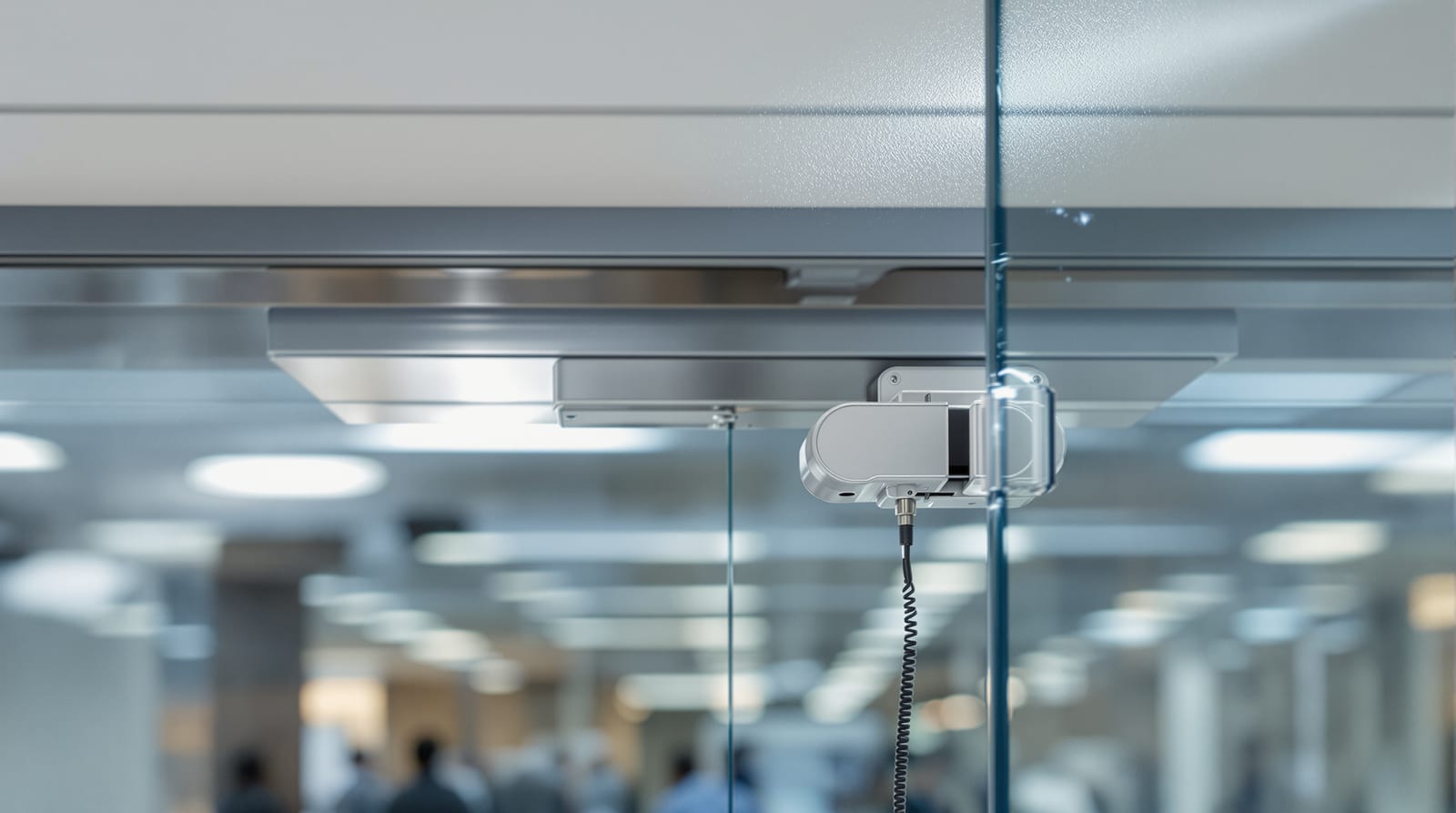
There are no moving parts in the lock itself. An electromagnet (the lock body) is fixed to the underside of the door frame head; a flat steel armature plate is bolted to the top of the door so the two faces meet when the door closes. When direct current flows through the coil, it generates a magnetic field that bonds the plate to the magnet. The holding force is the pull, in line with the door's plane, needed to shear that bond.
Because the magnet only holds when energised, a maglock is inherently fail-safe: lose power — mains cut, tripped supply, fire-alarm relay, exit button — and the door is free. This is the opposite of a deadbolt or a fail-secure electric strike lock, which stays locked when de-powered. Understanding that trade-off is the heart of any access design; we cover it fully in fail-safe vs fail-secure locks.
A maglock is only one component of a working door. It sits inside a small ecosystem of reader, controller, power supply, exit button and sensors — see access control systems for the whole picture and the cluster pillar, the complete door guide, for how it fits the wider hardware story.
Holding-force grades: 280 vs 600 kg
Maglocks are sold by holding force, quoted in kilograms (or pounds). Two ratings dominate the Indian market.
| Grade | Holding force | Typical use | Door type |
|---|---|---|---|
| Mini / 280 kg | ~280 kg (600 lb) | Interior offices, cabin doors, light glass doors, gates | Lightweight, low-traffic |
| Standard / 600 kg | ~600 kg (1,200 lb) | Main entrances, perimeter doors, high-security, heavy doors | Heavy, public-facing |
| Double / shear | 2 x 280 or 2 x 600 kg | Double-leaf entrances, very high-security | Pairs and frameless glass |
As a rule of thumb, specify 600 kg for any external or security-critical single door and reserve 280 kg for internal, low-abuse openings. A bonded plate must be hit much harder than its rating to fail, but under-specifying invites forced entry. For double doors use a twin (double) maglock, one body per leaf. Some applications use shear locks, which resist force vertically and sit concealed in the frame — useful where a surface lock would look intrusive, but fussier to align.
Mounting: timber, metal and glass
Mounting is where most maglock installs go wrong. The magnet and armature faces must meet flush and parallel, or holding force collapses.
Brackets
- L-bracket: carries the lock body when the frame head has no flat soffit to bolt to — the standard fix on most commercial frames.
- Z-bracket (or LZ): used with the L-bracket on inward-opening doors so the armature clears the stop.
- Glass-door clamp / U-bracket: for frameless toughened-glass doors, the armature is held in a clamp that grips the glass top rail with no drilling, or fixes to the patch fitting.
Always fit the armature with the supplied rubber washer and a degree of float so it can self-align to the magnet face on each closing — bolting it rigid is the classic cause of a weak hold. For automatic glass entrances also read automatic glass doors.
The non-negotiable: free egress and fire release
This is the legal core of every maglock job. Under NBC 2016, a door on a means of escape must allow occupants to leave freely without a key, code or special knowledge, and access-controlled escape doors must release automatically on a fire-alarm signal. A maglock satisfies this only if it is wired correctly:
1. Fire-alarm interface. The lock's power must drop the instant the building fire-alarm panel signals — typically via a normally-closed relay in the power line so any alarm de-energises the lock.
2. Request-to-exit (exit / REX button). A clearly visible green break-glass or push-to-exit button on the egress side cuts power locally. Many jurisdictions also want a second fail-safe release.
3. Free mechanical egress where required. On primary escape routes, electronics must not be the only path out; combine with panic/exit hardware so a person can always leave.
Never install a maglock on an escape door without the fire-alarm release and exit button. A door that traps occupants when power holds it shut is both illegal and lethal. The access control standards guide details NBC, RPwD and DPDP obligations.
Power, backup and the India power-cut reality
A fail-safe lock and an unreliable grid have an awkward relationship: every power cut unlocks the door. That is fine for safety but bad for security, so a maglock controller must have a backup battery (or UPS) so the door stays locked through routine outages while still releasing on a genuine fire signal.
| Component | Indicative installed cost (₹) | Notes |
|---|---|---|
| 280 kg maglock + plate | 1,500 - 3,000 | Interior / light doors |
| 600 kg maglock + plate | 2,500 - 5,000 | External / security |
| Double-leaf maglock | 4,500 - 9,000 | Two bodies |
| L / Z / glass bracket kit | 800 - 3,500 | Per door, by type |
| 12V DC SMPS + backup battery | 2,500 - 6,000 | Sized to load |
| Exit button / REX | 400 - 1,500 | Egress side |
| Fire-alarm relay interface | 1,000 - 3,500 | Plus integration labour |
Prices exclude 18% GST and cabling/labour, and vary with brand and project scale. Maglocks are stocked by access-control suppliers including Hikvision, Dorset, Godrej and several specialist EM-lock makers; choose generically on holding-force grade and build quality rather than badge. Estimate a whole opening with the access control cost estimator, and weigh fail-safe against fail-secure with the fail-safe vs fail-secure selector. Ongoing care is covered in door automation AMC and power planning in door access power backup.
Maglock control wiring
The reader and controller decide who may enter; the wiring above decides that everyone can always leave. Get the egress loop signed off before the access logic. For the full integration picture see door automation wiring and door automation.
Where maglocks fit — and where they do not
Maglocks shine on glass shopfronts, office suites, server rooms, society gates and any door where instant, silent, fail-safe release matters. They are weak where you need the door to stay locked through a power cut for theft protection without a battery, or where occupants distrust electronics on a fire door — in those cases pair them carefully with mechanical exit hardware. Because biometrics and footage are now common at these doors, treat captured data under the DPDP Act 2023.
Frequently asked questions
Are magnetic door locks safe in a fire?
Yes, when wired correctly — that is their advantage. A maglock is fail-safe, so it releases the moment power drops. NBC 2016 requires escape-route doors to release on the fire-alarm signal and on an exit button, so the lock must be tied into the fire-alarm panel through a normally-closed relay and fitted with a request-to-exit device.
What holding force do I need, 280 or 600 kg?
Use 600 kg for external, main-entrance and security-critical doors, and 280 kg for internal, low-traffic openings. For double doors fit a twin (double) maglock with one body per leaf. The rating is the straight pull needed to break the bond; under-specifying invites forced entry.
Will a maglock keep my door locked during a power cut?
Not on its own — it unlocks when power drops. That is desirable for safety but a security gap, so always pair the lock with a backup battery or UPS so it stays locked through routine Indian outages while still releasing on a genuine fire alarm.
Can a maglock be fitted to a frameless glass door?
Yes. Use a glass-door clamp or U-bracket that grips the toughened-glass top rail or patch fitting with no drilling. Keep the armature on its rubber washer with a little float so it self-aligns to the magnet on each close.
How does a maglock differ from an electric strike?
A maglock is always fail-safe and holds the door by magnetic force across the whole leaf. An electric strike replaces the keep and can be wired fail-safe or fail-secure, working with a latch. See electric strike locks for the comparison.
Do I need a professional to install one?
For any access-controlled or escape-route door, yes. The fire-alarm release, exit button and power isolation are safety-critical and should be wired by a qualified integrator or electrician, then tested against NBC egress requirements before handover.
Export this guide
Related Guides — Deep-dive reading
Fail-Safe vs Fail-Secure Locks: The Guide (India 2026)
Why fail-safe vs fail-secure is the single most important access-control decision, and how to get it right for every door.
Home Doors & EntrancesDoor Automation Guide: Access Control for India 2026
The complete map of smart locks, automatic operators, access control and intercom for Indian buildings, with the standards and power-cut realities.
Home Doors & EntrancesStaircase Access Control in India (2026): Securing the Stair Without Locking In Escape
How to control who can enter a stair from a floor while guaranteeing that anyone inside can always walk out - free-exit egress hardware, fail-safe locks that release on fire and power loss, monitored doors, and coordinating the whole thing with your fire officer and the NBC.
SecurityRelated Tools — Try Free
Access-Control Battery-Backup Calculator
Size the standby battery so an access system keeps running through a power cut, with an egress life-safety note.
Battery BackupAccess-Control Power Calculator
Total current and power an access system draws, to size the power supply — locks, readers and controllers.
AC PowerDoor Lock Selector
Answer a few questions and get the right lock type — mortise, multipoint, deadbolt, privacy or smart — for any door.
Door Tool